


Key Points and Summary – Six U.S. Navy EA-18G Growlers have deployed to Puerto Rico, sharpening Washington’s pressure campaign on Nicolás Maduro and hinting this may be more than a symbolic show of force.
-The electronic-warfare jets, built on the F/A-18 Super Hornet airframe, specialize in detecting and jamming enemy radars, directing stand-off strikes, and firing AGM-88 anti-radiation missiles.
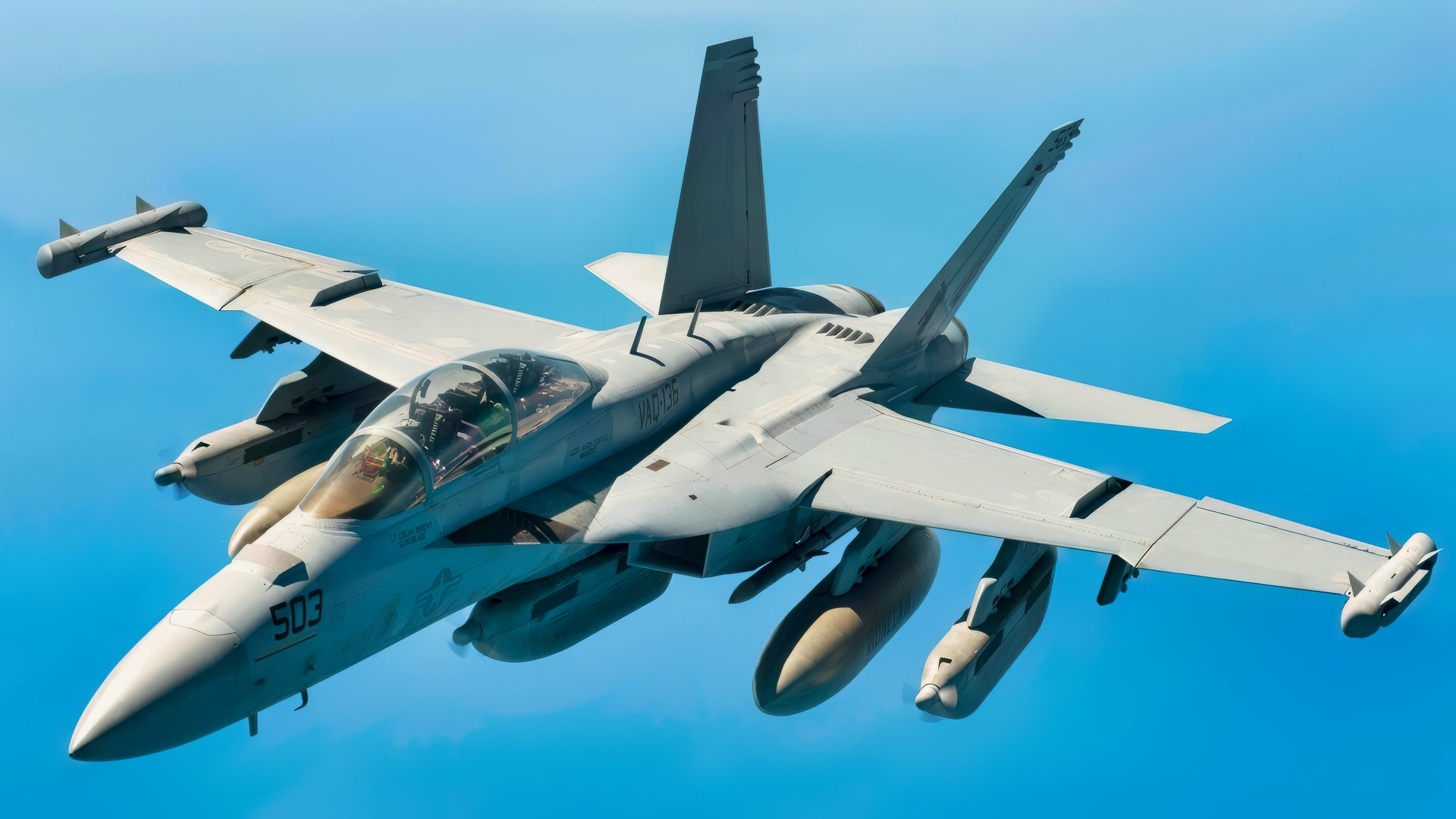
A U.S. Navy EA-18G Growler assigned to the USS Carl Vinson breaks away from a U.S. Air Force KC-135 Stratotanker from the 909th Air Refueling Squadron after conducting in-air refueling May 3, 2017, over the Western Pacific Ocean. The 909th ARS is an essential component to the mid-air refueling of a multitude of aircraft ranging from fighter jets to cargo planes from different services and nations in the region. (U.S. Air Force photo by Senior Airman John Linzmeier)
-Their arrival places advanced SEAD/DEAD capability less than 600 miles from Venezuela and likely brings total Growler strength in the Caribbean to around a dozen aircraft.
-Paired with carrier-based assets and Trump’s record of sudden air campaigns, the move raises real questions about potential strikes on Venezuelan targets.
U.S. Deploys EA-18G Growlers to Puerto Rico: Prelude to Strikes on Maduro?
Six U.S. Navy EA-18G Growler jets have touched down in Puerto Rico as part of the United States’ build-up of forces in the Caribbean. Their deployment suggests Washington’s pressure campaign may be more than a show of force against the Maduro regime in Venezuela.
Growlers bring a unique capability to U.S. carrier operations. Based on the F/A-18E/F Super Hornet, the Growler is a two-seat Electronic Warfare (EW) variant of the Super Hornet that is equipped to jam enemy radars. Each Growler carries up to five ALQ-99 tactical jamming pods mated to the wings or fuselage.
These are integrated into the jet’s internally housed AN/ALQ-218 EW system, giving the specialized jets the ability to detect enemy radars and jam them.
Growlers are powerful force multipliers, and their deployment to Puerto Rico, less than 600 miles from Venezuela, lends gravitas to the American show of force. These would be some of the first aircraft to engage enemy forces during any operation against the Venezuelan military.
While Growlers would be tasked with taking out land-based air-defense batteries to allow friendly aircraft to fly unopposed, they would also help direct the firing of stand-off munitions against Venezuelan targets.

An EA-18G Growler, assigned to Electronic Attack Squadron (VAQ) 209, U.S. Navy Reserve, prepares for takeoff as part of Exercise Southern Strike 2021 at the Gulfport Combat Readiness Training Center in Gulfport, Miss., April 19, 2021. Southern Strike is a large-scale, conventional and special operations exercise hosted by the Mississippi National Guard and is designed to maintain combat readiness, build relationships, and strengthen combat readiness across all branches of the U.S. military. (U.S. Air National Guard photo by Tech. Sgt. Jon Alderman)
Though laser-focused on radar jamming, Growlers are hardly defenseless. In addition to their AGM-88 High-Speed Anti-Radiation Missile/Advanced Anti-Radiation Guided Missile, which homes in on radar systems once these have been detected, the jets also carry AIM-120 Advanced Medium-Range Air-to-Air Missiles for their own self-protection against enemy aircraft.
The Growlers are also in the midst of an upgrade that will see them add the Next Generation Jammer Mid-Band (NGJ-MB) system.
The Pentagon’s Office of the Director of Test and Evaluation (DOT&E) explains the new capability: “The NGJ-MB is an airborne electromagnetic attack system, consisting of two pods, mounted under the EA-18G wings, containing Active Electronically Scanned Arrays (AESA) that radiate over a range of frequencies,” the office writes in a public report.
It adds that the NGJ-MB is “the first of three proposed programs for the overall Next Generation Jammer upgrade that is intended to eventually replace the legacy AN/ALQ-99 Tactical Jammer System in the EA-18G. The NGJ-MB will add increased jamming capability at higher power and longer ranges than the AN/ALQ-99 Tactical Jammer System, as well as the ability to rapidly update hardware and software to counter rapidly evolving threat capabilities.”
The upgrade was anticipated to bring a more robust suite of capabilities to the Navy’s Growlers, but it faces headwinds.
“DOT&E could not draw definitive conclusions about the system’s operational effectiveness or suitability based on the IT results,” the report explains. “The data reveal that while progress has been made, significant technical challenges remain, particularly in the area of reliability, which currently hinders the system’s ability to fully support operational missions.”
If successful, the NGJ-MB would allow Growlers to engage multiple threats simultaneously from farther ranges than previously possible. In the previous year’s report, the DOT&E explained that the NGJ-MB would perform four core mission profiles: standoff, modified escort, penetrating escort, and stand-in jamming.
Though the deployment of six Growler aircraft to the region provides U.S. forces in the Caribbean with a potent capability that would be a prerequisite to a larger strike campaign, a squadron of Growlers was already present. Five to seven aircraft embark on carriers such as the USS Gerald R. Ford (CVN-78), the lead ship of the new Ford-class supercarriers. With the addition of the six Growlers in Puerto Rico, the Navy might have as many as 13 of these EW aircraft present in the Caribbean.
With the buildup of U.S. forces in the Caribbean seemingly reaching a crescendo, the question now is what U.S. President Donald Trump will do. Trump has touted his lack of interest in foreign military interventions but has shown a surprising willingness to strike adversaries kinetically.
In addition to the targeted killing in 2020 of Qasem Soleimani, the commander of the Islamic Revolutionary Guard Corps’ Quds Force, Trump also joined the Israelis in their decapitation campaign against Iranian nuclear infrastructure. During that campaign, American B-2 Spirit stealth bombers dropped the world’s largest, deepest-penetrating bunker-busting munitions against Iranian targets buried deep underground.
Trump’s propensity for quick, violent action from the air, without deploying troops, was clearly apparent during that attack, which was labeled Operation Midnight Hammer. The U.S. Navy is clearly preparing for a similar campaign against Maduro. But is this preparation only designed to pressure Maduro and his regime—or to actually bomb Venezuela?
About the Author: Caleb Larson
Caleb Larson is an American multiformat journalist based in Berlin, Germany. His work covers the intersection of conflict and society, focusing on American foreign policy and European security. He has reported from Germany, Russia, and the United States. Most recently, he covered the war in Ukraine, reporting extensively on the war’s shifting battle lines from Donbas and writing on the war’s civilian and humanitarian toll. Previously, he worked as a Defense Reporter for POLITICO Europe. You can follow his latest work on X.


