


Key Points and Summary – The U.S. Navy is abruptly walking away from most of its Constellation-class frigate program, canceling four of six planned ships and keeping only USS Constellation and USS Congress.
-Officials say the move is about speed: redirecting unspent funds into ships that Marinette can deliver faster, and reshaping the fleet for a more dispersed fight against China’s A2/AD networks.

An artist rendering of the U.S. Navy guided-missile frigate FFG(X). The new small surface combatant will have multi-mission capability to conduct air warfare, anti-submarine warfare, surface warfare, electronic warfare, and information operations. The design is based on the FREMM multipurpose frigate. A contract for ten ships was awarded to Marinette Marine Corporation, Wisconsin (USA), on 30 April 2020.
-The shift fits a broader plan that trims large surface combatants and amphibs while growing smaller ships and unmanned systems.
-The result is a generational force rethink—and a looming question over where billions in freed-up frigate money will go next.
The Navy’s Frigate Gamble Can Be Summed Up in One Word: Dispersal
The United States Navy is moving decisively away from the upcoming Constellation-class of frigates, built by Fincantieri Marinette Marine, a Wisconsin-based shipbuilder. The program is indeed being halted.
Though they will take the first two ships into service, an acknowledgment that progress on those two ships, the USS Constellation and the USS Congress, has already begun, and that those two hulls will help Fincantieri Marinette Marine stay in business and build vessels for the U.S. Navy in the future.
“We are reshaping how the Navy builds its fleet. Today, I can announce the first public action is a strategic shift away from the Constellation-class frigate program,” Secretary of the Navy John C. Phelan said in a video posted to X, formerly Twitter. “The Navy and our industry partners have reached a comprehensive framework that terminates, for the Navy’s convenience, the last four ships of the class, which have not begun construction.”
The U.S. Navy has already sunk about $2 billion into the Constellation-class, and the United States Congress has allocated nearly $8 billion for the program. It is not immediately clear how the Navy will redirect the Constellation’s funds.
“The Navy will work with Congress in the coming weeks to seek the reappropriation of a portion of the unspent frigate funds on more readily producible ships in Marinette,” a senior, unnamed U.S. Navy official said to USNI News. “We do hope to retain the unspent frigate funds, as I mentioned, and have them reallocated to other ships that can be built in Marinette and delivered to the fleet faster.”
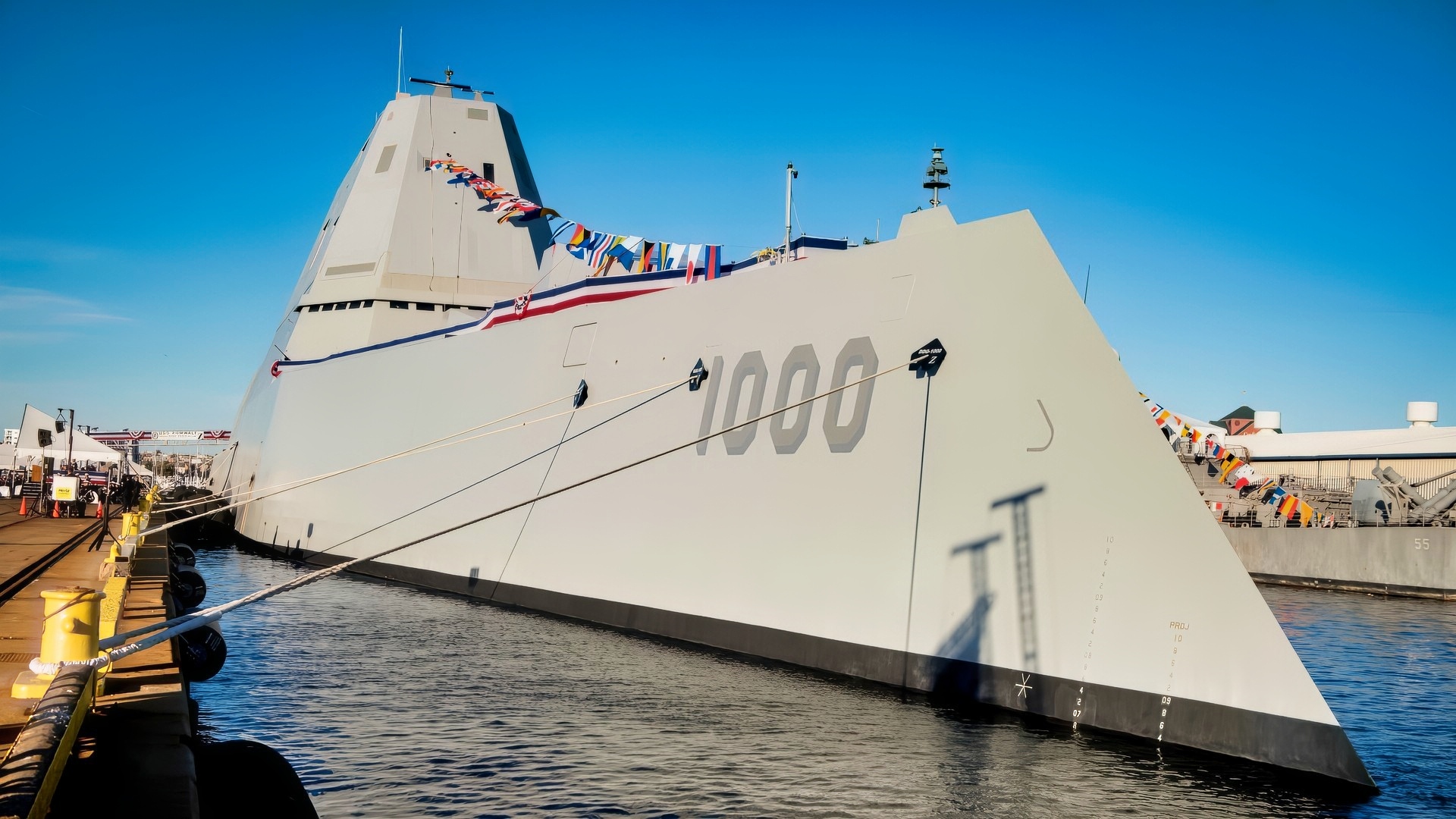
The Navy’s newest and most technologically advanced warship, USS Zumwalt (DDG 1000), is moored to the pier during a commissioning ceremony at North Locust Point in Baltimore. (U.S. Navy photo by Petty Officer 1st Class Nathan Laird/Released)
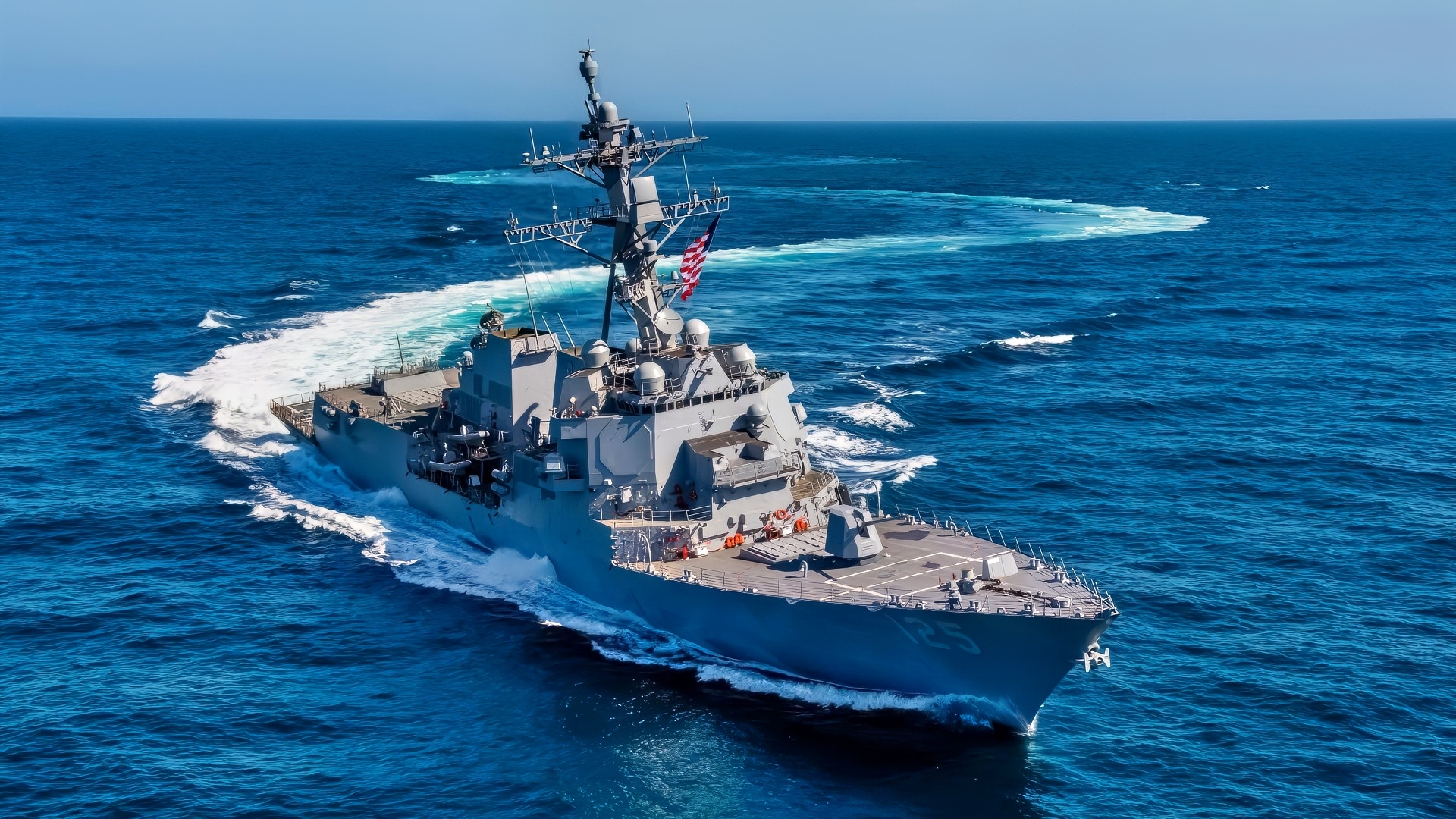
Pascagoula, MS – The future USS Jack H. Lucas (DDG 125) completed acceptance trials, May 18. DDG 125 is the first Arleigh Burke-class guided-missile destroyer built in the Flight III configuration. Photo courtesy of Huntington Ingalls Industries’ Ingalls Shipbuilding division
Another senior, unnamed U.S. Navy official told USNI that “A key factor in this decision is the need to grow the fleet faster to meet tomorrow’s threats. This framework seeks to put the Navy on a path to more rapidly construct new classes of ships and deliver capabilities our war fighters need in greater numbers and faster.” It is a sentiment that echoes the current Secretary of Defense, Pete Hegseth.
“Speed to delivery is now our organizing principle,” Defense Secretary Hegseth said during his Arsenal of Freedom speech, delivered earlier this month. “The sense of urgency has slipped too much, and when you look at what we face, we have to recapture it.”
The Navy is in the midst of a significant force composition adjustment, part of a broader conversation about how to adapt to China’s burgeoning anti-access/aerial denial capabilities and the proliferation of robust anti-ship weaponry in the Indo-Pacific region.
Recent projections of the United States Navy’s fleet composition do not reduce the number of some of the Navy’s largest vessels, such as aircraft carriers and submarines. Still, it does curtail the numbers of some other ships, like the Constellation-class, in favor of smaller vessels and a reflection of the Navy’s desire to field a more dispersed force.
A Shift in the Wind
The composition of the United States Navy is poised for change, with a growing emphasis on unmanned naval vessels and a shift toward smaller ships, favoring a smaller, big-ship-centric fleet.
One analysis, composed by the non-partisan Congressional Research Service, offers a few insightful data points.
Nearly 10 years ago, in 2016, the United States Navy’s goal was 355 ships.

Oliver Hazard Perry-Class Frigates. Image Credit: Creative Commons.
That fleet would have been represented by a diverse mix of ships, including submarines, auxiliary platforms, large surface ships, and other vessels.
But by 2023, that goal had increased somewhat, and the Navy discussed a new 381-ship build target.
But more important than just a numerical difference was the composition of those two fleets.
There is significant overlap between the two lists. A projection of aircraft carrier numbers remains unchanged at 12. Ballistic missile and attack submarine numbers remain unchanged at 12 and 66, respectively.
But the number of “big” surface combatants, like destroyers and cruisers, dips by 17.
Amphibious assault ships, another large surface ship, also drop by seven hulls. But some ship categories increase.
Medium Landing Ships, considered a smaller kind of ship, increased by 18. And Small Surface Ships, another category, increases by 21.
What Happens Now?
Transitioning to a larger force that is more widely dispersed builds a measure of resiliency into the U.S. Navy’s vessel composition. In cooperation with unmanned vessels — both below and above the waves — the U.S. Navy is in the throes of a generational force adjustment, but one that, if successful, may complicate adversary calculus in the Indo-Pacific.
One of the more immediate questions now, then, is what the U.S. Navy will do with the savings from canceling big-ticket shipbuilding programs?
About the Author: Caleb Larson
Caleb Larson is an American multiformat journalist based in Berlin, Germany. His work covers the intersection of conflict and society, focusing on American foreign policy and European security. He has reported from Germany, Russia, and the United States. Most recently, he covered the war in Ukraine, reporting extensively on the war’s shifting battle lines from Donbas and writing on the war’s civilian and humanitarian toll. Previously, he worked as a Defense Reporter for POLITICO Europe. You can follow his latest work on X.
More Military
The F-35 Fighter Is In More Trouble Than You Think
Was USS Wasp Really the Worst U.S. Navy Aircraft Carrier?
The Navy Had a Nuclear Submarine That Could Tap Russia’s Undersea Cables and Self Destruct
The U.S. Navy’s Flying Aircraft Carrier Mistake Still Stings


