

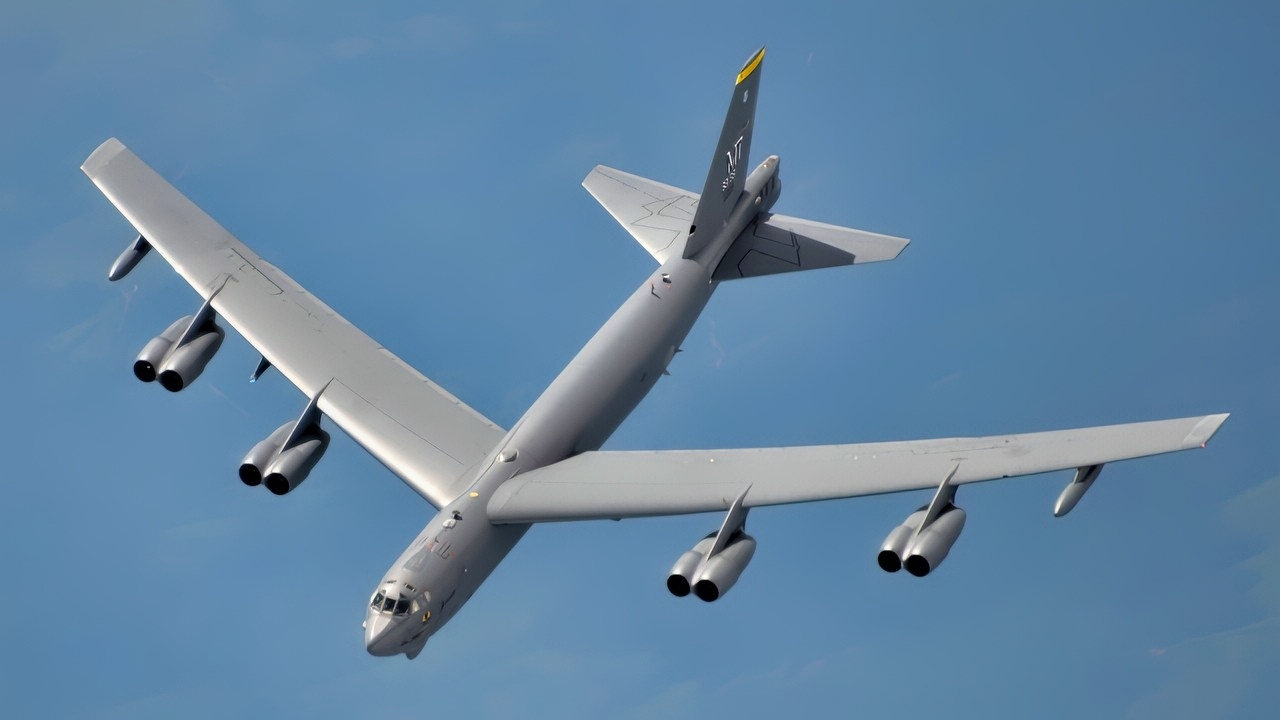
Key Points and Summary – The U.S. Air Force is undergoing a major strategic shift that will see it flying the world’s oldest and newest bombers simultaneously. The venerable B-52 Stratofortress, in service since the 1950s, is being heavily upgraded with new engines and avionics to serve for a full century. At the same time, the B-21 Raider, the world’s first sixth-generation bomber, is set to enter service.
-The B-21 will eventually replace the B-1B Lancer and B-2 Spirit fleets, creating a future two-bomber force designed for long-range strike in the modern era.
The US Air Force Will Fly the World’s Oldest and Newest Bombers Simultaneously
The United States maintains a diverse stable of bomber aircraft that collectively represent several different eras of the Cold War and beyond.
One of the bombers is approximately 75 years old, while another is a product of late Cold War-era thinking on strategic bombing. Another is not yet in service, although it will join the fleet sometime next year.
B-52 Stratofortress
The B-52 Stratofortress is the oldest bomber in the United States Air Force—by a long shot. That bomber entered service in the 1950s, during the early years of the Cold War with the Soviet Union, following the cessation of the Second World War. But despite its age—having entered service nearly 75 years ago—the B-52 will, if US Air Force plans unfold according to schedule, finally retire after a century of service sometime in the 2050s.
The latest iteration of that venerable strategic bomber is the B-52J, a substantially upgraded B-52 variant. The centerpiece of the modernization effort is the B-52J’s new engines, podded into dual engine arrangements that offer both a significant boost to thrust but also significantly better fuel economy, and consequently, combat radius.
The B-52’s Pratt & Whitney TF33 engines, in place virtually since the B-52 came online, will be swapped out for Rolls-Royce F130 turbofan engines. In addition to being more fuel-efficient than the TF33, they are also quieter and more reliable, with less downtime for maintenance, offering significant cost savings.
These up-engined Stratofortresses will retain the podded engine configuration—eight engines in total—to avoid costly and time-consuming modifications to the bomber’s airframe, which would be significantly more complex and expensive to achieve.
But in addition to the new engines, the B-52s selected for refurbishment and upgrade will also receive new radars, communications, and navigation systems that will improve situational awareness and lethality.
B-1B Lancer
Central to the Lancer is its variable-geometry wing design. Although mechanically more complex than a fixed-wing aircraft, the design choice enables the jet to take off and land more efficiently at slower speeds, while also allowing for quick sprints with its wings tightly folded.
The bomber’s original role would have seen the jet sprinting through the skies, but hugging the ground and — hopefully — under the radar of Soviet air defenses. Upon successful penetration, B-1Bs would have dropped their nuclear payload and quickly flown away to return to base.
There are only about 45 Lancer bombers left in service, down from their Cold War nadir of approximately 100, a number that will most likely decrease in the coming years as an entirely new class of stealth bombers comes online for the United States Air Force.
B-2 Spirit
As the world’s first fifth-generation strategic bomber capable of dropping conventional and nuclear munitions, the B-2 was a groundbreaking aircraft. A computer-assisted design process enabled the B-2 to shed the faceted, almost jagged edges of the F-117 Nighthawk in favor of smoother, more rounded counters, which are so readily recognizable today.
Thanks to its tailless, flying-wing design as well as the advanced stealth coatings, the Spirit remains a formidable aircraft, as evidenced by the B-2 bombing of Iranian nuclear infrastructure earlier this year. And it is getting continuously upgraded. The most recent round of B-2 upgrades focuses on “modernizing the aircraft’s communications and survivability.”
B-21 Raider
Although outwardly similar to the B-2 Spirit—both are flying wing-type aircraft—the Raider is somewhat smaller but is anticipated to bring a significant leap ahead in capabilities. In fact, the United States Air Force refers to it as the world’s first sixth-generation bomber.
Northrup Grumman, the aerospace firm behind both the B-2 Spirit and B-21 Raider designs, leveraged the experience gleaned from building the Spirit to inform the design and build process of the more modern Raider. And rather than take a high-risk approach by trying to incorporate new and relatively untested technologies, Northrup decided to take an iterative approach that builds and expands upon the mature technologies incorporated into the B-2 design.
To that end, the B-21 purportedly sports significantly more advanced materials, particularly the stealth coatings and airframe geometry that keep the bomber undetectable to enemy radar. Recently, Congress gave B-21 production a boost thanks to a $4.5 billion award passed via a reconciliation bill awarded specifically for that purpose.
The argument for increasing production is difficult to disagree with. Speaking to Air & Space Force Magazine, General Thomas A. Bussiere, the head of Air Force Global Strike Command, explained that the production boost can be chalked up to “a great realization of the value and prominence of long-range strike and the ability to hold at risk anything on the planet at a time and place of our choosing.”
In tandem to that realization, Gen. Bussiere elaborated, is “the urgency to replace our aging bombers and the increased cost and challenges of sustaining a legacy bomber fleet, coupled with a world environment that, quite frankly, everybody looks at and says, ‘we need more long range strike, not less,’ and so that all comes together.”
Ultimately, the B-21 will replace the B-1B Lancer fleet as well as the B-2 Spirits, which means that the United States Air Force will, for a time, have both the world’s newest in-service bomber, the Raider, as well as the oldest, the B-52 Stratofortress, and consequently become a 2-bomber air force.
About the Author: Caleb Larson
Caleb Larson is an American multiformat journalist based in Berlin, Germany. His work covers the intersection of conflict and society, focusing on American foreign policy and European security. He has reported from Germany, Russia, and the United States. Most recently, he covered the war in Ukraine, reporting extensively on the war’s shifting battle lines from Donbas and writing on the war’s civilian and humanitarian toll. Previously, he worked as a Defense Reporter for POLITICO Europe. You can follow his latest work on X.
Military Affairs
China’s Stealth Air Force Has 1 Mission


