


Summary and Key Points: The Trump-class battleship, the centerpiece of the “Golden Fleet,” represents a controversial return to large-scale surface combatants.
-At 35,000 tons and nearly 900 feet long, this modern battlecruiser is designed to outgun any adversary with 24 Conventional Prompt Strike (CPS) cells, 128 VLS cells, and a 32 MJ railgun.

Trump-Class Battleship. Image Credit: White House.
-While critics argue the design contradicts the Navy’s shift toward distributed operations, proponents highlight its role as a persistent command-and-control hub.
-Equipped with hypersonic missiles and directed-energy weapons, the class aims to secure strategic shipping lanes and project unmatched non-nuclear deterrence in contested waters.
Why the 35,000-Ton Trump-Class Battleship is the Centerpiece of the New “Golden Fleet”
The announcement of a Trump-class battleship came out of left field for a lot of people. With the U.S. Navy attempting to transition toward smaller and more distributed assets, the last thing anyone expected was a large, nuclear-powered missile carrier similar to Russia’s Kirov-class battle cruisers.
Many commentators were quick to dismiss the proposed Trump-class, probably due to its association with U.S. President Donald Trump himself—but there are legitimate reasons why a missile-carrying battlecruiser could be relevant, even in today’s warfare. The size and armaments of the vessel could make it a valuable asset for holding down strategic positions and denying access to adversaries.
Design and Development
The Trump-class battleship is part of Trump’s larger initiative to revitalize U.S. naval might and bring back U.S. shipbuilding. The ship is intended to serve as the centerpiece of what Trump calls the “Golden Fleet.”
It is designed to outmatch and outgun any vessel fielded by U.S. adversaries and provide long-range missile support. At triple the size of an Arleigh Burke-class destroyer, the class is expected to be the largest surface ship commissioned in decades, excluding aircraft carriers. “As we forge the future of our Navy’s Fleet, we need a larger surface combatant and the Trump-class Battleships meet that requirement,” said Chief of Naval Operations Admiral Daryl Caudle.

Trump-Class Battleship. Image Credit: White House.
Design details are still unknown, but thanks to official renderings and some statements from the Navy, analysts have a general picture of what the new class is expected to do. It should measure about 840–880 feet in length, with a draft of roughly 24 feet and a displacement of about 35,000 tons. (Keep in mind these are rough estimates and not official numbers.) Much like the DDG(X) concept, the Trump-class is expected to use gas turbine and diesel engines to power and propel the ship. The ship would have a top speed of about 30 knots and be equipped with a hanger for V-22 Osprey tilt-rotor aircraft.
The Trump-class’s Fearsome Armament
The new battleship will be equipped with 24 Conventional Prompt Strike (CPS) cells, 128 Mk 41 vertical launching systems (VLS), and two RIM-116 Rolling Airframe Missile launchers for air defense. It will feature two Mark-45 five-inch guns, a 32 MJ railgun, and at least one directed-energy weapon.
It should be noted that the United Kingdom successfully tested its DragonFire directed-energy weapon in 2024.
This armament gives the Trump-class considerable amounts of firepower to work with. The Mark-41 VLS can be armed with surface-to-air or surface-to-surface missiles, making it incredibly versatile. But the CPS cells are the real centerpiece.
The CPS program was designed to allow the United States to deliver a precision-guided conventional weapon strike anywhere around the world within one hour. The program began development as far back as the early 2000s, under President George W. Bush, to ensure non-nuclear deterrence.
Originally, CPS was intended to be integrated into submarines and Zumwalt-class destroyers, but now the Navy plans to expand its use to the Trump-class battleship as well. The CPS reportedly uses hypersonic missiles which can strike anywhere around the world in roughly an hour.

Zumwalt-class Guided Missile Destroyer USS Michael Monsoor (DDG 1001) transits the Pacific Ocean, June 25, 2022. Twenty-six nations, 38 ships, four submarines, more than 170 aircraft and 25,000 personnel are participating in RIMPAC from June 29 to Aug 4 in and around Hawaiian Islands and Southern California. The world’s largest international maritime exercise, RIMPAC provides a unique training opportunity while fostering and sustaining cooperative relationships among participants critical to ensuring the safety of sea lanes and security on the world’s oceans. RIMPAC 2022 is the 28th exercise in the series that began in 1971.

(July 28, 2022) U.S. Navy Zumwalt-class guided-missile destroyer USS Michael Monsoor (DDG 1001) sails in formation during Rim of the Pacific (RIMPAC) 2022, July 28. Twenty-six nations, 38 ships, three submarines, more than 30 unmanned systems, approximately 170 aircraft and 25,000 personnel are participating in RIMPAC from June 29 to Aug. 4 in and around the Hawaiian Islands and Southern California. The world’s largest international maritime exercise, RIMPAC provides a unique training opportunity while fostering and sustaining cooperative relationships among participants critical to ensuring the safety of sea lanes and security on the world’s oceans. RIMPAC 2022 is the 28th exercise in the series that began in 1971. (U.S. Navy photo by Mass Communication Specialist 3rd Class Aleksandr Freutel)
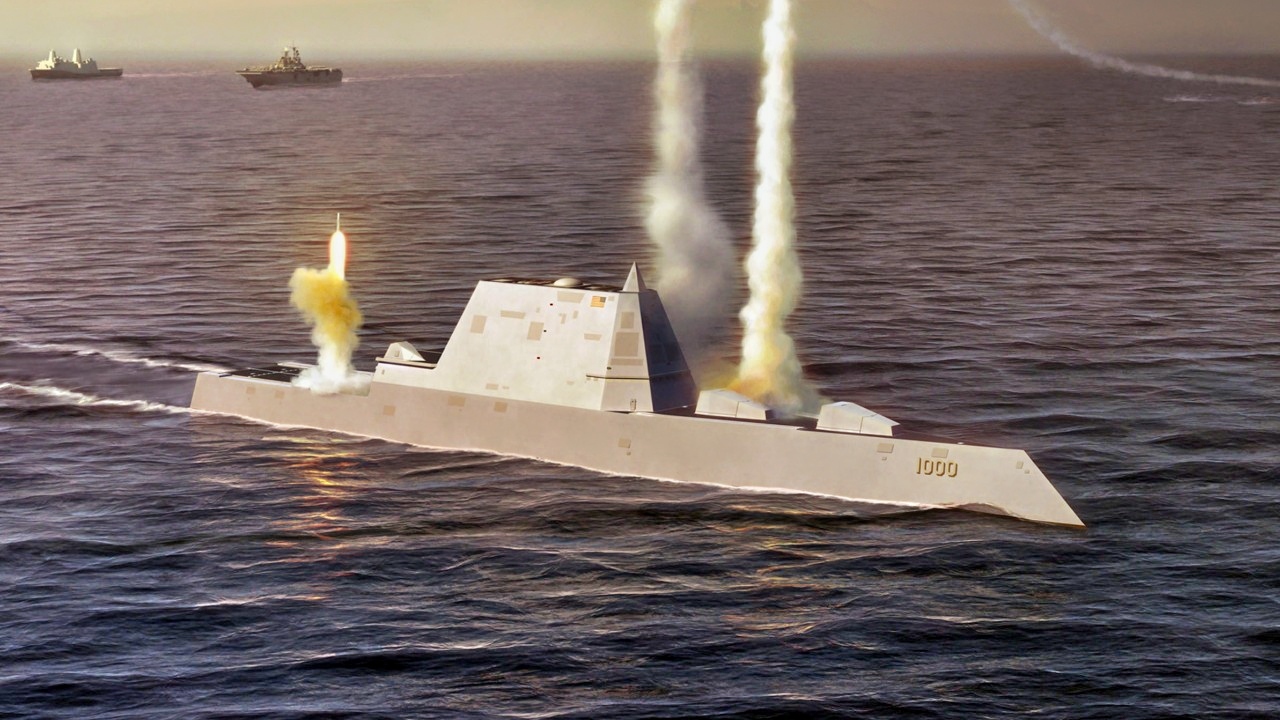
The US Navy’s troubled Zumwalt-class destroyers are being revitalized with the integration of Conventional Prompt Strike (CPS) hypersonic missiles, transforming them into powerful long-range strike platforms. The original class of 32 ships was cut to just three after its Advanced Gun System failed due to exorbitant costs. Now, these stealthy, $8 billion warships are having their defunct guns replaced with vertical launch tubes for hypersonic weapons. This upgrade will dramatically increase their strike range from a mere 63 miles to over 1,700 miles, making the Zumwalts relevant and formidable assets for deterring adversaries like China in the 21st century.
This significantly increases the versatility of the Trump-class, which would need not travel far outside of U.S. waters to deliver devastating conventional strikes.
Directed-energy weapons and railguns have been under development for some time now. Japan has made considerable progress with its own railgun project, including its first sea-firing tests in 2023.
Railguns could be used for missile defense, specifically against hypersonic missiles, but have yet to demonstrate such capabilities in practice. The biggest concern with railguns and directed-energy weapons is the amount of power they use. This is especially a concern, because the Trump-class would rely on diesel and electric power plants rather than nuclear power, which generates significantly more electricity.
In Defense of the Modern “Battleship”
Many analysts have already dismissed the Trump-class as obsolete, and for good reasons. The U.S. Navy has been shifting its focus toward distributed maritime operations. However, there is always an argument to be made for a large, resilient class of warship.
MORE – The A-12 Avenger II Stealth Bomber Has A Message for the U.S. Navy
Smaller vessels are necessary to win fights, but they cannot exercise control the same way that an aircraft carrier, or, in this case, a battleship can. The greatest downside to smaller distributed operations is their lack of endurance. They cannot remain at sea for as long as larger warships, making them less ideal for holding territory.
Critics of the Trump-class argue that naval warfare has changed significantly, and the old paradigm of naval “battlelines” that held sway when battleships were actually relevant is no longer standard doctrine; this is certainly true.
But if the U.S. wants to revitalize its Navy, it also needs larger warships that can secure and hold strategic shipping lanes.
About the Author: Isaac Seitz
Isaac Seitz, a Defense Columnist, graduated from Patrick Henry College’s Strategic Intelligence and National Security program. He has also studied Russian at Middlebury Language Schools and has worked as an intelligence Analyst in the private sector.


Richard Millerick
February 17, 2026 at 12:45 pm
Who in the hell decided to name ANYTHING Trump ?
Rich Durbin
February 17, 2026 at 4:17 pm
While nuclear vessels routinely generate more power during normal operations, one would expect a battleship class to have sufficient space to include dedicated SSTGs for the directed energy weapons and railgun. These could be quickly spun up at battle stations while relying on capacitors for the first few moments.
The railgun should have space provided for it, but not actually installed until the technology is proven. The dedicated space could be filled with VLS cells in the meantime.
The largest issue I see with these is the expense of building them which is an opportunity cost for other systems. Also the terms ” battleship” and “Golden Fleet” prejudice many observers against it.
Murky
February 18, 2026 at 9:33 am
If you want to “bring back shipbuilding,” commercial maritime is where we need to compete.
Not narcissistic naval boondoggles.