

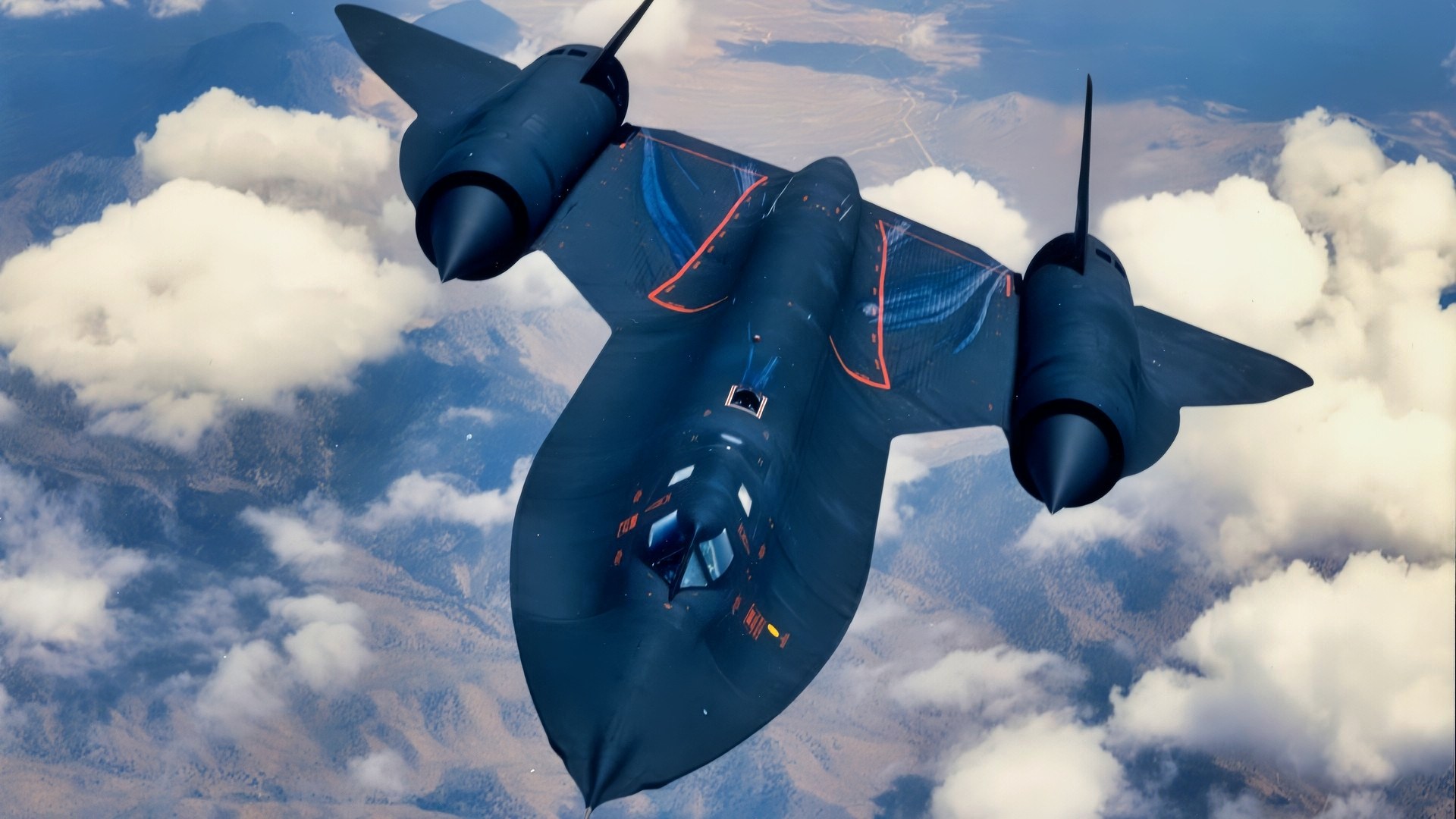
Between its maiden flight in 1964 and its retirement in 1999, the U.S. Air Force lost 12 of its Lockheed SR-71 Blackbird reconnaissance aircraft to non-combat accidents — but only one of those 12 crashes was fatal. The most catastrophic mishap killed Lockheed flight test reconnaissance systems officer Jim Zwayer during a Mach 3.18 disintegration over New Mexico when his ejection broke his neck; pilot Bill Weaver survived to make the first supersonic ejection in SR-71 history. Two other notable Blackbird losses both occurred at Kadena Air Base on Okinawa: the loss of SR-71 #61-7974 “Ichiban” after a compressor bearing froze at Mach 3, ultimately resulting in the aircraft being buried at sea in the Mariana Trench by the U.S. Navy with full military honors; and the loss of SR-71 #61-7978 “Rapid Rabbit” during a typhoon crosswind landing where both crewmen survived but the airframe was scrapped.
The SR-71 Blackbird Could Hit Mach 3.56, and Accidents Could Occur
Accidents are an unfortunate fact of life, stemming from the inherently flawed nature of human beings (Homo sapiens), and therefore they afflict even the best manmade objects, including the iconic Lockheed “Skunk Works” SR-71 Blackbird spy plane, which is still the world’s fastest air-breathing aircraft (official record Mach 3.2, unofficially Mach 3.56), 27 years after its official retirement. In the 35 years from maiden flight to retirement (1964 to 1999), SR-71s were involved in a total of a dozen crashes (none of them combat-related). The silver lining behind the cloud is that only one of those crashes is fatal (though of course that’s no comfort to the surviving loved ones of the deceased crewman). This writer now covers the Top 3 worst SR-71 mishaps (25 percent of the total), or, to put it another way, Blackhawks Breaking Bad.

SR-71 National Security Journal Image.
SR-71 Crash #1: The 1966 Edwards AFB Incident
This one is ranked #1 because it’s the only fatal incident.
On January 25, 1966 (the same month that the Blackbird attained official operational status with the U.S Air Force), an SR-71A bearing AF Serial No. 61-7952 embarked from Edwards Air Force Base, California, with test pilot Bill Weaver and his friend, Lockheed flight reconnaissance systems officer (RSO) Jim Zwayer, at the controls. They were tasked with (1) investigating procedures designed to (1) reduce trim drag, and (2) improve high-Mach cruise performance. The latter half of the task necessitated flying with the center of gravity (CG) located further aft than normal, which reduced the warbird’s longitudinal stability.
The first leg of their mission went smoothly enough, as they conducted a successful refueling linkup with a KC-135 Stratotanker, and then the duo turned eastbound, accelerated to a Mach 3.2 cruise speed (2,455 mph; 3,951 km/h; 2,133 knots), and climbed to 78,000 feet (23,774 meters), their initial cruise-climb altitude, for their second leg.
That’s when something went terribly wrong: a serious engine unstart and the subsequent “instantaneous loss of engine thrust” occurred, and that thrust could not be regained.
Weaver urgently attempted to relay a warning to Zwayer, hoping to encourage his friend & partner to stay with the bird until they reached a lower speed and altitude, as the prospects of surviving an ejection at Mach 3.18 and 78,800 feet seemed rather dicey. But the Intercom connection was garbled, so Bill had no choice but to make aviation history with the first supersonic parachute jump in an SR-71.
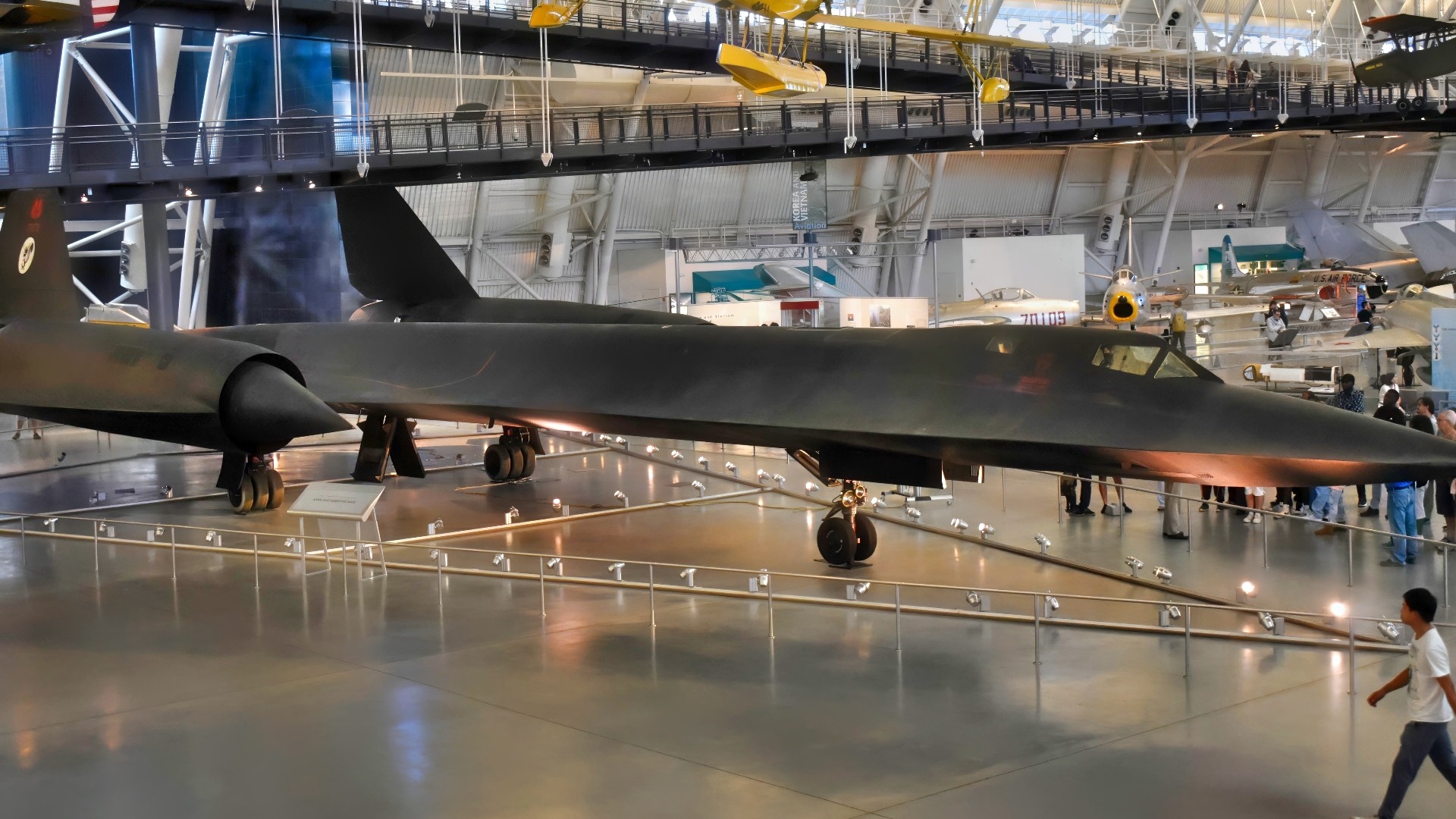
SR-71 Blackbird Smithsonian. Image Credit: National Security Journal.
Bill didn’t even remember the initial moments of his history-making ejection. In his own words, “Still trying to communicate with Jim, I blacked out, succumbing to extremely high g-forces. The SR-71 then literally disintegrated around us. From that point, I was just along for the ride.” He regained consciousness in mid-parachute descent, and he safely landed in a huge cattle ranch in northeastern New Mexico. The first earthbound person to come to his aid was the ranch’s owner, a certain Mr. Albert Mitchell, Jr., who had already notified the New Mexico State Police, the Air Force, and the nearest hospital.
Sadly, Jim wasn’t so fortunate, as he died instantly of a broken neck during the ejection.
According to the Born into the Wild Blue Yonder Habubrats Facebook page, Col. James Pershing Zwayer was born on February 26, 1918, in Bryan, Williams County, Ohio, making him 47 years old at the time of his untimely death. He was laid to rest at Arlington National Cemetery. May he rest in peace.
SR-71 Crash #2: The 1989 Okinawa/Kadena AB Incident
As a refreshing contrast to the preceding tragic story, we share an SR-71 crash story with an amusing postscript. (After the depressing start to this article, we could all use a bit of levity, n’est-ce pas?)

SR-71 Blackbird National Security Journal Photo by Dr. Brent M. Eastwood.
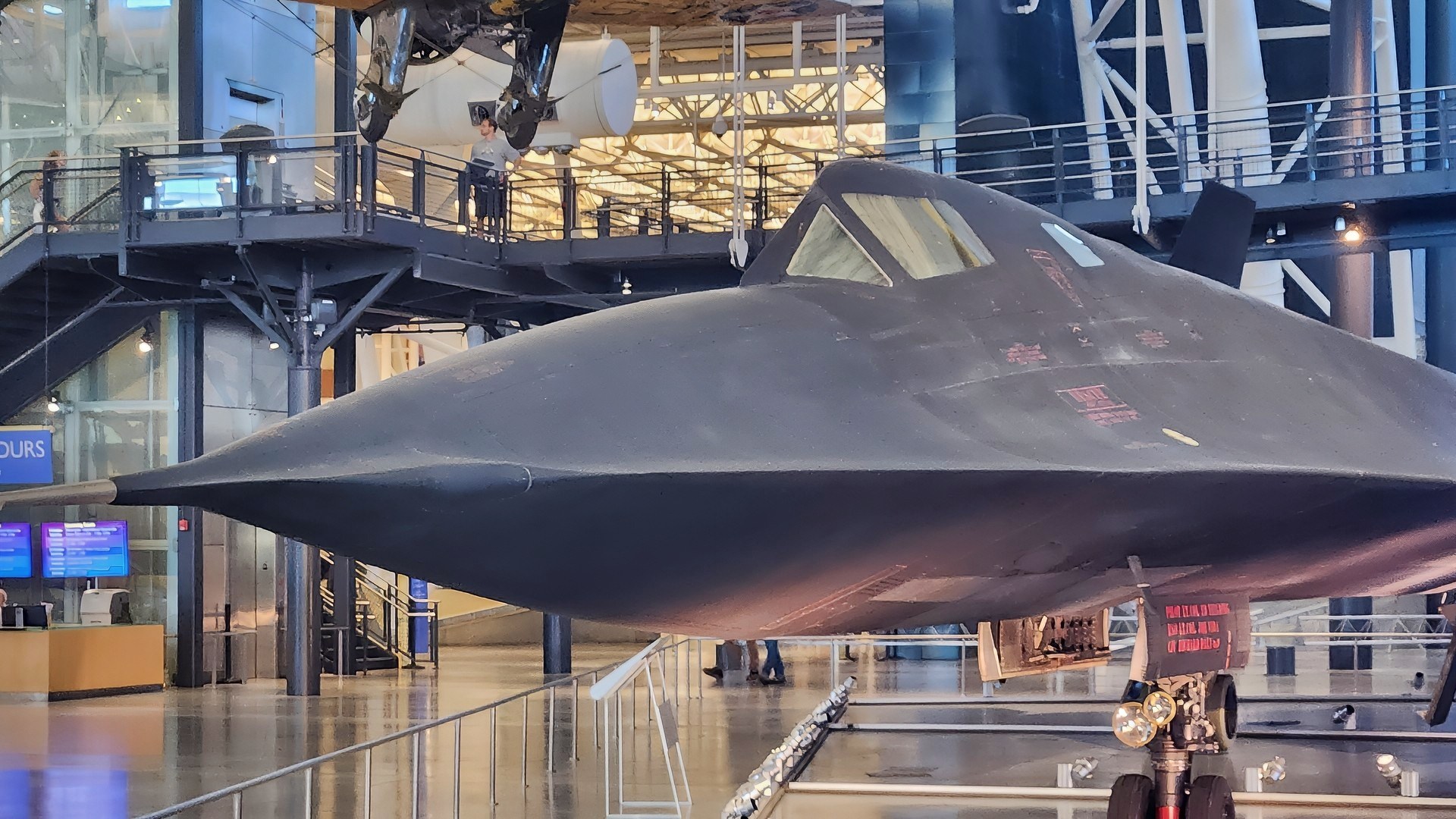
SR-71 Blackbird National Security Journal Photo Collection.
This particular incident would turn out to be the last-ever SR-71 crash. On April 21, 1989 (at a time when the Cold War was thawing, with U.S. President George H.W. Bush in the White House and Soviet head of state Mikhail Sergeyevich Gorbachev’s glasnost [“openness”] and perestroika [“restructuring”] were in full effect), an SR-71A bearing Air Force Serial No. 61-7974 and the affectionate nickname of “Ichiban” (Japanese for “Number One”) departed from Kadena Air Base on Okinawa, with USAF pilot Lt. Col. Dan House and RSO Blair Bozek at the controls.
(As a sidebar note, speaking of Okinawa, the Blackbird was also unofficially nicknamed the “Habu” in honor of a highly venomous pit viper native to that Japanese island.)
As House & Bozek accelerated past Mach 3 speed, the left compressor bearing suddenly froze, causing the immediate disintegration of the port engine and a catastrophic explosion that sent metallic fragments through critical hydraulic lines. As a testament to Lt. Col. House’s flying skills and coolness under fire, he managed to slow the dying “Ichiban” and descend below 10,000 feet. Those in-flight emergency skills paid off, as both crewmen ejected safely and were quickly rescued by local fishermen in the waters below.
“Ichiban” impacted the water surface while inverted, sending all heavy components through their upper support structure; the landing gear protruded from the top of the wing.
Both of the Pratt & Whitney J58 turbojet engines broke all mounts and broke through their nacelles’ upper structure.
Speaking of the local fishermen (Ryoushi), one of them approached a USAF recovery team that was searching for the remains of the downed plane and asked them in perfect English, “Do you want to know where the airplane went down?” The helpful chap put three sticks in the sand to mark the spot; the plane lay at a depth of just 120 feet, well within the practical range of scuba equipment.
In a fine example of interservice cooperation, the U.S. Navy went to work, helping their USAF comrades-in-arms recover the downed aircraft. Former Blackbird RSO Col. Don Emmons recalled, as cited in Richard H. Graham’s book SR-71 Blackbird Stories, Tales and Legends, that “SR-71 #61-7974 wreckage was placed back in the same hangar [sic] it departed on its ill-fated flight months earlier.” Once the classified equipment was recovered from the wreckage and the investigation was completed, (quoting Col. Emmons again), “the wreckage needed to be removed ASAP. Burial at sea seemed the best option.”
Once again, the Navy performed the service, doing so at 1157 hours Local Time on Christmas Eve 1989—“with full military honors,” per Colonel Emmons—this time in a much deeper final resting place, at 25,597 feet below the surface. The burial spot was the Mariana Trench, which is the deepest part of the ocean.
What about that amusing postscript? Well, rumor has it that not every piece of Ichiban was buried at sea. The town’s mayor, who had picked up the downed crew in his boat, took them to a party—he was very excited about his new guests. As a gesture of gratitude for his hospitality, Hizzoner (which roughly translates as “Kakushita”) was reportedly given the pilot seat; it sits in his home to this day as a treasure memento.
SR-71 Crash #3: The 1972 Okinawa/Kadena AB Incident
One (not so) good Okinawa/Kadena AB crash story deserves another. We can also term this one the “No So Lucky Rabbit” incident. (No, we won’t talk about the infamous Bad Bunny 2026 Super Bowl halftime show.
The details of this story come to us courtesy of Derrick Leiker of The Aviationist in a June 9, 2025, article titled “A Look at the Dozen SR-71 Blackbird Losses.” As Mr. Leiker notes, “Perhaps one of the best known Blackbirds was SR-71A 61-7978, nicknamed ‘Rapid Rabbit,’ known for its popular white bunny logo on the tails.”
This incident took place on July 20, 1972 (which means we’ve now covered an example from all three decades’ worth of Blackbird crashes: 1960s, 70s, and 80s). Pilot Capt. Dennis Bush and RSO Capt. James Fagg attempted a landing in excessive crosswinds as a typhoon approached (a repeat of the kamikaze [“Divine Wind”] that saved Japan from Kublai Khan’s Mongol invasion fleets in 1274 and 1281 A.D?)
The crew deployed the braking chute (aka drogue chute or deceleration parachute) upon touchdown, but, suffering poor directional control on the runway, Capt. Bush jettisoned the chute, pushed up the power, and took the aircraft around for a second landing attempt.
The second touchdown was also successful…but the two captains weren’t out of the proverbial woods yet.
The crosswinds had become so strong that Bush could not keep the aircraft on the runway, and one set of landing gear hit a concrete structure.
The “rabbit’s foot” (the landing gear, that is) was damaged, and the fuselage suffered significant damage as well.
The rabbit luck did prevail, enabling both Bush and Fagg to escape serious injury. The stricken plane was stripped of spare parts, and the remaining airframe sections were scrapped.
About the Author: Christian D. Orr
Christian D. Orr is a Senior Defense Editor. He is a former Air Force Security Forces officer, Federal law enforcement officer, and private military contractor (with assignments worked in Iraq, the United Arab Emirates, Kosovo, Japan, Germany, and the Pentagon). Chris holds a B.A. in International Relations from the University of Southern California (USC) and an M.A. in Intelligence Studies (with a concentration in Terrorism Studies) from American Military University (AMU). He is also the author of the book “Five Decades of a Fabulous Firearm: Celebrating the 50th Anniversary of the Beretta 92 Pistol Series,” the second edition of which was recently published.


