

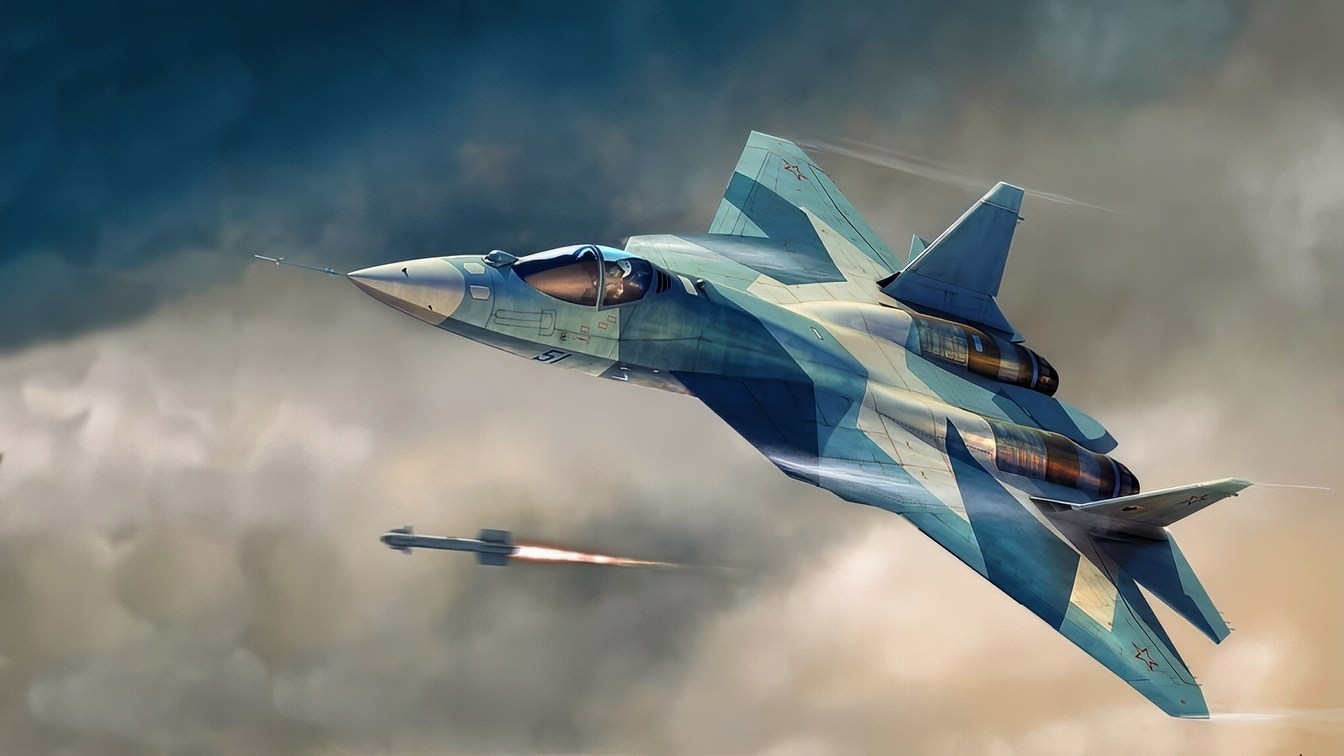
Russia has built only 20-32 Sukhoi Su-57 Felon stealth fighters total, including prototypes and test aircraft. The U.S. has produced nearly 200 Lockheed Martin F-35 Lightning II stealth fighters per year at peak tempo. Russia originally planned to build hundreds of Su-57 stealth fighters.
Russia’s Su-57 Felon Fighter Gap

Su-57 Felon Fighter Stealth. Image Credit: Creative Commons.
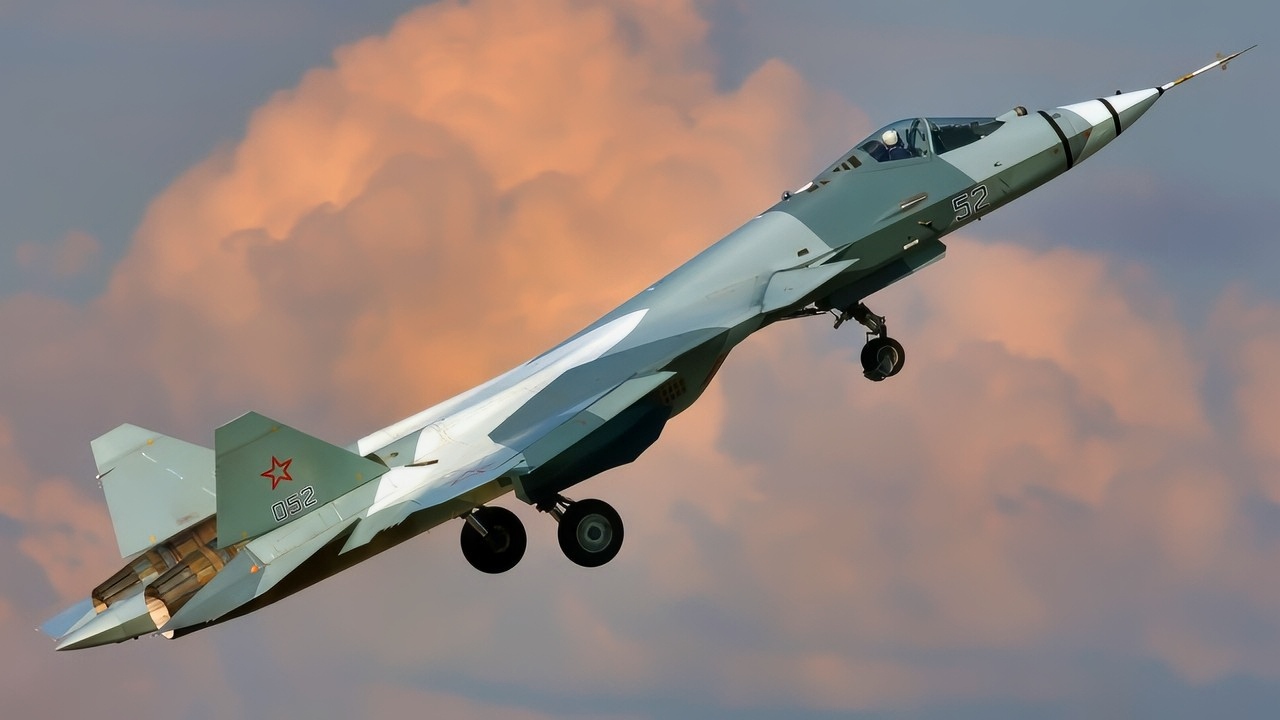
Su-57 Felon Stealth Fighter in the Sky. Image Credit: Creative Commons.
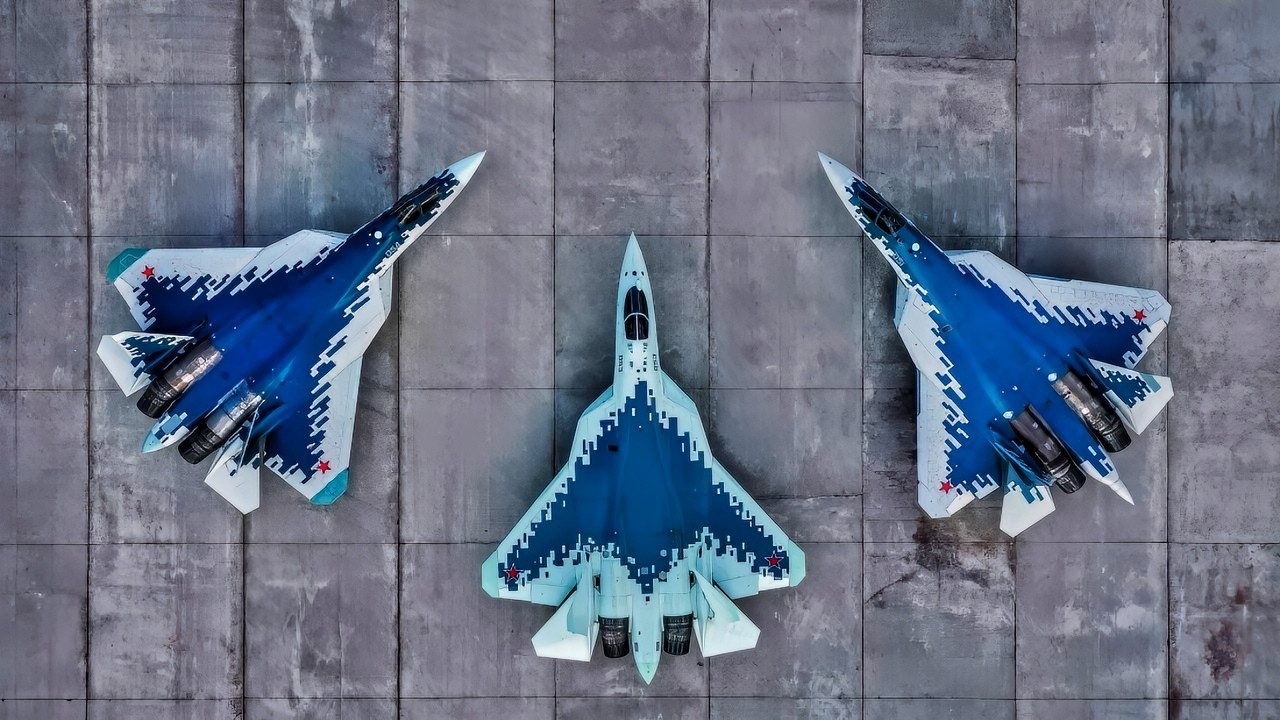
Su-57 Felon Screengrab from Russia. Image Credit: X Screengrab.
Russia’s Sukhoi Su-57 “Felon” began as the PAK FA program in the early 2000s. Moscow believed this aircraft would restore Russian aerospace prestige after the collapse of the Soviet Union. The Su-67 was to be Russia’s attempt at a fifth-generation warplane, minus the complexity and cost of a fifth-generation warplane.
So, the Felon was less a direct answer to the F-22 Raptor and more of a hybrid merging stealth fighter, missile truck, and strike aircraft with a sensor node. Many experts over the years have defined the Su-57 as a “fourth-generation-plus” warplane because of this.
The plane is formidable, though. Russian designers imbued the Su-57 with stealth shaping, supercruise capability, thrust-vectoring maneuverability, internal weapons bays (which help with maintaining stealth), AESA radar, advanced electronic warfare (EW) systems, and long-range missile integration. Historically, Russian warplane designers prioritized range, missile range, survivability, EW, and integrated air-defense fusion.
Those Russian design priorities are distinct from the doctrine and priorities of American warplane designers. For instance, most US doctrine demands that US warplanes prioritize air dominance, stealth-first penetration, sensor integration, and kill-chain superiority.
Given that the Su-57 is not purely a fifth-generation warplane and that there are doctrinal differences between US and Russian airpower, comparisons between the Su-57 and the F-22 are unfair. The Russian Su-57 and American F-22 do similar yet different things for their respective countries.
Plus, the Russians purposely designed the Felon with affordability in mind. The Americans, with their iconic F-22, spent gobs of tax dollars on these planes with wanton abandon. Moscow never had that luxury.
Of course, the Felon is not an F-22. It doesn’t have to be, though. In fact, most Russian systems designed to threaten exquisite Western platforms are cheaper than their American and NATO counterparts.
That’s partly because the Russians simply don’t have the defense budget to go toe-to-toe with the American one. That’s also, more importantly, because the Russians want to export their systems to as many other countries as possible. If they make systems that are too complex and expensive, not just to purchase but to maintain, then (as the Americans so often do), Moscow is reducing the Su-57’s sellability.
Thus, Russia makes its platforms, like the Su-57, good enough to take on NATO but not so great that no one can afford to procure and maintain them.
Ukraine, Sanctions, and the Industrial Bottleneck Crisis
Nevertheless, the Russian Felon is more advanced than most warplanes that post-Soviet Russia has designed and deployed. Because these birds were more complex and developed before the recent unpleasantness between Washington and Moscow erupted, Russia sourced many of the Su-57’s components from the West. Once the Ukraine War began, and the West imposed bitter sanctions on the Russian economy, Moscow found itself cut off from access to the supply chain that fed the Su-57.
Plus, as the Ukraine War progressed, Moscow had to prioritize their production lines for sustaining the fight on the ground in Ukraine. And the Ukrainians, thanks to their NATO alliance, have forced Russia to prioritize its domestic industrial base. Construction of advanced planes, like the Su-57, has not been prioritized because Moscow has learned that its older, cheaper planes are better suited to fighting over Ukraine.
Before the war, Moscow talked about building hundreds of Su-57s. Instead, after more than a decade of delays, crashes, sanctions, engine problems, and funding issues, production has not scaled. Most serious estimates place Russia’s Su-57 fleet at around 20-32 airframes (including prototypes and test aircraft), with perhaps only a small number of fully operational combat jets. Russia ordered 76 units for delivery around 2027-2028. Analysts, however, doubt Moscow can hit those numbers.
Komsomolsk-on-Amur is where Su-57s get built. That plant has struggled through multiple complications in the Su-57 program. Everything from component shortages to industrial bottlenecks to forced prioritization of cheaper, less advanced, older systems for the war effort. There have even been reports of fires and other disruptions that have stymied the reliable production of these planes.
On the other hand, the United States, despite its own defense-industrial-base woes, has produced nearly 200 Lockheed Martin F-35 Lightning II multirole fighters per year at peak tempo. That production gap is staggering.
The Engine Problem That Won’t Go Away
One of the biggest issues affecting the mass production of the Su-57 has been its engine. Most operational Su-57s fly with upgraded AL-41 engines derived from the old Flanker family aircraft rather than the true “second-stage” Izdeliye 30 engine designers originally wanted. The AL-41 engines have lower fuel efficiency, weaker supercruise, higher infrared signatures, and a poorer thrust-to-weight ratio than the Izdeliye 30 engines.
The engine problem alone ensures that the Su-57 will never be considered a truly “fifth-generation warplane.”
Is the Su-57 Actually Stealthy?
Then there’s the seemingly endless debate amongst Western analysts who insist the Su-57 is not truly a stealth plane. That is an overstatement by Western observers. What is fair to say, though, is that the Su-57 likely does not achieve the ultra-low observable levels of the F-22, F-35, and probably not even the Chengdu J-20 “Mighty Dragon.” But the Russians are glad to make that trade-off because the Felon preserved the need for speed, agility, payload, maintenance simplicity, and operational flexibility.
Western assumptions about the Su-57 are based on cherry-picked data and ideology rather than on actual analysis. The Russians never intended the Su-57 to directly challenge Western fifth-generation fighters. Instead, Moscow conceived the Su-57 as being necessary for launching long-range missile launches, intelligence, surveillance, and reconnaissance (ISR) coordination, targeting support, EW, suppression of enemy air defenses, and other standoff attacks.
Russia would never send the Su-57 into combat alone. Instead, it’s part of a larger anti-access/area-denial (A2/AD) system.
Algeria, India, and the Export Gamble
The biggest development for the Su-57 program has been in the export market. Algeria is the first foreign buyer of the system. According to some reports, Algeria plans to purchase 12-14 units, with its pilots already training in Russia. Moscow has done its best to keep that deal secret to avoid sanctions pressure or other embarrassing scrutiny of its production (and to maintain negotiating leverage with other potential foreign buyers).
Many had assumed that Russia’s long-time partner, India, would have been the first to procure the Su-57 export variant. And the Russians have done everything from offering India local production licensing deals, full technology transfer, and co-development proposals. India has not publicly committed to this. New Delhi is interested. But they’re cautious.
After all, India wants its own system, and since the fallout between the Trump administration and the Modi government during the Trade War last year, India has been reticent to buy the F-35, as China’s J-20 fleet grows.
So, the Su-57 might become a necessary temporary strategic bridge for India until its indigenous AMCA fighter is ready.
Rumors persist that Moscow is interested in selling both Iran and North Korea the Su-57. Little evidence exists proving this.
Why the Su-57 Could Still Become a Serious Threat
The real danger of the Su-57 is that the Russians will finally perfect its design. In so doing, Moscow might finally export enough units to make this plane a problem for the US and its allies. What’s more, Russia might develop drone-wingman integration for this plane, enhancing its threat, or add hypersonic weapons to the Su-57’s arsenal.
Russia’s Su-57 is at once overhyped, underestimated, underproduced, and still potentially very dangerous. It’s not the equivalent of the F-22. Contrary to Western analysts, though, the Su-57 is not a “fake” stealth fighter. Instead, the Su-57 resembles an unfinished but still dangerous prototype of the kind of aerospace ecosystem Russia wants badly to mass-produce. Currently, however, Russia lacks the industrial base to fully realize this vision. At some point–soon–that reality might change.
About the Author: Brandon J. Weichert
Brandon J. Weichert is a Senior National Security Editor. Recently, Weichert became the editor of the “NatSec Guy” section at Emerald. TV. He was previously the senior national security editor at The National Interest. Weichert hosts The National Security Hour on iHeartRadio, where he discusses national security policy every Wednesday at 8 p.m. Eastern. He hosts a companion show on Rumble entitled “National Security Talk.” Weichert consults regularly with various government institutions and private organizations on geopolitical issues. His writings have appeared in numerous publications, among them Popular Mechanics, National Review, MSN, and The American Spectator. And his books include Winning Space: How America Remains a Superpower, Biohacked: China’s Race to Control Life, and The Shadow War: Iran’s Quest for Supremacy. Weichert’s newest book, A Disaster of Our Own Making: How the West Lost Ukraine, is available for purchase at any bookstore. Follow him via Twitter/X @WeTheBrandon.


