

Democrats want to impeach Donald Trump for starting a war without congressional authorization. The constitutional case is strong. But the proposed remedy misses the deeper problem. And that problem is something Congress would rather not discuss.
The constitutional outrage is real. On February 28, the United States and Israel launched a full-scale air war against Iran without a single congressional vote.

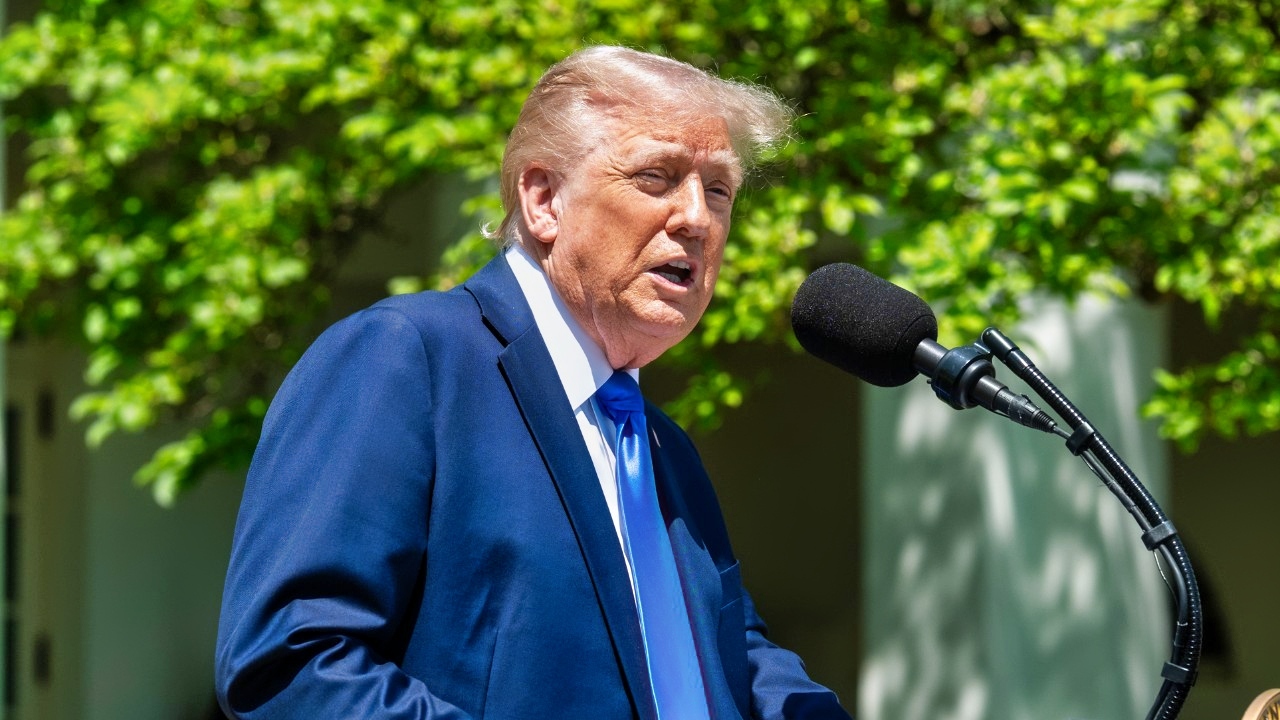
President Donald Trump delivers remarks before signing an executive order creating a task force for the 2028 Los Angeles Olympics, Tuesday, August 5, 2025, in the South Court Auditorium of the Eisenhower Executive Office Building at the White House. (Official White House Photo by Joyce N. Boghosian)
Iran’s Supreme Leader was killed. American service members died. The Strait of Hormuz closed. A naval blockade followed. And at one point, the president posted a threat to eliminate “a whole civilization.” None of that was authorized by the branch of government to which the Constitution assigns the war power.
Rep. John Larson’s articles of impeachment, charging Trump with “serial usurpation of the congressional war power,” are not frivolous. The scholars backing that argument are serious people. The violation is as clear as it has ever been in modern American history.
But impeachment won’t fix it. And the reason has more to do with Congress than with Trump himself.
Congress Handed This Power Away
Trump did not steal the war powers from Congress. Congress stopped defending it decades ago, and the vacancy he walked into has been accumulating since Harry Truman sent troops to Korea in 1950 without a declaration of war. Truman called it a “police action.” Congress grumbled, appropriated the money anyway, and the precedent stuck.
Vietnam followed the same logic on a larger scale, with the Gulf of Tonkin resolution providing retroactive cover for a war already underway in practice. In 1991, Congress voted to authorize the Gulf War — but only after Bush had assembled a coalition, deployed half a million troops, and made the vote a near-foregone conclusion. In 2001 and 2002, Congress handed the executive two Authorizations for Use of Military Force so broadly written that presidents have invoked them for operations their drafters never contemplated. Both are still on the books today.
The pattern running through all of this is familiar enough by now. Congress has repeatedly preferred to let the executive make the decision. War votes are politically dangerous.
If a military operation succeeds, the president receives the credit. If it unravels, Congress can distance itself from the consequences. Over time, that became an institutional habit.

B-2 Spirit stealth bombers assigned to Whiteman Air Force Base taxi and take-off during exercise Spirit Vigilance on Whiteman Air Force Base on November 7th, 2022. Routine exercises like Spirit Vigilance assure our allies and partners that Whiteman Air Force Base is ready to execute nuclear operations and global strike anytime, anywhere. (U.S. Air Force photo by Airman 1st Class Bryson Britt)

A U.S. Air Force Maj. B-2 pilot marshals a B-2 Spirit bomber, deployed from Whiteman Air Force Base, Missouri, at Andersen Air Force Base, Guam in support of Valiant Shield 24, June 13, 2024. The speed, flexibility, and readiness of our strategic bombers plays a critical role in our ability to deter potential adversaries and signal our unwavering support to our allies and partners. Counter-maritime missions provide valuable training opportunities to improve our interoperability and demonstrate that our forces are capable of operating anywhere, anytime, to meet any challenge decisively. (U.S. Air Force photo by Staff Sgt. Kristen Heller)
The Resolution That Resolved Nothing
Congress tried to stop the drift in 1973 with the War Powers Resolution.
It has never worked.
Not once in fifty-three years has a president acknowledged its binding force. Not once has Congress followed through with the one enforcement tool that would actually matter — cutting off funding. The Resolution became a ritual more than a restraint: the executive files a notification, Congress complains, and the operation proceeds.
Trump did not invent that arrangement. He operated inside it, while making its underlying reality harder to ignore.
The Iran war is not an anomaly. It is the endpoint of a process Congress set in motion a long time ago, accelerated with every conflict it chose not to vote on, and completed when it returned majorities more interested in managing their relationship with the White House than in defending their own constitutional authority.
The Real Reform Agenda
Impeachment, whatever its symbolic value, changes none of this. Even if the House passed articles tomorrow — it won’t, with Republicans in control — a Senate conviction is a fantasy. And even if both happened, the structural problem would survive into the next administration, and the one after that.
The harder work is legislative. A reformed War Powers Resolution with automatic funding cutoffs after thirty days would give the law actual teeth. Mandatory floor votes on any military operation exceeding seventy-two hours — with no pocket veto by leadership — would force members of Congress to go on record.
Repeal or serious revision of the 2001 and 2002 AUMFs would close the blank-check loophole that has functioned as standing authorization for a generation of presidential military decisions. Judicial review mechanisms that give Congress real standing to sue when the war power is usurped would provide an enforcement mechanism that currently does not exist.
None of those reforms would be easy to enact. More importantly, they would require Congress to reclaim responsibilities it has spent decades avoiding. That is precisely the problem.
The Question Washington Won’t Ask
The impeachment debate frames this as a problem with Donald Trump. That framing is understandable. It is also convenient for people who would rather avoid examining the institutional record.
The Iran war is a constitutional crisis. It also grew out of seventy-five years of congressional retreat — one administration at a time, one conflict at a time, each decision making the next one easier, until a president could take the country to war, impose a naval blockade, and threaten to annihilate an entire civilization without members of Congress being required to cast a vote.
Impeachment asks whether this president crossed a line. The more uncomfortable question is why Congress spent decades weakening it in the first place.
No third impeachment will restore what Congress gave away. Only Congress can do that. Whether it still has the will to try is another matter.
About the Author: Dr. Andrew Latham
Andrew Latham is a professor of international relations and political theory at Macalester College in Saint Paul, MN. You can follow him on X: @aakatham.


