

Summary and Key Points: Iran has quietly built the legal and bureaucratic machinery to take permanent control of the Strait of Hormuz.
-In May 2026, it created the Persian Gulf Strait Authority, which now requires transit permits — banning Israeli ships, restricting American ones, and charging up to $2 million per passage, paid in Chinese yuan to dodge U.S. sanctions.

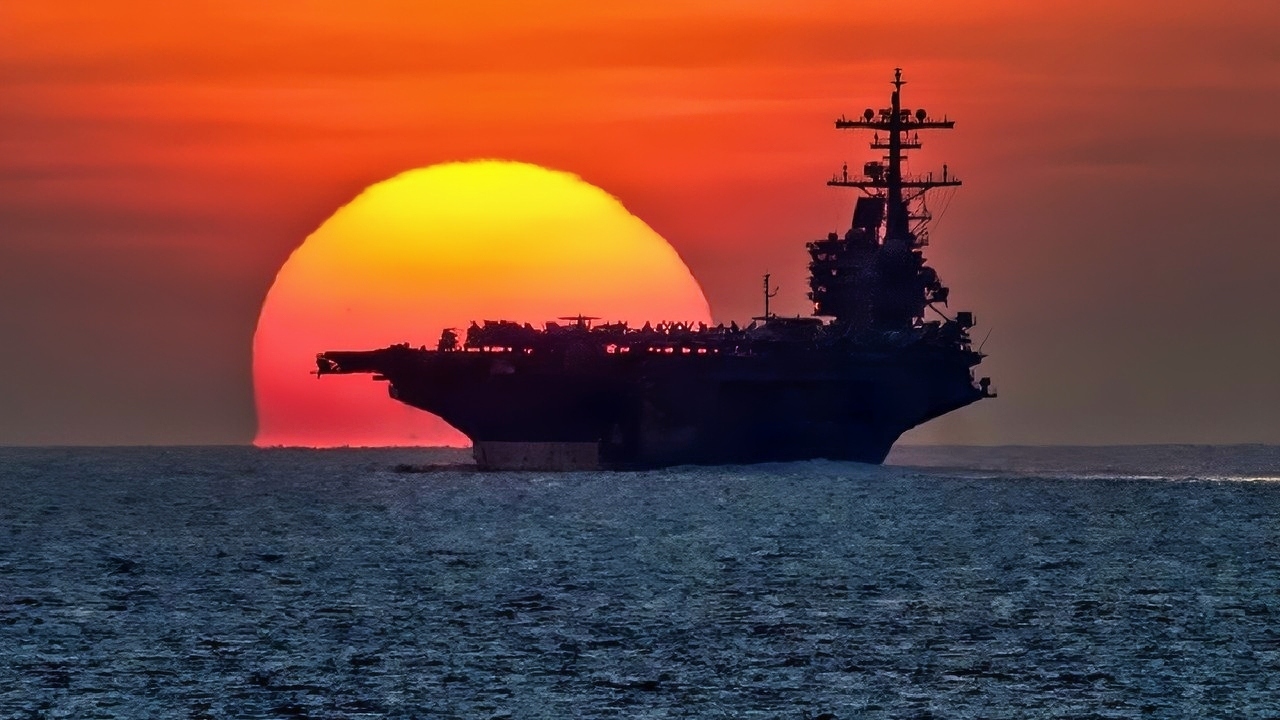
Navy Aircraft Carrier At Sea. Image Credit: Creative Commons.
-Iran’s map even claims waters that the UAE and Oman have long held. Five Gulf states, the U.S., and China have all objected.
Iran Has Built A Legal Framework To Permanently Own The Strait Of Hormuz — And A Trump Ceasefire Deal Will Lock It In
The Persian Gulf Strait Authority did not exist three months ago. Today it does, and it is now the regulatory entity through which the Islamic Republic of Iran intends to administer one of the world’s most strategically important maritime chokepoints in perpetuity.
The PGSA was established by the Iranian government in May 2026 as a sovereign regulatory body governing transit through the Strait of Hormuz.
The official PGSA account on X went live on May 18, announcing real-time updates on Hormuz operations. Vessels seeking transit through the strait must now submit applications to [email protected], disclosing ownership, insurance, crew manifests, and cargo before being granted a permit. Israel-linked vessels are banned outright. American-linked and other “hostile country” vessels face severe restrictions or outright denial.
This is the structural shift that has gone substantially unnoticed in the broader coverage of the Iran war and the ongoing ceasefire negotiations. Iran is not merely blockading the strait as a temporary wartime measure. Iran has built the legal, administrative, and bureaucratic infrastructure to make its control over the waterway permanent. And the longer the current diplomatic talks drag on, the more deeply that infrastructure roots itself into the operational reality of how the strait actually functions — to the point where a Trump ceasefire deal signed in the coming days will almost certainly leave the PGSA framework intact.
The Map That Reached Into Two Allied Countries
The geographic claim Iran has staked is more aggressive than the international maritime community has yet acknowledged. Iran published a map last week defining the PGSA’s claimed management zone as running from Kuh-e Mobarak inside Iran to a point south of Fujairah in the United Arab Emirates at the strait’s eastern entrance, and from the end of Iran’s Qeshm Island to Umm al-Quwain in the UAE at the western entrance. The zone covers waters that the UAE and Oman have regarded as sovereign territory for decades, and Iran is now asserting regulatory authority over commercial transit through those waters.
The response from Iran’s Arab neighbors has been immediate and unified. Five Gulf states have formally warned shipping companies through the International Maritime Organization not to comply with Iranian transit demands. That diplomatic warning matters because it puts the IMO, the United Nations specialized agency responsible for global shipping regulation, in a position of having to choose between accepting the Iranian unilateral assertion or backing the position of the established coastal states. The IMO has not yet rendered a definitive judgment, and the longer it takes, the more vessels will continue paying Iranian transit fees in the absence of clear international regulatory guidance.
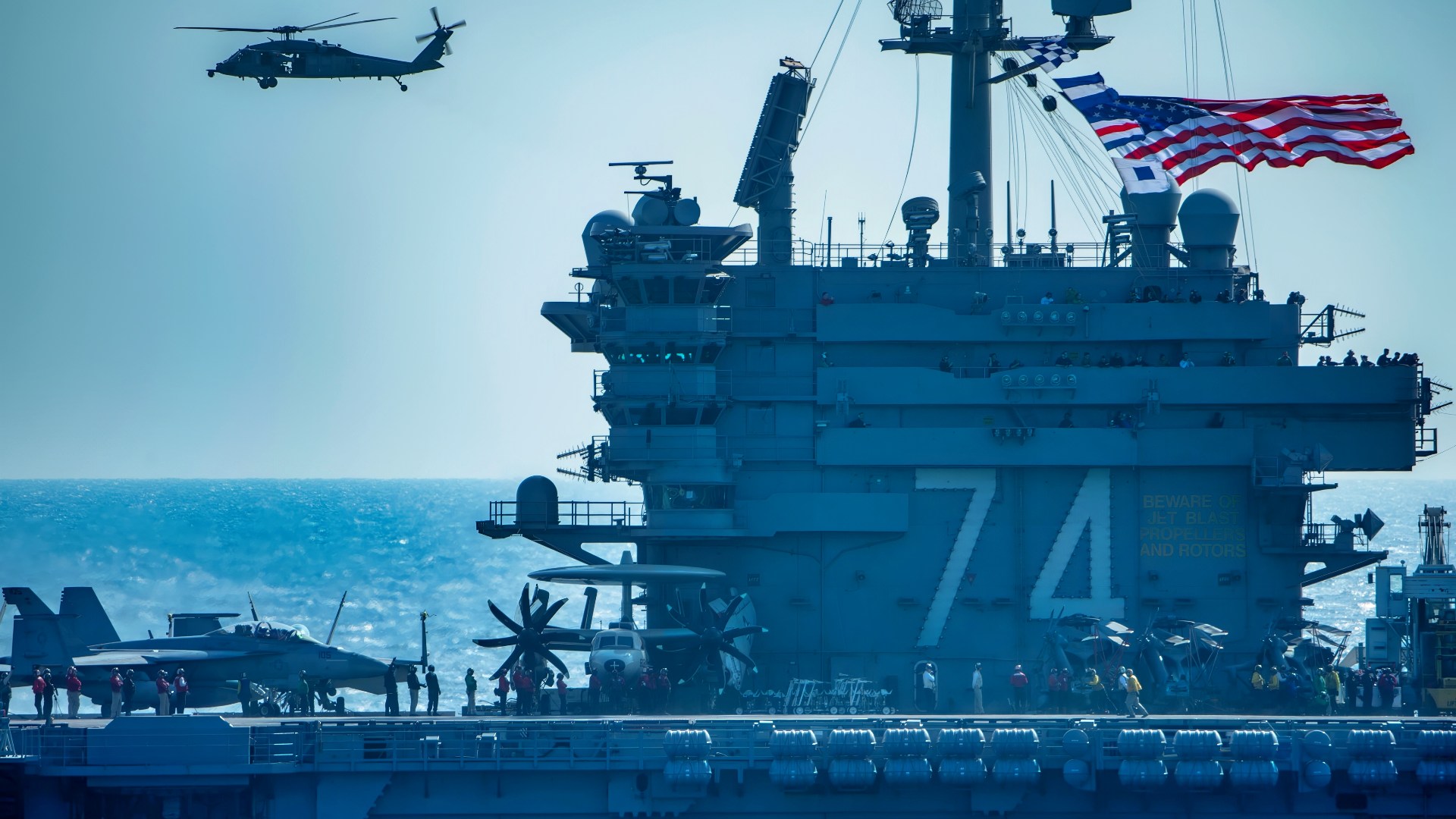
ARABIAN SEA (Dec. 14, 2018) The Nimitz-class aircraft carrier USS John C. Stennis transits the Arabian sea with the Essex Amphibious Ready Group (ARG) and 13th Marine Expeditionary Unit (MEU). The John C. Stennis Carrier Strike Group, Essex ARG, and 13th MEU are conducting integrated operations in the Arabian Sea to ensure stability in the Central Region, connecting the Mediterranean and the Pacific through the western Indian Ocean and three strategic choke points. (U.S. Navy photo by Mass Communication Specialist 3rd Class Tyler Diffie)
The Parliamentary Codification
The most consequential development inside Iran has been the Iranian parliament’s move to formally codify the PGSA’s authority in domestic law.
Lawmaker Mohammadreza Rezaei Kouchi has confirmed that legislation is being pursued to formally codify Iran’s sovereignty, control, and oversight over the Strait of Hormuz, while generating revenue by collecting fees. Kouchi’s framing in Iranian state media coverage presents the arrangement as “entirely natural,” because Iran provides security and therefore Iran should collect fees. The position is internally consistent and politically durable inside Iran. It is also a frontal assault on the customary international maritime legal framework that has governed global commerce since the Second World War.
The Iranian parliament approved the broader plan to impose tolls on Hormuz traffic in late March, and the PGSA framework that emerged in May represents the implementation of that legislative authorization. The administrative structure has been built. The fee structure has been activated. The geographic claim has been published. The diplomatic position has been advanced through statements from Foreign Ministry spokesman Esmail Baghaei. The legal codification is being completed by the parliament. Each of these is a separate, deliberate step in a coordinated effort to make Iranian control over the strait a permanent feature of the international maritime order rather than a temporary wartime aberration.
The Money That Is Already Moving
The fee structure is not a theoretical exercise.
According to maritime intelligence reporting, some vessels have already paid as much as $2 million per transit, with payments settled in Chinese yuan rather than dollars to evade U.S. financial monitoring.
The yuan-denominated payment structure also creates a financial infrastructure that links Iranian sovereignty assertions to Chinese strategic interests in shifting global oil trade away from the dollar. The arrangement benefits both Tehran and Beijing simultaneously, and it operates entirely outside the U.S. financial system.
The Office of Foreign Assets Control at the U.S. Treasury Department has issued guidance warning that payments to Iran for safe passage through the Strait of Hormuz could expose non-U.S. firms to secondary sanctions. The warning has had a limited deterrent effect. Vessels that need to move oil through the strait will pay the fees, because the alternative is sitting at anchor indefinitely or routing through alternative passages that do not exist.
The economic reality has now overtaken the legal position the United States is trying to defend.

(July 11, 2014) – The aircraft carrier USS Ronald Reagan (CVN 76) is underway during Rim of the Pacific (RIMPAC) 2014. Twenty-two nations, more than 40 ships and submarines, more than 200 aircraft and 25,000 personnel are participating in RIMPAC exercise from June 26 to Aug. 1, in and around the Hawaiian Islands. The world’s largest international maritime exercise, RIMPAC provides a unique training opportunity that helps participants foster and sustain the cooperative relationships that are critical to ensuring the safety of sea lanes and security on the world’s oceans. RIMPAC 2014 is the 24th exercise in the series that began in 1971. (U.S. Navy photo by Mass Communication Specialist 2nd Class Jacob Estes/Released)
The Diplomatic Trap
Foreign Ministry spokesman Baghaei stated on May 25 that Iran does not charge “tolls” on Hormuz traffic, while simultaneously confirming that “services will be provided” that “require charging fees.”
The semantic distinction is deliberate. International maritime law explicitly prohibits coastal states from levying charges on vessels exercising the right of transit passage through international straits. By framing the fees as compensation for navigational services, security provision, and environmental management, Iran is attempting to construct a legal architecture that nominally complies with UNCLOS while functionally extracting revenue from every ship that uses the waterway.
The mechanism is being administered through what Iran calls a coordination arrangement with Oman, which adds another layer of diplomatic complication. By involving a second littoral state, Iran is trying to frame the fee structure as cooperation among coastal nations rather than unilateral Iranian assertion. The Omani government’s actual stance on the arrangement remains opaque, but the Iranian framing is designed to deflect international criticism by spreading legal responsibility among multiple actors.
What The U.S. And China Said In Beijing
The Trump administration and the Chinese government issued a rare joint statement at the May 2026 Beijing summit affirming that the Strait of Hormuz must remain open and that no tolls or militarization should be permitted under international law.
President Xi Jinping made explicitly clear China’s opposition to Iranian militarization of the strait and to any attempt to charge transit fees. The U.S. and Chinese positions are aligned on the legal substance, and a UN Security Council draft resolution demanding the reopening of the Strait of Hormuz now has broad backing among the major powers.
The resolution faces Russian resistance, which limits its likely passage. But the substantive diplomatic alignment between Washington and Beijing on the maritime law issue is the most significant aspect of the situation, because it removes Iran’s ability to play the United States and China against each other, as Tehran has historically exploited great-power competition. Both major powers are now publicly committed to the position that Iran cannot legally assert sovereignty over the strait.
The Trap In Any Ceasefire and Hormuz
The deeper problem is what Iran has explicitly told American negotiators. Per Iranian Foreign Ministry statements reported in regional coverage, any understanding with Washington will not cover the management of the strait. Iran’s position is that the strait is the responsibility of littoral states, with coordination underway, and that the PGSA framework is not on the negotiating table.
In plain English: Iran is willing to sign a ceasefire that ends the immediate military hostilities, but Iranian control over the strait is non-negotiable and will remain in place after the war ends.
The framework Tehran has spent the past two months building is the price Iran intends to extract from the United States in exchange for ending the war. If Trump signs the deal currently under negotiation, the war ends, but the PGSA framework remains. Iranian sovereignty over the strait becomes a fait accompli enforced not by Iranian naval power but by the diplomatic infrastructure of the ceasefire agreement itself.
The strategic disaster of that outcome is difficult to overstate. The United States will have fought a war to remove Iranian control over the strait and ended that war by accepting Iranian control over the strait. The Gulf Arab states will pay transit fees to Iran in perpetuity to move their own oil through Iran’s claimed territorial waters. Chinese strategic influence in the Persian Gulf will have expanded substantially through the yuan-denominated payment infrastructure that Iran has built around the fee regime.
International maritime law, as it has functioned since the Second World War, will have been fundamentally rewritten, and in Tehran’s favor.
About the Author: Harry J. Kazianis
Harry J. Kazianis (@Grecianformula) was the former Senior Director of National Security Affairs at the Center for the National Interest (CFTNI), a foreign policy think tank founded by Richard Nixon based in Washington, DC. Harry has over a decade of experience in think tanks and national security publishing. His ideas have been published in the NY Times, The Washington Post, The Wall Street Journal, CNN, and many other outlets worldwide. He has held positions at CSIS, the Heritage Foundation, the University of Nottingham, and several other institutions related to national security research and studies. He is the former Executive Editor of the National Interest and the Diplomat. He holds a Master’s degree focusing on international affairs from Harvard University. Kazianis is Editor-In-Chief of 19FortyFive.


AllahsHappyaHalalPorkEmporium
May 29, 2026 at 2:16 pm
Is NSJ THAT stupid or is this story just for the click bait…..
WHO CARES whatever the ‘authority’ these arrogant terrorist loons create…
They still have to successfully defend their claims!
Their ‘authority’ won’t be worth squat with their regime bombed out of existence!!!