

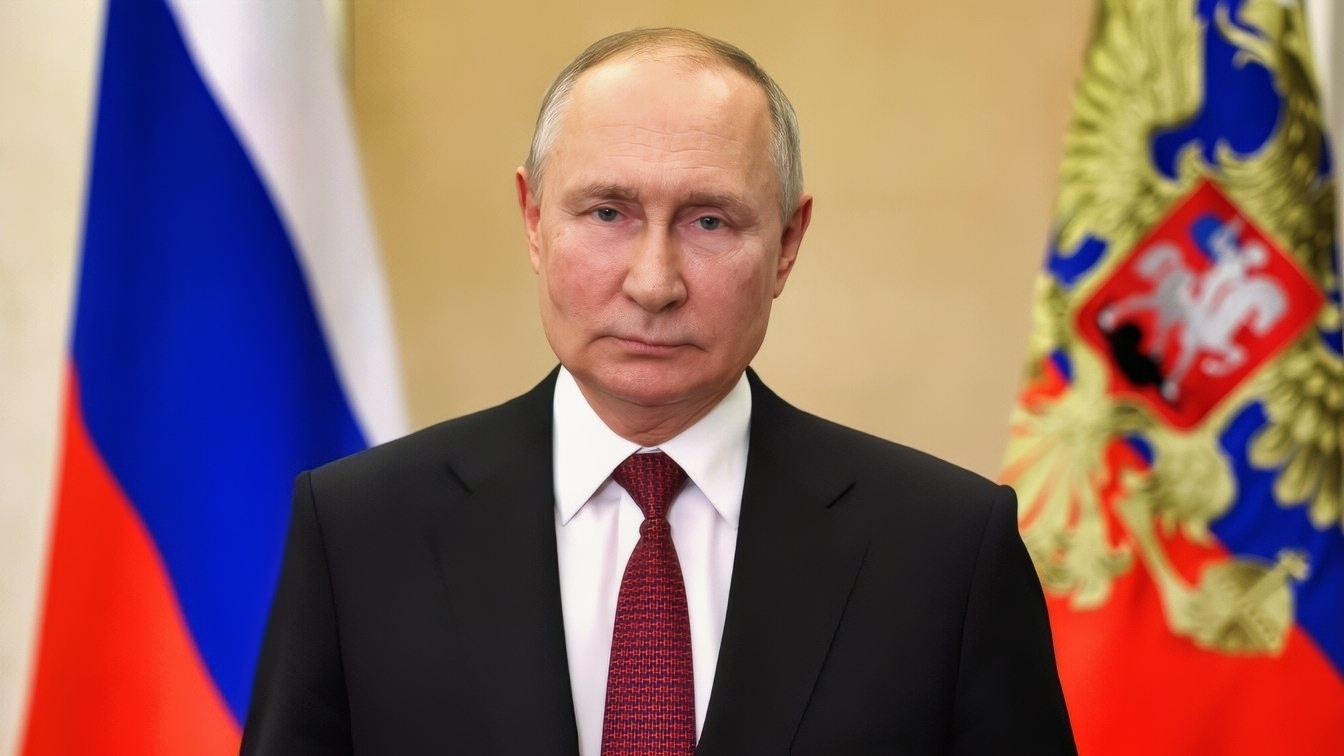
“Putin made a grave mistake invading Ukraine, and the Russian people should never forgive him for it.” That’s what a now-retired Russian military commander told me earlier in the week when I began plotting out this article. This expert, whom I met many years ago on the sidelines of a Track 2.0 think tank forum in Asia in the early 2010s, was clear: “Putin will never be able to undo the damage he has done to Russian power due to his Ukraine fiasco.”
And he is clearly correct. Russia entered the full-scale invasion of Ukraine in February 2022 with one of the strongest macroeconomic positions of any major economy on the planet.

Russian President Putin. Image Credit: Creative Commons.
Federal debt stood at roughly 15 percent of gross domestic product, a figure that the United States, Japan, and every major European economy could only envy. The National Wealth Fund, the sovereign wealth fund built from years of oil and gas surpluses, held hundreds of billions of dollars in reserve. Inflation was under control. The ruble was stable.
Russia had spent the better part of two decades building a fortress economy specifically designed to absorb the kind of Western financial pressure that everyone in Moscow knew would follow any military adventure against a Western-aligned neighbor.
The War in Ukraine Is Russia’s Pandora’s Box. It Can’t Close It
That fortress is now cracking from the inside, and the cracks are structural rather than cyclical. That’s all, thanks to the Ukraine war.
The combination of military spending that consumes nearly 40 percent of the federal budget, inflation driven by a labor market stretched past its breaking point, oil and gas revenues collapsing under sanctions pressure and Ukrainian drone strikes, and a demographic crisis that no amount of money can reverse has produced an economy that is no longer merely strained.
It is beginning to fail in ways that the Kremlin can no longer fully conceal.
The Budget That Eats Everything Else
The single clearest measure of how far Russia has traveled is the defense budget.

MiG-31 Flying High Russian Air Force. Image Credit: Creative Commons.
Moscow is allocating 16.84 trillion rubles, roughly $238 billion, to defense and security in its 2026 budget, which amounts to nearly 40 percent of total government spending. That figure is itself an understatement of the real military burden, because a substantial portion of Russian defense spending is hidden in classified budget lines that never appear in the published accounts.
Even the enormous official figure is not enough to cover the actual cost of the war. Russian Finance Minister Anton Siluanov warned the government in a February letter that wartime expenditures were creating mounting pressure on the federal budget, and that Russia’s war spending is now expected to exceed the 2026 budget by approximately 2 trillion rubles, or $28 billion.
The document indicated that Russia may need to freeze planned spending in other areas to cover the growing costs of the war. The mechanism is straightforward and brutal.
Every ruble the Kremlin pours into artillery shells, contract soldier bonuses, and drone production is a ruble that does not go into roads, hospitals, schools, or the civilian economic development that any normal economy requires to grow.
The Inflation the Central Bank Cannot Kill
The cost of all that military spending shows up most visibly in inflation, and the story of how Russia’s central bank has fought it tells you everything about the bind the Kremlin is in. In response to the inflationary surge that wartime spending produced, the Bank of Russia under Governor Elvira Nabiullina raised the benchmark interest rate to a record 21 percent in October 2024, a drastic attempt to cool an economy overheated by military spending.
Since then, the central bank has walked the rate back through a series of consecutive cuts, bringing it down to 14.5 percent by late April 2026.
The rate cuts are not a victory lap. They are a signal of how badly the economy is stalling. The central bank is easing precisely because economic activity is grinding to a halt, not because it has actually conquered inflation.
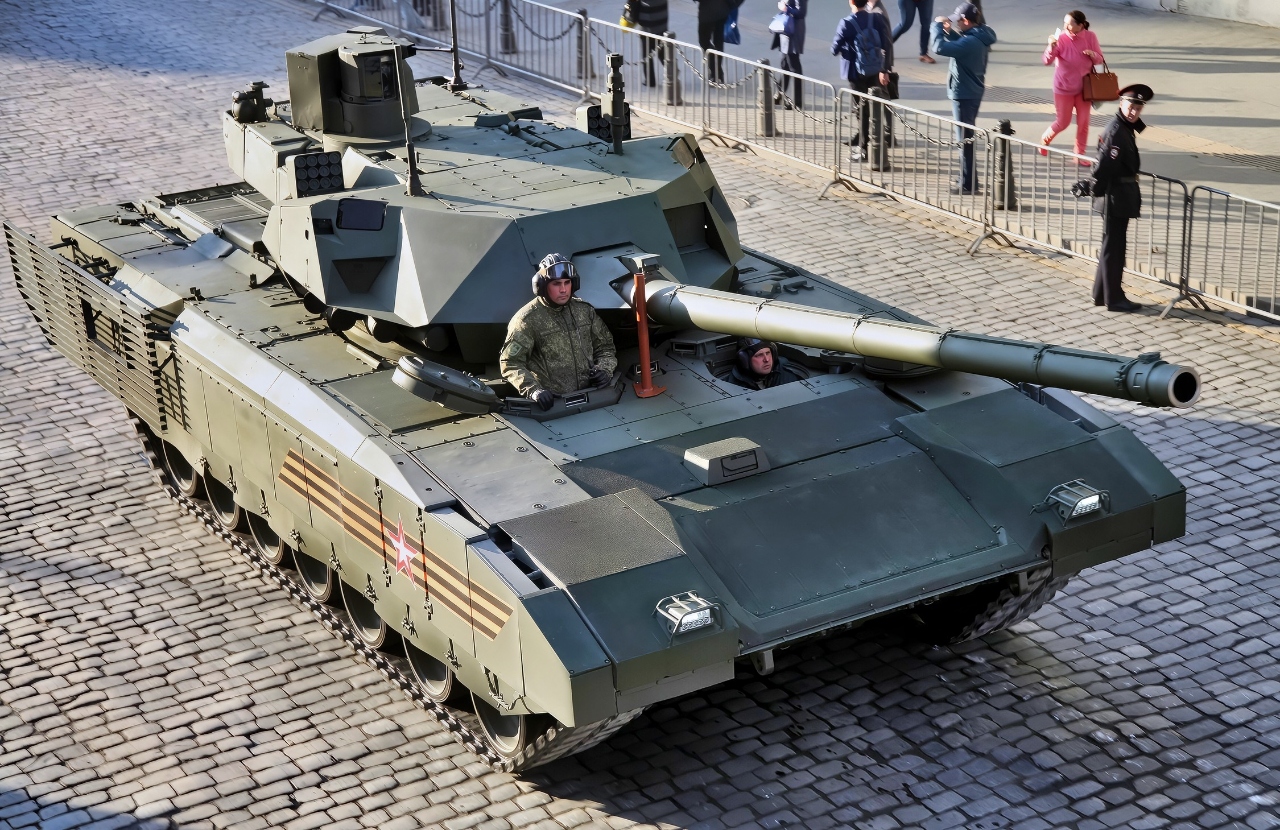
T-14 Armata Tank Russia. Image Credit: Creative Commons.
The structural causes of the inflation remain entirely intact. Military wages that exceed civilian pay continue to pull workers out of the productive economy and into the war effort. Government military procurement continues to crowd out private demand.
Annualized inflation has run well above 8 percent across much of the war. Russia is now caught in the worst possible position, fighting inflation generated by its own war spending while the underlying economy slides toward stagnation.
The Oil Money That Stopped Flowing
The revenue side of the Russian ledger is collapsing at the same moment the spending side is exploding. The appreciation of the ruble and the tightening sanctions regime have produced a drop of more than 25 percent in oil and gas revenues, along with a decline in import tax receipts.
Russia built its entire fiscal model around hydrocarbon exports, and that model is failing under the combined pressure of Western price caps, the loss of the European market, and a global oil price environment that has not cooperated with Russian budget assumptions.
Ukrainian long-range drone strikes have accelerated the damage. Ukrainian President Volodymyr Zelensky has said that Ukrainian strikes cut Russian oil refining by approximately 10 percent in recent months and forced Russian energy companies to shut down wells. The combination of sanctions limiting where Russia can sell its oil and Ukrainian drones limiting how much oil Russia can actually refine and export has hit the single revenue stream the entire Russian war economy depends on.
The debt picture compounds the problem. Russia’s federal debt remains relatively low by international standards, but the cost of servicing that debt is ballooning. In 2021, debt servicing consumed just 0.9 percent of GDP.

Tu-95 Bomber Russian Air Force. Image Credit: Creative Commons.
In 2026, servicing costs are projected to reach close to 2 percent of GDP, nearly 9 percent of all federal spending, which is twice the share it represented in 2021. With inflation running above 8 percent and interest rates still in the teens, borrowing from the domestic market to fill the deficit gap is not a viable option. The high interest payments offset whatever the government manages to raise.
The People Who Are No Longer There
The deepest problem Russia faces is the one that money genuinely cannot fix.
The Russian war economy is consuming workers it cannot replace, in a country that was already running out of working-age people before the war began. At the end of 2024, Russian companies were short roughly 2.2 million workers, with almost 70 percent of companies reporting labor shortages.
The war has pulled hundreds of thousands of working-age men into the military, killed or permanently disabled a substantial fraction of them, and driven roughly a million more out of the country entirely in successive waves of emigration.
The demographic math is catastrophic over any time horizon longer than a few years. Russian Labor Minister Anton Kotyakov told Putin that the economy will need nearly 11 million additional workers by 2030 to replace the 10.1 million people reaching retirement age plus 800,000 new jobs.
In 2024, Russian births fell to 1.22 million, the lowest level since 1999, while deaths rose to 1.82 million. The country’s fertility rate sits around 1.4 children per woman, far below the 2.1 needed to maintain a stable population.
The Kremlin understands exactly how dire the situation has become. Russia’s national statistics agency Rosstat stopped publishing monthly demographic data in an effort to obscure the true scale of the decline, and Russian fertility rates are now the lowest they have been in two hundred years.
A government that hides its own population statistics is a government that has concluded the real numbers are politically intolerable.
Why Putin Cannot Spend His Way Out
Every one of these problems compounds the others, and that is what makes the current moment different from the periodic economic difficulties Russia has weathered before.
The military spending drives the inflation. Inflation forces high interest rates. The high interest rates choke off the civilian economic activity that might otherwise generate growth.

MiG-29 Fighter. Image Credit: Creative Commons.
The labor shortage drives up wages, which further fuels inflation. The collapse of oil revenue removes the one source of money that historically allowed the Kremlin to paper over all these problems simultaneously. The demographic decline guarantees that even a negotiated end to the war would not restore the working-age population the economy needs.
Putin’s Nightmare Just Won’t End
Putin built his political legitimacy on the promise of stability and rising living standards funded by oil and gas wealth. That bargain is now broken. Russian Economy Minister Maxim Reshetnikov publicly warned that the country was on the brink of recession.
The Moscow Times economic analysis concluded that Russia has largely exhausted the temporary drivers that underpinned its wartime growth in 2023 and 2024 and is sliding from managed cooling into outright stagnation, with no meaningful recovery likely before 2027 at the earliest, and only then if the war ends.

MiG-29 Fighter. Image Credit: Creative Commons.
The fortress economy Putin spent twenty years building was designed to survive a financial siege. It was not designed to survive a financial siege, a manpower crisis, a collapsing birth rate, a war that consumes 40 percent of the budget, and a revenue base falling apart all at the same time.
Four years into the war he expected to win in three days, the bill is finally coming due, and there is no amount of money in the National Wealth Fund that can purchase Russia a new generation of workers, a higher birth rate, or the oil revenues that sanctions and Ukrainian drones have taken off the table.
About the Author: Harry J. Kazianis
Harry J. Kazianis (@Grecianformula) was the former Senior Director of National Security Affairs at the Center for the National Interest (CFTNI), a foreign policy think tank founded by Richard Nixon based in Washington, DC. Harry has over a decade of experience in think tanks and national security publishing. His ideas have been published in the NY Times, The Washington Post, The Wall Street Journal, CNN, and many other outlets worldwide. He has held positions at CSIS, the Heritage Foundation, the University of Nottingham, and several other institutions related to national security research and studies. He is the former Executive Editor of the National Interest and the Diplomat. He holds a Master’s degree focusing on international affairs from Harvard University.


