

Summary and Key Points: In the 1970s, under CNO Admiral Elmo Zumwalt, the Navy studied the CVV — a smaller, conventionally powered carrier meant as a cheaper alternative to the nuclear supercarrier.
Pitched as a “minimum-cost” ship at $550 million, its price ballooned to $1.5 billion, and the design was compromised: only 52–60 aircraft versus a Nimitz’s 90, half the catapults and elevators, fuel for barely a day. Analysts found two CVVs would cost more than one Nimitz — so America kept building supercarriers.

USS Gerald R. Ford (CVN 78) conducts high-speed turns in the Atlantic Ocean. Ford is at sea conducting sea trials following the in port portion of its 15 month post-shakedown availability. (U.S. Navy photo by Mass Communication Specialist 3rd Class Connor Loessin).

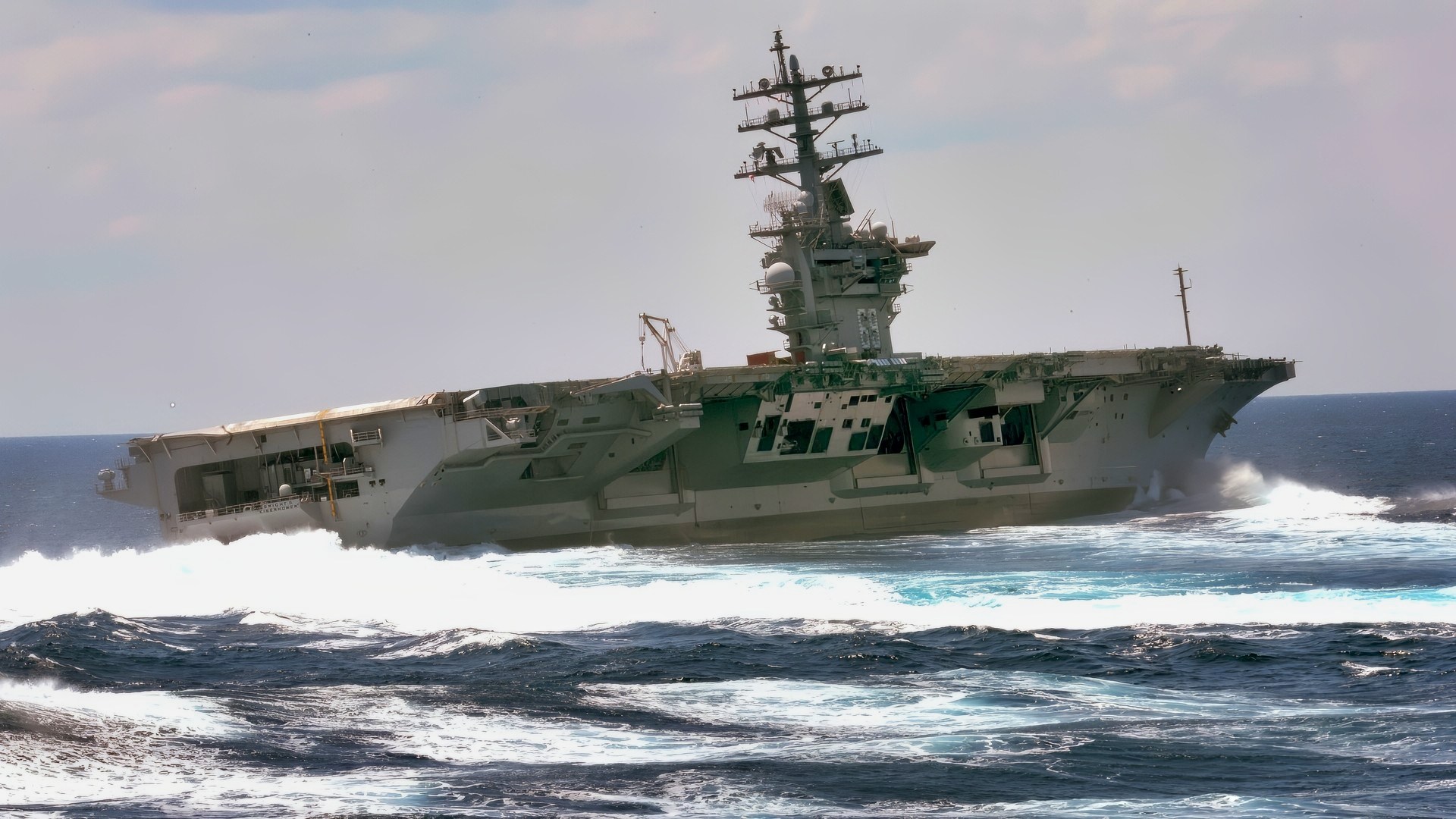
ATLANTIC OCEAN (June 14, 2011) The Nimitz-class aircraft carrier USS Dwight D. Eisenhower (CVN 69) conducts rudder turns during sea trials. Dwight D. Eisenhower completed a nine-month planned incremental availability at Norfolk Naval Ship Yard on June 10 and is scheduled to resume underway operations this summer. (U.S. Navy photo by Mass Communication Specialist 1st Class Christopher Stoltz/Released).

(April 8, 2017) The future USS Gerald R. Ford (CVN 78) underway on its own power for the first time. The first-of-class ship — the first new U.S. aircraft carrier design in 40 years — will spend several days conducting builder’s sea trials, a comprehensive test of many of the ship’s key systems and technologies. (U.S. Navy photo by Mass Communication Specialist 2nd Class Ridge Leoni/Released)
The Medium Aircraft Carrier Dream
The CVV Medium Aircraft Carrier (also known as the Vari-Purpose Carrier) was a proposed 1970s concept for a larger number of smaller, cheaper aircraft carriers. The idea came under the doctrine instituted by Chief of Naval Operations (CNO) Admiral Elmo Zumwalt, which resulted in design studies for a “minimum-cost” carrier of 50,000–60,000 tons.
The design, initially known as T-CBL, was projected to cost less not only because of its reduced size but also because it was fitted with a conventionally powered, oil-fired power plant. Deleting the reactor from this new class of ships was supposed to make it considerably cheaper than the nuclear-powered carriers of the day.
Thus, in 1972, the CVV was projected to cost $550 million. Despite its smaller size, it would still be suitable for replacing the aging Midway-class aircraft carriers. The project then appeared to be dead on arrival when a fourth Nimitz-class carrier was ordered in 1976.
Gerald Ford Administration
What appeared to be new life was breathed into the program when the Gerald Ford Administration canceled the fourth Nimitz carrier at the end of the same year it was ordered, which created the proposal for a new medium-sized carrier concept. The ship would still utilize conventional propulsion, but the idea of using Vertical/Short Take-Off and Landing (VSTOL) aircraft had been discarded in favor of regular Catapult-Assisted Take-Off But Arrested Recovery (CATOBAR) aircraft.
While this idea seemed attractive at first, the final numbers presented were well in excess of the original estimates. When the bill to finance the CVV was determined in 1977, it was now a $1.5 billion vessel. This compared with $2.4 billion for a Nimitz-sized ship, so much less a carrier for almost three times what the “low-cost” price had been intended to be.
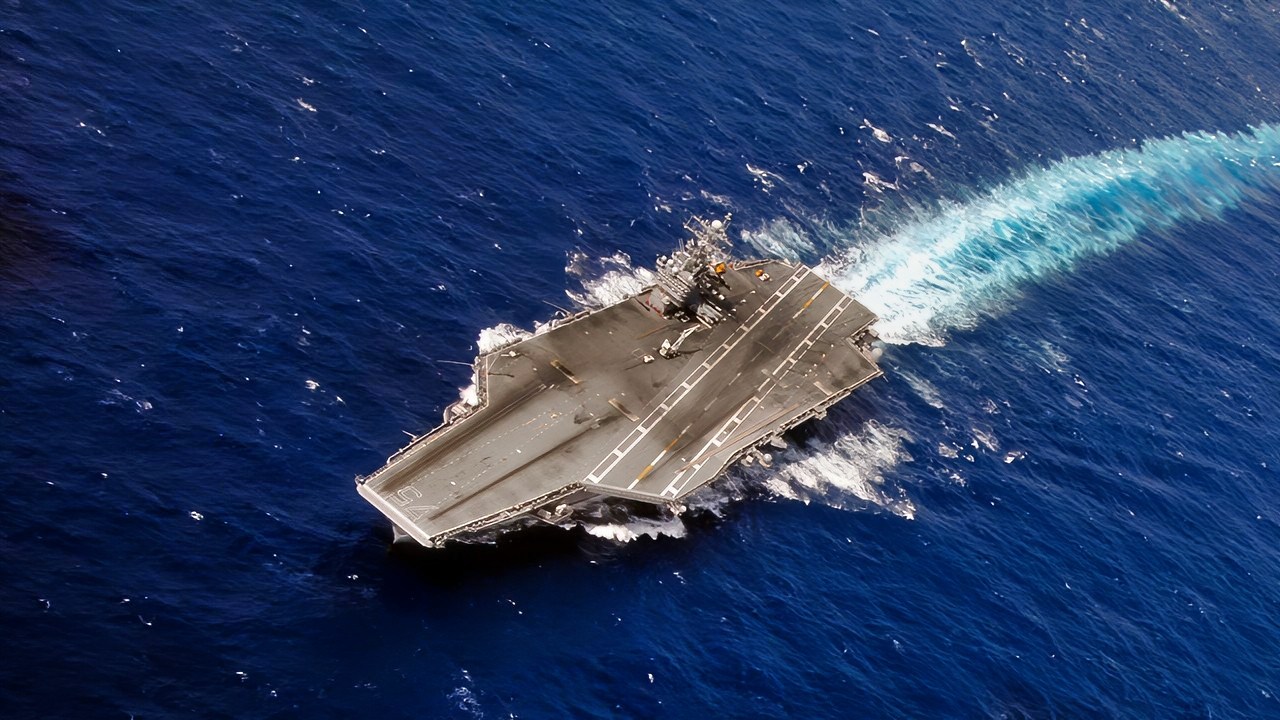
The aircraft carrier USS Harry S. Truman conducts high-speed turns during a rudder check. Truman is conducting carrier qualifications in the Atlantic Ocean.
Another factor, as one naval shipbuilding contractor specialist explained to me, is that “carriers exist to be deployed to trouble spots on the globe. Usually, the requirement is for them to arrive there ‘immediately if not sooner,’ as the saying goes.”
The CVV’s shortcoming in this regard is that its conventional power plant created a vessel slower than the other larger carriers (28 knots compared with 21 knots).
The CVV also suffered from having been designed in a rather “backward” manner. Carriers and other naval vessels normally start out with an in-depth threat analysis that determines the operational requirement. Then, the mission for the ship is detailed out, which determines a price point. Instead, the CVV was designed from the beginning with a price tag in mind, leading to the entire design being essentially reverse-engineered.
Endless Shortcomings for CVV
However, regarding carrier operations, the CVV was decidedly less than optimal.
Due to its reduced size, the carrier’s required capabilities had to be dialed back. This meant many of the necessary electronic systems, even in the 1970s, had to be deleted from the design.
(A reduced complement of electronic systems would be an even greater impediment to making this kind of design work in the present day for those wondering if the concept is more viable in this century than it was in the previous one.)
Being a smaller carrier also meant a smaller number of aircraft on board, especially only 52 or 60 compared to the 90 aircraft that were carried on the Nimitz. There was no precedent for structuring an air group with these reduced numbers, so the complement of aircraft would have to be cobbled together, with the requirement being that they would fit aboard the ship rather than being the optimal mix for specific missions.
Overall, the CVV design appeared to have focused on supporting strike missions flown by the A-7 Corsair attack aircraft. Therefore, it would have been the naval aviation version of a “one-trick pony” and would not have functioned as a multi-role aviation platform like the Nimitz.
As other naval engineers pointed out, perhaps the most limiting factor would have been that this carrier would have only had two catapults and two elevators—50 percent less than the Nimitz in both categories.
Complicating the latter point, there were fewer ammunition elevators as well, so in a high op-tempo environment, the aircraft elevators would have to pull double duty—with all the safety hazards that would present.
Lastly, the poor design of the store’s internal arrangement resulted in aviation fuel sufficient for only 1.35 days of air operations. However, there was enough ordnance on board for 4.5 days if the ship were configured for a strike. This disparity was even more pronounced when the ship was carrying fighters rather than attack platforms.
The Medium Aircraft Carrier Failure
Looking at the lack of utility for this design concept—even today—one naval analyst has written, “The CVVs would have required two boats to deliver the airpower that one Nimitz could deliver. And two CVVs would have ultimately been more expensive, with respect to crew and support vessels, than just one Nimitz.”
“One hull with a six-thousand-man crew was cheaper to operate than two hulls that required a total of nine thousand men, but collectively had just as many planes. A single carrier also required only one set of cruisers, destroyers, and frigates as escorts. Finally, larger carriers could also generate more air sorties than a smaller carrier and could operate more and larger aircraft.”
Like so many ideas throughout military history, this medium-sized carrier seemed to have considerable merit in the abstract or on paper, but in practice, it would most likely have proved costly and disastrously deficient.
About the Author
Reuben F. Johnson is a survivor of the February 2022 Russian invasion of Ukraine and is an Expert on Foreign Military Affairs with the Fundacja im. Kazimierza Pułaskiego in Warsaw. He has been a consultant to the Pentagon, several NATO governments and the Australian government in the fields of defense technology and weapon systems design. Over the past 30 years he has resided in and reported from Russia, Ukraine, Poland, Brazil, the People’s Republic of China and Australia.


