


Right now, a meaningful share of the oil that keeps the global economy moving is not being pumped from the ground. It is being drained out of emergency reserves that governments spent decades filling for exactly this kind of catastrophe, and those reserves are running down at a pace that gives the world a hard deadline. The Strait of Hormuz has been effectively shut since the war with Iran erupted on February 28, choking off roughly a fifth of the planet’s seaborne oil, and the only thing standing between that supply shock and a full-blown price spiral is a stockpile cushion that the world’s own energy analysts now expect to run out around the middle of July. After that, the math gets ugly fast, and the question stops being whether reserves can hold the line and becomes how deep the recession runs if the Strait is still closed when they cannot.
A Deadline The Whole Industry Agrees On

Trump Speaking Outside White House. Image Credit: The White House.

President Donald Trump delivers remarks at a National Day of Prayer event, Thursday, May 1, 2025, in the White House Rose Garden. (Official White House Photo by Molly Riley)
What makes the current moment unusual is how tightly the forecasters have converged on a single date.
The coordinated emergency release that 32 nations launched in March, more than 400 million barrels poured into the market to blunt the shock, was structured to flow at about 2.5 million barrels a day over four months, a stream that on current schedules runs dry around July 9.
That is the point at which the temporary buffer is spent, and the market has to adjust on its own.
Independent analysis from the trading side arrives at the same conclusion. One desk’s relatively calm, price-capped outlook for crude is explicitly time-limited, and the analysts behind it warn it would have to be torn up if the closure extends past the end of July, because the depletion of emergency buffers would fundamentally change the setup.
A reserve-arithmetic assessment reached the same conclusion from yet another angle, judging that the economically manageable window is realistically one to three months rather than six, not because the world physically runs out of oil but because the macroeconomic pain for vulnerable importers intensifies well before the tanks are empty.
Three different methods, three different institutions, one answer: mid-summer is the cliff edge. And almost no one is talking about it, at least the stock market surely isn’t.
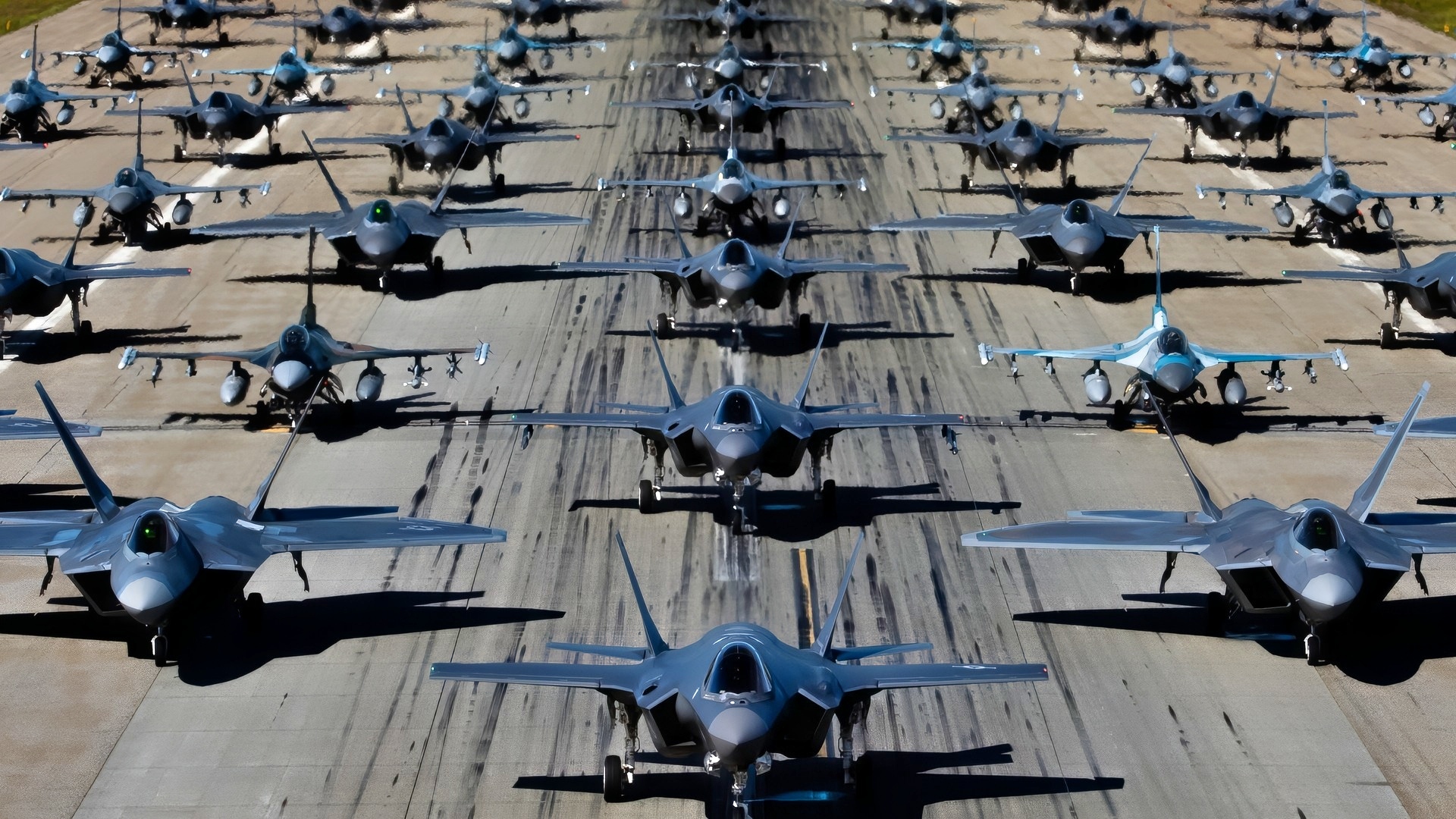
The 354th Fighter Wing conducts a 75-fighter jet formation at Eielson Air Force Base, Alaska, Aug. 12, 2022, in honor of the U.S. Air Force’s 75th Anniversary. This capabilities demonstration included F-35A Lightning II, F-16 Fighting Falcon and F-22 Raptor aircraft from across Pacific Air Forces. (U.S. Air Force photo by Senior Airman Gary Hilton)
The Cushion Is Thinner Than The Headlines Suggest
The 400-million-barrel release sounded enormous when it was announced, and politically it was, but in the context of global demand, it is almost trivially small.
The world burns through roughly 105 million barrels of oil a day, so the entire historical release would amount to about four days of global consumption if it had to cover the gap outright. It does not work quite that way because the barrels are metered out to soften prices rather than replace lost supply one-for-one, but the scale comparison is the point. Even the world’s largest stockpile cannot flood the market, and the U.S. reserve’s maximum physical drawdown rate is capped at 4.4 million barrels a day, with crude taking roughly two weeks to reach the market after a release is ordered.
Stretch the release across the real-world drawdown pace, somewhere between 4.8 and 6.6 million barrels a day across all participating nations, and the authorized volume provides only 60 to 83 days of partial offset before it is exhausted.
And the gap it is trying to fill is enormous. Even after accounting for the 3.5 to 5.5 million barrels a day that can be rerouted through Saudi and Emirati pipelines that bypass Hormuz, the net shortfall runs to roughly 14.5 to 16.5 million barrels a day. Reserves were built to bridge a short, sharp interruption, not to substitute for a fifth of world supply month after month, and the structure is buckling under a load it was never designed to carry.
America’s Reserve Is Sliding Toward Its Floor
Nowhere is the drawdown more visible than in the United States.
The Strategic Petroleum Reserve stood at 365 million barrels in the week ending May 22, down more than 50 million barrels since the war began and the lowest level since April 2024. The Trump administration’s contribution to the global release was the largest single-country emergency drawdown in history, around 172 million barrels, and the reserve has been bleeding steadily ever since.
The floors are closer than most people realize. Below the current level sit two hard limits, a legal minimum around 252 million barrels and a geological minimum near 150 million barrels, beneath which the salt caverns that hold the oil cannot be safely drawn, and at the present depletion rate, those thresholds could be reached within three to five months.

A U.S. Air Force F-16 Fighting Falcon connects with a U.S. Air Force KC-10 Extender over Iraq, Nov. 5, 2021. The F-16 is a compact, multi-role fighter aircraft that delivers war-winning airpower to the U.S. Central Command area of responsibilty. (U.S. Air Force photo by Staff Sgt. Jerreht Harris)
That timeline runs straight into the autumn, which means that even if the July buffer somehow stretched, the United States’ physical ability to keep releasing oil would be running out by September or October. Refilling will not rescue the situation either. The administration has floated a plan to add 200 million barrels back later in 2026, but that would only return the reserve to its depleted pre-war level, and a more sober industry estimate puts full recovery to around 414 million barrels somewhere near July 2028. The reserve drains in months and refills in years.
A Shock Bigger Than The Crises That Made Reserves Necessary
To grasp why the buffers are struggling, it helps to measure the hole they are trying to fill against history.
The head of the International Energy Agency has called this the worst energy crisis on record, noting that the oil shocks of 1973 and 1979 each removed about 5 million barrels a day from the market and triggered global recessions, while this closure has knocked out roughly 12 million barrels a day, more than those two landmark crises combined. The strait normally carries close to 20 percent of global oil, and the closure has produced what is now described as the largest supply shock in the history of the crude market, with net cumulative losses from Gulf producers already exceeding a billion barrels.
That scale is the whole problem. Every previous oil disruption left substantial spare capacity somewhere in the system that prices could eventually coax into the market. This one operates at a magnitude that swamps the available cushions, and once the emergency reserves are spent and the rerouting options are maxed out, the market has only one lever left to balance supply and demand: raising prices until enough consumers and industries are forced to stop buying.
Economists have a clinical phrase for that mechanism, demand destruction, and a blunter one for what it does to an economy when it happens at this scale, which is recession.
China Was Asia’s Shock Absorber, And It Is Drawing Down Too
The piece of this that has gotten the least attention may be the most consequential, and it runs through Beijing.
As of December 2025, just before the emergency releases began, the single largest strategic oil inventory in the world belonged not to the United States but to China, which had spent 2025 aggressively adding to its stockpiles. China entered this crisis with the deepest cushion on earth, an estimated 1.4 billion barrels of total crude inventory, and that depth is exactly why it has been able to absorb the shock longer than anyone else. For the past several years, that Chinese hoarding quietly functioned as a shock absorber for all of Asia, a vast reserve sitting behind the region’s supply chains.
Now China is consuming that cushion rather than building it. Chinese refiners have been running on stored crude while slashing purchases, cutting imports to 6.6 million barrels a day in May, down from a normal average near 11 million, and that import collapse is one of the main reasons global prices have not spiked even harder than they have. The signal in that behavior is what matters. When even the country holding the largest oil reserve on the planet starts drawing it down and pulling back from the market, the system has lost its deepest reservoir of slack, and it has lost it at the worst possible moment.
This matters far beyond China’s borders because of where Hormuz oil actually goes. Around 84 percent of the crude transiting the strait is bound for Asian markets, and the region’s seaborne crude arrivals have already fallen more than 5 million barrels a day below normal, with April marking the lowest monthly arrivals in over a decade. The most exposed economies, the import-dependent states with thin reserves and limited spare cash, are the ones that crack first in a sustained shock, and they no longer have a deep-pocketed regional buyer quietly stabilizing the market on their behalf.
Iran War Crisis: What Actually Happens If The Strait of Hormuz Stays Shut
Lay the timelines on top of one another, and the picture sharpens into something close to a schedule. The coordinated reserve release runs dry around mid-July. The U.S. reserve approaches its legal and geological floors across the following few months, into the autumn. China and the rest of Asia burn through the regional cushion on a parallel track. Strip those buffers away one by one with the strait still closed, and the price-suppressing effects that have so far kept crude from spiraling, the steady reserve flow, and the market’s lingering hope of a reopening, both expire at roughly the same time. What replaces them is the only remaining balancing mechanism: prices climb until demand breaks, which is the textbook on-ramp to a global downturn.
Whether that downturn stays a recession or tips into something historians would give a worse name depends almost entirely on how long the closure lasts past the point at which the reserves give out. A strait that reopens in July, even partially, deflates the pressure before the buffers are fully gone and pulls the world back from the edge. A strait still shut in October, with the U.S. reserve scraping its floor and Asia’s cushion spent, removes every shock absorber at once and exposes the global economy to the full force of a supply gap bigger than the 1970s crises combined. The reserves were always meant to be a bridge rather than a destination, and a bridge only does its job if there is solid ground waiting on the far side.
An Economic Crisis of Historic Proportions is Coming Due to the Strait of Hormuz
Right now, the world is most of the way across with the planking running out beneath its feet, and the only thing that puts ground under the far end is a waterway Tehran has so far refused to reopen.
The release began draining in March and gives out in July, and if the strait is still closed after that, the global economy will be walking on oil it does not have.
About the Author: Harry J. Kazianis
Harry J. Kazianis (@Grecianformula) was the former Senior Director of National Security Affairs at the Center for the National Interest (CFTNI), a foreign policy think tank founded by Richard Nixon based in Washington, DC. Harry has over a decade of experience in think tanks and national security publishing. His ideas have been published in the NY Times, The Washington Post, The Wall Street Journal, CNN, and many other outlets worldwide. He has held positions at CSIS, the Heritage Foundation, the University of Nottingham, and several other institutions related to national security research and studies. He is the former Executive Editor of the National Interest and the Diplomat. He holds a Master’s degree focusing on international affairs from Harvard University.


easy dawn
June 3, 2026 at 10:44 am
I hope 2026 will see a repeat of the 1973 oil crisis, thereby, paving the way, or allowing for numerous countries and regions to point the usual finger of blame on one another.
When that happens, time for Russia to get rid of Putin, and end the uktro conflict and achieve final victory over the banderovtsy nazis.
Which means, that immediately after the crisis peters out, or when those bad days are over, no more risk of ww3 in Europe.
Instead, NATO, EU and the US state dept and US war dept will make a beeline for the western Pacific.
By 2030, the UK, France, italy and US could be banging and clanging war drums in east Asia.