

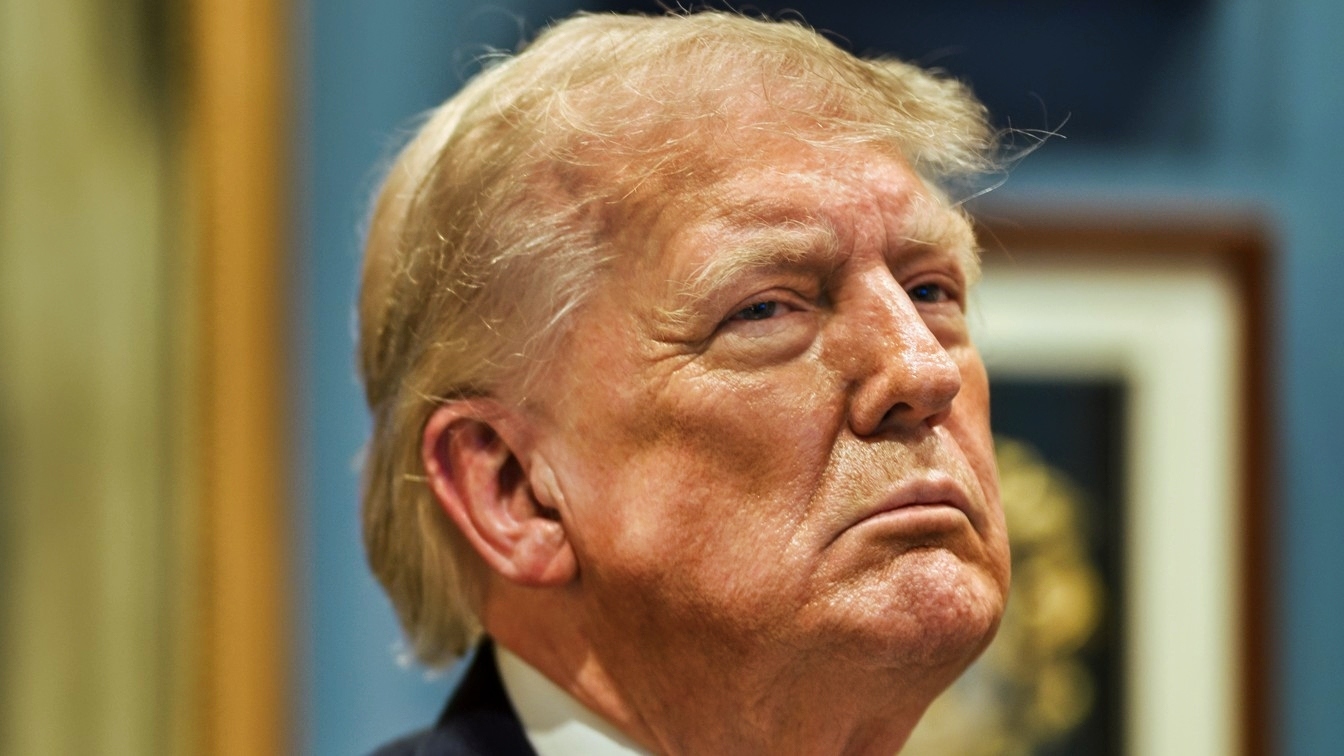
The greatest danger facing the United States in its war of choice against the Islamic Republic of Iran is not a sudden decision by President Donald Trump to launch a full-scale invasion of the country populated by more than 90 million people. It’s what’s known as “escalation-by-exhaustion.”
Currently, there’s little evidence in Trump’s repertoire that he is chomping at the bit to repeat the same mistakes as former Republican President George W. Bush: invading an ancient Mideast country with insufficient troop levels, a lack of political will, and no plan for any fallout.

President Donald Trump meets with Canadian Prime Minister Mark Carney, Tuesday, May 6, 2025, in the Oval Office. (Official White House Photo by Daniel Torok)
Iran is even bigger than Iraq and more geographically challenging for any potential ground invasion. What’s more, the Islamic Republic’s ideological defenders have already demonstrated their commitment to defending the regime and country against any attacks by the United States.
This scenario is why Washington is even considering landing troops in Iran. The air war and naval operations against the Islamic Republic failed.
The Real Risk of a Ground War
The real danger, though, is subtler. It’s potentially far more dangerous. And we’ve already experienced it throughout the conflict that was supposed to last only 96 hours and end in a popular uprising against the maligned Islamic Republic. That never happened. The Americans got stuck holding the bag. Now, Washington is scrambling to determine a better future course.
Wars rarely unfold according to plan. Leaders enter conflicts believing that a combination of military power, economic pressure, and political leverage will force their adversaries to capitulate. When those expectations fail to materialize, however, governments are confronted with a painful choice: accept defeat or escalate.
Historically, many choose escalation.

U.S. Soldiers assigned to the 2nd Armored Brigade Combat Team, 1st Cavalry Division supporting the 4th Infantry Division maneuver an M1A2 Abrams tank and M2 Bradley Fighting Vehicle past a simulated opposing force’s Leopard 2A6 tank during exercise Arrow 23 in Niinisalo, Finland, May 5, 2023. Exercise Arrow is an annual, multinational exercise involving armed forces from the U.S., U.K., Latvia, Lithuania and Estonia, who train with the Finnish Defense Forces in high-intensity, force-on-force engagements and live-fire exercises to increase military readiness and promote interoperability among partner nations. (U.S. Army National Guard photo by Sgt. John Schoebel)
That is the risk the United States faces today. It’s precisely what we experienced during the Vietnam War. Rather than de-escalate and walk away early in an unwinnable war, the US president at the time, Lyndon B. Johnson, could not countenance the embarrassment, so he kept escalating, believing that the next rung on the escalation ladder would benefit the mighty US military. It never did. North Vietnam defeated America in the Vietnam War, with the US spending decades thereafter licking its psychic wounds as a result.
The Strait of Hormuz Embarrassment
The Strait of Hormuz remains the central sticking point in the US-Iranian geopolitical dance. The world’s economy depends upon the uninterrupted flow of energy through that narrow waterway. As long as Iran retains the ability to threaten shipping traffic there, it maintains what many believe is unacceptable leverage over the global economy.
This reality presents a growing problem for Washington, which desperately needs the Strait reopened.
Running Out of Intermediate Options
Most policymakers prefer conflicts that offer multiple rungs on the escalation ladder. You start with diplomacy. Then move to sanctions. Possibly take limited military strikes. If necessary, you expand the air campaign. Then move to covert action. Then the blockades. If you can’t tell, we are at the blockade portion of the ladder.
The problem emerges when every rung fails to produce the desired outcome.
At some point, decision-makers begin running out of options that fall short of ground operations.

A U.S. Army M1A2 SEPv2 Abrams assigned to Alpha Company, 1st Battalion, 67th Armor Regiment, 3rd Brigade Combat Team, 1st Armored Division prepares to move off the live fire range after completing the day portion of Table VI Tank Gunnery conducted at McGregor Range, New Mexico, Sept. 29, 2023. Gunnery Table VI evaluates crews on engaging stationary and moving targets while utilizing all weapons systems in offensive and defensive positions, ensuring our crews are trained and ready for any mission. (U.S. Army photo by Spc. David Poleski)
That’s the danger of escalation by exhaustion.
The Logic of Escalation
The most dangerous wars, again, like the Vietnam War, begin with limited objectives. Leaders convince themselves that one final push will achieve victory. A decade later, after tens of thousands of your own people get killed, as well as millions of civilians, you still haven’t achieved victory.
Each decision made to change the game at the tactical level that appears isolated and limited is, in fact, a move toward full-blown war. That’s why people are panicking right now about the prospects of a potential US ground invasion. It doesn’t help that President Donald Trump keeps likening the timeline in the Iran War to World War II, Korea, and Vietnam.
It’s doubly more disconcerting that senior White House officials have publicly speculated about the need for a national draft. While those officials ultimately (slightly) walked their comments back after receiving pushback in the press, the United States Congress passed a law that automatically registers every draft-eligible person in America for the Selective Service system. Maybe it’s just a coincidence. After all, the state of Florida has automatically registered 18-year-olds in the state for years for the draft.
Given the circumstances of what’s happening, though, one is justified in being concerned that President Trump might go for it all and attempt a ground invasion.
What Would That Look Like?
Early in the war, after the Iranians shuttered the Strait of Hormuz, there was speculation that the Trump administration would attempt a limited Marine landing on one of the outlying islands off the Iranian coast. This turn of events would be part of a limited mission set to conduct sea control operations.
Basically, establishing a foothold somewhere along Iran’s coastline in the Strait of Hormuz would both complicate Iran’s ability to disrupt shipping and ensure the safe passage of civilian ships through the Strait.
The only problem is that no US Navy warship, let alone landing vessels, dares to enter the Strait of Hormuz because the Iranian web of anti-ship ballistic missiles (ASBMs) and drones is so powerful there that they could damage or even sink US warships. So, then what?
Possibly a protracted cycle of Special Forces operations to hunt for Iran’s suspected WMDs?
That, too, is a non-starter. Again, getting close to Iranian air defenses is a suicide mission for any transport plane trying to insert Special Forces near one of those suspected nuclear weapons sites.
Plus, if Iran really develops nuclear weapons–US intelligence still denies this is the case–then any attempt to seize them with ground forces could become catastrophic fast.
Even though there are literally no good options for any ground incursion into Iran, however limited it might be, the escalation-by-exhaustion scenario still holds. Trump is clearly committed to winning in Iran. He’s also clearly opposed to Iran maintaining control over the Strait of Hormuz or developing nuclear weapons.
The Trap Ahead
President Trump just might assume he has no choice but to try one last escalation to break the cycle of violence. If the economic consequences from the shutdown of the Strait of Hormuz continue worsening, if military operations against Iran continue failing, and if Iran demonstrates a repeated ability to absorb punishment while resisting, Washington could face increasingly unattractive choices.
That is the essence of exhaustion by escalation. And that is why we might very well see US ground forces landing in some capacity in Iran–creating a mass slaughter for those forces and potentially breaking the US Army and Marines for decades.
About the Author: Brandon J. Weichert
Brandon J. Weichert is the Senior National Security Editor at 19FortyFive.com. He also manages The Weichert Brief on Substack. Weichert hosts “National Security Talk” on Rumble, too. He is the author of four bestselling national security books, the most recent of which is A Disaster of Our Own Making: How the West Lost Ukraine (Encounter Books). Follow him via Twitter/X @WeTheBrandon.


