

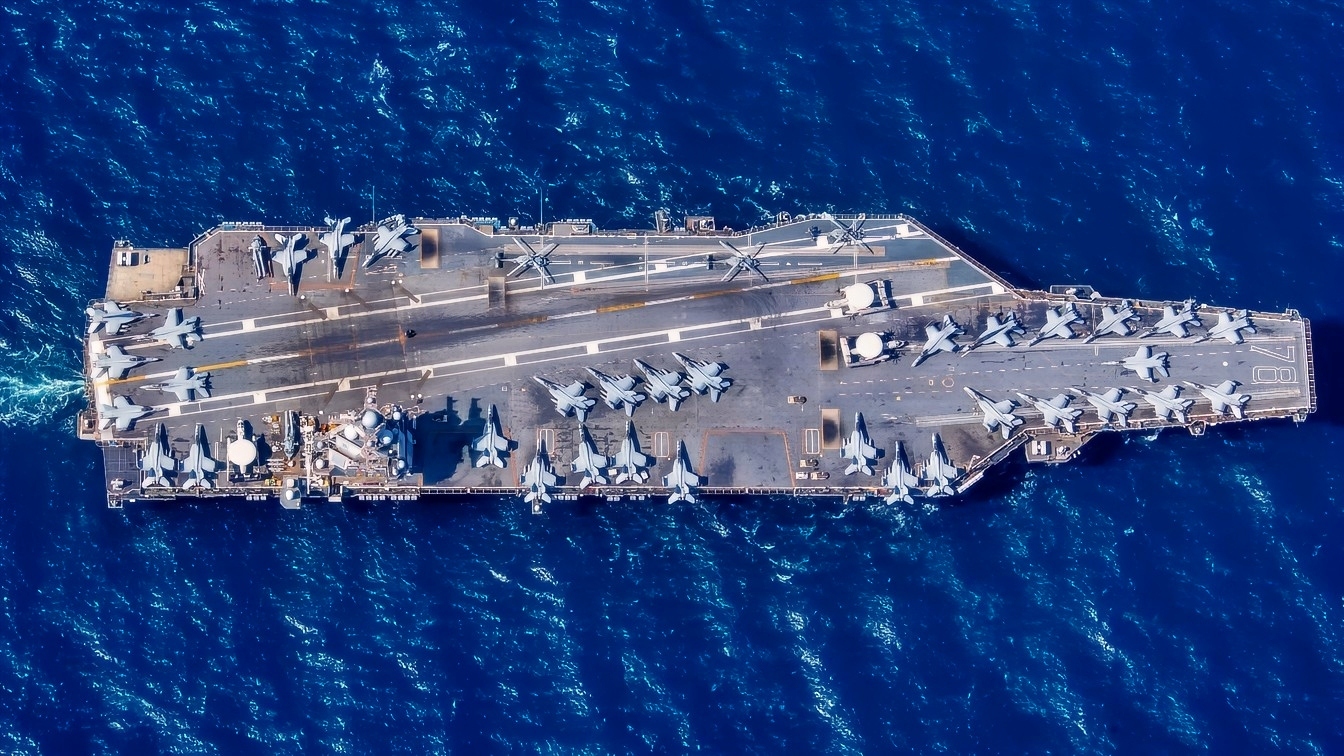
Summary and Key Points: In the spring of 2005, the United States Navy set out to sink one of its own aircraft carriers — and for most of a month, it failed. The decommissioned USS America absorbed torpedoes, missiles, and bombs and refused to go under until the Navy finally scuttled her with charges set off inside the hull. To this day, she is the only supercarrier ever sent to the bottom, anywhere on earth. That ordeal is often cited as proof that the American aircraft carrier is nearly unsinkable — and in one sense, it is.
-But it points to a more uncomfortable truth: sinking a carrier outright may be the wrong goal entirely.
What It Would Actually Take To Sink A U.S. Navy Aircraft Carrier
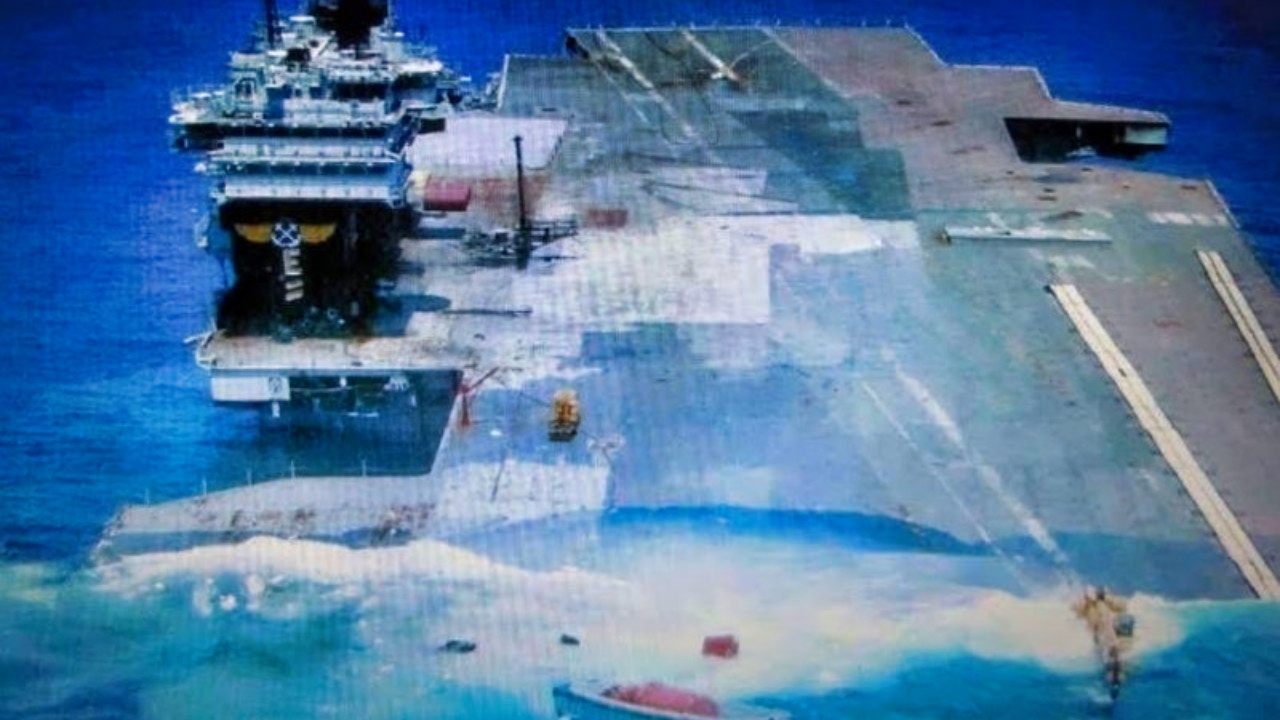
Navy Aircraft Carrier USS America is sinking in a controlled detonation. Image Credit: U.S. Navy.
Since 2009, when I enrolled in graduate school to study national security affairs, one question has dominated my thinking: what would it take to sink a U.S. Navy aircraft carrier in a war with China? In many respects, the question is baked into almost every article I have written for decades now.
And, at least to some extent, we do have some sense of what it would take, and no one had to get hurt to get the answer.
In the spring of 2005, the United States Navy spent four weeks trying to sink one of its own aircraft carriers, and for most of that month it failed. The decommissioned USS America, a Kitty Hawk-class supercarrier, absorbed torpedoes, missiles, and bombs in a controlled live-fire test and refused to go under until the Navy finally set explosive charges inside the hull and scuttled her from within.
That single fact, that it took weeks of deliberate punishment and a finishing blow from the inside to sink a carrier nobody was even defending, is the starting point for any serious answer to what it would take to sink an American flattop in combat.
The answer is both reassuring and alarming, depending entirely on what you mean by the word sink.
The 2005 SINKEX That Sent USS America To The Bottom
The USS America, hull number CV-66, was the third Kitty Hawk-class carrier, commissioned in 1965 and a veteran of both Vietnam and Operation Desert Storm before the Navy decommissioned her in 1996.
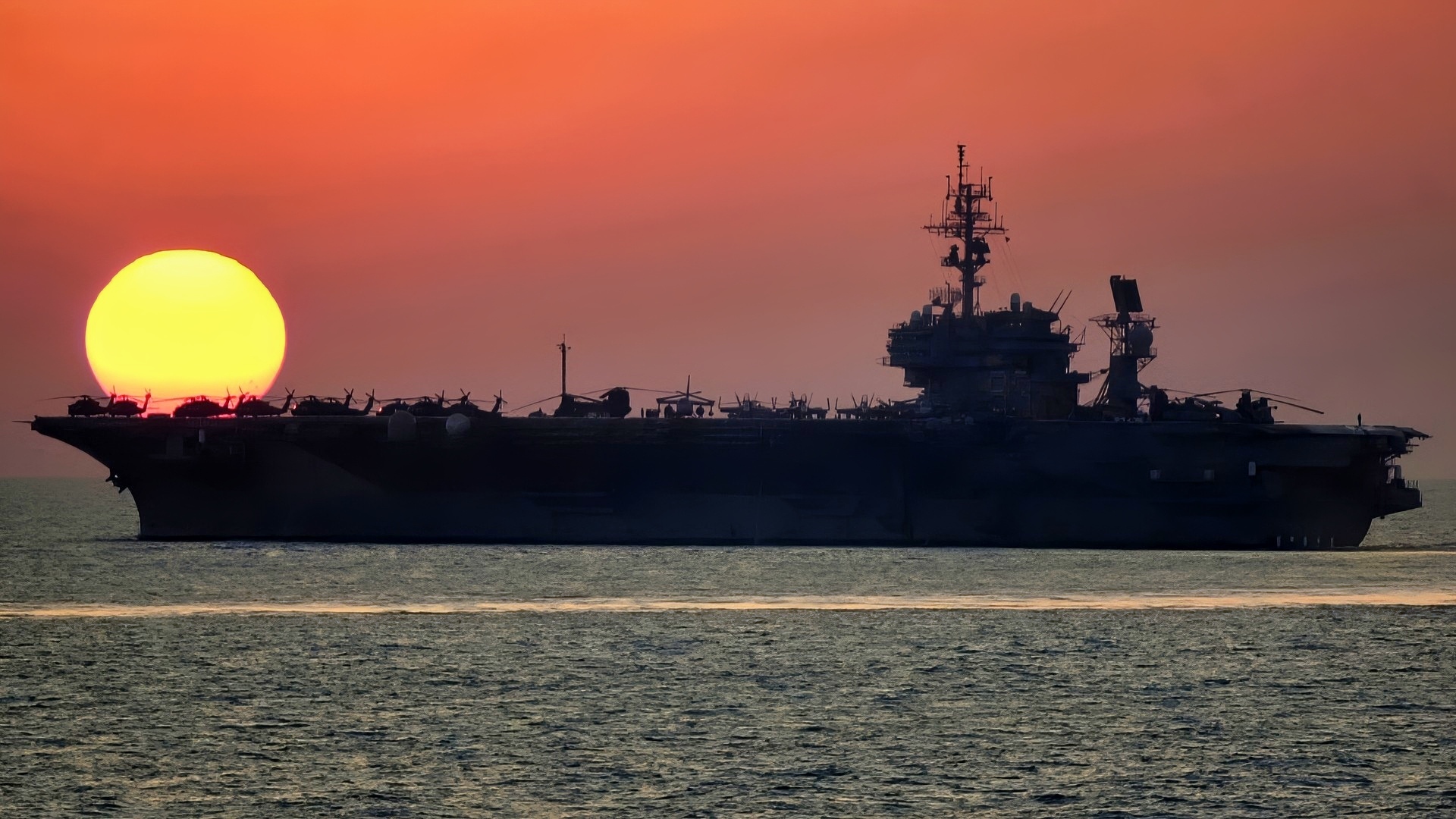
USS Kitty Hawk of Kitty-Hawk-Class. Image Credit: Creative Commons.
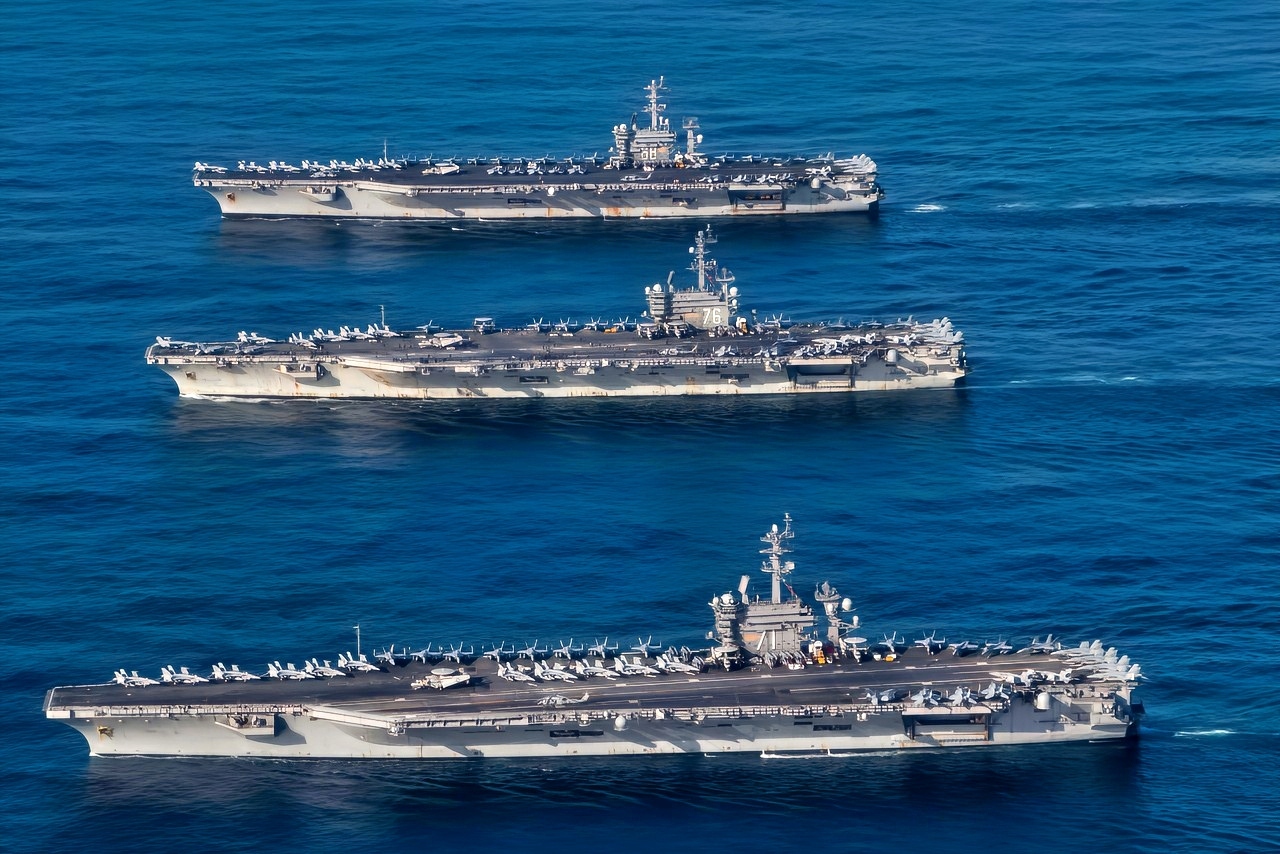
The U.S. Navy aircraft carriers USS Nimitz (CVN-68), USS Theodore Roosevelt (CVN-71) and USS Ronald Reagan (CVN-76) underway in the Western Pacific on 12 November 2017. The strike groups were underway and conducting operations in international waters as part of a three-carrier strike force exercise. This was the first time since August 2007 that three U.S. Navy carriers operated together. In 2007, USS Kitty Hawk (CV-63), USS Nimitz (CVN-68) and USS John C. Stennis (CVN-74) participated in exercise “Valiant Shield”.
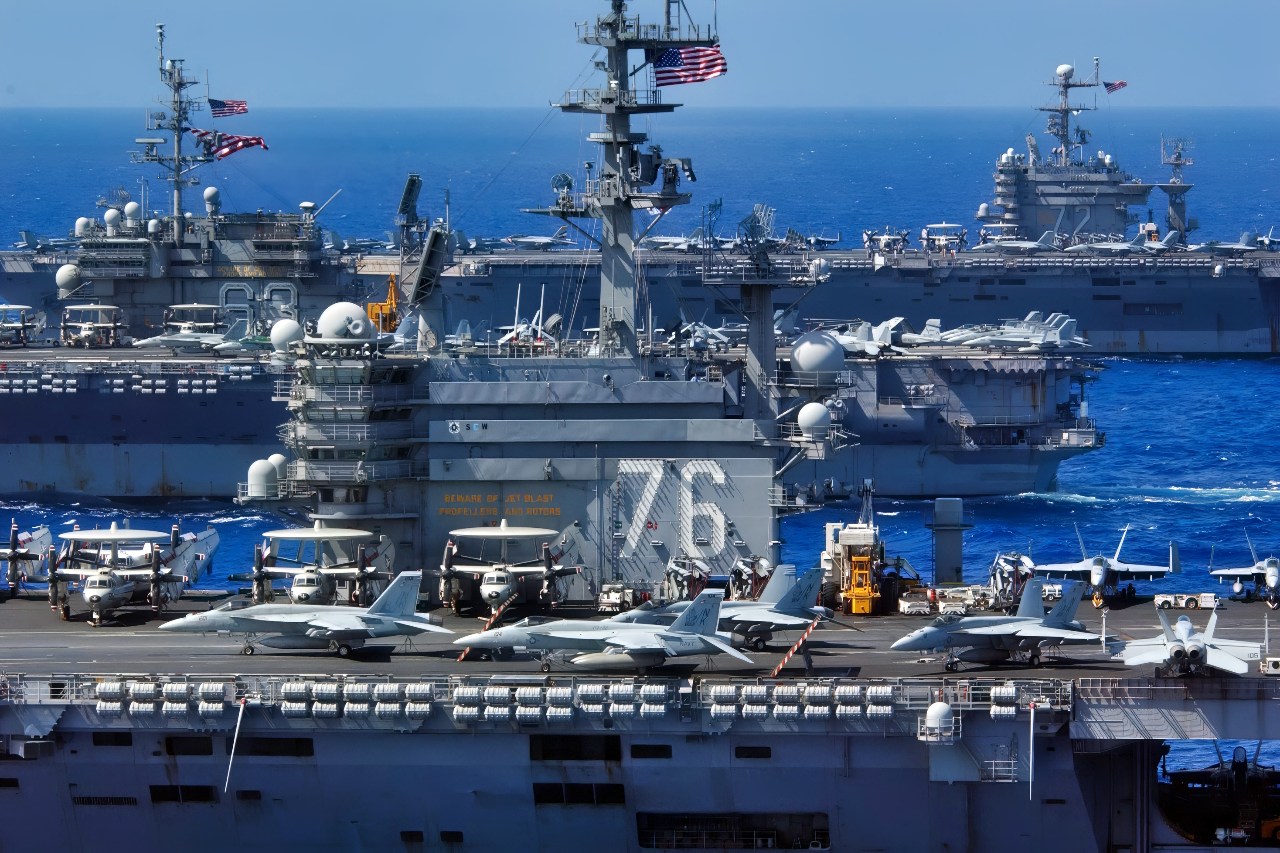
USS Ronald Reagan (CVN 76), USS Kitty Hawk (CV 63), and USS Abraham Lincoln (CVN 72) cruise side-by-side in the Philippine Sea June 18, 2006, during exercise Valiant Shield 2006. The joint exercise consists of 28 naval vessels, more than 300 aircraft, and approximately 20,000 service members from the Navy, Army, Air Force, Marine Corps and Coast Guard. (U.S. Navy photo by Chief Photographer’s Mate Spike Call) (Released)
After nearly a decade tied up at a Philadelphia inactive-ship facility, she was towed out in April 2005 for a classified sinking exercise, the first time the service had ever subjected a full-size carrier to live-fire survivability testing.
The attack followed a deliberate sequence designed to wring out data rather than to sink the ship quickly. The Navy began with underwater explosive charges to simulate torpedo strikes against the hull below the waterline, then sent aircraft to fire missiles and drop bombs onto the flight deck and structure, and only after all of that failed to finish her did the Navy resort to scuttling charges placed on board. She finally went down in May 2005.
It was the first aircraft carrier sent to the bottom since the Second World War and remains the only supercarrier ever sunk, by accident or design, anywhere in the world.
Why The USS America Test Flatters The Modern Supercarrier
The four-week ordeal is often cited as proof that carriers are nearly unsinkable, and the toughness it demonstrated was genuine.
But the conditions of the test flatter the ship in ways that matter enormously. The USS America was a stationary, unmanned hulk. No crew fought the fires, shored the bulkheads, or counter-flooded to keep her level, and no escorts intercepted a single incoming weapon.
The exercise was a slow, methodical study conducted to gather data rather than a concentrated assault under combat conditions, and a two-decade-old test against a 1960s conventionally powered design tells us little about how a carrier fares against today’s hypersonic and mass-produced anti-ship missiles.
The USS America proved that a carrier can soak up extraordinary punishment. It did not prove that a carrier could do so while being hunted.
Sinking A Nimitz Supercarrier Versus Mission-Killing It
The most important insight from the America’s long death is that sinking a carrier may be the wrong goal to begin with.
An aircraft carrier is valuable for one reason: it is a floating airfield that launches and recovers a powerful air wing. Crater its flight deck, jam its catapults and arresting gear, or knock out its island and radars, and the ship becomes useless as an airbase even if it remains afloat and underway. That outcome, what the military calls a mission kill, can be achieved with a fraction of the damage required to actually sink a carrier.
This reframes the entire question. An adversary does not need to replicate four weeks of explosives to defeat a carrier strike group. It needs to land enough well-placed hits to stop flight operations, and against a ship that costs over thirteen billion dollars and carries thousands of sailors, even a mission-kill is a strategic catastrophe.
The distinction between sinking and mission-killing is the difference between a near-impossible task and a merely very difficult one.
The DF-21D, DF-26, And China’s Carrier-Killers
This is precisely the gap China has spent two decades engineering weapons to exploit. The People’s Liberation Army fields a family of anti-ship ballistic missiles built expressly to threaten American carriers, led by the DF-21D, nicknamed the “carrier killer,” and the longer-range DF-26 “Guam killer.” More recently, the Pentagon has assessed that China fielded the DF-27, an anti-ship system able to threaten ships at intercontinental distances that pushes the danger toward the American West Coast.
The ballistic threat is only one layer. China is estimated to field up to 600 hypersonic weapons that maneuver in flight to defeat interceptors built for predictable arcs, and its doctrine pairs cheap missiles fired in bulk to soak up a defender’s interceptors with advanced systems that slip through the gaps.
Add submarine-launched torpedoes designed to break a keel from below, and the modern carrier faces a converging set of threats arriving from the air, the surface, and beneath the waves at once, all aimed less at sinking the ship outright than at landing the handful of hits that end flight operations.
The Aegis Shield Around A Ford-Class Carrier
A modern aircraft carrier, though, is nothing like the silent hulk the Navy bombarded off the Atlantic coast.
A Nimitz- or Ford-class ship is nuclear-powered, far more heavily compartmentalized, and crewed by thousands of sailors trained to fight damage as it happens. It never sails alone. It sits at the center of a strike group whose escorting destroyers form a layered defensive screen, each Arleigh Burke carrying 96 vertical launch cells that can hold a mix of weapons, including the SM-2 for area air defense and the SM-3 for intercepting ballistic missiles outside the atmosphere.
That magazine is the catch, and it ties directly to why saturation matters. Those launch cells hold a mix of weapons, and every tube loaded with a land-attack or anti-submarine weapon is one not available to shoot down an incoming missile, while the supply of interceptors aboard the screen is finite and cannot be reloaded at sea. The shield is formidable, but it is not bottomless, which is the entire logic behind throwing more missiles at it than it can engage.
Damage, Don’t Destroy, U.S. Navy Aircraft Carriers in a War Is the Lesson
The honest answer to what it would take to sink an American carrier, then, has two halves. Sending a modern supercarrier to the bottom outright remains one of the hardest tasks in warfare, a feat that took the Navy four weeks against a ship that could not even fight back. But putting one out of the fight is a different and far more achievable goal, and it is the one every modern anti-ship arsenal is actually built to accomplish, by overwhelming the screen long enough to land the blows that turn a floating airfield into a drifting target. The aircraft carrier is not totally obsolete, and it is not easily killed. It is, however, no longer the invulnerable fortress the four-week struggle to sink the USS America once seemed to suggest.
About the Author: Harry J. Kazianis
Harry J. Kazianis (@Grecianformula) was the former Senior Director of National Security Affairs at the Center for the National Interest (CFTNI), a foreign policy think tank founded by Richard Nixon based in Washington, DC. Harry has over a decade of experience in think tanks and national security publishing. His ideas have been published in the NY Times, The Washington Post, The Wall Street Journal, CNN, and many other outlets worldwide. He has held positions at CSIS, the Heritage Foundation, the University of Nottingham, and several other institutions related to national security research and studies. He is the former Executive Editor of the National Interest and the Diplomat. He holds a Master’s degree focusing on international affairs from Harvard University.


