

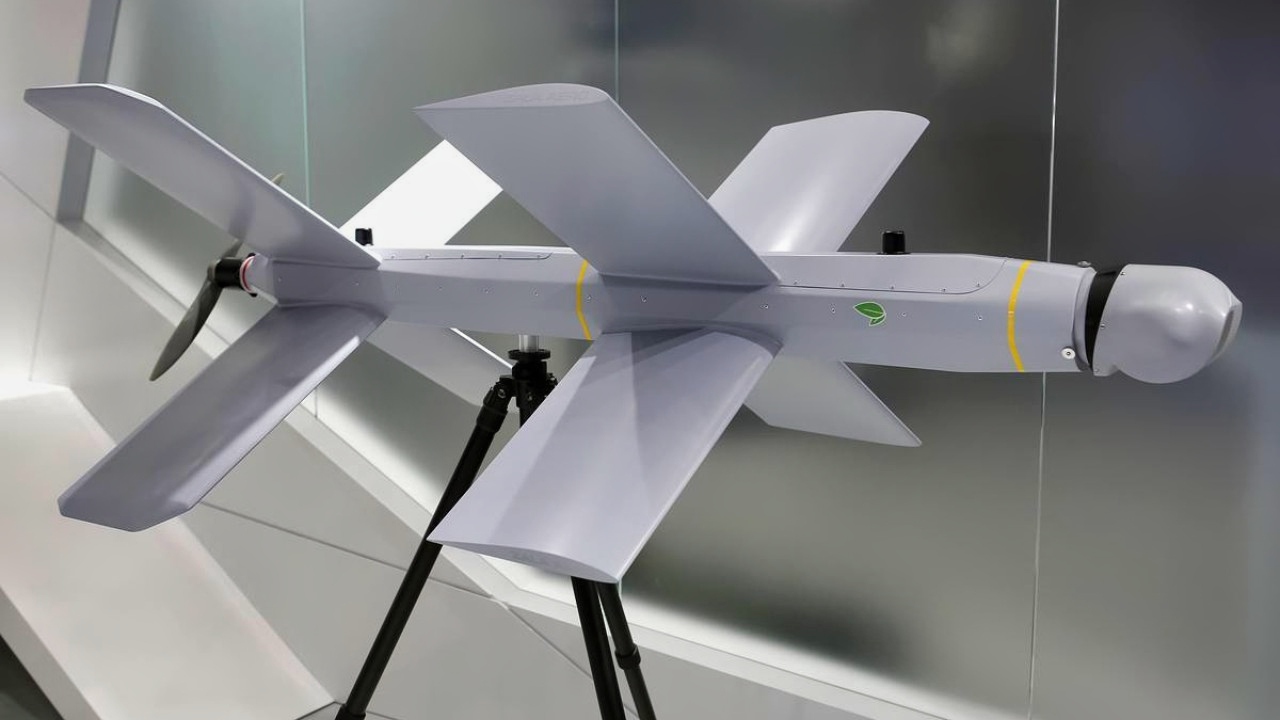
The Russians have been hammered by Ukrainian drone attacks against their energy infrastructure. Additionally, Ukrainian interceptor drones have been very effective in shooting down Russian Shahed drones.
In response, Russia has stepped up attacks against Ukrainian civilian targets using jet-powered drones. These new drones, known as the Geran-3, Geran-4, and Geran-5, are proving much harder to bring down.

Iran’s Drones That Russia Is Using. Image Credit: Creative Commons.
Russia has been using the Geran-3 since last year, but the newer Geran-4 has only recently appeared on the battlefield. These have a range of over 1,000 kilometers and are equipped with a much larger warhead.
The New Geran-4 Drone, Powered By Chinese Engines
The Geran-4 is a jet-powered kamikaze drone that Russia first deployed in combat in May 2026.
Designed as a countermeasure against Ukrainian interceptor drones, it features a purpose-built, reinforced airframe and Chinese-made turbojet engines, enabling much faster, high-G evasive maneuvers than older propeller-driven models.
Geran-4 drones cruise at about 300 km/h and reach a top speed of about 500 km/h (311 mph). The drone has a range of 450-850 km and carries either a 50 kg high-explosive/thermobaric payload or an enlarged 90 kg thermobaric payload.
The drone uses two types of Chinese-made turbojet engines in the drone: the Telefly LX-WP-160 and the Telefly TF-TJ2000A, the latter previously identified for use in the “Geran-5” model.
Most concerning for Ukrainian military members is the amount of Western components found in the Geran-4. Although most components are made in China, some originate from the United Kingdom, the United States, Germany, Switzerland, Japan, and Taiwan.
The Geran-4 operates at altitudes of up to 5,000 meters (16,404 feet). Russia developed the drone to counter Ukraine’s highly effective but propeller-powered Sting drones. In response, Ukrainian defenses have upgraded their interceptors with chemical accelerators to track and neutralize these jets.
Drone Warfare Constantly Evolving In Ukraine
Ukraine’s Commander in Chief of the Armed Forces, Oleksandr Syrskyi, warned that Russia aims to increase the share of jet-powered drones in its bombing campaign up to 50 percent. “The enemy is constantly changing tactics, increasing the number of drones and improving their quality,” he said.
Drone war technology changes very quickly, and updates are necessary as each side seeks an advantage. The Russians have been scrambling for answers since Ukraine’s interception rate of Russian strike drones doubled during the first four months of 2026, according to Ukrainian Defense Minister Mykhailo Fedorov.
“We continue to build up the ‘small’ air defense system, thanks to which the interception rate of Shaheds has significantly improved,” Fedorov said, according to Interfax. “The percentage of Shaheds shot down by interceptor drones has increased twofold over the last four months.”
Using “Sting” interceptor drones, Ukrainian operators have been getting very adept at intercepting Shahed drones at long ranges, even a couple of jet-powered Shaheds.
“They’ve proven themselves exceptionally well. We have no complaints at all. We’ve flown them in minus 30 degrees. Out of ten sorties, we achieve about a 95% success rate. At most, we lose one drone out of ten,” the crew said.
However, the increasing use of jet-powered drones will now require further innovations from the Ukrainian side.
Drone Usage Is Vastly Increasing On Both Sides
Despite Russian defense manufacturing struggling to produce enough aircraft, armored vehicles, and other combat equipment, drone manufacturing is booming.
Drone output, including UAV systems, rose by 117 percent since last April, while overall production growth averaged 68 percent in 2025, according to Russian statistics.
Ukrainian intelligence estimates suggest Russia will produce as many as 7.3 million FPV drones and 7.8 million combat drone units by 2026, up from 1.4 million drones in all of 2024, according to an article in the Kyiv Post.
Ukraine Has Its Own Jet-Powered Drone
A Ukrainian long-range drone appeared in Russia in early 2024. A crashed example of the jet-powered drone was shared on Russian social media. It is evidently a type of one-way kamikaze attack drone, and is known as “The Bullet.”
It is unknown, but it is believed that the jet drone has been in service for some time; this is simply the first reported example. This drone is powered by a single German-made JetCat P400-PRO commercial micro turbojet.
The drone has a delta wing configuration with a single vertical tail. It is similar in size to other one-way attack drones.
Ukraine also used two types of jet-powered “missile drones” in its attacks on Russia and especially against Moscow.
The rate of development and usage of drones has been enormous in the war in Ukraine. Both sides are continually trying to upgrade and outperform the other. But ultimately, it is the civilians who pay the price in these attacks.
About the Author: Steve Balestrieri
Steve Balestrieri is a National Security Columnist. He served as a US Army Special Forces NCO and Warrant Officer. In addition to writing on defense, he covers the NFL for PatsFans.com and is a member of the Pro Football Writers of America (PFWA). His work was regularly featured in many military publications.


