


President Donald J. Trump declared this morning that the United States will hit Iran “VERY HARD TONIGHT” for a third consecutive night, and then went further than he has at any point in this 103-day war: “We will be taking Kharg Island, and other oil infrastructure points, and assume total control of their Oil and Gas Markets,” in what seems to be citing Venezuela as the model. Set aside the bravado and take the proposal seriously, because the military planning has reportedly been live for months. Seizing Kharg would work, briefly, and then it would become the worst American position on earth.
Taking Kharg Island Is The Easy Part

U.S. Marine Corps Lance Cpl. Dylan Butler, left, a machine gunner, and Cpl. Gevorg Hovasafyan, a section leader, both with 3rd Battalion, 7th Marine Regiment, 1st Marine Division, carry an M2 .50-caliber heavy machine gun during Range 400 at Marine Corps Air-Ground Combat Center Twentynine Palms, California, Oct. 25, 2025. Range 400 is a dynamic live-fire range that allows companies to rehearse tactics and procedures for attacking fortified areas. (U.S. Marine Corps photo by Sgt. Juan Torres)

A U.S. Marine with Combat Logistics Battalion 2, Combat Logistics Regiment 2, 2nd Marine Logistics Group, posts security at the Infantry Immersion Trainer at Marine Corps Base Camp Lejeune, North Carolina, Nov. 21, 2025. The IIT is a facility which provides an urban training environment for Marines and Sailors, aiding in increasing combat efficiency by training in realistic conditions. (U.S. Marine Corps photo by Lance Cpl. Isabella Ramos)
Trump’s own parenthetical in this morning’s post — Iran’s navy, air force, radar, and air defenses are “GONE!” — is largely accurate, and it explains why the seizure itself would succeed.
Kharg sits roughly 25 kilometers off Iran’s coast, handles about 90 percent of the country’s crude exports, and has already been bombed twice in this war, with its defenses among the 90-plus military sites destroyed in March.
A Marine expeditionary unit could take it in a day against whatever remains.
Trump has wanted exactly this since 1988, when he told The Guardian that one bullet fired at an American would have him “do a number” on Kharg and go in and take it. Thirty-eight years later, nothing stands between that ambition and doing it.
However, every factor that makes Kharg easy to take makes it impossible to hold.
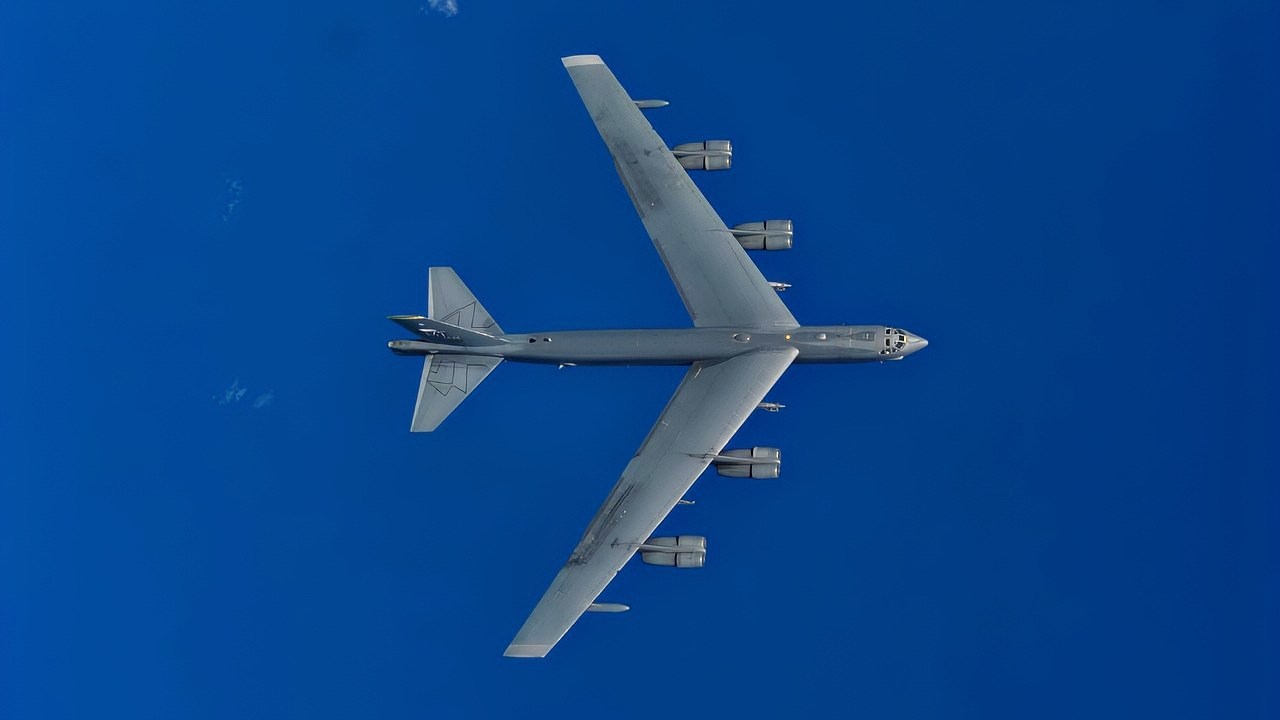
A B-52H Stratofortress from the 69th Bomb Squadron, Minot Air Force Base, N.D., flies over the Pacific Ocean during an international sinking exercise for Rim of the Pacific 2016 near Joint Base Pearl Harbor-Hickam, July 14, 2016. Twenty-six nations, more than 40 ships and submarines, more than 200 aircraft, and 25,000 personnel are participating in RIMPAC from June 30 to Aug. 4 in and around the Hawaiian Islands and Southern California. The world’s largest international maritime exercise, RIMPAC, provides a unique training opportunity that helps participants foster and sustain the cooperative relationships that are critical to ensuring the safety of sea lanes and security on the world’s oceans. RIMPAC 2016 is the 25th exercise in the series that began in 1971. (U.S. Air Force photo by Tech. Sgt. Aaron Oelrich/Released)
25 Kilometers From Iran: A Garrison Inside The Kill Zone
An American garrison on Kharg would sit within visual range of the Iranian mainland, inside the engagement envelope of every weapon Tehran has left — and the weapons Iran has left are precisely the cheap, numerous ones that survive air campaigns.
Coastal missile batteries hidden in the Zagros foothills. Ballistic missiles from deep inland. Shahed drones by the hundreds. FPV quadcopters across 25 kilometers of water, the same weapons that have made the Ukraine front uninhabitable.
Fast boats, frogmen, naval mines, and mortar teams on the shoreline. The IRGC attacked American bases across the region again last night, its second consecutive night, while supposedly beaten; a fixed American position on Iranian sovereign soil would receive that treatment daily, indefinitely, at point-blank range.
The arithmetic runs entirely in Iran’s favor. A Shahed costs a few tens of thousands of dollars; the interceptors defending a static garrison cost millions each, and this war has already burned through roughly half of America’s Patriot and THAAD stockpiles, with replacement timelines measured in years. Furthermore, a garrison solves Iran’s hardest military problem: targeting.

A Terminal High Altitude Area Defense (THAAD) interceptor is launched from the Pacific Spaceport Complex Alaska in Kodiak, Alaska, during Flight Experiment THAAD (FET)-01 on July 30, 2017 (EDT). During the test, the THAAD weapon system successfully intercepted an air-launched, medium-range ballistic missile (MRBM) target.
Tehran would know exactly where several thousand Americans were standing, every hour, forever. This entire escalation spiral began with a single downed Apache. Kharg would offer Iran an Apache every morning.
An Oil Terminal That Cannot Export Oil
The strategic prize evaporates on inspection. A terminal generates leverage only if oil flows through it, and oil flows require tankers, crews, and insurers willing to operate at a pier under daily rocket fire inside a closed Persian Gulf. Trump already boasted in March that American strikes had demolished most of the island while urging allies to send warships just to keep the Hormuz Strait passable.
Venezuela, his stated model, involves no occupation, no garrison, and no enemy shore within swimming distance. What America would actually hold is a smoking tank farm that produces nothing, costs a fortune to defend, and bleeds men for as long as any Iranian government refuses to legitimize its loss, which is to say, permanently. No government in Tehran, revolutionary or successor, signs a deal while a foreign power occupies the national patrimony. The seizure meant to force the agreement is the one act that makes the agreement impossible.
Just a Giant Mistake
White House officials tell reporters the strikes are meant to push Iran toward flexibility in the nuclear talks.
The threat may be exactly that — pressure, theater, an opening bid. If so, it should stay in the theater. Trump’s instinct throughout this war, to hit hard and keep the blows calibrated, served him better than his critics admit; the proportional response to the Apache proved it.
Occupying Kharg abandons that discipline for the one move with no off-ramp: a static American outpost in Iran’s kill zone, an oil hostage that cannot be ransomed, a deal rendered unsignable, and a war that stops being measured in nights of strikes and starts being measured in years of garrison casualties.
The president can have the island, or he can have the deal. He cannot have both, and only one of them ends the war.
About the Author: Harry J. Kazianis
Harry J. Kazianis (@Grecianformula) was the former Senior Director of National Security Affairs at the Center for the National Interest (CFTNI), a foreign policy think tank founded by Richard Nixon based in Washington, DC. Harry has over a decade of experience in think tanks and national security publishing. His ideas have been published in the NY Times, The Washington Post, The Wall Street Journal, CNN, and many other outlets worldwide. He has held positions at CSIS, the Heritage Foundation, the University of Nottingham, and several other institutions related to national security research and studies. He is the former Executive Editor of the National Interest and the Diplomat. He holds a Master’s degree focusing on international affairs from Harvard University.


yeye
June 11, 2026 at 3:49 pm
US president telangpu chuanpu will do anything, even kickstart ww3, in order to avoid getting grilled by the committee, never mind taking over kharg island.
Chuanpu ‘s name has been mentioned over a million time in the files, and therefore it’s impossible for the committee to pretend he was never involved in any shady shenanigan.
The US has been vacillating, or continuously changing its position on the iran war, due mainly or solely to chuanpu’s dilemma.
Should the president face the people on the subject of proving complete innocence, or should he continue to use the US military as a weapin to avoid scrutiny.
No prizes for guessing the correct answer.