

In January of this year, Iran’s regime faced its biggest protests in years as anger spread over spiraling prices and a crumbling economy. The regime murdered thousands in a vicious crackdown.
Now, despite its bellicose talk, the country’s military has been battered by war and suffocated by a U.S. naval blockade; the country is now in even worse shape economically as Washington has tried to negotiate with Tehran into a deal to reopen the Strait of Hormuz.
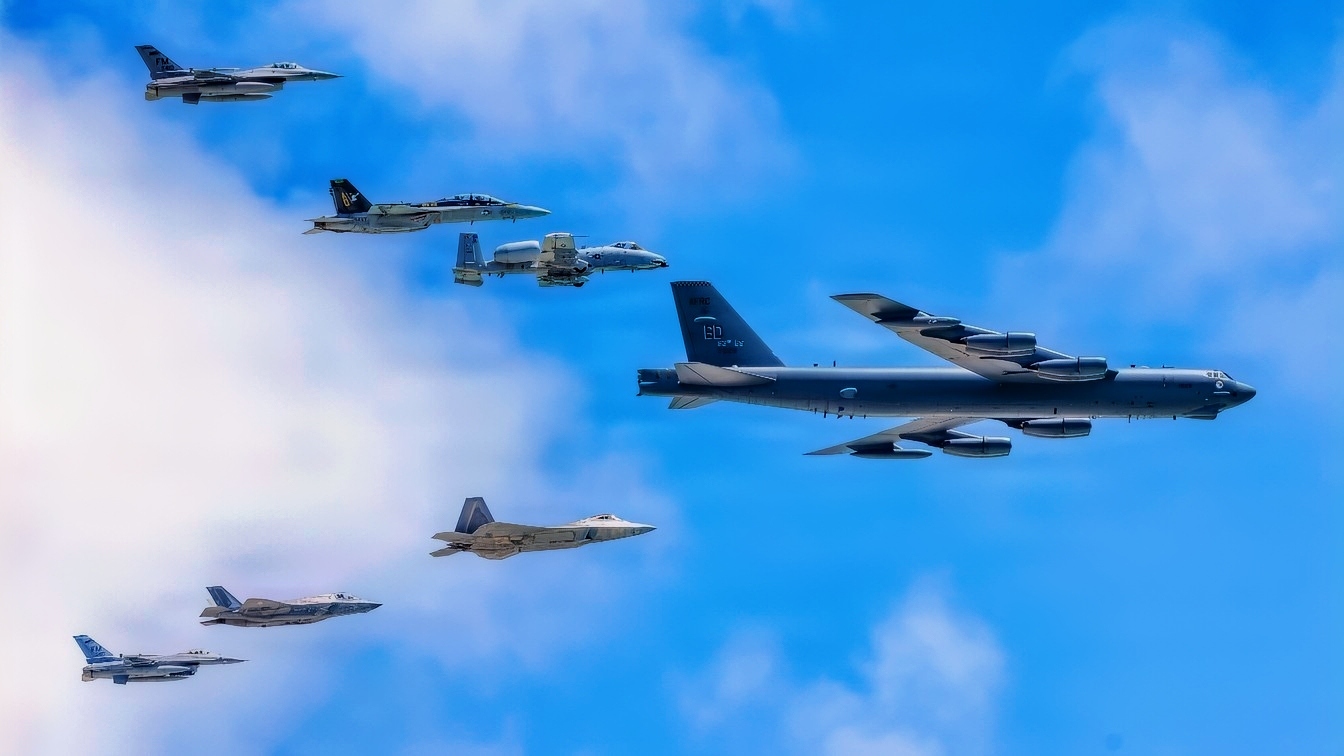
A B-52 Stratofortress leads a formation of a B-1 Lancer, A-10 Warthog, F-16 Fighting Falcon, F-18 Hornet, F-22 Raptor and F-35 Lightning, assigned to Air Combat Command and Global Strike Command, during the Hyundai Air and Sea show at Miami, Florida, May 23, 2026. Each aircraft played a unique role in demonstrating the comprehensive reach of the U.S. Air Force, from legacy bombers to cutting-edge fifth-generation fighters. Known as the Arsenal of Freedom Formation, the event underscored the Air Force’s capability to project force anywhere, anytime, as a key component of national defense. (U.S. Air Force photo by Staff Sgt. Lauren Diaz)
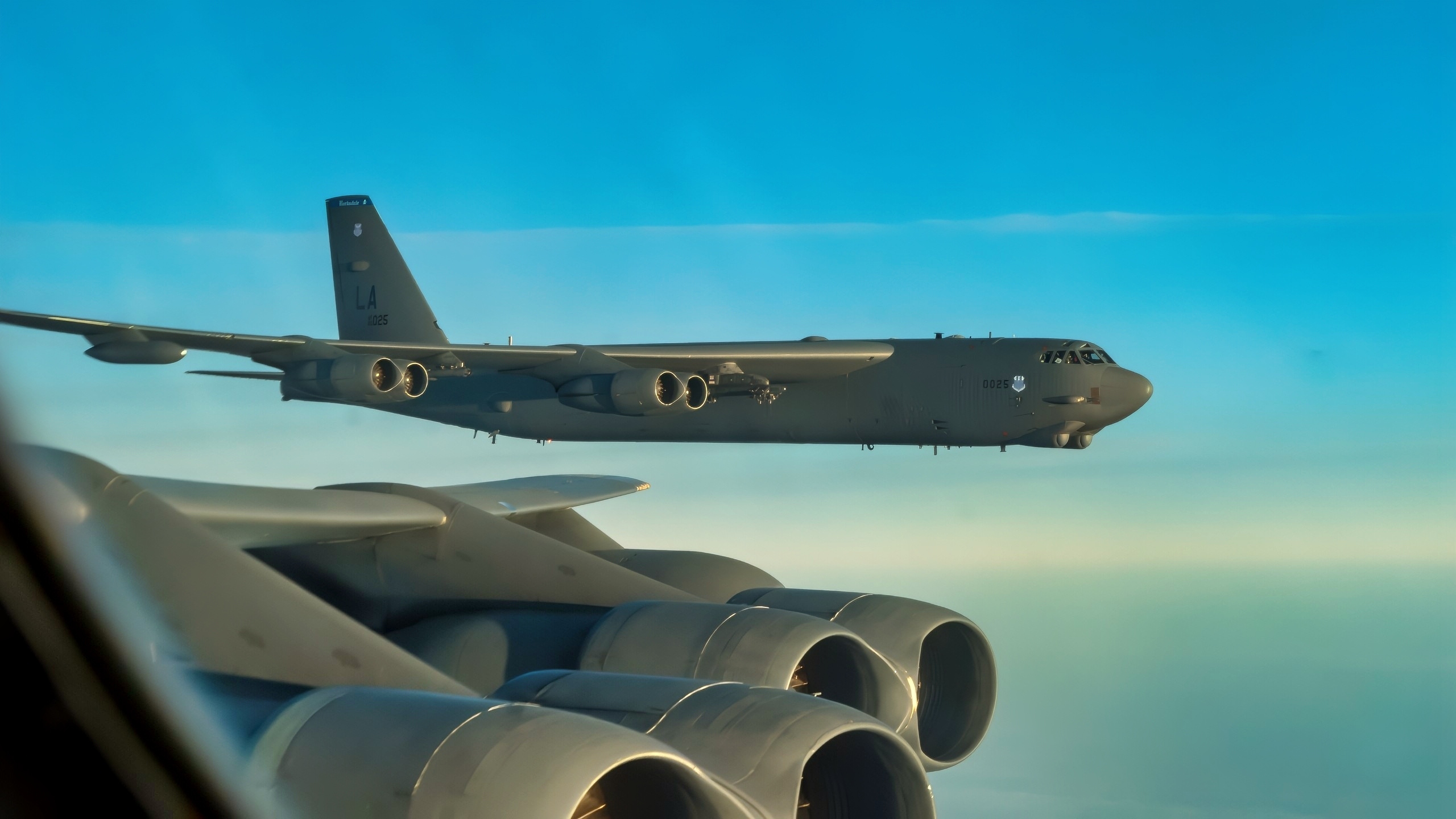
Two B-52 Stratofortresses assigned to the 2nd Bomb Wing from Barksdale Air Force Base, Louisiana fly in a formation after completing missions over the Baltic Sea for Bomber Task Force Europe 20-1, Oct. 23, 2019. This deployment allows aircrews and support personnel to conduct theater integration and improve bomber interoperability with joint partners and allied nations. (U.S. Air Force photo by SSgt. Trevor T. McBride)
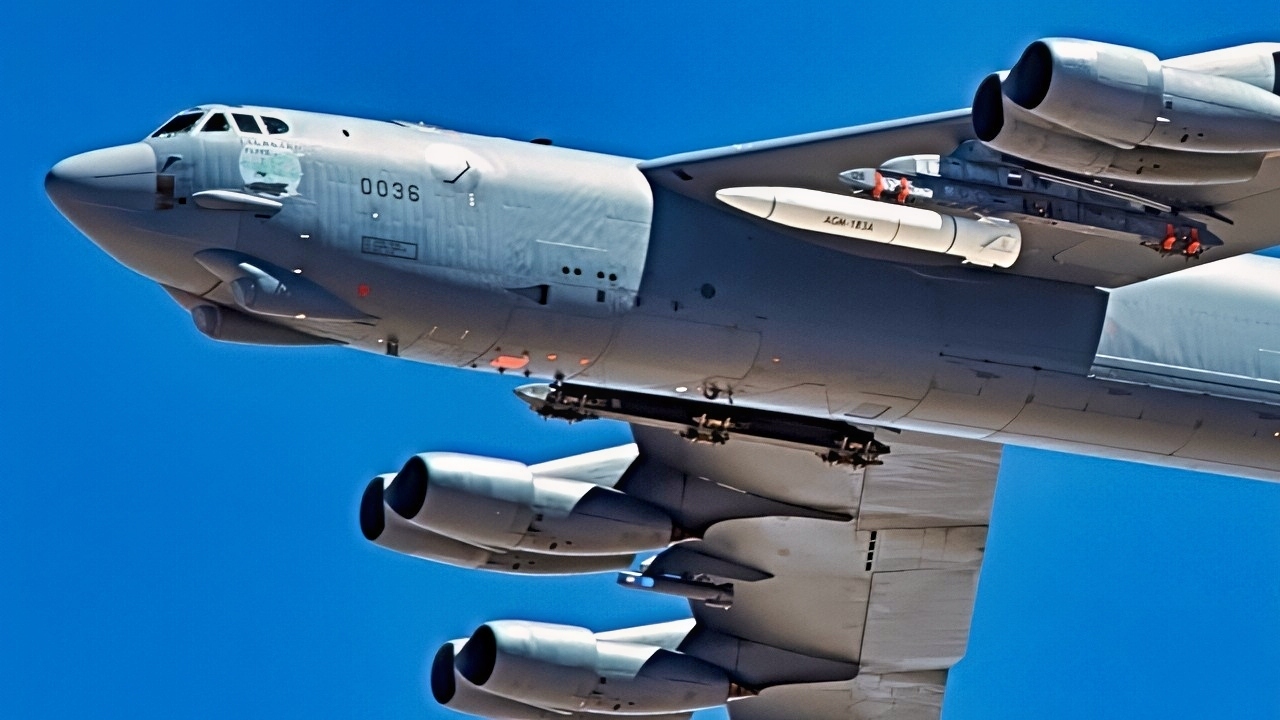
EDWARDS AIR FORCE BASE, Calif. (June 12, 2019) B-52 out of EDW carries ARRW IMV asset for its first captive carry flight over Edwards Air Force Base. (U.S. Air Force photo by Christopher Okula)
The Middle East Institute reported that Tehran says the war has caused roughly $270 billion in damage, equivalent to around 57 percent of its GDP, suggesting its recovery will take many years.
Each additional month that the war continues could set the Iranian economy back by more than five years, reflecting the compounding impact on capital stock and productivity.
Iranian Parliament Speaker Mohammad Bagher Ghalibaf recently made headlines by stating, “We prefer the language of diplomacy, but we speak other languages far more fluently.”
But how much longer can the tough-talking regime withstand the economic hardships with an already fragile, shattered economy?
After decades of chanting “Death To America”, “Death To Israel,” the regime has to face its choices. Iran’s economy is not collapsing because of Israel or the United States.
The economy is suffering because the Islamic Republic chose jihad over jobs, centrifuges over citizens, and terror proxies over food for the people.
Iran Is Structured To Endure Economic Pressure
Tehran’s government uses specialized avoidance tactics to survive, meaning economic strain increases hardship rather than triggering a regime collapse.
The Iranians have been under sanctions for years and have structured highly sophisticated informal trade networks and back-door oil deals with China, using alternative land routes that have allowed them to circumvent the blockade to some extent and keep the economy afloat.
The regime is perfectly willing to let the population suffer to ensure that the regime retains its power.
Economic Pressure Is Rising, However
Iran’s already stretched-thin economy is teetering amid severe economic hardship. Inflation in April was running at a soaring 67 percent, the highest rate since World War II, while inflation in basic goods and food rose by 115.4 percent in April and May.
The International Monetary Fund projects that inflation for 2026 will top 68.9 percent, while the country’s nominal GDP will fall by $300 billion.
The compounding effects of strikes, supply shortages, and international blockades have left as many as two million Iranians out of work. Hundreds of thousands have applied for unemployment benefits, which the regime is finding increasingly harder to pay. The system is so overworked that it keeps crashing.
The prices for solid vegetable oil have risen 374 percent, and premium rice has risen 208 percent since May of last year.
Seaborne trade has dried up, and the regime cannot currently pay its troops. The Iranian rial is dropping to historic lows.
Although the price of Iranian oil has surged in international markets, production has declined. According to OPEC assessments, the price of Iranian oil rose by nearly 86 percent last month to over $124 per barrel; however, daily output fell by around 182,000 barrels as the blockade has left the regime with full storage tanks and nowhere to sell them.
Iran has been trying to circumvent the blockade by using rail lines to ship oil to China via Pakistan and the Caspian Sea, but those routes are less efficient than sea routes through the Strait and are targets for interdiction if the air campaign is fully restarted.
The US Continues To Limit Any Strikes To Military Targets
The US has kept strikes “limited”; operations are typically designed to degrade specific capabilities without restarting a full-scale air campaign.
Targets have included Iranian radar installations, drone and missile launch sites, fast boats laying naval mines, and select nuclear infrastructure.
But the US has not targeted any civilian infrastructure. However, Strategic Resource Interdiction operations are a definite possibility. Conducting operations against critical Iranian infrastructure—such as the primary oil export terminals on Kharg Island—to sever the nation’s primary revenue source and force concessions.
Kharg Island handles nearly 90 percent of Iran’s crude oil exports; it acts as the primary lifeline for the Iranian economy, making it a critical hub for any interdiction campaign. If the US feels that it could cripple the regime, it may rethink this strategy.
While U.S. forces have repeatedly struck military targets on Kharg Island, seizing or destroying its economic lifeblood could push Iran to an existential breaking point. The US has not attempted to destroy the island’s oil facilities to prevent global oil prices from skyrocketing, and the president has made it clear he wants Iran in the future to be able to trade in oil, just not the current regime.
Iran’s Threats To Close The Strait Of Hormuz Are Ruinous To Them
While the global economy has felt the pinch and inflation inside the United States has risen since the Strait of Hormuz was closed, it is Iran that is actually feeling the brunt of its actions.
“Miad Maleki, a senior fellow at the Foundation for Defense of Democracies and a former senior sanctions strategist at the US Treasury, said Iran had spent decades threatening to close the Strait of Hormuz but had never prepared its own economy for the consequences, including the naval blockade.”
“If we’re at the point that we have to close the Strait of Hormuz, can our own economy handle $455 million a day in trade that we have to rely on going through the Strait of Hormuz?” Maleki said.
“The clock is much faster on Iran’s economy side than it is on our own side,” Maleki said. “But we know historically that the Iranian regime doesn’t really care to the extent that Iranians are starved or dealing with major economic issues.”
The regime and the economy are not yet at the point of collapse, but now that they’ve stopped paying their own troops, they are quickly nearing it.
About the Author: Steve Balestrieri
Steve Balestrieri is a National Security Columnist. He served as a US Army Special Forces NCO and Warrant Officer. In addition to writing on defense, he covers the NFL for PatsFans.com and is a member of the Pro Football Writers of America (PFWA). His work was regularly featured in many military publications.


