

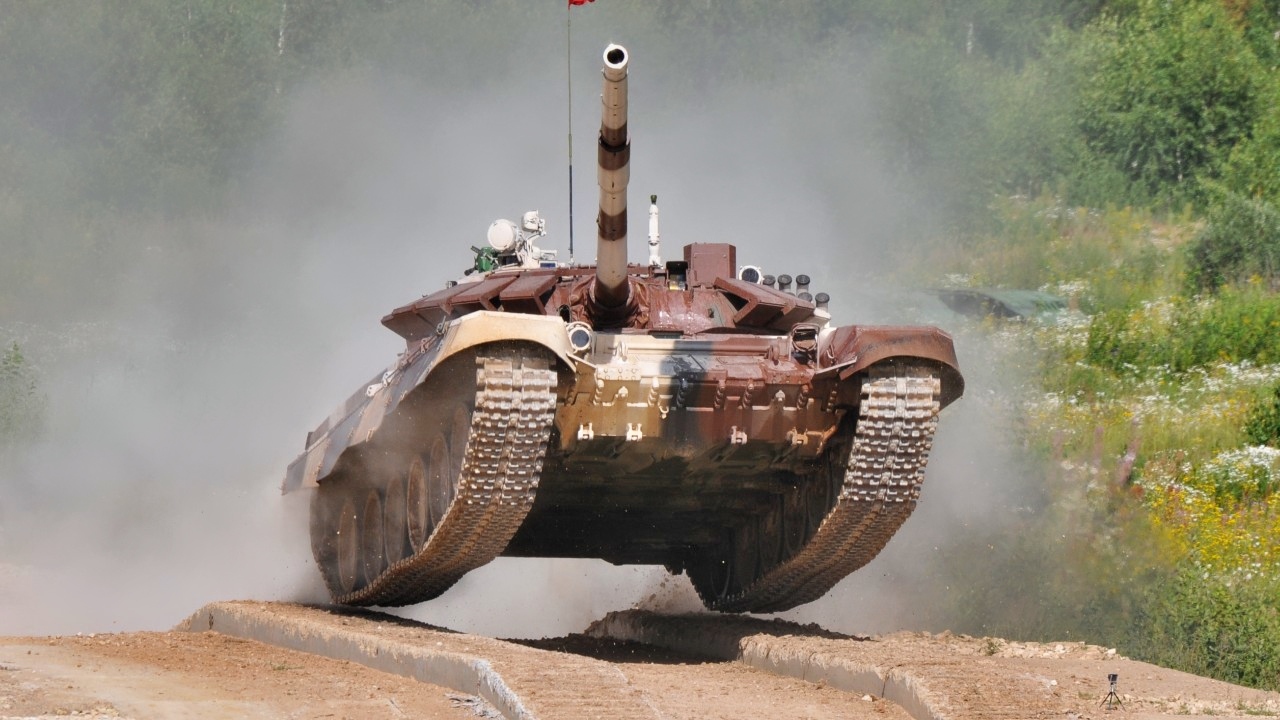
After four years of brutal attrition, the war in Ukraine has taken its toll on Moscow’s armored reserves, with the majority of its pre-war Soviet-era stocks now seemingly depleted.
According to some reports, Russia’s old stocks, which numbered between 10,000 and 20,000 prior to the war, now consist of around 2,000 mothballed tanks in poor condition.
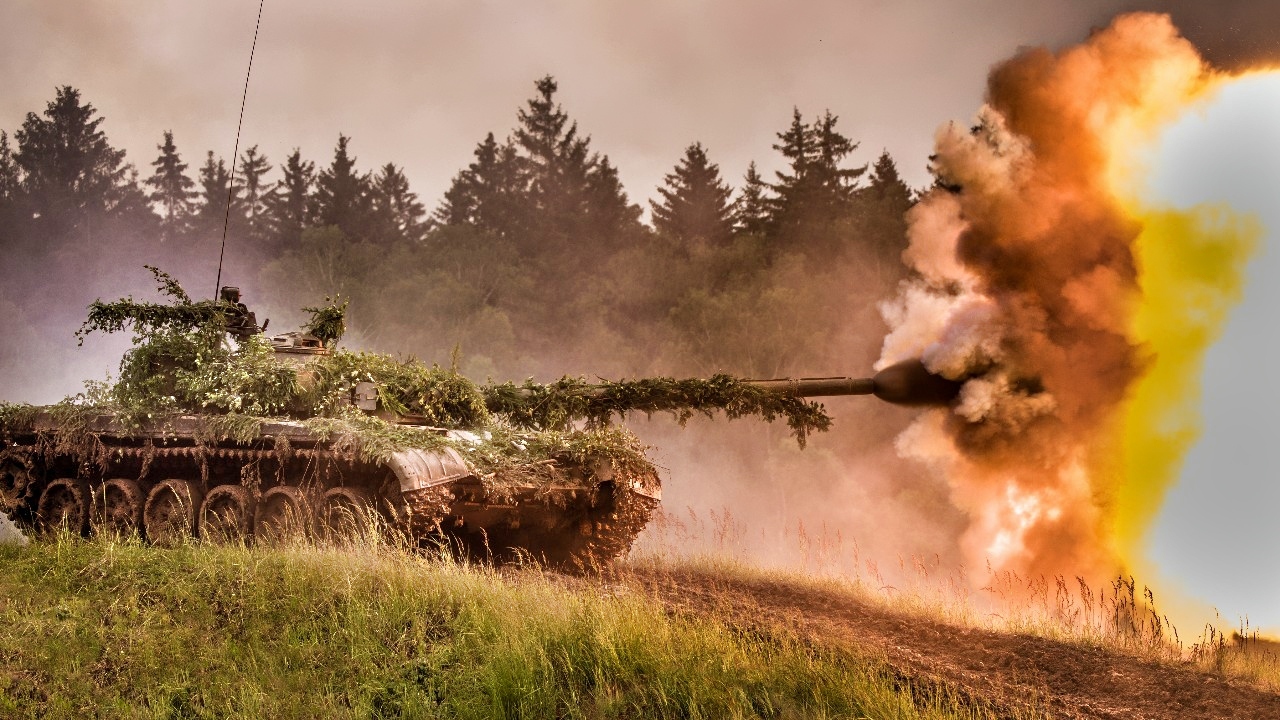
T-72 Like Those Fighting in Ukraine.
Even with Russian tank factories maintaining a steady stream of new tanks, there is growing concern that efforts to ramp up production may fail to meet the Russian Army’s needs.
Furthermore, there remains ambiguity about the role of tanks in this new era of drone-centric warfare.
Russia’s Soviet Tank Stocks are Finally Drying Up
According to new satellite imagery of Russia’s tank stocks, Russia retains only around 2,088 tanks in its old Soviet-era storage sites.
These stocks include older models such as T-54/55s, T-62s, T-72s, and T-80s. These old stocks are among the oldest and most dilapidated in Moscow’s tank forces, but can be easily and cheaply refurbished at factories.
Russia’s Soviet-era tank stocks were instrumental in cushioning the initial blow suffered in the initial months of the war in Ukraine, when Moscow’s tank losses were at their all-time high.
Now, these stocks are nearing depletion, forcing Russia to rely primarily on newly built models, which take considerably more time and cost considerably more to produce.
Since the beginning of the war in 2022, Western news sources have claimed that Russia has effectively run out of tanks.
Now, however, it looks as if Russia’s stock of older Soviet tanks may be nearing its end as the war continues in its fourth consecutive year.
To compensate for the rise in demand, Russia’s tank factories have ramped up production to around 300-500 tanks per year, roughly triple the number of tanks produced in 2021.
This is a far cry from the 4,000 tanks the Soviet Union produced during the 1980s; however, it is more than Europe can produce in its current state.
Despite four years of war, production has scaled up slowly, with the goal of reaching 1,000 new T-90Ms produced per year by 2028.

T-90 Tank from Ukraine War. Image Credit: Creative Commons.
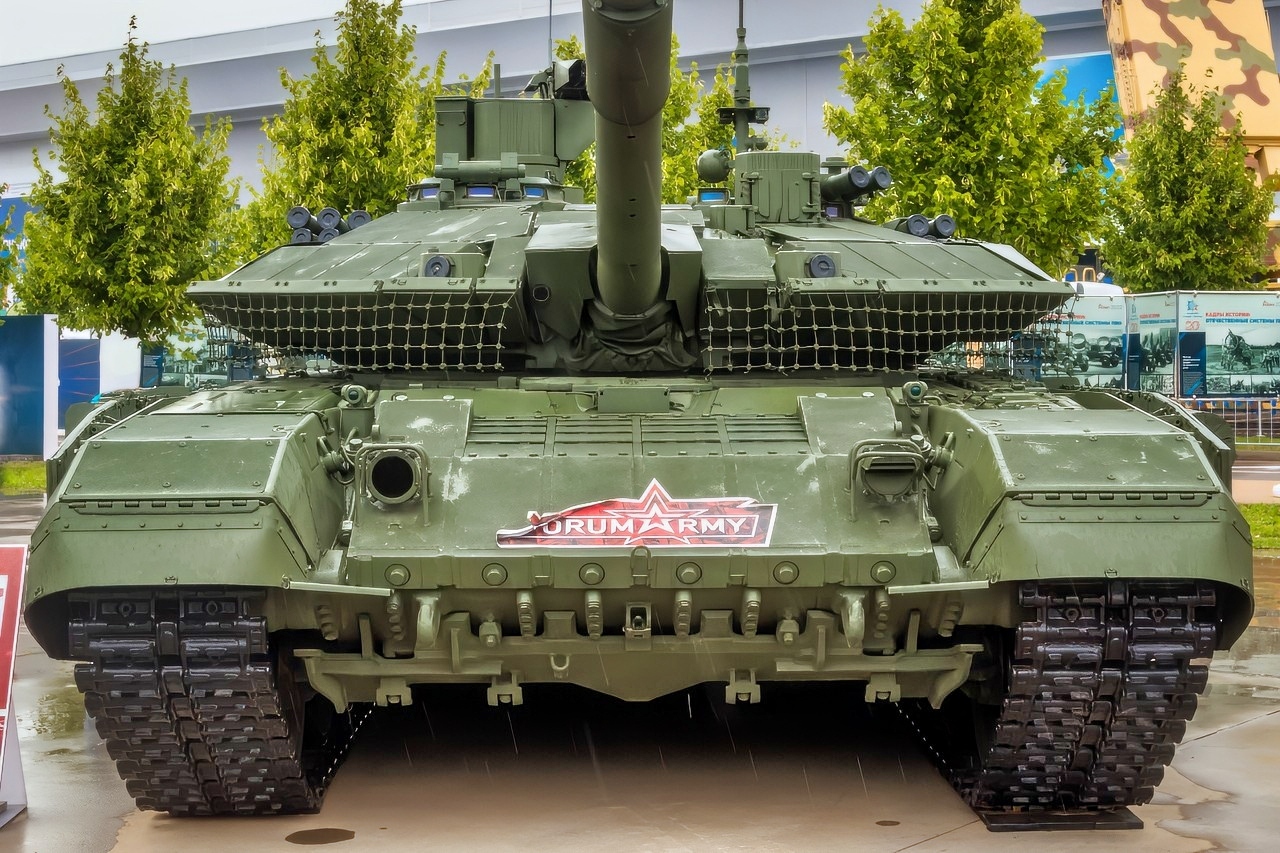
T-90M Russian Army. Image Credit: Creative Commons.
Ukraine War Problems for Russia and Pre-war Tank Stocks
At the collapse of the Soviet Union, Moscow inherited an enormous pool of armored vehicles, with some estimates reaching as high as 40,000, although only a fraction of these were retained in active service or long-term storage after the economic collapse and disarmament processes of the 1990s.
In the 90s and early 2000s, Russia, at the behest of the U.S., scrapped many of its Soviet stocks, losing around two-thirds of its entire inventory.
Since Putin came to power, Russia’s domestic military policy has been to reverse the damage done by deindustrialization and rebuild its stocks to Cold War levels.
By the eve of the Ukraine war, most credible open-source estimates placed Russia’s stored tank inventory at roughly 7,000 to 20,000 vehicles, composed largely of Cold War models such as the T‑72, T‑80, T‑62, and older T‑54/55s.
This stockpile provided a deep reserve of armored platforms, but even from the outset, these tanks varied in usability, with some models relatively well preserved and others more derelict after decades of exposure to the elements.
Even today, among the models still available in Moscow’s inventories, it is unknown which vehicles can be refurbished and which are beyond repair.
After the war broke out, reports indicated that some 4,000 models were relocated from deep storage to the factories for refurbishment.
Since then, Moscow’s stock has been slowly but steadily decreasing as the conflict has dragged on.
As higher-quality reserves have been depleted, Russia has increasingly turned to older and less capable Soviet designs.
Tanks such as the T‑62 and even the T‑55, whose origins date to the early 50s, have been reactivated and deployed.
Lacking modern thermal sights and fire control systems, these tanks are not used in breakout roles as modern MBTs usually are, but are instead relegated to indirect fire support roles.
In some cases, older T-55s have performed better than some dedicated infantry support vehicles like the BMP-2, which have thinner armor and considerably lighter armaments.
Still No Answer to the Drone Problem
What’s more interesting is that Moscow has seemingly deployed its tanks in smaller numbers recently. From January through the end of May, only 43 Russian tanks have been visually confirmed damaged or destroyed.
This represents a significant drop in tank casualties, especially when compared to 2022 and 2023.
This is not because Moscow is running out of tanks; in fact, reports suggest that most newer tank models are not being sent to Ukraine at all, instead remaining in reserve units nowhere near the front.
Rather, I suspect Russia is waiting to deploy its armored forces in large numbers until reliable anti-drone measures are developed.
It is unlikely that the Army is massing its tanks for a large offensive across Ukraine; instead, neither side seems to know what to do with its tanks aside from using them for indirect fire support.
The war in Ukraine has forced militaries all across the world to rethink their assumptions on armored assaults.
With the widespread adoption of drones, the old paradigm of armored maneuver and exploitation no longer works.
The tank is not irrelevant in this new environment, but its role on the battlefield is being actively revised as Russia and Ukraine struggle to figure out what works and what doesn’t.
Some experts have surmised that unnamed armored vehicles will replace tanks as the breakout weapon of choice, with tanks being used for clearing operations and fire support.
Regardless of the outcome, the value of a mobile 125mm cannon is unlikely to go away anytime soon.
About the Author: Isaac Seitz
Isaac Seitz, a Defense Columnist, graduated from Patrick Henry College’s Strategic Intelligence and National Security program. He has also studied Russian at Middlebury Language Schools and has worked as an intelligence Analyst in the private sector.


