


On Tuesday, 16 June, a Russian warship fired warning shots at a private, unarmed yacht in the English Channel.
It was crewed by two British retirees, who posed no danger at all, but appeared to be the latest victims of a new escalation in tensions between London and Moscow.
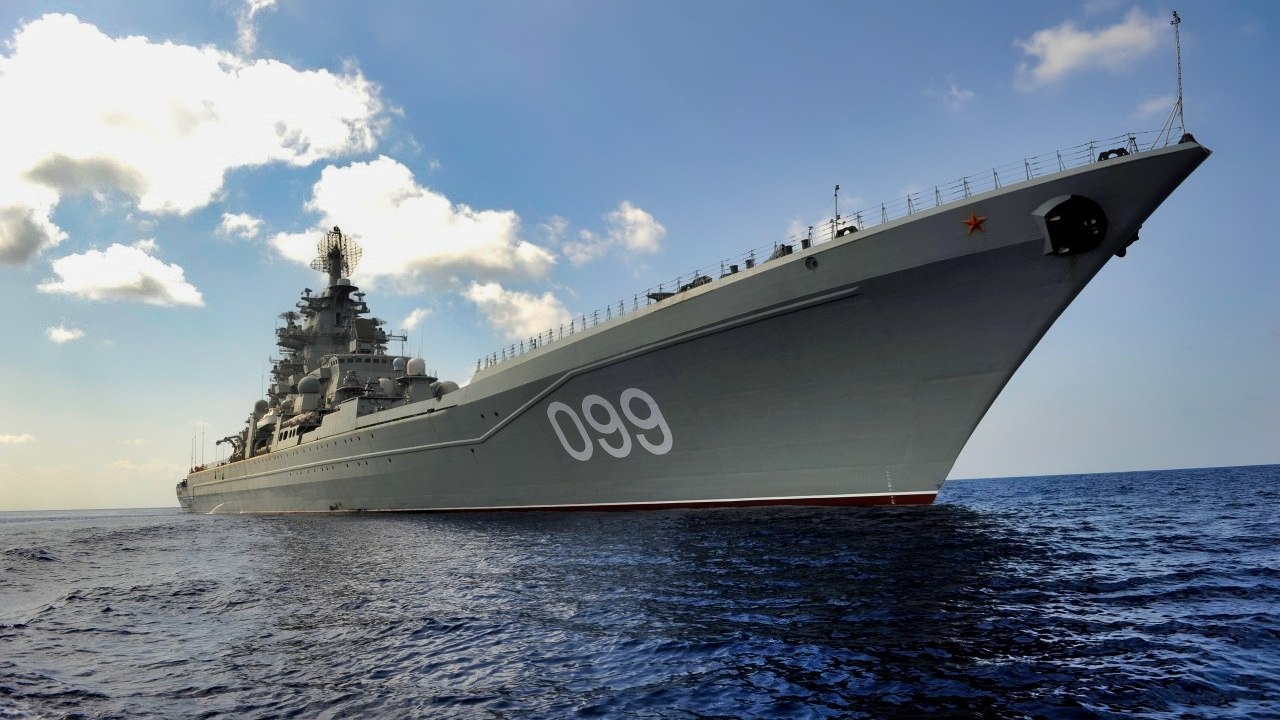
Kirov-Class Battlecruiser Russian Navy. Image Credit: Creative Commons.
The 40ft British-flagged vessel, called Bright Future, is owned by Jane and Alan Kelvey.
They reported on Tuesday morning that the 409ft-long (which is more than ten times longer) Russian military frigate the Admiral Grigorovich had fired warning shots at them at around 11.40 am.
This incident comes after the Smyrtos, a shadow tanker carrying sanctioned Russian oil and flagged as a Cameroon-based vessel, was boarded and seized by Royal Marines in the Channel the weekend prior.
The Russian Defense Ministry defended its actions against the much-smaller privately-owned and non-military craft by claiming that Mr. and Mrs. Kelvey’s yacht was following a “dangerous course”.
The MoD also said that one of its ships had made “several attempts” to contact it by firing flares and sound signals at the vessel.
However, the Kelveys disputed these accusations on Tuesday night, saying that they “didn’t do anything wrong” and that allegations they were on a “collision course” were “simply not true”.
The retirees, aged 69 and 71, had set off from Lymington, Hampshire, at 0400 on Tuesday and were sailing for the French port city of Cherbourg.
They were about 20 nautical miles south of the Isle of Wight when gunshots from the Russian vessel rang out.
Poor Visibility
Military sources who spoke to the London Daily Telegraph stated that the Bright Future had been outside UK territorial waters and was sailing in foggy conditions.
They also reported that the Russian vessel had issued several warnings before firing.
In response, the Kelveys said visibility had been “reasonable” and that they had spotted the much larger Russian military ship ahead of them.
They had planned to alter course in order to pass the Admiral Grigorovich off its starboard side at a distance of 500 meters.
They said that the Russians then sounded their horn five times, causing them to change course by an additional two degrees to pass the ship at an even greater distance.
Mrs. Kelvey had told the BBC the Russians “didn’t send up any flares, they didn’t try to radio us” and that “it wasn’t an incident until the gunfire started.
They didn’t look to us like they were adrift, and we were definitely not on a collision course,” she said.
“There was absolutely no problem as far as we were concerned,” she continued.
“We were just going to go sailing straight past them … as soon as they sent the five blasts on the horn, we took [evasive action], not that any was necessary, but then they did the following five and then the gunfire.”
“They’re blaming us, and as far as we’re concerned, we were blameless.”
An Unidentifiable Ship
The couple also pointed out that there was almost no way they could have known the Admiral Grigorovich was a military vessel, as it was not broadcasting its GPS location.
UK defense community sources also said the Grigorovich appeared to be drifting rather than acting under its own power at the time, as if there was a problem with its engines.
It is possible, they stated, that if the ship were having trouble with its propulsion system, they might have felt vulnerable, as they would have lacked the power to maneuver in the channel.
Military sources played down the encounter as a “nautical incident” rather than escalatory behavior by Russia, and seemed to be suggesting that the fault lay with the retirees and their pleasure boat.
They added that the frigate had issued several preliminary warning sounds before firing warning shots. It is understood that the shots were single shots rather than automatic gunfire.
The same military sources stressed that issuing warning shots was standard procedure for warships feeling vulnerable to collision.
About the Author: Reuben F. Johnson
Reuben F. Johnson has thirty-six years of experience analyzing and reporting on foreign weapons systems, defense technologies, and international arms export policy. Johnson is the Director of Research at the Casimir Pulaski Foundation. He is also a survivor of the Russian invasion of Ukraine in February 2022. He worked for years in the American defense industry as a foreign technology analyst and later as a consultant for the U.S. Department of Defense, the Departments of the Navy and Air Force, and the governments of the United Kingdom and Australia. In 2022-2023, he won two awards in a row for his defense reporting. He holds a bachelor’s degree from DePauw University and a master’s degree from Miami University in Ohio, with a specialization in Soviet and Russian studies. He lives in Warsaw.


