

The Strait of Hormuz could remain a critical geopolitical flashpoint.
While the deal promises a removal of the US blockade within 30 days and a restoration of pre-war shipping traffic, the future of the Strait remains uncertain.
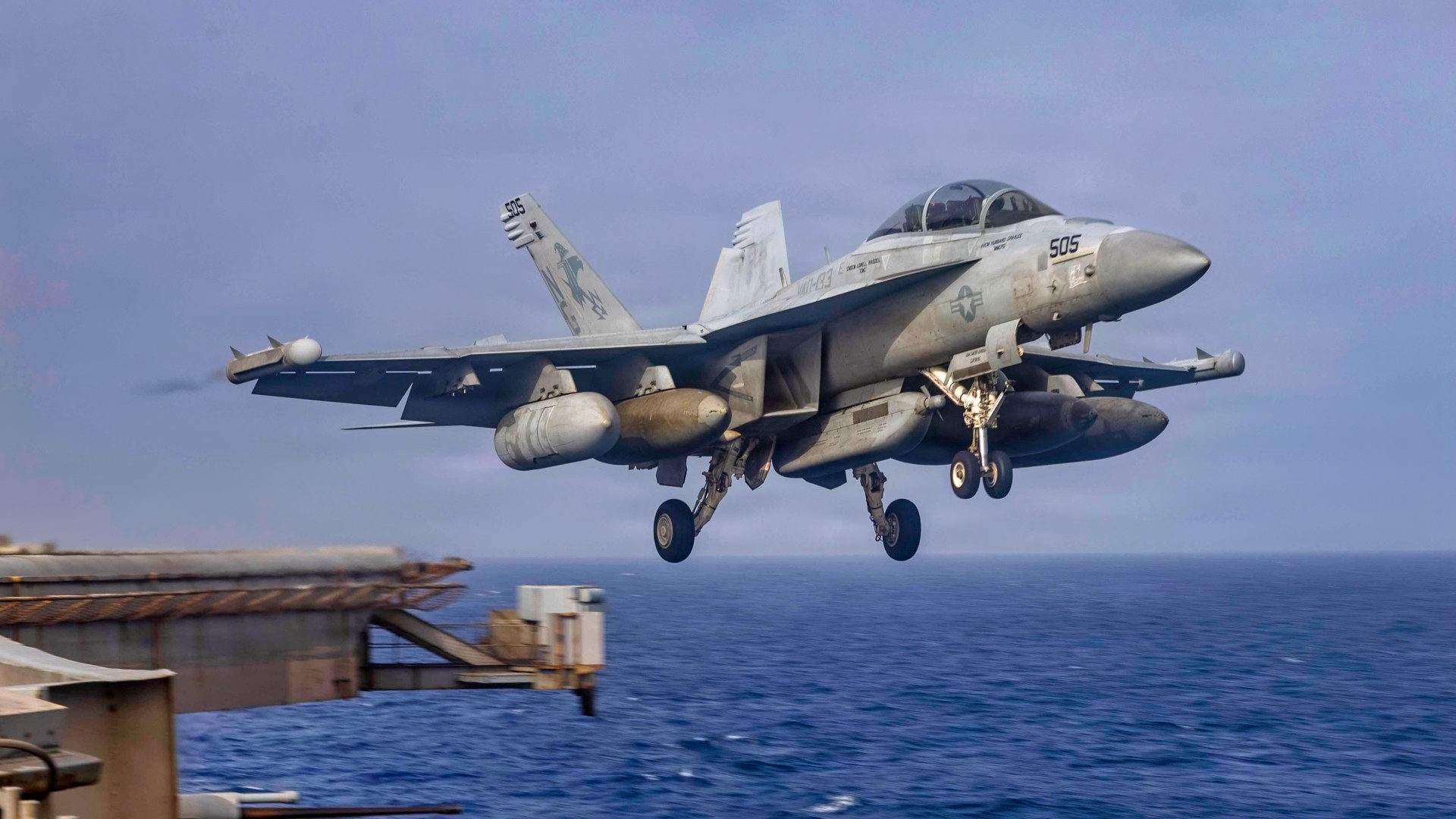
An EA-18G Growler, attached to Electronic Attack Squadron (VAQ) 133, takes off from the flight deck of Nimitz-class aircraft carrier USS Abraham Lincoln (CVN 72), May 21, 2026. Abraham Lincoln is deployed to the U.S. 5th Fleet area of operations to support maritime security and stability in the Middle East. (U.S. Navy photo)
The memorandum of understanding states that ‘the traffic of commercial vessels will immediately start.’ But it also acknowledges the need for Iran to remove mines and obstacles in the Strait, which it says it will begin within 30 days of the agreement.
The demining phase of the agreement could be long and costly. However, there are paths Iranian ships are running that should already be clear; what is a potential showstopper, however, is what happens in the future.
An Emboldened Iran May Attempt To Charge “Fees” In the Future
Although President Trump has said passage through the Strait will be ‘permanently toll-free’, the Iranians claim that after the 60-day window expires, they will work with Oman in conversation with other littoral states to ‘define the future administration and maritime services’ in the Strait.
Iranian officials had previously said ‘fees will be charged’ for unspecified ‘services’ going forward.
Fees and tolls are the same thing. In the event of any future conflict or in the case of an emboldened IRGC, Iran will very likely attempt to close or control the Strait of Hormuz in the future.

NAVAL AIR STATION NORTH ISLAND, Calif. (July 10, 2024) USS George Washington (CVN 73) arrives at Naval Air Station North Island, July 10, 2024. USS George Washington and crew are in the process of completing a homeport change, replacing USS Ronald Reagan (CVN 76) as the forward-deployed U.S. Naval Forces Japan aircraft carrier at Fleet Activities Yokosuka, Japan.(U.S. Navy photo by Mass Communication Specialist 1st Class Keenan Daniels)
Iran’s long-term geopolitical objective is to legitimize its sovereignty over the waterway.
Tehran can leverage asymmetric tactics like mines, drones, and selective tolls to assert control and close the Strait to traffic again.
And Then There Is Iran’s Proxy In Yemen
While Iran likes to claim that its proxies operate independently, that is simply not the case.
Tehran’s militias in Iraq, Hamas, Hezbollah, and the Houthis in Yemen get their support from Iran and do the regime’s bidding.
And any future conflict in the Middle East, the Houthis will attempt to block and restrict maritime traffic in the Red Sea.
The Yemeni rebel group, early last week, declared a complete ban on “enemy navigation”, specifically targeting Israeli-owned or linked ships, and has threatened to turn the Bab al-Mandab Strait into an active theater of military confrontation.
Two days later, on June 10, a small vessel operating off Yemen’s coast reportedly harassed a commercial ship close to Bab al-Mandab.
During the 2024-2025 timeframe, the Houthis attacked over 190 commercial ships in the Red Sea, causing major disruption to global trade.
While trying to conduct an outright, total physical blockade is difficult to enforce, the threat of drone and missile strikes has an effect on global trade.
Even mere threats lead to immediate increases in shipping insurance premiums and crew safety concerns, causing many major shipping companies to reroute vessels entirely.
Can the Houthis “close” the Red Sea? No, they don’t have the power projection for that, and after the Suez crisis, ships have been using the long route around the Horn of Africa. More expensive?
Definitely, but safer and takes away leverage from the group.
Energy Companies Are Already Planning On Bypassing The Strait
Energy companies and Gulf producers are planning to bypass the Strait of Hormuz by rerouting crude flows through overland pipelines directly to open waters.
Major state-owned operators are rapidly constructing new pipeline mega-projects to reduce their reliance on the Persian Gulf. The crisis in the Strait of Hormuz has forced a massive operational shift in global energy logistics, and oil companies do not want to repeat the situation of ships being at a standstill there.
The United Arab Emirates (UAE) is fast-tracking the construction of its West-East pipeline.
Scheduled for completion in 2027, the project is nearly 50 percent complete and will double export capacity from the port of Fujairah, which sits on the Gulf of Oman outside the strait.
“Right now, too much of the world’s energy still moves through too few chokepoints,” Sultan Ahmed Al Jaber, the CEO of the Abu Dhabi National Oil Company (ADNOC), said in an interview at the Atlantic Council.
“This is not just an economic problem,” Al Jaber added.
“In fact, this sets a dangerous precedent once you accept that a single country can hold the world’s most important waterway hostage.”
Saudi Arabia has ramped up flows through its East-West Pipeline to over 7.5 million barrels per day, allowing crude to exit via the Red Sea port of Yanbu.
Goldman Sachs predicts that the Strait may never fully recover to pre-conflict traffic levels.
Many Asian countries that rely on the Middle East for their oil needs, such as South Korea and Japan, are seeking alternative suppliers from the United States, Canada, Venezuela, Azerbaijan, and Russia.
And the two nations signed a comprehensive energy cooperation agreement.
This includes plans for joint stockpiling, enhanced information sharing, and the establishment of a petroleum and LNG swap framework in the Indo-Pacific.
While these ventures can’t replace the amount of oil that flows through the Strait daily, every barrel from an alternative source reduces the leverage that Iran can wield in the future.
Critics of President Trump argue that failing to secure permanent control or address Iran’s fundamental nuclear capacity during the initial conflict was a blunder, while supporters view the reopening of the vital trade route as a strategic victory.
These issues will remain sticking points, and absolutely won’t be agreed upon by the US and Iran during the 60-day negotiating window.
About the Author: Steve Balestrieri
Steve Balestrieri is a National Security Columnist. He served as a US Army Special Forces NCO and Warrant Officer. In addition to writing on defense, he covers the NFL for PatsFans.com and is a member of the Pro Football Writers of America (PFWA). His work was regularly featured in many military publications.


Cody
June 18, 2026 at 2:52 pm
Why not a canal to bypass the straight? Trump could build resorts with waterfront views. The statement was sarcasm.
Dr. Hujjathullah M.H.Babu Sahib
June 18, 2026 at 2:55 pm
The Trump camp may not be wrong in viewing the relieving of tension around the Straits of Hormuz as a victory, though one of a technical if not also a tactical nature. It definitely can’t be deemed a strategic victory though. For one to even dream of it being so, the U.S. and/or it’s regional allies must have mobilizable capabilities on hand to rapidly move in and demine the Straits physically directly or via AIed demineing drones. In the absence of such capacities within the region itself, the viewing of the interim relief as a “strategic” victory is obviously unwarranted and even U.S. allies in the Indo-Pacific will not take it seriously.