

Ukraine’s campaign of “long-range sanctions” continues, with President Volodymyr Zelenskyy confirming that his country’s military had conducted long-range strikes overnight on June 27 – this time targeting one of Russia’s most important military-industrial facilities in the Volgograd region. According to a statement from Zelenskyy, the domestically manufactured FP-5 cruise missile struck the Titan-Barrikady defense plant overnight.
Ukraine’s Security Service (SBU) also said its drones had attacked a major oil pumping station in the Vladimir region of Russia.

Putin in December 2025 Russian Federation Handout Image
The news comes after Zelenskyy promised a 40-day-long campaign of long-range strikes against Russian infrastructure – a campaign that he believes will be enough to raise the cost of continuing the war and bring Moscow back to the negotiating table.
Flamingo Missiles Strike Titan-Barrikady
In a statement published on Telegram, Zelenskyy confirmed that Ukrainian forces successfully struck the Federal Research and Production Center Titan-Barrikady located in Volgograd. According to the Ukrainian president, the attack caused serious damage, igniting a fire inside the facility after several Flamingo cruise missiles hit the complex.
“Every Russian defense facility that serves the war against Ukraine is a just target for our long-range sanctions. Last night, FP-5 Flamingo missiles successfully struck the Titan-Barrikady facility in Volgograd. It is a major industrial complex where the enemy produces artillery systems and specialized military equipment, including components for missile launch systems used in attacks against our people. Confirmed strikes were followed by a fire on the plant’s premises. I thank the warriors of our Defense Forces for their precision,” the statement reads.
Zelenskyy also said that Ukrainian pressure on Russia’s war machine is laying the “groundwork for a dignified peace in the end.”
Why It Matters
Titan-Barrikady is one of Russia’s top defense manufacturers.
It is a critical part of the country’s military-industrial base, and the strike proves that, despite efforts to redeploy air defense systems to defend its most critical sites, Russia is still struggling to defend itself.
The facility manufactures launchers for Russia’s Iskander-M ballistic missile system, as well as parts for the Yars and Topol-M missile systems. It also supports the production of other heavy artillery equipment and hardware used by the Russian forces and has been under international sanctions since the Russian invasion of Ukraine began.
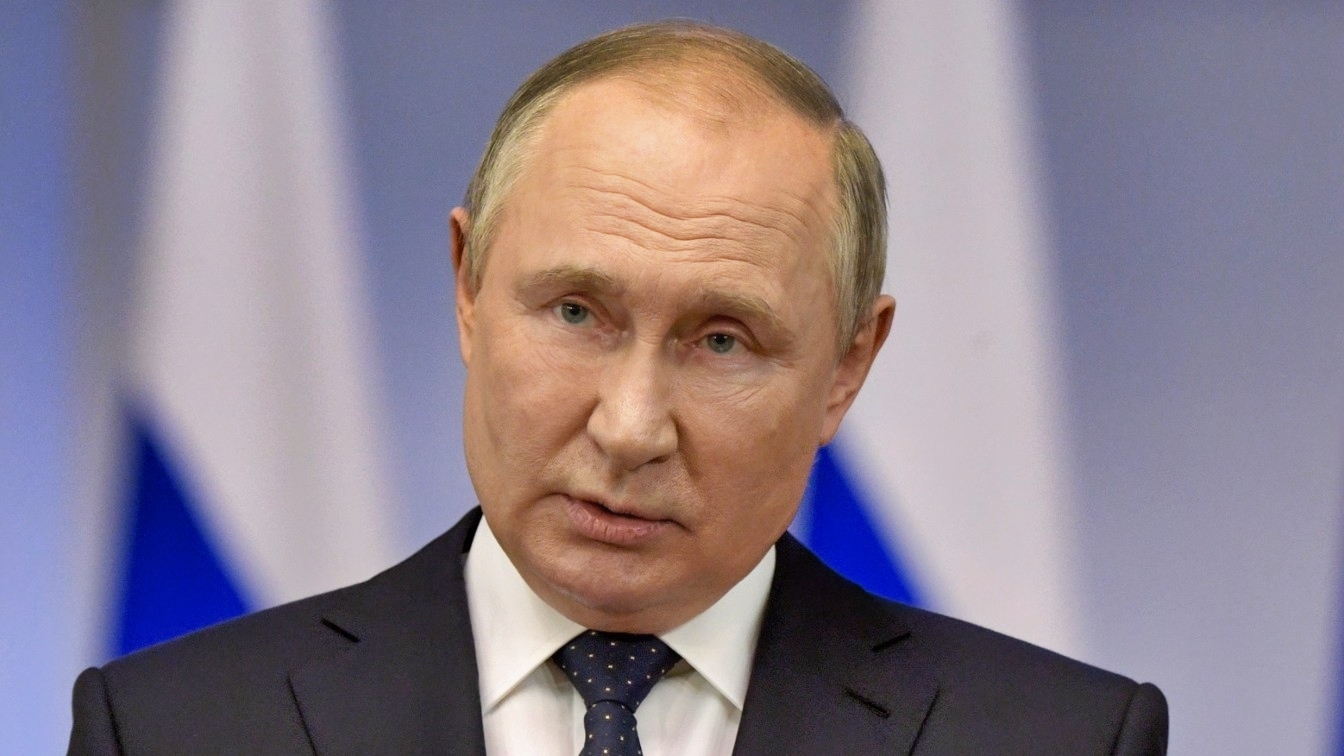
Putin Back in April of 2022 Creative Commons Photo
Videos of the strike quickly went viral on social media, showing large plumes of smoke rising from the industrial complex.
Russia Reports Injuries
The attack in Volgograd was acknowledged by the Russians, although the facility was not explicitly named.
In a statement, Volgograd regional governor Andrei Bocharov said that “production facilities at one of the facilities in the Krasnooktyabrsky district” had been damaged. Bocharov also said that localized fires were quickly extinguished by emergency workers and confirmed that 10 people were injured in the strike and required hospital treatment. He confirmed that no residential buildings were damaged in the attack.
Flight restrictions were imposed soon after at the Volgograd Airport.
The Russian Defense Ministry also claimed it intercepted 175 Ukrainian drones across 10 Russian regions, including occupied Crimea, although it did not comment on the reported missile strike against the defense plant.
It’s embarrassing news for Moscow, and a problem that is only set to get worse over the next month.
Ukraine Also Targets Russian Oil Infrastructure
Ukraine’s Security Service also confirmed a series of attacks against Russia’s energy infrastructure overnight. The SBU said that Ukrainian drones struck the Vtorovo oil pumping station in the Vladimir region for the second time this month.
The agency described the facility as a critical logistics hub that is used to transport petroleum products to both domestic and export markets. It is just one of many Russian oil-related facilities targeted by Ukraine in recent weeks and months, as Kyiv seeks to disrupt military logistics and cripple Russia’s wartime economy that is heavily reliant on oil.
The FP-5 Flamingo Changed Everything
The latest strikes prove just how crucial it has been for Ukraine to build its own long-range strike capacity. The domestically developed FP-5 Flamingo cruise missile is one of the country’s newest long-range precision weapons, developed by the defense company Fire Point. The weapon system was designed after the Russian invasion of Ukraine and publicly unveiled in 2025.
The missile allows Ukraine to launch long-range strikes inside Russian territory without asking for Western permission to use a limited number of donated missiles and weapons systems.
The FP-5 is believed to have a range of up to 3,000 kilometers, allowing it to reach targets virtually anywhere in European Russia.
Exactly how many Flamingo missiles Ukraine has today is unknown, and President Volodymyr Zelenskyy acknowledged earlier in the year that production is still limited after Russian strikes damaged a production line.
That being said, production is gradually expanding, and the missile is already a central feature of Ukraine’s deep-strike campaign. Videos shared online in recent weeks have shown Flamingo missiles flying hundreds of miles across Russian territory, completely unchallenged by air defense systems and striking military and industrial targets.
The missiles are proving that Ukraine has the capacity to fight back, and now, Russia’s vast territory is becoming a major disadvantage in the war.
About the Author: Jack Buckby
Jack Buckby is a British researcher and analyst specializing in defense and national security, based in New York. His work focuses on military capability, procurement, and strategic competition, producing and editing analysis for policy and defense audiences. He brings extensive editorial experience, with a career output spanning over 1,000 articles at 19FortyFive and National Security Journal, and has previously authored books and papers on extremism and deradicalization.


