

Warsaw, Poland – In a gambit to gain advantage in the PR and psychological war campaign, Ukrainian President Volodymyr Zelenskiy has announced his counterpart in Moscow is leaving huge areas of Russia defenseless against Kyiv’s drone and missile attacks.
“The Russian leadership is now pulling more air defense assets to Moscow, Valdai (Russian President Vladimir Putin’s palatial estate in the St. Petersburg region), and the bridge across the Kerch Strait – at the expense of air defense elsewhere. In the Moscow region alone, they have amassed hundreds of launchers for S-400, S-500, and Pantsir systems,” writes Zelenskiy on his X page.
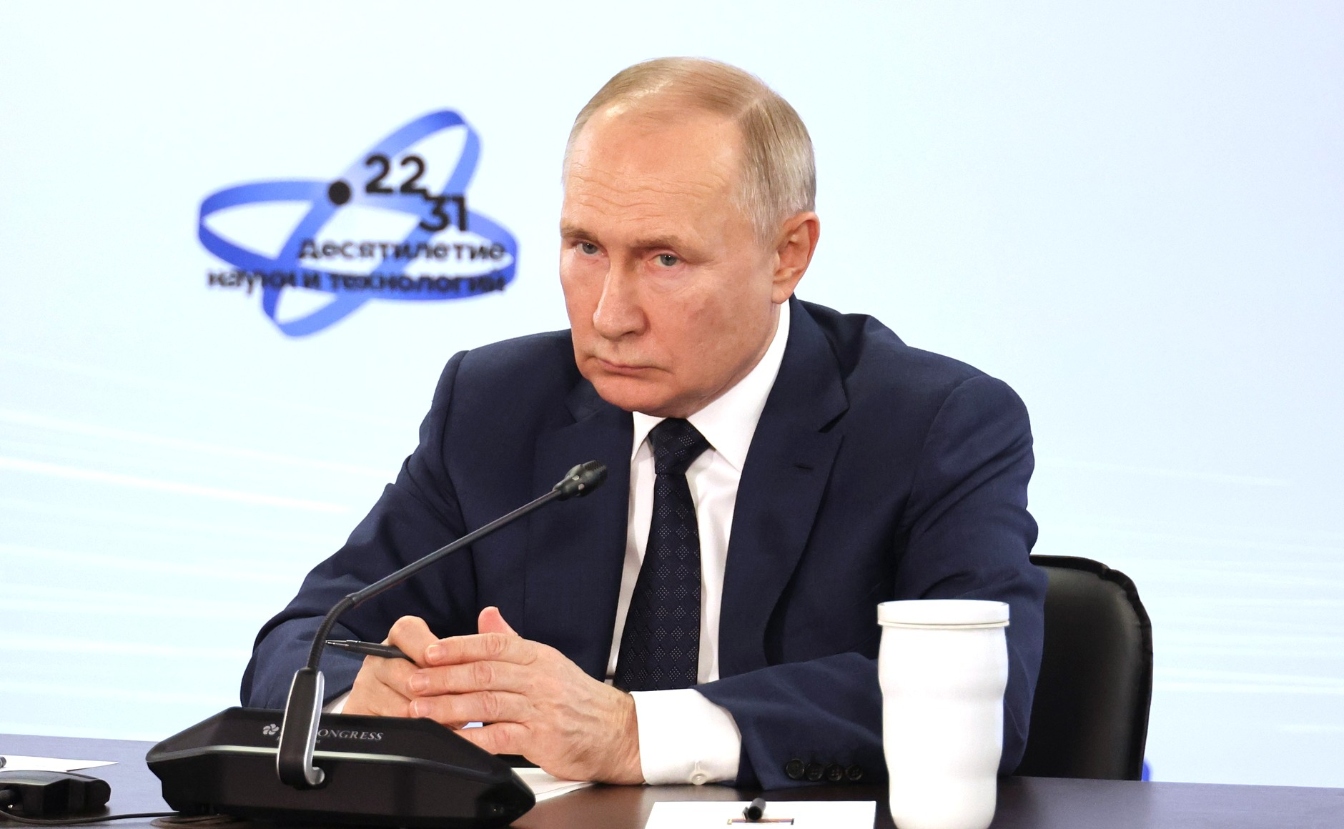
Putin at the November 2023 Science Fair, Russian Government Photo
“Nearly 90 launchers have been redeployed to Valdai from other regions of Russia, and a special air defense division is also being formed there to safeguard the peace and quiet of the Russian chief. To compare, there are only a couple of launchers per direction across Russia and around their other cities. Those are their priorities. They are protecting their power – the source of this war,” he continued.
“More than 60 Russian regions are already experiencing fuel shortages. There has also been a sharp increase in gas and diesel prices – if they are available at all. Russian security services have even proposed postponing or cancelling altogether the ritual of electing ‘United Russia’ to the State Duma.”
Mid-Term Elections May Be Postponed
These elections, set for September, are Moscow’s equivalent of the US midterm Congressional and gubernatorial contests. Although due to the system in Russia, where outcomes are pre-ordained, there is usually little semblance of competition in this balloting.
This “rigged” arrangement was the situation in the past, but as Zelenskiy’s message continues to explain, “Their [the Kremlin’s] latest imitation of elections was scheduled for September, and intelligence reports now show that Russia itself is not confident about what will be happening by September. There are many difficulties – all because Putin refuses to end his war and to hear our proposals for a meeting, genuine negotiations, and a dignified peace.”
To put it simply, Putin’s United Russia party – despite all of the overwhelming resources they have at their disposal that can usually bury any opposition in an election – could still turn in an embarrassing set of defeats at the polls because of the country’s internal situation.
“Conducting elections under such conditions is a bold task,” a source told Meduza news service, arguing that worsening economic conditions could affect public support for the authorities.

Putin in Briefing. Image Credit: Russian Government.
According to Meduza, the Russian news site now based in Riga, Latvia, this proposal to postpone the elections has been promoted by senior Federal Security Service (FSB) officials and the National Guard (RosGvardia) commander, Viktor Zolotov. The latter is a longtime Putin ally and former bodyguard of the Russian president, dating back to their days together in the 1990s in St. Petersburg.
The news outlet cited two sources close to Russia’s presidential administration who said deferring the elections – or even canceling them altogether – is being viewed as a safeguard amid growing economic pressures, rising prices, and budget shortfalls, for which there are few, if any, scenarios to resolve them.
Degraded Petroleum Industry
One of Putin’s long-time allies and confidants is the head of Rosneft, Igor Sechin. He has also been one of those reported to be advocating for the elections to be deferred to a later date. Today it was reported that he had also informed Putin as to the “unprecedented number of damage” to Russian oil refineries from Ukrainian strikes.
To compensate for the drop in petrol production, he proposed a series of measures to the Russian president to stabilize Russia’s fuel market. But all of these come down to temporarily suspending the “Euro-5” fuel sales standards and increasing sales of lower-quality “Euro-3” fuel. This will make Russia one of the world’s largest producers of fuel, which is far below the emission and clean air standards adopted by the rest of Europe.
Analysts at Energy Intelligence note that the volume of oil being refined in Russia at the beginning of June fell below 4 million barrels per day. This is the lowest figure for Russia’s oil industry for the last 21 years. According to their estimates, almost a third of Russia’s oil refining capacity is idle.
Moving most of Russia’s air defense assets away from protecting the oil and gas industry so that bunkers, palaces, and senior elites can be protected only guarantees more damage will be done to an already crippled industry. For a Russian president increasingly bedeviled by a Ukrainian adversary that is growing stronger and more emboldened by the day, it promises to be a long, hot summer.
About the Author: Reuben F. Johnson
Reuben F. Johnson has thirty-six years of experience analyzing and reporting on foreign weapons systems, defense technologies, and international arms export policy. Johnson is the Director of Research at the Casimir Pulaski Foundation. He is also a survivor of the Russian invasion of Ukraine in February 2022. He worked for years in the American defense industry as a foreign technology analyst and later as a consultant for the U.S. Department of Defense, the Departments of the Navy and Air Force, and the governments of the United Kingdom and Australia. In 2022-2023, he won two awards in a row for his defense reporting. He holds a bachelor’s degree from DePauw University and a master’s degree from Miami University in Ohio, specializing in Soviet and Russian studies. He lives in Warsaw.


