

Apocalyptic scenes unfolded in Moscow last week and bore stark testament to the effectiveness of Kyiv’s ongoing strike campaign against Russian energy infrastructure.
Russian social media was replete with images of the city burning, and thick clouds of acrid black smoke billowed into the sky from refineries and other energy-related infrastructure within the Russian capital, the result of Ukraine’s expanding campaign of drone strikes against Russia.
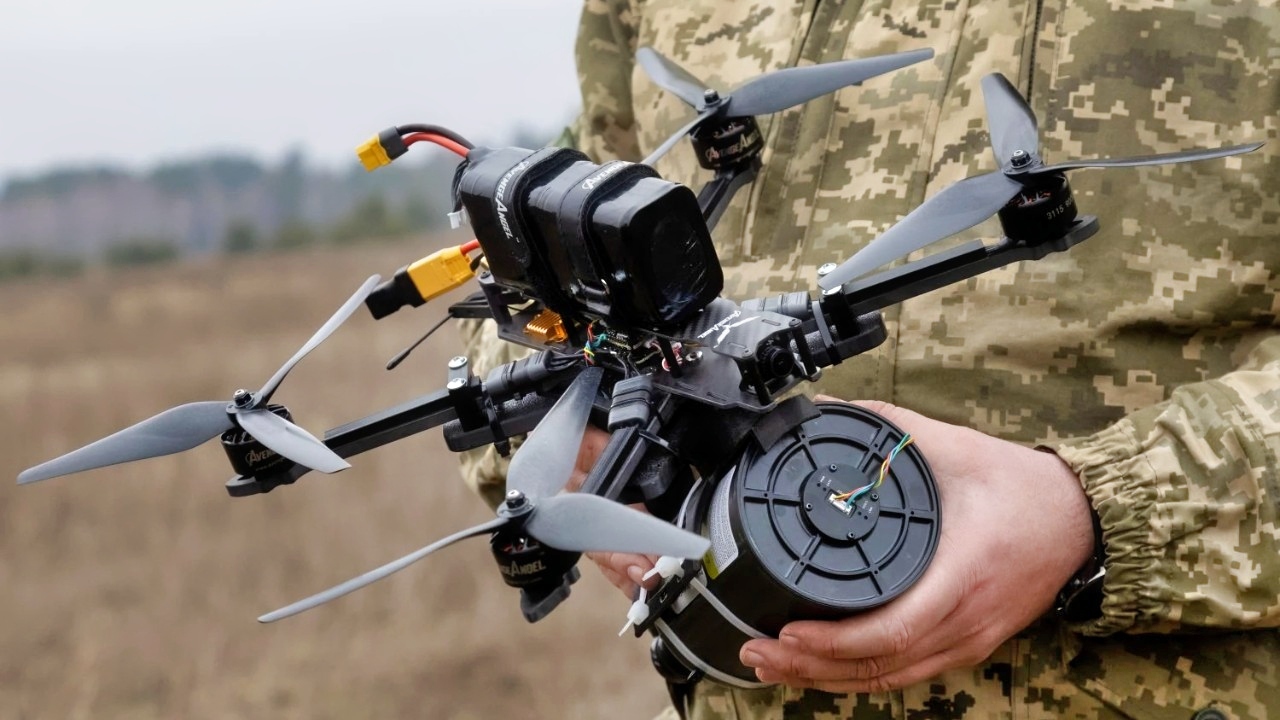
Ukraine Drone. Image Credit: Creative Commons.
Moscow’s airports decided to temporarily suspend operations on Monday after Russian air defenses began tracking dozens of Ukrainian attack drones flying toward the city.
Moscow Mayor Sergei Sobyanin wrote on social media that Russia had intercepted potentially as many as 80 Ukrainian drones, but many had managed to evade Russian air defenses.
All four of Moscow’s major airports — Domodedovo, Sheremetyevo, Vnukovo, and Zhukovsky — shuttered their doors just days earlier in response to an earlier Ukrainian wave of drone strikes in and around the city.
Long-Range Sanctions Regime
It is part of what Ukrainian President Volodymyr Zelenskyy has dubbed his country’s “long-range sanctions” regime against Russia, and part of a broader Ukrainian effort to hobble Russia’s ability to finance its ongoing war in Ukraine.
The effects of Ukraine’s strike campaign have been, in a word, remarkable. Pummeled from the skies, Russia — the world’s number three producer of oil — has banned fuel exports since April, while some gas stations have begun rationing to stretch supplies and prevent hoarding.

Bohdan, a drone pilot from the Unmanned Systems Battalion of Ukraine’s 110th Separate Mechanized Brigade, pilots an FPV drone in Donetsk Oblast during active battle operations. Photo: David Kirichenko
While Ukrainian drones are relatively small and carry only a small explosive payload, that is not necessarily a disadvantage.
Flying low and relatively slow, Ukrainian drones may be somewhat difficult to track on radar despite their relative simplicity.
They’re also ideal for the kind of infrastructure currently being targeted.
Unlike Russian ammunition stores in Ukraine, which have become dispersed and distributed around parts of occupied Ukraine to prevent the kinds of catastrophic losses seen during the war’s first year, Russian energy infrastructure is both centralized and immobile and therefore difficult to reliably protect.
It is also highly flammable.
Ukraine has launched multiple waves of attacks, hitting infrastructure multiple times and preventing quick repair times, and has also prioritized some of the most sensitive and lucrative processing sections of Russia’s energy infrastructure.
Shortages in Occupied Crimea
Crimea’s occupation government suspended the sale of gasoline to civilians, reserving the peninsula’s limited supplies for government and military purposes only.
Occupied by Russia after Moscow’s annexation in 2014, Crimea’s energy supplies have been disrupted before, but the current disruption is among the worst in at least a decade, with some reports on social media indicating black market sales of fuel topping double the market rate.
An Escalation Spiral?
The reaction from the Kremlin has been strangely muted, perhaps a testament to how Ukraine’s long-range sanctions have actually been felt, or a reflection of Russia’s limited options.
The Bell, an independent Russia-focused news outlet, reports that the Kremlin is feeling squeezed and that “the prospect of using tactical nuclear weapons is approaching.”
But the Russian state, while seemingly shifting to the back foot, is far from collapsing.
Indeed, bellicosity from the Kremlin vis-à-vis nuclear weapons has been heard before, bluster that was tamped down by both the United States Department of Defense and China.
Backlash of a nuclear nature would hardly advance Russia’s military aims in Ukraine, and is unlikely to occur.
Flying into the Future
How long will Ukraine be able to maintain — or expand — its strike campaign against Russia proper?
One important factor will be Kyiv’s Flamingo, a pink-colored cruise missile that will extend the reach of Kyiv’s long-range sanctions campaign while also delivering a significantly larger payload than the current crop of one-way attack drones.
With a claimed range of up to 3,000 kilometers, or nearly 1,900 miles, and a warhead that weighs as much as a midsized car, waves of Ukrainian cruise missiles could well inflict a level of destruction not seen in the Russian heartland in generations.
But in the meantime, Ukraine has managed quite well with the tools at its disposal.
For the foreseeable future, Russian airports, military installations, and energy infrastructure will be under threat from Ukrainian bombardment, further stretching Russia’s already strained air defenses and forcing a devious cost-benefit analysis: does the Kremlin allocate air defenses to its war machine in Ukraine — or to infrastructure within Russia itself?
What Russia or Ukraine’s next moves will be remains to be seen, but increasingly broad swathes of Russia proper are in Ukrainian crosshairs.
About the Author: Caleb Larson
Caleb Larson is an American multiformat journalist based in Berlin, Germany. His work covers the intersection of conflict and society, focusing on American foreign policy and European security. He has reported from Germany, Russia, and the United States. Most recently, he covered the war in Ukraine, reporting extensively on the war’s shifting battle lines in the Donbas and writing about its civilian and humanitarian toll. Previously, he worked as a Defense Reporter for POLITICO Europe. You can follow his latest work on X.


