


In a tacit admission of how effective Ukraine’s ongoing drone strike campaign against Russian oil and gas infrastructure has been, Russian President Vladimir Putin said that Russia is feeling a “certain deficit” but attempted to assure audiences that Russia still has options for meeting domestic energy needs.
Now approaching its fifth year, Russia’s full-scale invasion of Ukraine has been hampered in recent months by what Ukrainian President Volodymyr Zelensky has dubbed his country’s “long-range sanctions” regime.

T-14 Armata. Image Credit: Creative Commons.
“Our soldiers got off to a very strong start on Ukraine’s Constitution Day,” the president wrote on his Telegram channel. “Last night, our long-range strikes hit two oil refineries in Russia.
The “Slavyansky” refinery in the Krasnodar region—located about 300 kilometers from the front line—was struck. We also struck an oil refinery in the Yaroslavl region, approximately 700 kilometers from our border.”
“We are continuing our operations, which are undermining Russia’s ability to wage this war,” President Zelensky added. “Each of our far-reaching sanctions reduces the resources fueling the Russian war machine and brings us one step closer to peace.”
Russian Energy and Fuel Squeezed
Drones of increasing sophistication — defined by factors such as range, payload capacity, and jamming resistance — have seriously disrupted Russian operational planning.
A roughly thirty-kilometer stretch behind the Russian side of the front, or around 18 miles, is increasingly contested from the air.
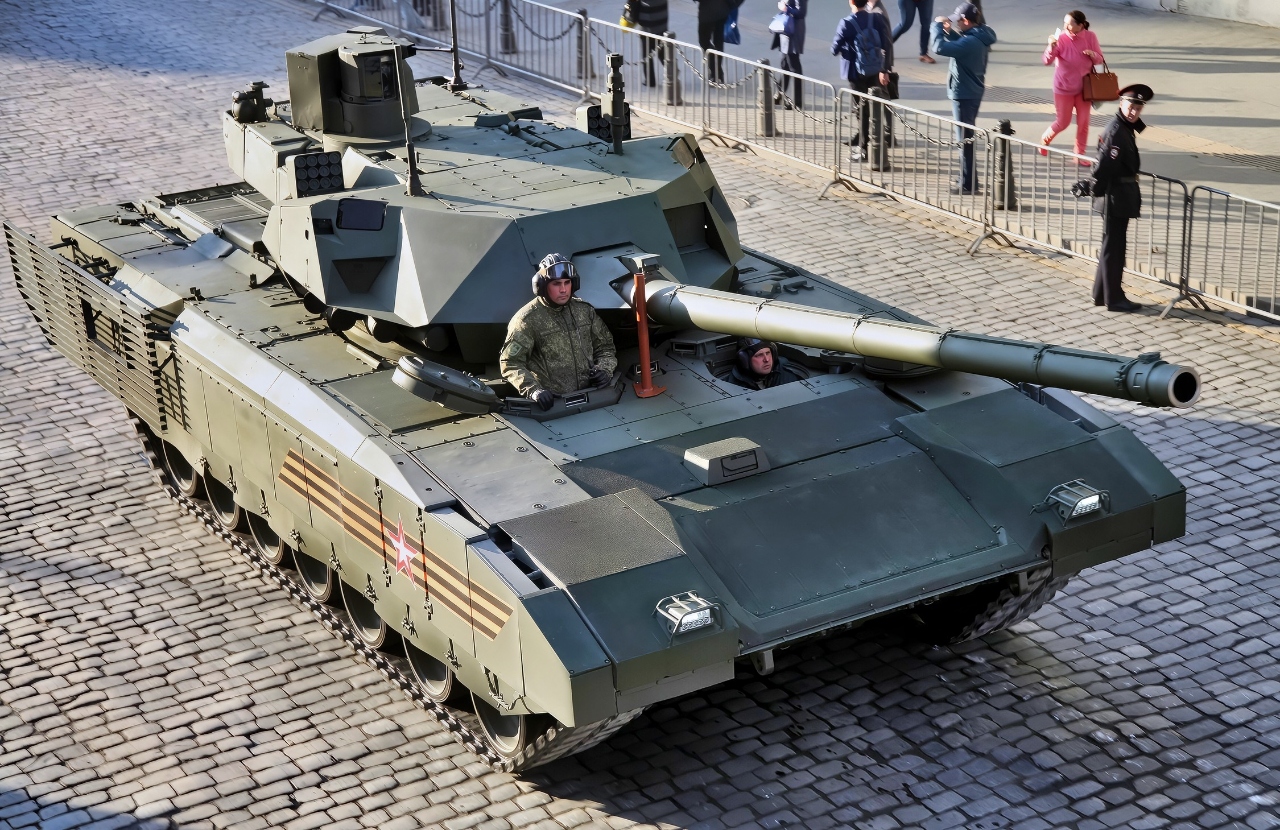
T-14 Armata Tank Russia. Image Credit: Creative Commons.
But battered on the battlefield by Ukrainian drone strikes of increasing frequency and depth, the Russian heartland, too, has become a target of Ukrainian FPV fury.
Ukrainian strikes against Russia’s oil extraction and refining infrastructure, particularly in Russia’s south, have resulted in fuel rationing in Crimea, the Russian-occupied Ukrainian peninsula annexed by Russian forces in 2014.
Aside from military or official government purposes, fuel is increasingly difficult to source — and prohibited for civilian vehicles.
While Western sanctions caused by Russia’s invasion of Ukraine initially crimped Moscow’s ability to export energy products and squeezed the Kremlin’s coffers, the country remained one of the world’s top oil exporters.
But the effects of Ukraine’s strike regime are now apparent even thousands of miles from the front lines in Ukraine.
Fuel shortages and rationing have been felt as far away as Siberia, where purchasers at state-run fuel stations are limited to 50 liters per fill-up per day, or a little more than 13 gallons.
Energy exports form the lion’s share of Russian state revenue and are of vital importance to maintaining the Russian war machine’s momentum.
But Ukraine’s drone strikes have reportedly slashed Russia’s oil refining capacity by twenty-five percent, creating a domestic shortage of about fifteen percent.
Russian social media has been rife with posts from across the country lamenting a fuel shortage — something not experienced since the early 2000s.
Shifting Battle Lines
Taking the fight into Russia itself has forced the Kremlin to make difficult decisions about what — and where — it prioritizes its air defenses.
Protecting energy infrastructure at home is certainly important, but it also risks leaving parts of Ukraine occupied by Russian forces vulnerable.
Russia is still managing to eke out small gains on the battlefield and appears poised to capture Kostiantynivka, a city in Ukraine’s Donetsk region. The fight has been extremely costly.
Estimates of Russian and Ukrainian personnel losses are decidedly turbid, and figures are best-guess estimates rather than concrete totals.
Still, it appears that Ukraine is managing to hold the Russian Army’s overall numbers almost static, a sign that Kyiv is killing or wounding roughly as many soldiers per month as Russia is able to recruit domestically and from abroad, in many instances forcibly.
The Path Forward
Speaking to Russian media, President Putin said that the production of additional air defense systems would ramp up and that the current deficits are temporary.
He also voiced full-throated support for restoring fuel availability to Crimea and other parts of Russia where supplies have been squeezed.
But Russia’s war aims of seizing the entirety of Ukraine’s Donbas and what the Kremlin calls Novorossiya, a term used during Russia’s Imperial era that encompasses Ukraine’s Zaporizhzhia and Kherson oblasts, appear to be an increasingly distant pipe dream.
With recruitment holding steady at best, and possibly even on the wane, the route forward for Russia — and victory — is elusive.
What options President Putin has at his disposal for achieving his war aims are unclear. But what is much more obvious is how effective Ukraine’s long-range sanctions regime has been thus far.
About the Author: Caleb Larson
Caleb Larson is an American multiformat journalist based in Berlin, Germany. His work covers the intersection of conflict and society, focusing on American foreign policy and European security. He has reported from Germany, Russia, and the United States. Most recently, he covered the war in Ukraine, reporting extensively on the war’s shifting battle lines from Donbas and writing on the war’s civilian and humanitarian toll. Previously, he worked as a Defense Reporter for POLITICO Europe. You can follow his latest work on X.


