

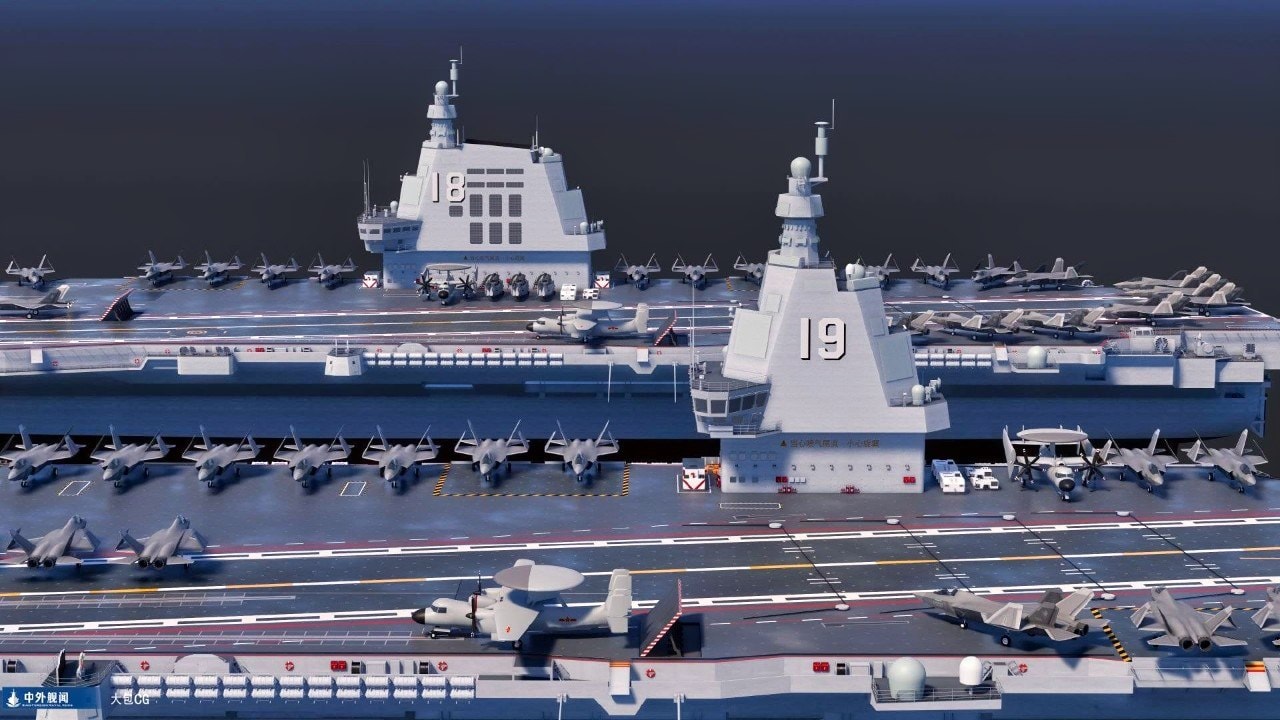
The People’s Liberation Army Navy, or PLAN for short, recently notched what was for it a long carrier deployment, with the Liaoning completing 40 days at sea, during which it conducted a number of training exercises.
Though notable for the PLAN, it pales in comparison to the Gerald R. Ford, a U.S. Navy aircraft carrier, and that ship’s post-Cold War record of nearly 300 days at sea.
The Liaoning’s Origin Story

China New Carrier Type 003 CCTV Screencap Photo.
Although the Liaoning is China’s first aircraft carrier, it was not built in China. Instead, the carrier began life in the Soviet Union as the Varyag, intended as the second of the troubled
Kuznetsov-class of ships. But after the collapse of the Soviet Union, construction ended. Tied up at port in Ukraine for several years, the ship was eventually purchased by China in the late 1990s.
Though nominally purchased to serve as a kind of floating casino, the ship was completed in China after extensive refitting.
Many of the ship’s Soviet-era systems were stripped and replaced with equipment compatible with People’s Liberation Army Navy operations. The ship would be commissioned as the Liaoning in 2012.
China’s First Aircraft Carrier
Unlike its larger counterparts in the United States and French Navies, the Liaoning uses conventional rather than nuclear propulsion and displaces about 65,000 tons.
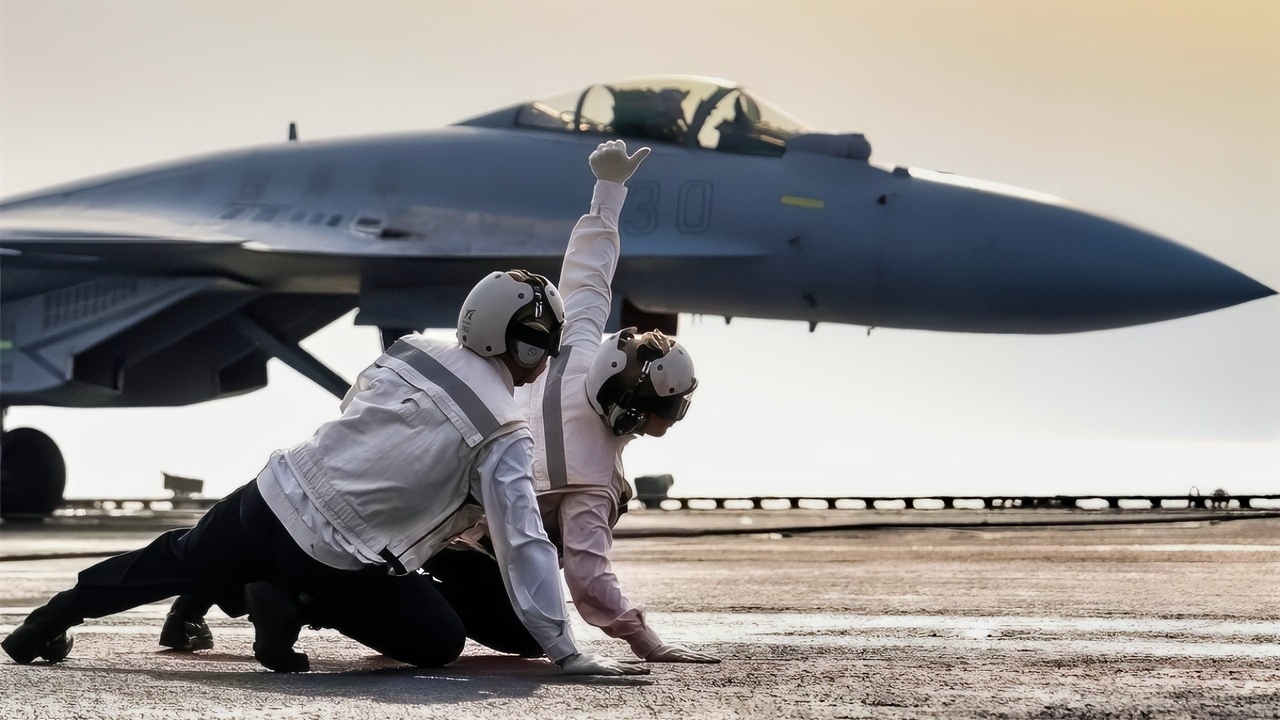
China Aircraft Carrier Operations. Image Credit: Chinese Navy.
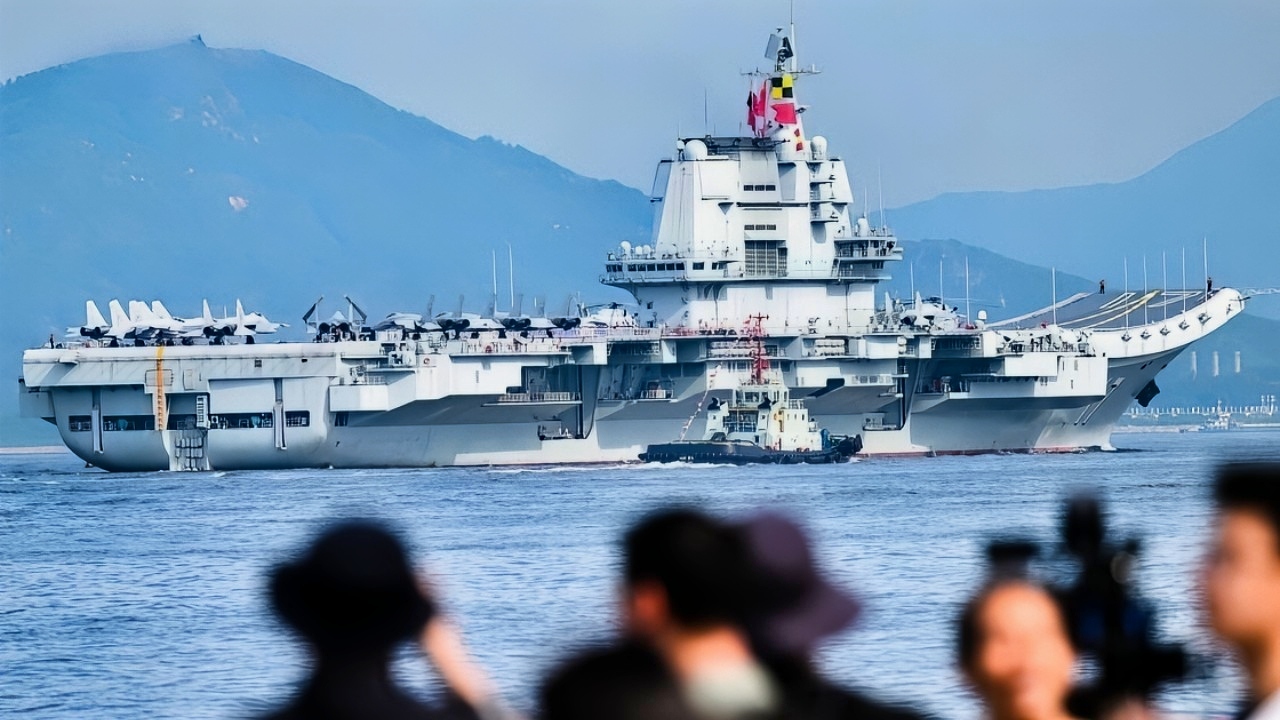
China Aircraft Carrier in Port. Image Credit: Chinese Navy.
Compared to the 100,000-ton displacement of the U.S. Navy’s newest aircraft carrier class, the Gerald R. Ford-class supercarriers, the Liaoning is considerably more modest in size and capabilities.
And while more limited in endurance, the Liaoning is capable of conducting operations throughout the western Pacific.
Perhaps one of the carrier’s most recognizable characteristics is its sloped ski-jump flight deck.
Unlike catapult-assisted takeoffs seen on U.S. Navy carriers, combat aircraft on the Liaoning use the upward slope of the flight deck to launch themselves into the air under their own power.
Though simpler in design, the choice limits the amount of fuel and weapons that airplanes can carry compared to aviation elements on other aircraft carriers.
Intended Role
The Liaoning was intended primarily as a training platform for PLAN sailors and pilots. As the PLAN’s first aircraft carrier, it provided an invaluable opportunity for the PLAN to learn and experiment with carrier aviation operations, a uniquely challenging experience.
Working in confined, below-deck spaces, coordinating aircraft launch and recovery, and the related logistical challenges presented were honed by the PLAN aboard the Liaoning.
Though it has since been eclipsed by the PLAN’s other aircraft carriers, the ship played an important foundational role for Beijing’s ambitions in its near abroad.
Signaling with an Aircraft Carrier
The deployment of the Liaoning earlier this year was interpreted by Chinese naval watchers as a signal from Beijing — and one of anger, seemingly in response to a Japanese warship transiting the Taiwan Strait while conducting freedom-of-navigation operations.
Though China’s Eastern Theater Command said that the carrier’s deployment was “routine training activity organized in accordance with the annual plan” and “not aimed at any specific country or target,” it was hard not to mistake the deployment’s composition, timing, or location.
Sailing through the Ryukyu Islands near the Japanese mainland, the Liaoning was accompanied by the Baotou, one of China’s Type 052D guided-missile destroyers.
At the time of the Liaoning’s deployment, the United States and the Philippines were in the midst of the Balikatan exercises, an annual readiness and training event.
That edition of Balikatan included Japan, a first for the country.
While Japan’s participation in the exercises was noteworthy in and of itself, so too was what Tokyo’s warships did: north of Luzon, the Balikatan participants conducted a live-fire sinking exercise facing Taiwan, a clear signal that they could reliably contest parts of their neighborhood.
But not long thereafter, China’s Liaoning conducted drills in roughly the same part of the ocean east of the Philippines.
Other Assets Taking the Lead, and into the Future
Following the commissioning of the Liaoning, China rapidly began designing and manufacturing its own aircraft carriers.
The PLAN’s next carrier, the Shandong, was commissioned in 2019, and while it retains the same basic outline as the Liaoning, retaining the latter’s ski-jump flight deck, the design was tweaked and refined for optimum air operations with Chinese aircraft.
Just three years later, in 2022, the PLAN would see the Fujian enter service.
Rather than simply further refining the Shandong, the Fujian is a from-scratch aircraft carrier design that is much larger than its two predecessors.
It eschews a ski-jump flight deck in favor of three modern EMALS — electromagnetic aircraft launch systems — and is thought to be capable of greater sortie generation as well as other improvements.
The PLAN’s next carrier, now provisionally dubbed the Type 004, is thought to incorporate nuclear, rather than conventional, propulsion. Although the carrier would not necessarily be larger or faster than its predecessors, it would be capable of much greater endurance, potentially limited only by its crew’s food requirements.
About the Author: Caleb Larson
Caleb Larson is an American multiformat journalist based in Berlin, Germany. His work covers the intersection of conflict and society, focusing on American foreign policy and European security. He has reported from Germany, Russia, and the United States. Most recently, he covered the war in Ukraine, reporting extensively on the war’s shifting battle lines in the Donbas and writing about its civilian and humanitarian toll. Previously, he worked as a Defense Reporter for POLITICO Europe. You can follow his latest work on X.


