

When the U.S. launched a war in Iran in February, the Iranians responded not long after by closing off the Strait of Hormuz, choking off a major chokepoint for shipping traffic and also causing energy prices to rise.
Trump was heavily criticized for not seeming to realize that the closure of the Strait was a strong possibility, and as the war continued, it soon became clear that the U.S. side had no easy options to reopen it.

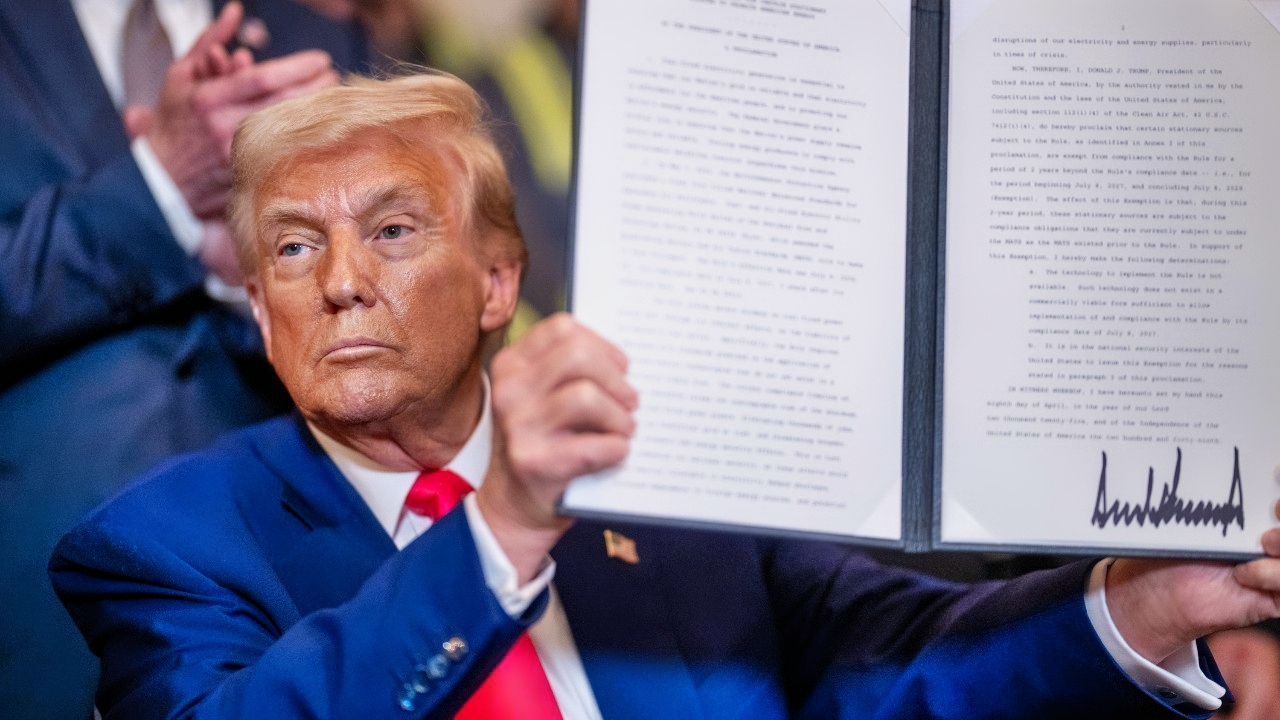
Donald Trump in 2023 Speaking. Image Credit: Gage Skidmore.

Donald Trump Giving a Speech. Image Credit: Gage Skidmore.
The “memorandum of understanding” that brought hostilities to a halt in June included a reopening of the strait, but hostilities have now resumed– and it’s become clear that Iran now has the leverage of closing the Strait of Hormuz anytime they want.
A New Threat That Was Quickly Dropped
On Monday, Trump took to Truth Social and declared that “the Hormuz Strait is OPEN, and will remain OPEN, with or without Iran. We are reinstating the IRANIAN BLOCKADE, so named because it is only stopping Iran’s ships or customers from entering or leaving.
All other countries will have fair and open use of the Strait.” Trump went on to state that the United States is now “THE GUARDIAN OF THE HORMUZ STRAIT” and that the U.S. would now be “reimbursed” at a rate of 20 percent for all cargo shipped through there.
By the next day, however, Trump had backed down on the threat, in what looked very familiar to anyone who had followed his tariff machinations.
After declaring that “flowing like never before” and that the Strait of Hormuz was now “open to ALL Ship traffic except for Iran,” Trump shared a ” never mind ” on that 20 percent in another Truth Social post.
“Based on highly productive conversations with Middle East leadership, I have decided to replace the 20% United States Reimbursement Fee with Trade and Investment Deals that the various Gulf States will be making with the United States,” the president added, without sharing details.
“Those Investments will be MASSIVE but, at the same time, extraordinarily good for them and their future.”
Reopening Isn’t Easy
CBS News, in an analysis published Tuesday, examined why the U.S. has struggled to keep the Strait of Hormuz open. Various actions, whether blockades or threats to Iran’s “whole civilization,” have not succeeded in ending the war in such a way that keeps the waterway clear.
The U.S. has found that it has few options for pushing Iran into submission.
“But restoring oil tanker traffic in the vital Middle East shipping corridor to prewar flows likely will require a much bigger armada of U.S. warships if not tens of thousands of American troops on Iranian soil, experts say.
Despite on-and-off fighting, Iran can still target vessels in the slim Persian Gulf waterway with drones and missiles that have been hidden in a country a third the size of the continental United States,” CBS said.
Part of it is that Iran has been prepared.
“Iran has been preparing for this type of asymmetric conflict for decades now,” Jason H. Campbell, a senior fellow at the Middle East Institute and a former Pentagon official, told CBS News. “I think they’re starting to demonstrate why no other U.S. president since Reagan has elected to engage at this level of conflict with Iran, because they have that ability to completely disrupt the Strait of Hormuz.”
Campbell also told CBS that this exact scenario was discussed long ago in war game scenarios when he worked for the RAND Corporation.
And this has the potential to cause big political problems for the president.
“They thought the situation was under control, and now they’re seeing renewed escalations, and the markets are responding negatively to this,” Eric Lob, a nonresident scholar at the Carnegie Endowment for International Peace’s Middle East program, told CBS.
“It’s really a kind of test of wills to see how much economic pain the Iranians are willing to absorb and then how much economic pain and even political liability this could be for Trump and the Republicans heading into November.”
About the Author: Stephen Silver
Stephen Silver is an award-winning journalist, essayist, and film critic, and a contributor to the Philadelphia Inquirer, the Jewish Telegraphic Agency, Broad Street Review, and Splice Today. Stephen, the co-founder of the Philadelphia Film Critics Circle, lives in suburban Philadelphia with his wife and two sons. For over a decade, Stephen has authored thousands of articles that focus on politics, national security, technology, and the economy. Follow him on X (formerly Twitter) at @StephenSilver, and subscribe to his Substack newsletter.


