


Russia says its air defenses intercepted 328 Ukrainian drones overnight into July 25 as attacks stretched from the Belgorod border region to Yekaterinburg in the Urals and an oil refinery in western Siberia. Two people were killed in Belgorod, according to regional officials, while Moscow said nearly 200 drones had been directed toward the capital region, according to current reporting on the overnight wave.
The most visible disruption in Yekaterinburg came at a Wildberries logistics center. The company evacuated employees and suspended operations for about four hours after falling debris ignited cars in a parking area.
Reuters reported no damage to the warehouse itself and no injuries, although the same alert temporarily stopped the Russian national athletics championships.
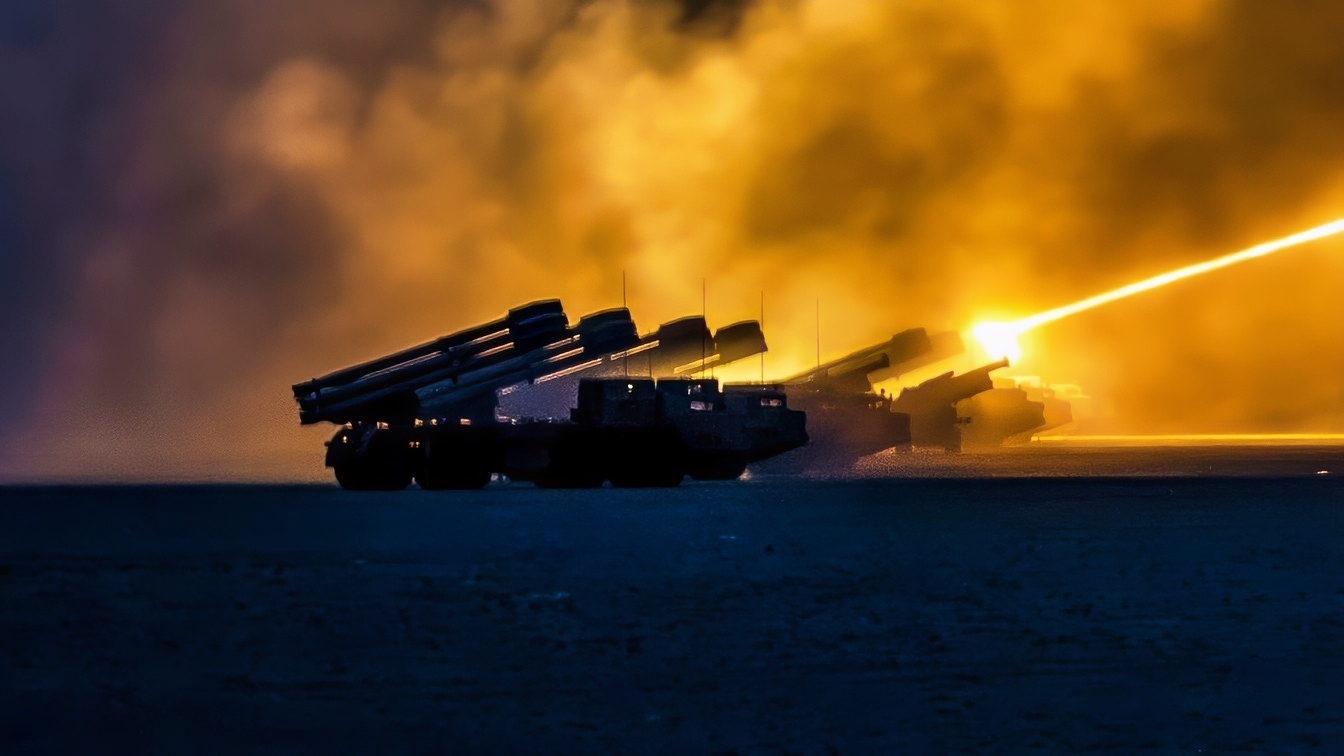
U.S. Soldiers assigned to the 65th Field Artillery Brigade, and soldiers from the Kuwait Land Forces fire their High Mobility Artillery Rocket Systems (U.S.) and BM-30 Smerch rocket systems (Kuwait) during a joint live-fire exercise, Jan. 8, 2019, near Camp Buehring, Kuwait. The U.S. and Kuwaiti forces train together frequently to maintain a high level of combat readiness and to maintain effective communication between the two forces. (U.S. Army photo by Sgt. James Lefty Larimer)
Farther east, a drone fell inside the Tyumen Oil Refinery and started a fire, regional Governor Alexander Moor said. The plant sits more than 2,000 kilometers from Ukraine and processes millions of tons of oil each year. The extent of the damage remained unclear Saturday afternoon, according to a developing account of the refinery fire.
The strikes occurred during another deadly day on both sides of the war. The Associated Press reported Russian attacks that killed Ukrainian civilian workers, while Kremlin-backed officials said a Ukrainian strike killed civilians in occupied Zaporizhzhia. Each side’s casualty claims require independent verification.
Ukraine’s Drone Campaign Now Reaches Across Russia
Ukraine’s attack zone now extends across a large part of Russia. Moscow has to defend border communities, the capital, energy facilities, defense plants, transport nodes, and commercial warehouses at the same time. Ukraine’s growing long-range drone production gives Kyiv more opportunities to test gaps across that enormous territory.
The Russian Defense Ministry’s interception claim cannot be independently confirmed. Even if it is broadly accurate, it does not settle the operational question. A force can stop most incoming aircraft and still face refinery fires, airport restrictions, evacuations, and repeated demands on radar crews and air-defense equipment.
Ukraine does not need every drone to reach its assigned point. Large waves force Russia to activate sensors, move emergency crews, close airspace, and decide which locations receive the strongest protection. The pressure increases when the target list includes Moscow, oil infrastructure, and facilities more than a thousand miles from the border.
Wildberries Has Become a Politically Sensitive Target
Wildberries is central to Russia’s consumer economy, processing millions of orders each day and supporting merchants across the country. Ukraine says some facilities help move drone parts, navigation equipment, and other military-related goods. The Kremlin and the company deny that characterization. The repeated attacks have become part of Ukraine’s campaign against Russian logistics.
The July 25 incident caused limited physical damage in Yekaterinburg, but it followed repeated warehouse strikes that killed workers, destroyed inventory, and disrupted sellers. The latest evacuation shows how the threat alone can interrupt operations even when the main building survives. The broader campaign has been described as long-range economic pressure on Russia.
Russia Cannot Protect Every Fixed Site Equally
The Tyumen fire matters because refineries, logistics centers, airfields, and power systems cannot be moved easily. Russia can add air defenses around selected locations, but every additional assignment leaves less coverage somewhere else. Ukraine has increasingly used deep strikes to turn Russia’s size from a protective buffer into a resource problem.
Russia still intercepted large numbers of drones and prevented more extensive damage at several locations. The July 25 wave nevertheless forced emergency responses across thousands of kilometers, killed two people in Belgorod, halted a major warehouse, interrupted a national sporting event, and started a fire at a Siberian refinery.
The next evidence will come from refinery operating data, Wildberries reopening notices, satellite imagery, and any movement of additional Russian air defenses toward the Urals.
Those indicators will show whether the night produced temporary disruption or longer damage to energy and logistics operations.
About the Author: Harry J. Kazianis
Harry J. Kazianis (@Grecianformula) was the former Senior Director of National Security Affairs at the Center for the National Interest (CFTNI), a foreign policy think tank founded by Richard Nixon based in Washington, DC. Harry has over a decade of experience in think tanks and national security publishing. His ideas have been published in the NY Times, The Washington Post, The Wall Street Journal, CNN, and many other outlets worldwide. He has held positions at CSIS, the Heritage Foundation, the University of Nottingham, and several other institutions related to national security research and studies. He is the former Executive Editor of the National Interest and the Diplomat. He holds a Master’s degree focusing on international affairs from Harvard University.


