


Romania Shot Down a Third Drone in Three Days as NATO Airspace Breaches Mount: Romania shot down a third unauthorized drone in three days on July 26, marking a change in how the NATO member responds to aircraft crossing its border during Russian attacks on Ukraine. A Romanian F-16 destroyed the latest drone over the Black Sea, about 12 kilometers northeast of Sulina, according to France24’s report.
President Nicușor Dan called the repeated breaches “inadmissible and intolerable,” while Romania summoned the Russian ambassador. Reuters reported that investigators identified Friday’s drone as a Shahed-type aircraft used by Russia. The origins of the drones destroyed Saturday and Sunday remained under investigation.
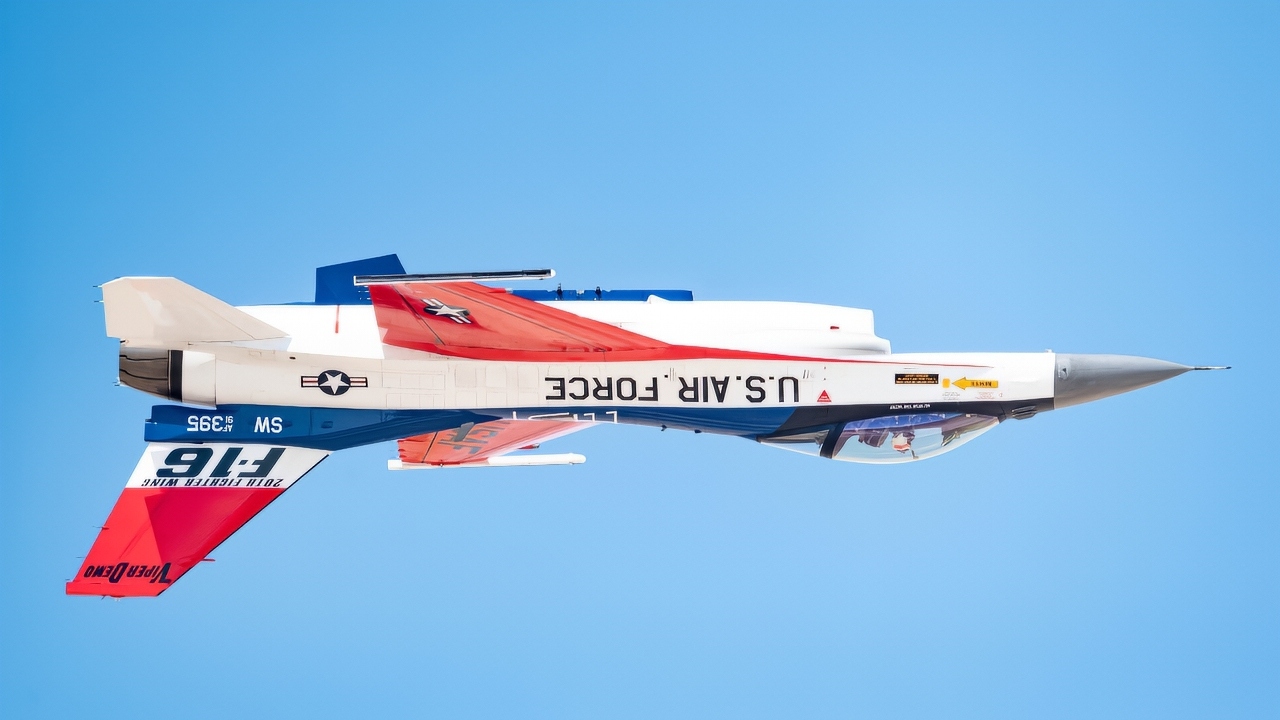
U.S. Air Force Maj. Taylor “FEMA” Hiester, F-16 Viper Demonstration Team commander and pilot, performs aerial maneuvers in an F-16C Fighting Falcon during an air show at Marine Corps Air Station Yuma, Ariz., March 15, 2025. The flight demonstration highlights the versatility of the F-16, a multi-role fighter aircraft proficient in both air-to-air and air-to-ground combat. (U.S. Air Force photo by Senior Airman Steven Cardo)

A U.S. Air Force F-16 Fighting Falcon flies over the U.S. Central Command area of responsibility Oct. 14, 2020. The F-16 Fighting Falcon is a compact, multirole fighter aircraft that has proven itself in both air-to-air combat and air-to-surface attack. (U.S. Air Force photo by Senior Airman Duncan C. Bevan)
Friday’s interception was Romania’s first drone shootdown since Russia began its full-scale invasion in 2022. Bucharest scrambled two F-16s while two Italian Eurofighter Typhoons joined under NATO air-policing arrangements. Fragments landed in a wheat field without causing injuries or damage.
Romania says unauthorized drones have entered its airspace 33 times since the war began. Parliament adopted a law in 2025 allowing the military to neutralize or destroy unmanned aircraft after assessing the threat and danger to people or property. The legislation treats destruction as a last resort.
Romania Has Shifted From Tracking Drones to Destroying Them
Romanian commanders spent years monitoring incursions while avoiding engagements that might drop wreckage onto homes. That caution carried its own danger. On May 29, a Russian Geran-2 drone struck an apartment building in Galați, injured two people and started a fire, according to the Associated Press. The incident showed why Romania could no longer treat drone spillover as harmless debris.
The July shootdowns occurred where authorities judged interception safer. That does not create an automatic order to fire at every unidentified aircraft. Crews still have to identify the track, assess its behavior and select a location where falling wreckage presents the least danger. Romania’s response shows that NATO air policing is adding counter-drone missions.
NATO Faces a Border Defense Problem Rather Than an Automatic War
No Romanian official has described the incidents as an armed attack requiring a collective military response. The repeated entries still test how quickly NATO can detect, classify and neutralize aircraft approaching allied territory. The pattern has raised concern that the Ukraine war is moving closer to NATO’s borders.
NATO launched Eastern Sentry after Russian drones and aircraft violated several allied airspaces in 2025. The alliance says the activity adds fighters, air defenses, surveillance systems and counter-drone technologies along the eastern flank. Its current posture is intended to improve coordination from the Black Sea to northern Europe.
Three shootdowns in three days also increase the risk of miscalculation. Russia can describe an incursion as accidental, while Romania must act before knowing the aircraft’s full route or payload. That uncertainty is why border incidents carry escalation risks without an intentional attack.
Romania Needs Ground-Based Counter-Drone Defenses
F-16s can intercept a slow drone, but fighter sorties consume fuel, maintenance hours and pilot availability. NATO said Romania and other allies are acquiring more ground-based interceptors. The alliance’s integrated defense network connects national sensors, command systems and weapons.

U.S. Air Force Nathalie Olarte, crew chief, launches an F-16 Fighting Falcon from an undisclosed location within the U.S. Central Command area of responsibility, Jan. 14, 2024. The F-16 can fly more than 500 miles (860 kilometers), deliver its weapons with superior accuracy, defend itself against enemy aircraft, and return to its starting point. The U.S. Air Force’s expeditionary capability enables U.S. and coalition forces to rapidly establish credible, combat-ready forces within U.S. Central Command’s area of responsibility to proactively deter potential adversaries. (U.S. Air Force photo by Tech. Sgt. Alexander Cook)
Ground systems, electronic warfare and short-range interceptors would give Romania more options along the Danube and Black Sea coast. Europe is already expanding defenses against Russian missiles and drones, but the Romanian incidents show how quickly those plans have become operational requirements.
Investigators still have to identify the drones destroyed on Saturday and Sunday. Russia had made no immediate public comment, and Romanian teams were searching for wreckage. The next question is whether the three-day sequence ends or becomes the pattern whenever Russia attacks Ukrainian ports near the Danube.
About the Author: Harry J. Kazianis
Harry J. Kazianis (@Grecianformula) was the former Senior Director of National Security Affairs at the Center for the National Interest (CFTNI), a foreign policy think tank founded by Richard Nixon based in Washington, DC. Harry has over a decade of experience in think tanks and national security publishing. His ideas have been published in the NY Times, The Washington Post, The Wall Street Journal, CNN, and many other outlets worldwide. He has held positions at CSIS, the Heritage Foundation, the University of Nottingham, and several other institutions related to national security research and studies. He is the former Executive Editor of the National Interest and the Diplomat. He holds a Master’s degree focusing on international affairs from Harvard University.


