


A recent Barak Ravid exclusive in Axios quotes US President Donald J. Trump as “low-key negotiating” with the Islamic Republic of Iran.
To be clear, the Iranian side denies having anything close to a direct negotiating link to the American administration.
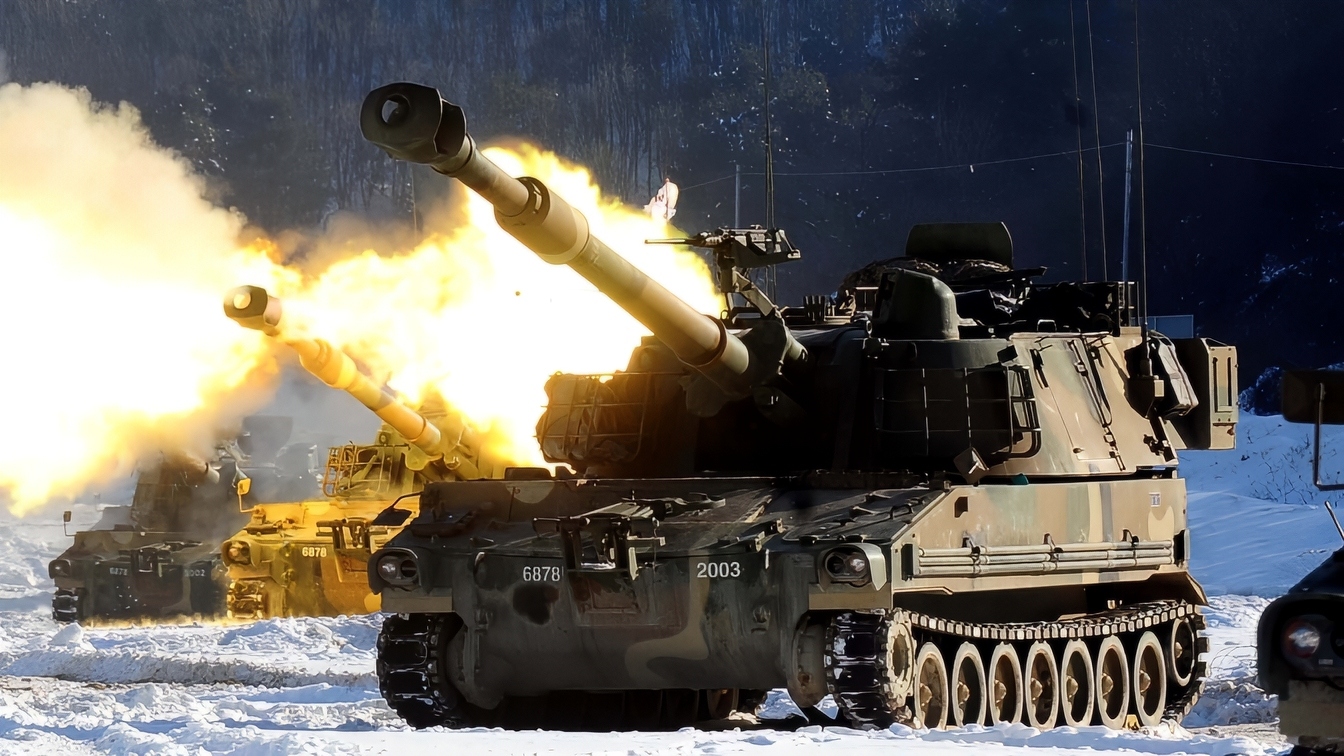
M109 Artillery Creative Commons Photo.
The Iranian claims have been confirmed by the likes of Pakistan, a country whose leaders are very close with both the Trump administration and the Iranian regime.
“Low-Key Negotiating”
So, when the president says he’s “low-key negotiating” with Iran, he means he’s so low-key that neither he nor his representatives are even talking to the Iranian side.
Meanwhile, Washington is leaving it up to regional proxies, like Oman, to conduct any talks with Tehran.
And the Omani side, while managing the expectations of the Americans, continues moving forward with their own designs for reopening the contested Strait of Hormuz (SoH), a key strategic waterway through which more than 20 percent of the world’s crude oil passes every year.
Iran says the waterway is theirs now.
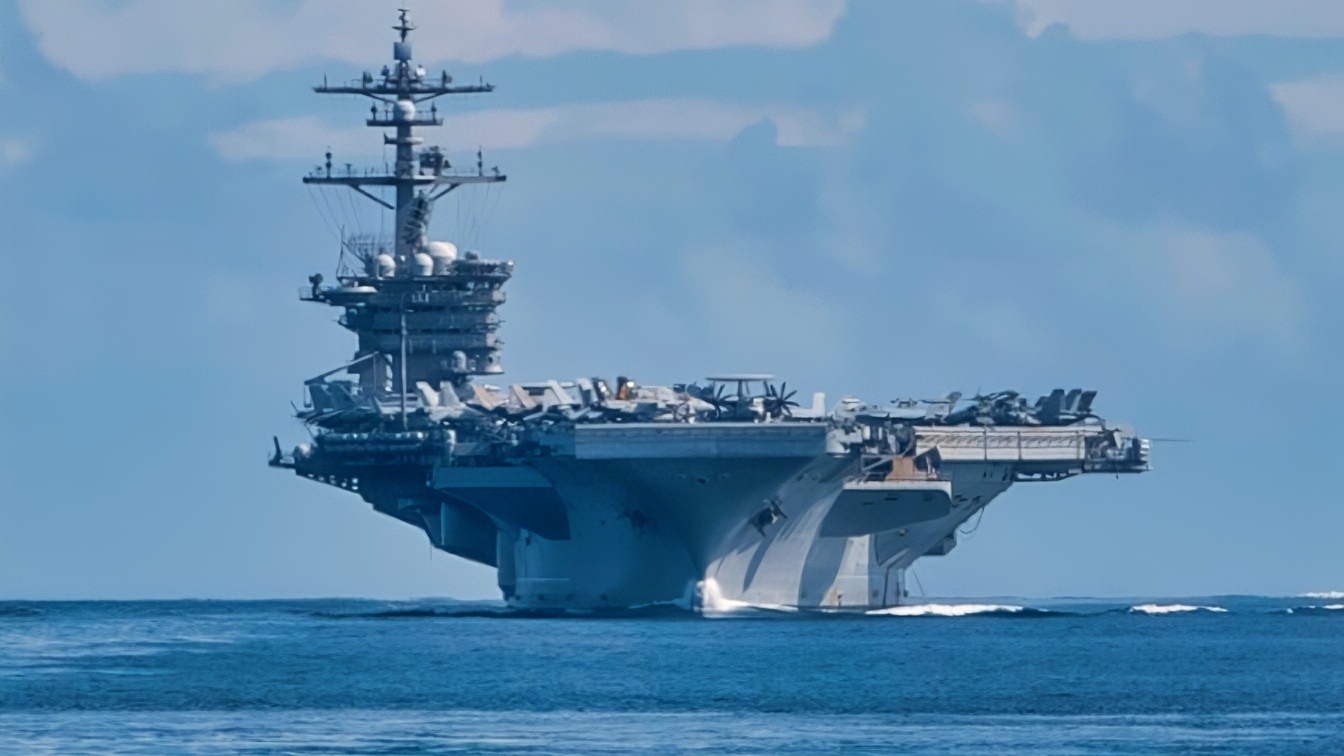
SIBUTU PASSAGE (Feb. 6, 2025) – The Nimitz-class aircraft carrier USS Carl Vinson (CVN 70), left, and the Ticonderoga-class guided-missile cruiser USS Princeton (CG 59) transit the Sibutu Passage Feb. 6, 2025. The Carl Vinson Carrier Strike Group is underway conducting routine operations in the U.S. 7th Fleet area of operations. (U.S. Navy photo by Mass Communication Specialist 3rd Class Brianna Walker)
The Americans want it reopened to the way it was before the war began on February 28.
While the SoH has always been important for global oil flows, it was once far more important than it currently is. Indeed, at one time, 40 percent of the world’s crude oil passed through the SoH.
The diversification of global energy production, such as America’s domestic production revolution and Brazil’s steadily increasing oil production, has helped reduce the importance of the SoH.
Trita Parsi, an expert on Middle East politics and Iran, has argued that if the war never began on February 28, given the persistently declining importance of the SoH, within a decade the world might have relied even less on the SoH because of diversification.
It’s a fascinating “what if” scenario.
Can the Gulf Arab States Diversify Their Way Out of the Strait?
Nevertheless, the region’s energy producers–notably the Kingdom of Saudi Arabia–have managed to avoid total economic collapse because they, too, built alternatives to the SoH.
Saudi Arabia built the East-West Pipeline, which reroutes its oil from the SoH side of the country to ports along the Red Sea.
And those pipelines became a lifeline for the embattled Saudi (and wider Gulf Arab) economy the longer that Iran blocked the flow of energy through the SoH.
Of course, now even Saudi Arabia’s Red Sea alternative has been complicated because Iran’s allies in Yemen–the Houthis–have selectively blocked the Strait of Bab el-Mandeb to any Saudi-flagged ships (until Riyadh agrees to lift its years-long blockade of Yemen and to normalize relations with the Iranian-backed Shiite resistance group).
Still, the Saudi experience with pipelines as an offset to the SoH has many analysts wondering what it would take to spend the next few years expanding upon the Middle East’s pipeline network to ensure that no one depends solely on a contested waterway, like the SoH.
Undoubtedly, pipelines are a necessary piece of the global energy infrastructure — especially in contested regions, like the Middle East. But they are expensive to build.
Pipelines are usually considered less practical than the massive container ships that define the global maritime petroleum trade.
What’s more, they take time to build — and the crisis over the SoH is happening now.
The world cannot afford to wait years for new pipeline builds to come online.
Plus, pipelines remain vulnerable to attack. Yes, they’re easier to repair than it is to reopen the SoH.
At the same time, though, Iran’s missiles and drones have consistently demonstrated their ability to target–and hit–anything in the Middle East (even possibly up to Ukraine).
The idea that Saudi or Qatari pipelines in the region would be immune to attack and disruption any more than the SoH is ridiculous.
The problem for the world is that the geography of the Middle East, and Iran’s ability to weaponize that geography, is far greater than any existing–or potential–workaround.
What Does the Future Hold?
Rather than a simple tweak of the oil flows to redirect them over potential pipelines, the problem facing the Gulf Arab states is actually existential.
Eventually, the world will diversify its reliance on energy flows out of the region entirely if things continue being as problematic and contested as they are (and the president’s “low-key negotiation” style underscores just how protracted this conflict will be).
And that spells real problems for the energy producers in the region (unless a deal with Iran to reopen the SoH and a deal with the Houthis to reopen the Bab el-Mandeb can be reached soon, with or without Washington’s approval).
About the Author: Brandon J. Weichert
Brandon J. Weichert is the Senior National Security Editor. He also manages The Weichert Brief on Substack. Weichert also hosts “National Security Talk” on Rumble. He is the author of four bestselling national security books, the most recent of which is A Disaster of Our Own Making: How the West Lost Ukraine (Encounter Books). Follow him via Twitter/X @WeTheBrandon.


