

Iran Is Offering Trump a Hormuz Off-Ramp—But Not the One He Wants: Trump can accept the Oman-Iran shipping arrangement taking shape right now. What he cannot do is call it the thing he asked for.
Iranian Foreign Minister Abbas Araghchi told his own cabinet on Sunday that talks with Muscat over managing the Strait of Hormuz are “nearing completion” and in their “final stages.” Trump, holding off on a new round of strikes to let the diplomacy play out, has said the parameters of an agreement are already in place and that he expects it to deliver full reopening plus guarantees on Iran’s nuclear program.
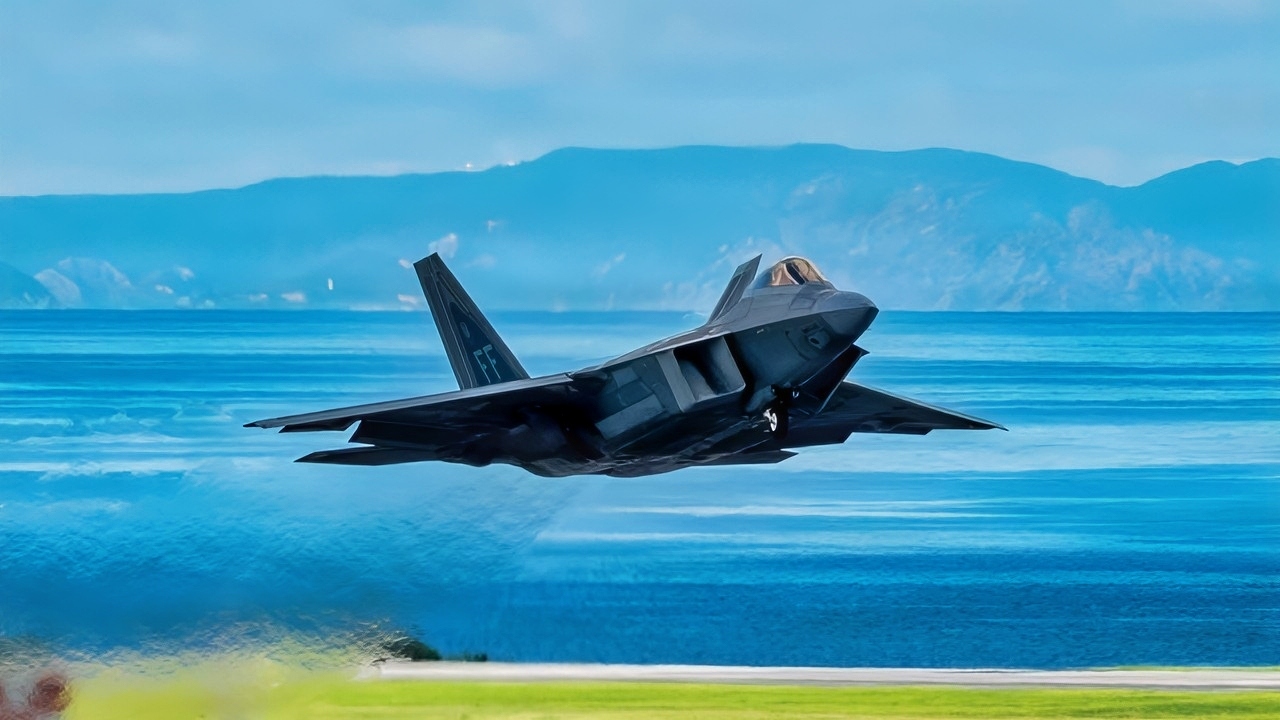
A U.S. Air Force F-22 Raptor assigned to the 27th Expeditionary Fighter Squadron, deployed to Kadena Air Base, takes off during readiness exercise BB26-1 at Kadena Air Base, Japan, Aug. 3, 2026. Exercises and operations incorporating agile combat employment concepts ensure forward-deployed forces in the Indo-Pacific are ready to protect and defend the United States, allied and partner interests at a moment’s notice. (U.S. Air Force photo by Senior Airman Violette Hosack) 18 WG/PA
Those are not merely different descriptions of the same negotiations. Washington is treating the Oman talks as part of a wider settlement process that Tehran says does not exist, and Tehran is the government whose forces have spent months restricting passage through the strait.
Iran Has Already Told You What This Deal Isn’t
Iran’s Foreign Ministry spokesman, Esmail Baghaei, has been almost unusually direct about this. Reaching an understanding with Oman on a shipping route, he said this week, is “necessary but not sufficient” for reopening the strait. A few days earlier, he put it more bluntly still: an agreement with Oman on a new route has “no link to the Strait of Hormuz being opened or closed. That is a separate discussion.”
He blamed the closure not on any disagreement with Muscat but on American and Israeli “aggression,” and made clear that ending that aggression, not signing a corridor deal, is the actual precondition for full reopening.

Iran Army Tank. Image Credit: Creative Commons.
Baghaei said the same thing twice, in two different registers, a few days apart, and it’s worth taking at face value rather than assuming it’s posturing for a domestic audience. That’s not a slip. It’s a position Tehran wants on the record before the ink on any Oman deal is dry.
The substance under negotiation is a new transit route agreed upon by the two littoral states. It would differ from both the prewar IMO traffic-separation scheme and the provisional northern and southern routes that replaced it after the fighting began.
There’s a real dispute buried in the details here — Oman has floated an arrangement modeled loosely on the Strait of Malacca, with shipping companies making voluntary contributions toward search-and-rescue, environmental protection, and navigational services in that waterway.
Iran rejected the specifics and countered with a proposal that gives Tehran more direct routing authority and keeps outbound and inbound traffic largely within terms it controls. Whichever version prevails, note what’s absent from both: any American role in the arrangement, any third-party demining commitment Iran has accepted, and any explicit reopening timeline tied to the corridor’s signature rather than to the end of hostilities as Iran defines them.
Iran Is Keeping the Strait as Leverage
This is where the “technical versus political” framing that’s been floated around in some commentary breaks down, and it’s worth being precise about why. Who administers a shipping lane, who collects fees on it, who has authority to clear mines from it — these aren’t trivial questions. They go to who exercises recognized control over a stretch of international water that carried roughly a fifth of the world’s seaborne oil before the war. An arrangement that gives Iran routing authority and a formal fee-collection role, even a modest one, is nothing. It’s a real concession to Iran’s standing in the strait, negotiated under the shadow of a war in which Iran turned mines and attacks on shipping into coercive leverage.
But administrative control and coercive leverage are not the same asset, and Iran seems to understand that better than most of the commentary crediting this as a breakthrough. Tehran can accept a workable corridor arrangement with Oman — one that lets some tonnage move, eases the immediate pressure Gulf states are putting on it, and gives Iranian diplomacy something to show for months of ruinous closure — while keeping intact the leverage the corridor talks were never going to touch: the standing claim that the strait stays shut, or reopens only partially, until Washington stops what Tehran calls aggression. That claim survives the corridor deal untouched. It was never on the table in the Oman talks to begin with, because Oman isn’t the party Iran says needs to make concessions.
This is a familiar way of managing coercive leverage during a negotiated de-escalation, and Iran isn’t disguising it. Tehran collects the diplomatic credit for cooperating with a neutral neighbor and eases the pressure from Gulf states who want tankers moving again, without conceding the deeper claim that keeps the strait as a lever against Washington specifically. The two Baghaei formulations, read together rather than separately, look less like Iran fumbling its messaging and more like Tehran testing how hard it can press the separation before Washington notices what isn’t included.
What Trump Actually Gets to Claim
So can Trump accept this as an off-ramp? Yes, in the narrow sense that matters most immediately: a signed corridor arrangement gives him grounds to keep holding off on further strikes, evidence that pressure and diplomacy produced something, and a way to move the harder questions, including nuclear guarantees and the military dimension of the war, onto a separate track without looking like he blinked.
What he cannot do is what his own public statements suggest he intends to do: treat this as the settlement he described. Trump has demanded the full reopening of the strait and nuclear guarantees, not a shipping corridor with disputed fee terms and no American role. Accepting the Oman deal as sufficient means either quietly lowering those stated terms or drawing a distinction between pausing the war and ending it, which his own rhetoric has not, so far, made room for. That’s a harder problem than the shipping arrangement itself, and it’s the one nobody in the administration has had to answer publicly yet.
A signature in Muscat will tell you that Iran and Oman have agreed on how some ships may move through some part of the strait. It will not tell you the strait has reopened. Only ships moving through it afterward, without mandatory fees, discretionary Iranian permission, or the threat of another mining campaign hanging over the insurance market, will tell you that. Trump can use the first fact to buy time. He needs the second before anyone lets him call it what he says it is.
About the Author: Dr. Andrew Latham
Andrew Latham is a professor of international relations and political theory at Macalester College in Saint Paul, MN. You can follow him on X: @aakatham.


