

When is a war not a war? Historically, a nation would issue a formal declaration of war against another sovereign state, effectively formalizing hostilities. These days, declarations of war are incredibly uncommon. Many conflicts since the Second World War have begun similarly ambiguously, showing how declarations of war have fallen out of use. In the case of Russia’s full-scale invasion of Ukraine, President Vladimir Putin announced a “special military operation” rather than a formal declaration against Kyiv.
When Argentina invaded the Falkland Islands in 1982, neither the Argentine military junta nor Margaret Thatcher’s British government formally declared war on one another, yet the conflict is widely known as the “Falklands War”.
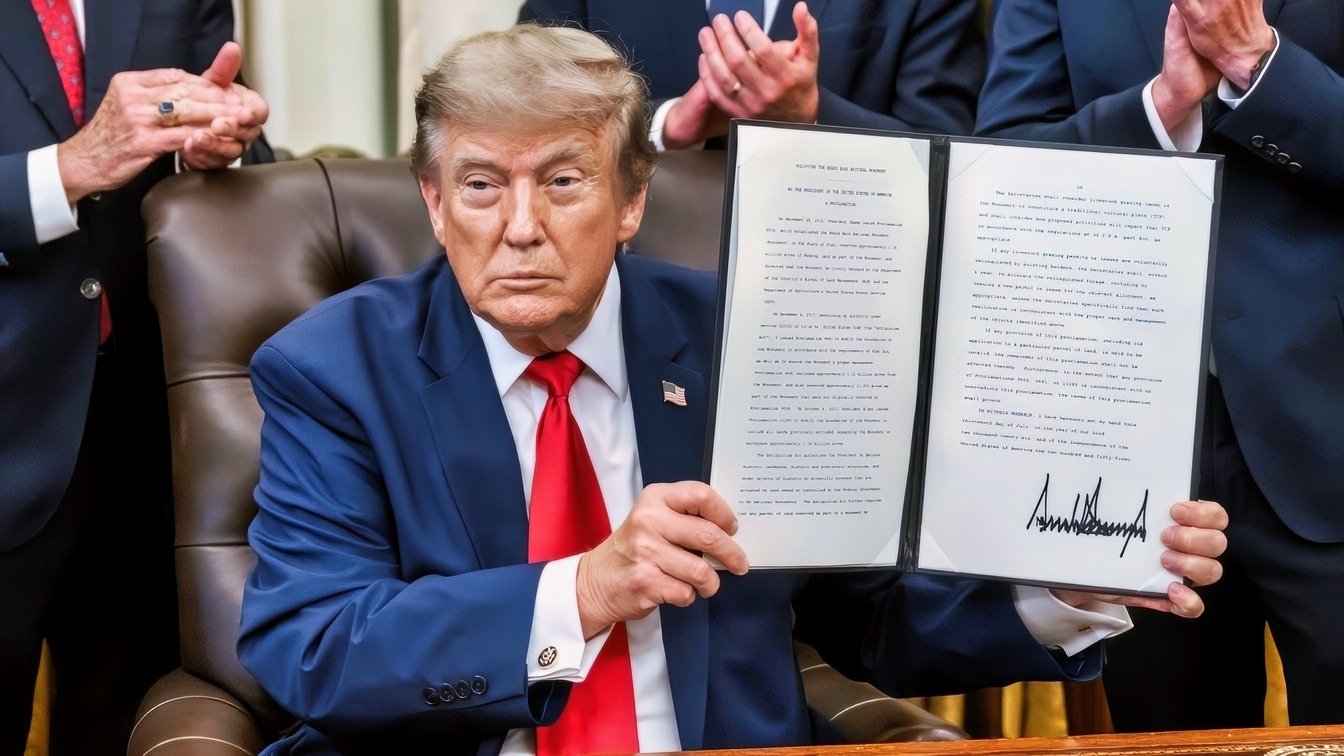
President Donald J. Trump signs executive orders alongside Utah Governor Spencer Cox and members of the Utah congressional delegation in the Oval Office, Monday, July 13, 2026. (Official White House Photo by Molly Riley)
The United States has not formally declared war since 1941, when Franklin D. Roosevelt signed a declaration of war against Nazi Germany. Constitutionally, such declarations require Congressional approval – something that the ongoing conflict with Iran has not received.
Iran Dominates Vance’s Briefing
On Thursday, 3rd September, Vice President J.D. Vance hosted the first White House Press Briefing in over 40 days. It was also the first since former White House Press Secretary Karoline Leavitt announced her resignation to spend more time with her family.
After a delayed start, Vance faced questions from reporters on a range of conflict-related topics.
Amid rising energy prices, Vance pointed the finger at Iran, arguing that gas prices would be “much, much higher” if it were not for the Trump administration’s efforts. He also addressed an alleged U.S. strike on an Iranian wedding party earlier this week, saying he was “extremely skeptical” of claims by Iranian state media. He added that the U.S. never targets civilians, reiterating that the reports were being investigated “very fully.”
The Strait of Hormuz was also discussed.
Vance said that the U.S. is “protecting a lot of ships” in the key waterway, through which 20% of the world’s oil passed before the war began in February.
He added that there would be a “catastrophic global energy crisis” were it not for ongoing U.S. operations to protect commercial shipping, and that the U.S. would only return to the negotiations once Iranian attacks on commercial vessels ceased.
On this, Vance said he did not know when the conflict would end, adding “You would have to ask the Iranians.”
It’s “Not a War”
One line which stuck, however, was Vance’s claim regarding terminology. “I wouldn’t call it a war,” he told reporters. “Right now, there is no active shooting.”
That may have been true at that moment, but the past week has been rocked by a re-escalation in the conflict.
The U.S. has struck targets across Iran, with Tehran retaliating with attacks on U.S. assets based in Middle Eastern allies.
Vance himself said that Iran had been “shooting at ships”, notably arguing that a U.S. return to the negotiating table could happen once that stopped.
Does it Matter?
Ultimately, whether you call it a “war” or a “conflict”, the outcome is the same: two sides attacking each other through military action, with ramifications for each country’s population.
In the U.S., Iran, and around the world, energy prices are rising as commercial oil shipments are unable to pass through the Strait of Hormuz, subsequently raising the cost of living – an issue that is increasingly discussed around election time.
In two months, the midterms will decide how the last two years of Donald Trump’s presidency play out. An unpopular war, combined with rising energy prices, will almost certainly favor the Democrats and make life difficult for the Trump administration.
The Importance of Terminology
When the conflict began earlier this year, senior figures repeatedly promised a short conflict that would be over in a matter of weeks.
In fact, Vance himself said there was “no chance” of a prolonged conflict shortly after Operation Epic Fury began. Yet, six months on, Iran is still fighting, and there’s no end in sight.
Granted, the daily bombardment of the war’s first six weeks has been replaced by economic warfare with occasional attacks from either side.
For Vance, not calling it a “war” may win over a few voters willing to believe it’s a short-term military operation instead.
But for the vast majority, faced with rising living costs and daily updates about ongoing events halfway around the world, are they really going to believe that the U.S. is not at war with Iran when they cast their vote at the ballot box?
About the Author: Shay Bottomley
Shay Bottomley is a British journalist. He has written for the Western Standard, Business Insider, Maidenhead Advertiser, Slough Express, Windsor Express, Berkshire Live and Southend Echo.