

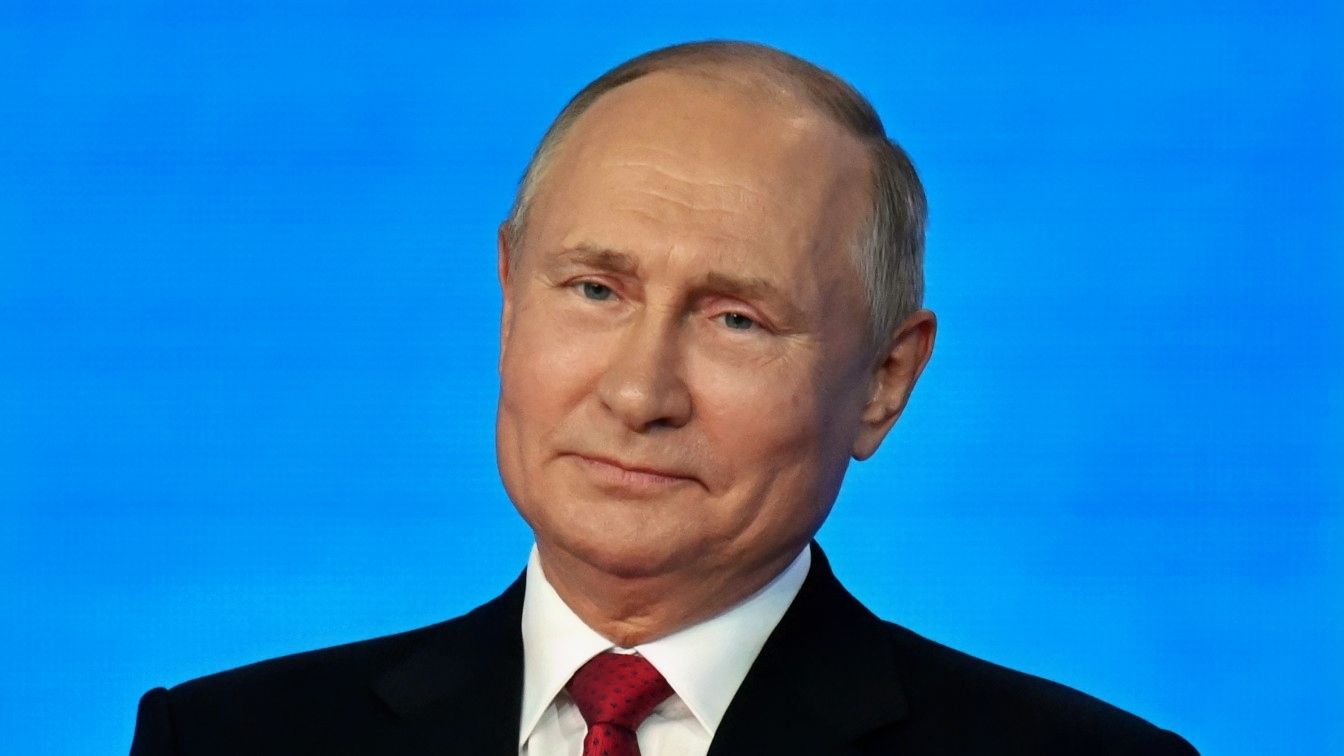
Warsaw, Poland – Speaking last month on Polish Television, the head of the Estonian Foreign Intelligence Service stated that the clock is ticking for Russia’s military and President Vladimir Putin, as trends in the Ukraine war increasingly turn against them both. The sharp increase in battlefield losses and the economic bad news continue to create combined pressures on Putin that should be pushing him to the position where he seriously has to engage in peace talks, said the Foreign Intelligence Service chief, Kaupo Rosin.
Rosin’s prediction is that Moscow has only four or five months left in which it can dictate peace terms from any position of advantage. He listed numerous economic, military, and societal trends facing Putin that he said should force the Russian dictator to negotiate.

Sukhoi Su-34 Fullback. Image Credit: Creative Commons.
“Time is not in Russia’s favor,” the spy chief told US news service CNN in an interview he gave to the network. As the head of an intelligence service of a country that is not only a NATO member and a former Soviet republic, but also one of Russia’s closest neighbors, Rosin stated that he spends a good deal of his time analyzing Russia’s internal situation.
“I do not hear any more talk about total victory. People [in the Kremlin] recognize that the situation on the Ukrainian battlefield is not going too well,” Rosin told the US broadcaster. He also referred to the problem Russia now faces: it is losing more personnel on the battlefield than it can replace through new recruitment.
The War is Not Going Well For Vova
“The war is not going well for Vova,” echoed a Russian military analyst formerly based in Moscow who spoke to National Security Journal – and who used the diminutive nickname for “Vladimir” in a denigrating reference to the Russian President.
“In addition to not being able to replace soldiers on the front line, he has the additional problem that his former KGB cronies and the other figures who dominate the former Lt. Col.’s inner circle have done a marvelous job in the past two decades of destroying what was once one of the more impressive defense-industrial complexes in the world,” he said.
“Between the stealing of the property of these military enterprises and robbing the state’s defense budget, many of the most famous companies in the history of Russian weapon systems development hardly exist. Once they are reduced to nothing, they cannot be reconstituted overnight – if ever. Their experienced personnel are all gone, and who knows where they are now,” he explained.

Su-34 Fullback Airshow Photo Creative Commons Image
This creates a difficulty for Moscow to supply hardware and has led to such absurd measures as sending Russian troops to attempt to infiltrate Ukrainian positions on horseback or in garage-modified “Mad Max” style motorbikes.
The consequences have been evident in recent months, with Russia recording its first net territorial losses in nearly two years in April. In May, Ukrainian President Volodymyr Zelenskiy announced that Ukraine’s forces had regained 590 square kilometers of land since the beginning of 2026.
Analysis of the losses suffered by Moscow forces calculates approximately 1,000 casualties a day – counting both dead and wounded – and that even with these horrific numbers, the average rate of advance is only about 70 meters per day. The US Secretary of State Marco Rubio stated in mid-May that “15,000–20,000 soldiers a month” were killed since May, and other estimates are as much as double these numbers.
Risks In Mobilizing Manpower
Rosin gave his interview more than three weeks ago, and in the intervening period, there has been an even more dramatic shift in favor of Ukraine in the overall progress in the war. “This shows just how rapidly the dynamics can change,” said the former Moscow-based military analyst.
The drone war has also seen a turnaround, with Ukraine in a markedly superior position, plus new-generation Ukrainian interceptors are now taking down a higher percentage of those UAVs that Russia launches.
Mykhailo Fedorov, Ukraine’s defense minister, had stated four weeks ago that Russian Shahed-type drones shot down by Kyiv’s interceptor drones had “doubled over the past four months.” With these increasingly dismal battlefield results, by the end of the summer, Moscow “may not be able to negotiate from a position of strength anymore,” Estonian spy chief Rosin said.
He pointed out that Putin’s only remaining option for seizing the whole of Ukraine’s eastern Donbas region would be “some type of forced mobilization”, but that such a change in policy would create “additional internal stability risks” for Russia’s leadership.
“They [in the Kremlin] are very concerned about internal stability, monitoring it very carefully,” Rosin said. Forced mobilization “is not a decision they would make very easily.” A partial Russian mobilization that was announced in 2022 caused an internal blowback and an exodus of men of fighting age fleeing abroad to escape conscription.
About the Author: Reuben F. Johnson
Reuben F. Johnson has thirty-six years of experience analyzing and reporting on foreign weapons systems, defense technologies, and international arms export policy. Johnson is the Director of Research at the Casimir Pulaski Foundation. He is also a survivor of the Russian invasion of Ukraine in February 2022. He worked for years in the American defense industry as a foreign technology analyst and later as a consultant for the U.S. Department of Defense, the Departments of the Navy and Air Force, and the governments of the United Kingdom and Australia. In 2022-2023, he won two awards in a row for his defense reporting. He holds a bachelor’s degree from DePauw University and a master’s degree from Miami University in Ohio, with a specialization in Soviet and Russian studies. He lives in Warsaw.


