

A Russian cruise missile crossed into NATO territory overnight on July 30 during Moscow’s latest barrage of missile and drone strikes against Ukraine. The action prompted Poland to scramble fighter aircraft.
Polish authorities say that a Russian Kh-101 air-launched cruise missile entered Polish airspace before it crashed in an uninhabited field near the village of Tarnawa-Kolonia in eastern Poland.

A U.S. Air Force F-16 Fighting Falcon flies over the U.S. Central Command area of responsibility Oct. 14, 2020. The F-16 Fighting Falcon is a compact, multirole fighter aircraft that has proven itself in both air-to-air combat and air-to-surface attack. (U.S. Air Force photo by Senior Airman Duncan C. Bevan)
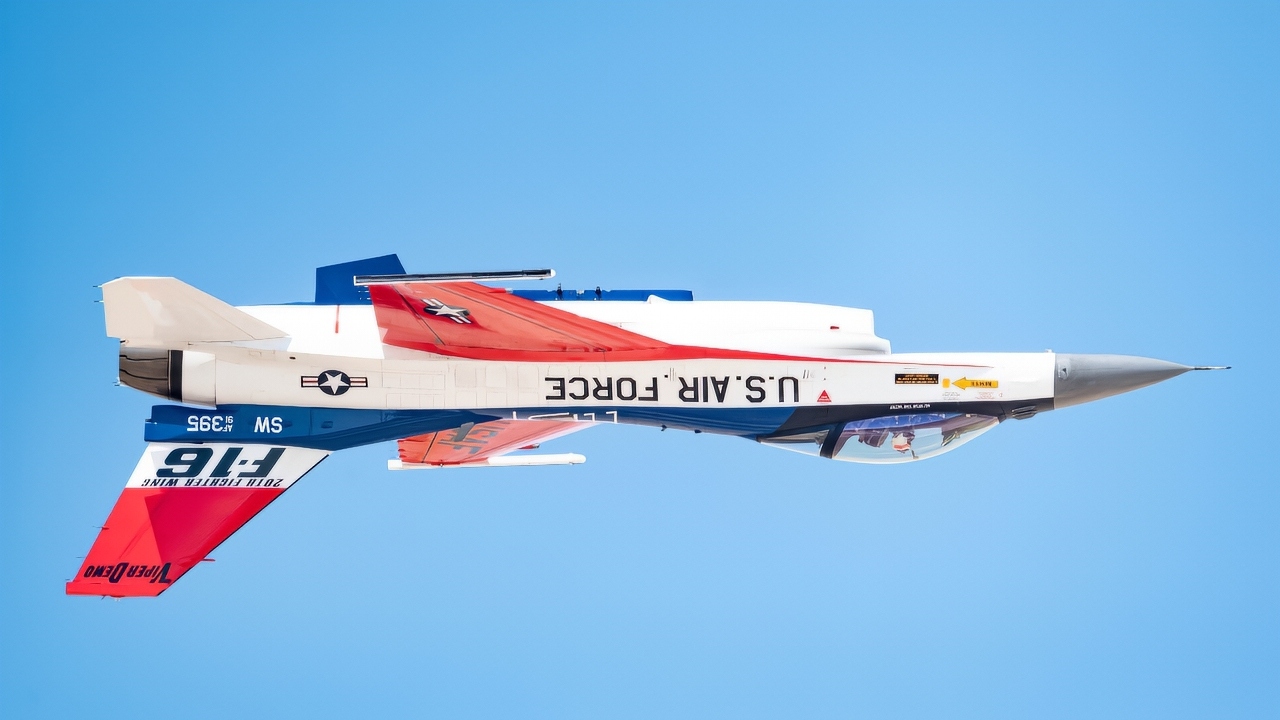
U.S. Air Force Maj. Taylor “FEMA” Hiester, F-16 Viper Demonstration Team commander and pilot, performs aerial maneuvers in an F-16C Fighting Falcon during an air show at Marine Corps Air Station Yuma, Ariz., March 15, 2025. The flight demonstration highlights the versatility of the F-16, a multi-role fighter aircraft proficient in both air-to-air and air-to-ground combat. (U.S. Air Force photo by Senior Airman Steven Cardo)
The missile left a roughly 10-meter-wide crater in the ground.
The incident occurred during an overnight attack that saw more than 70 missiles and almost 300 drones fired at targets across Ukraine.
Polish Prime Minister Donald Tusk said that there was no indication that Poland had been deliberately targeted in the attack, but confirmed that the military was prepared to intercept the missile if it had posed a greater threat.
Missile Lands In Poland
Polish police and military personnel quickly secured the impact site following reports from residents of a loud explosion overnight.
The crater was discovered in an agricultural field around two kilometers from the nearest residential buildings and approximately 100 kilometers from the Ukrainian border.
No injuries were reported.
Speaking during a press conference on the morning of Thursday, July 30, Tusk identified the object as a Kh-101 cruise missile.
“Everything indicates that it was a Russian Kh-101 cruise missile,” Tusk said.
The spokesperson for NATO’s Supreme Headquarters Allied Powers Europe, Col. Martin O’Donnell, also confirmed that NATO activated its defenses in response to the incident.
“In response to a Russian missile of currently unknown type that entered Polish airspace and later crashed into Polish territory — one of many missiles fired by Russia at Ukraine overnight — NATO and Poland activated their air and ground defenses,” O’Donnell said.
Poland’s military activated its air defense procedures overnight as Russia’s attacks on western Ukraine unfolded.
NATO Responds
NATO quickly confirmed that it had been informed of the incident and reiterated that the alliance is prepared to defend the territory of every member state.
Allied aircraft were activated to monitor the situation while Russia’s overnight attack on Ukraine continued, though the alliance has publicly acknowledged that the incident was likely unintentional.
The missile has therefore been treated as a consequence of Russia’s increasingly frequent large-scale strikes near the alliance’s eastern border.
Although brief airspace incursions do not automatically trigger NATO’s collective defense provisions, they are treated as serious security incidents given the risk they pose to innocent civilians.
Military commanders have only minutes to determine whether incoming missiles are a navigation error, a malfunction, or indeed part of a deliberate attack.
In this time, commanders must determine the appropriate defensive response while the situation is fully assessed.
Why Entering NATO Airspace Matters
Missiles landing outside of an active warzone and in NATO airspace matter for several reasons, but politically, it is significant because Poland is a full member of NATO.
That means any attack against its territory could potentially trigger consultations under Article 4 of the North Atlantic Treaty or, in the event of a deliberate armed attack, collective defensive obligations under Article 5.
In short, Article 5 requires that an attack on one NATO member is deemed an attack on all NATO members, meaning that the alliance will act collectively to respond to any incursion or strike.
However, the alliance has historically distinguished between accidental incursions into NATO territory and intentional military aggression.
This Has Happened Before
Incursions into NATO territory are not new.
Thursday’s overnight incident is just the latest in a series of Russian missiles and drones entering or landing on NATO territory since Moscow launched its full-scale invasion of Ukraine in February 2022.
While alliance officials have generally concluded that the incursions were unintentional, each incident has forced NATO members to rapidly assess whether Russia is taking appropriate care.
The most serious of the war’s incidents occurred early into the conflict, on November 15, 2022, when a missile struck the Polish village of Przewodów, killing two civilians.
It was initially feared that Russia had deliberately attacked NATO territory, prompting urgent consultations among leaders within the alliance.
Investigators from Poland and NATO, however, later concluded that the projectile was most likely a Ukrainian S-300 air-defense missile that had veered off course while attempting to intercept a Russian missile barrage.
Even so, the incident demonstrated how easily wars can spill over borders.
Since then, Russian weapons have repeatedly crossed into NATO airspace during large-scale strikes on western Ukraine.
On December 29, 2023, a Russian cruise missile entered Polish airspace for almost three minutes, traveling roughly 40 kilometers before turning back into Ukraine.
Polish and allied aircraft tracked the missile throughout the incident, with Warsaw later summoning Russia’s chargé d’affaires to demand an explanation.
Another similar incident occurred on March 24, 2024, when a Russian cruise missile briefly entered Polish airspace for 39 seconds near the village of Oserdów.
About the author: Jack Buckby
Jack Buckby is a British researcher and analyst specializing in defense and national security, based in New York. His work focuses on military capability, procurement, and strategic competition, producing and editing analysis for policy and defense audiences. He brings extensive editorial experience, with a career output spanning over 1,000 articles at 19FortyFive and National Security Journal, and has previously authored books and papers on extremism and deradicalization.


