


The Ukraine War appears to be entering an entirely new and unpredictable round of escalation (at the same moment that the Iran War is).
On top of Ukraine striking critical Russian energy infrastructure, Romania’s interception of an unidentified drone entering its airspace underscores the growing regional security challenges that concern policymakers and analysts alike.

A U.S. Air Force F-16 Fighting Falcon taxis to be disarmed after returning from a flight during Combat Archer UK at RAF Lakenheath, England, April 15, 2025. Combat Archer UK was one of six elements in the Combat Weapons Systems Evaluation Program, typically held in the U.S. By hosting Combat Archer UK in Europe, U.S. Air Forces Europe saved millions of dollars, allowing them to enhance the mission in other capacities. (U.S. Air Force photo by Airman 1st Class Zachary Jakel)
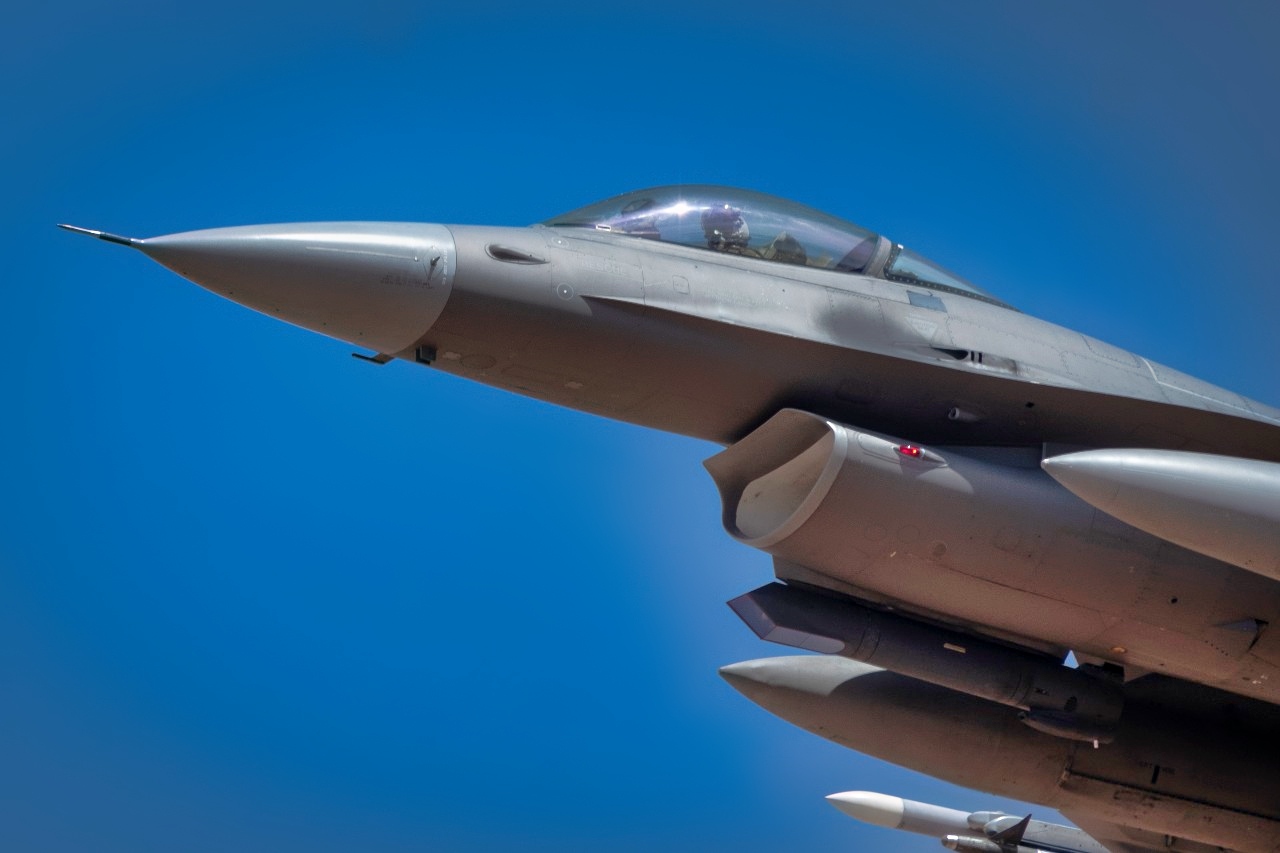
A U.S. Air Force F-16 Fighting Falcon assigned to the 54th Fighter Group soars through the sky over the Oscura Range at Holloman Air Force Base, New Mexico, April 21, 2025. During range operations, F-16 pilots perform munition drops and strafing maneuvers to test their abilities in the aircraft. (U.S. Air Force photo by Senior Airman Nicholas Paczkowski)
Romanian officials confirmed that an F-16 fighter destroyed the aircraft after it crossed into Romanian territory, though authorities stopped short of identifying which country launched the drone.
Drones Fly Over Romanian Territory
Romanian President Nicusor Dan has stated that the drone entered Romanian airspace during the morning hours, according to Romanian military surveillance systems.
Romanian authorities immediately launched a military response in the form of two Romanian Air Force F-16 Fighting Falcons and two Italian Air Force Eurofighter Typhoons, operating as part of NATO’s air policing mission, being scrambled to intercept the unidentified aircraft.
The Romanian forces tracked the drone for more than an hour, and Romanian authorities’ decision to order the F-16s to shoot the target out of the sky demonstrates their readiness to defend national security, reassuring the public and allies of Romania’s resolve.
Shortly after that order went out, the fighter successfully downed the drone over an uninhabited area near the village of Padina in Buzau County, around 70 miles northeast of Bucharest.
Romanian officials have since emphasized that the engagement occurred over an area devoid of civilians, meaning the pilot could rest easy when engaging the unknown drone.
Romanian authorities soon recovered the drone once it crashed.
Romania Won’t Name Names
Despite having repeatedly accused Moscow of violating its airspace during the Ukraine War, the Romanian government has refused to identify where the drone emanated from officially, leaving open questions about whether it was a state actor or non-state entity, which is crucial for assessing regional threats.
Many of these incidents occurred during Russian attacks against Ukrainian ports along the Danube River, including facilities located only a short distance from Romanian territory.
In fact, falling debris from drones has periodically landed inside Romania, prompting repeated investigations and increasing pressure on the Romanian government to strengthen its air defenses.
NATO’s Role
The presence of those Italian Eurofighter Typhoons showcases the way in which the conflict in Ukraine could easily become a truly regional–even possibly–world war, and how close we are possibly to that becoming a dangerous new reality.
Yet, this incident also highlights that Europeans, via NATO, are unwilling to abandon their previous commitments to regional defense.
If it was, in fact, a Russian drone that crossed into Romania, this could easily devolve into a true NATO-Russia war.
Understanding the Growing Complications of Drone Warfare
The incident further highlights the way in which drone warfare completely changed–complicated–Europe’s general security strategy.
Both Russia and Ukraine now rely heavily on these unmanned systems for reconnaissance, long-range strikes, and attacks on military infrastructure.
Officials have reported similar drone-related incidents in multiple NATO nations, ranging from Poland and Moldova to Finland and Turkey.
Romania Keeps Investigating
Romanian authorities have not disclosed the origin behind this specific drone interception over their territory. Yet, Bucharest says it is investigating the incident.
Until that investigation is complete, Romanian leaders will refrain from assigning responsibility.
One cannot also rule out the possibility that the drone was a stray friendly system. That a friendly state, like Ukraine, might be behind the drone and simply not be taking credit for it would not be unheard of.
After all, a 2024 incident near Poland’s border with Ukraine saw a missile straying into Polish territory. The Ukrainians claimed it was a Russian system fired at Poland.
It was later determined by skeptical Polish authorities to have been a Soviet-era air defense interceptor belonging to Ukraine.
But Ukraine refused to acknowledge it was their system and insisted that it was a Russian missile that attacked Poland (which would have prompted Article V discussions).
Until a fuller investigation into the Romanian incident is completed, Bucharest is right to withhold judgment.
About the Author: Brandon J. Weichert
Brandon J. Weichert is Senior National Security Editor. He also manages The Weichert Brief on Substack. Weichert also hosts “National Security Talk” on Rumble. He is the author of four bestselling national security books, the most recent of which is A Disaster of Our Own Making: How the West Lost Ukraine (Encounter Books). Follow him via Twitter/X @WeTheBrandon.


