
Will Russia Go Further? Russia continues to escalate its missile strike campaign against Ukraine, killing at least 10 people in attacks overnight into Monday, July 20. This time, the strikes centered on the Black Sea port of Odesa and included a deadly strike on a civilian cargo ship carrying Ukrainian grain. The attacks came a day after Russia carried out one of its largest ballistic missile barrages of the war against Kyiv. The strikes also suggest that Moscow still believes that the best way to respond to Ukraine’s crippling strikes against its energy and oil infrastructure is to respond in kind – at least, for now.
Russia Hits Grain Ship and Odesa Overnight

Challenger 3 On the March. Image Credit: Creative Commons.
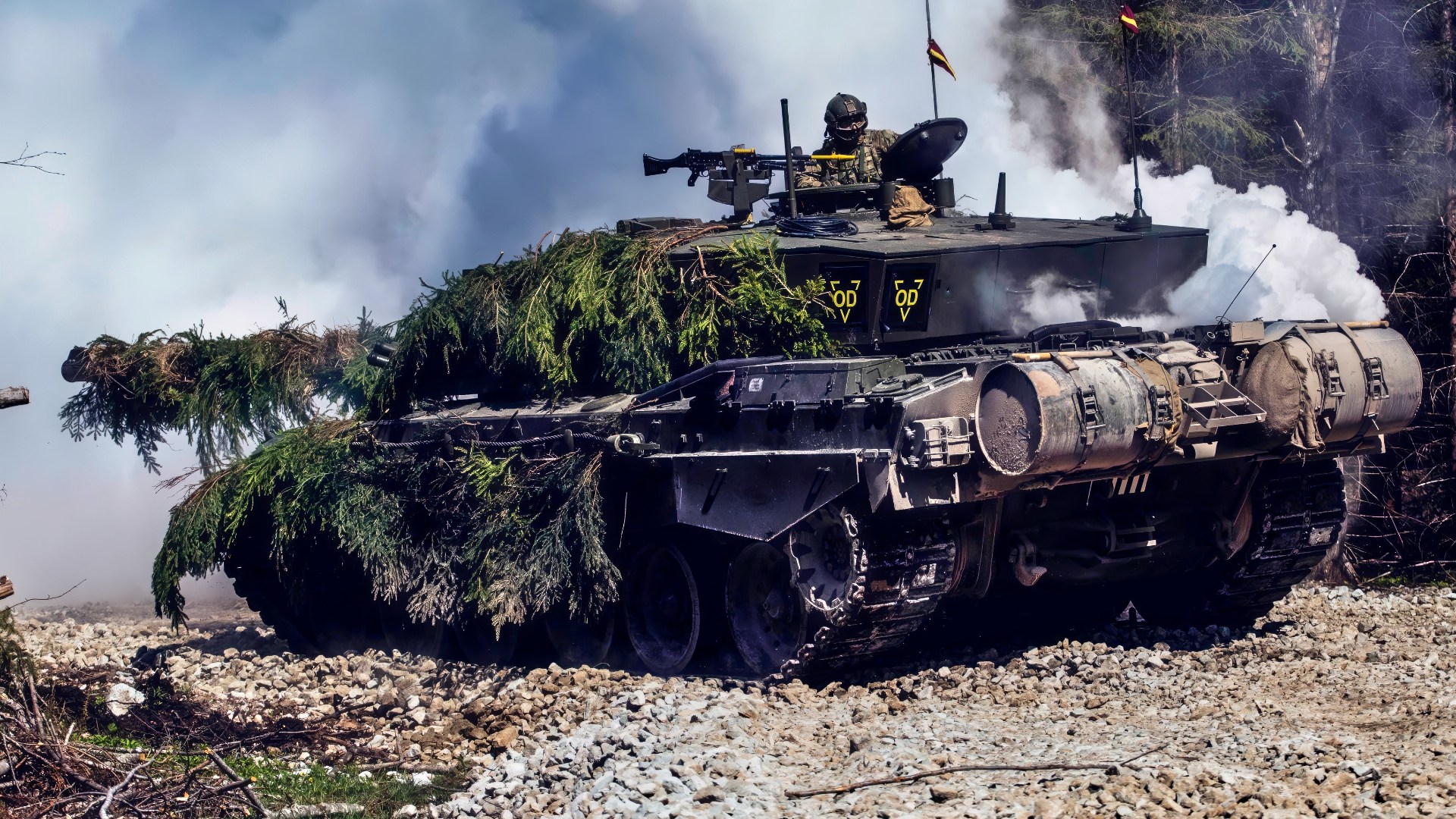
A British Army Challenger 2 Main Battle Tank (MBT) lays down a smoke screen during Spring Storm 19, Estonia’s largest annual military exercise. Roughly 9,000 soldiers from Estonia, other NATO Allies and partner nations have gathered near the town of Jõhvi to engage in a collective defence exercise, strengthening their ability to work together in times of crisis.
The deadliest of the overnight attacks took place near Ukraine’s largest seaport, where Russia struck the Guinea-Bissau-flagged cargo ship Golden Leo with three cruise missiles as it transported corn from Odesa. Ukraine’s Navy said the vessel, crewed by sailors from India and Syria, caught fire after the missiles struck on Sunday evening.
The Ukrainian Seaports Authority said that a search and rescue operation continued throughout the night, before rescuers recovered nine crew members and one Ukrainian pilot who had been killed. Eight of the vessel’s 17 crew members reportedly survived the attack.
The attack on the Golden Leo, owned by Mumbai’s Ocean Grace Shipping Ltd., is the deadliest attack on a commercial ship during the most recent escalation in the Black Sea, where both Ukraine and Russia are targeting maritime infrastructure. The attack follows Ukrainian assaults on Russian maritime assets and infrastructure supporting the export of Russian grain – just the latest assault on key revenues for Moscow.
Russia also launched a separate missile strike against Odesa itself early Monday, killing three civilians and injuring another three. Regional authorities said civilian infrastructure was damaged, while Russia’s Defense Ministry later claimed its forces had struck fuel reservoirs at the Port of Odesa during the overnight operation.
One of the War’s Largest Ballistic Barrages
The overnight strikes came less than 24 hours after Russia launched one of the largest ballistic missile attacks of the war against Kyiv. According to the Ukrainian Air Force, Russia fired 41 missiles and 125 attack drones, including 25 Iskander-M and S-400 ballistic missiles, 10 Zircon hypersonic missiles, three Oniks anti-ship missiles, and three Kh-59/69 guided missiles. Ukrainian air defenses also intercepted 18 missiles and 108 drones, but several ballistic missiles penetrated defenses and struck the capital – largely a result of Kyiv’s well-documented interceptor shortage.
President Volodymyr Zelenskyy has said that Russia is now deliberately concentrating ballistic missiles at Kyiv because they are Ukraine’s most difficult threat to intercept.
“A large number of ballistic missiles were used – today was one of the largest ballistic missile attacks. Kyiv and the region were the Russians’ primary target. They had been preparing this attack for several days, stockpiling missiles. The threat, of course, remains even now, and this must be taken into account. Russia is placing its wagers on ballistic missiles, and it is because of them that Putin still believes in his war,” Zelenskyy said in a statement.
In response to the attacks, the Ukrainian president once again called on his allies in the West to speed up the pace of deliveries of interceptors that would reduce the impact of Russia’s escalating ballistic missile campaign.
“It is very important that our partners understand what is happening and that air defense missiles are needed to protect lives literally every single day. I very much expect Ukraine’s Ministry of Foreign Affairs and other government officials at all levels to promptly engage with our partners regarding the packages we have already agreed on. It is important to accelerate everything – both with our European partners and with the United States. The result is needed every day,” he said.

Challenger 2 Tank. Image Credit: Creative Commons.
Will Russia Go Further?
For now, Russia appears set on exploiting Ukraine’s biggest vulnerability: its shortage of Patriot interceptor missiles. The growing concentration of Iskander ballistic missiles in the most recent attacks suggests Moscow believes it can achieve greater results by targeting a weakness that Kyiv has repeatedly warned its allies about – but if Western deliveries of new interceptors accelerate, that advantage will begin to disappear.
That possibly helps explain why NATO is discussing scenarios in which Russia extends the war beyond Ukraine. In an interview published over the weekend, Admiral Giuseppe Cavo Dragone, Chair of NATO’s Military Committee and the alliance’s highest-ranking military officer, said repeated warnings from Western intelligence agencies about possible Russian operations against Poland or the Baltic states should be taken seriously.
“ It is realistic to the point where we define Russia as a threat. It is a threat because Russia could make this kind of move. But again, it’s something we need to be prepared for, and we need to be prepared to give them much more damage than the advantage they could get from this kind of decision. And we are doing it. I mean, today they would lose a lot, much more than what they could gain just by touching Poland or the Baltic states. And we are ready,” Dragone said.
It is unclear exactly what Russia intends to do next, and there has been no direct suggestion that Moscow is preparing an imminent attack on NATO territory. But as Ukraine’s long-range strikes raise the economic cost of the war inside Russia, NATO appears to be intent on ensuring that, should Moscow look beyond Ukraine to regain the initiative, it faces a level of deterrence that ensures Putin does not make a miscalculation.
About the Author: Jack Buckby
Jack Buckby is a British researcher and analyst specializing in defense and national security, based in New York. His work focuses on military capability, procurement, and strategic competition, producing and editing analysis for policy and defense audiences. He brings extensive editorial experience, with a career output spanning over 1,000 articles at 19FortyFive and National Security Journal, and has previously authored books and papers on extremism and deradicalization.


Mark
July 22, 2026 at 9:52 am
So, We now know just as much as before we read this piece. Russia may or may not attack. Brilliant.