

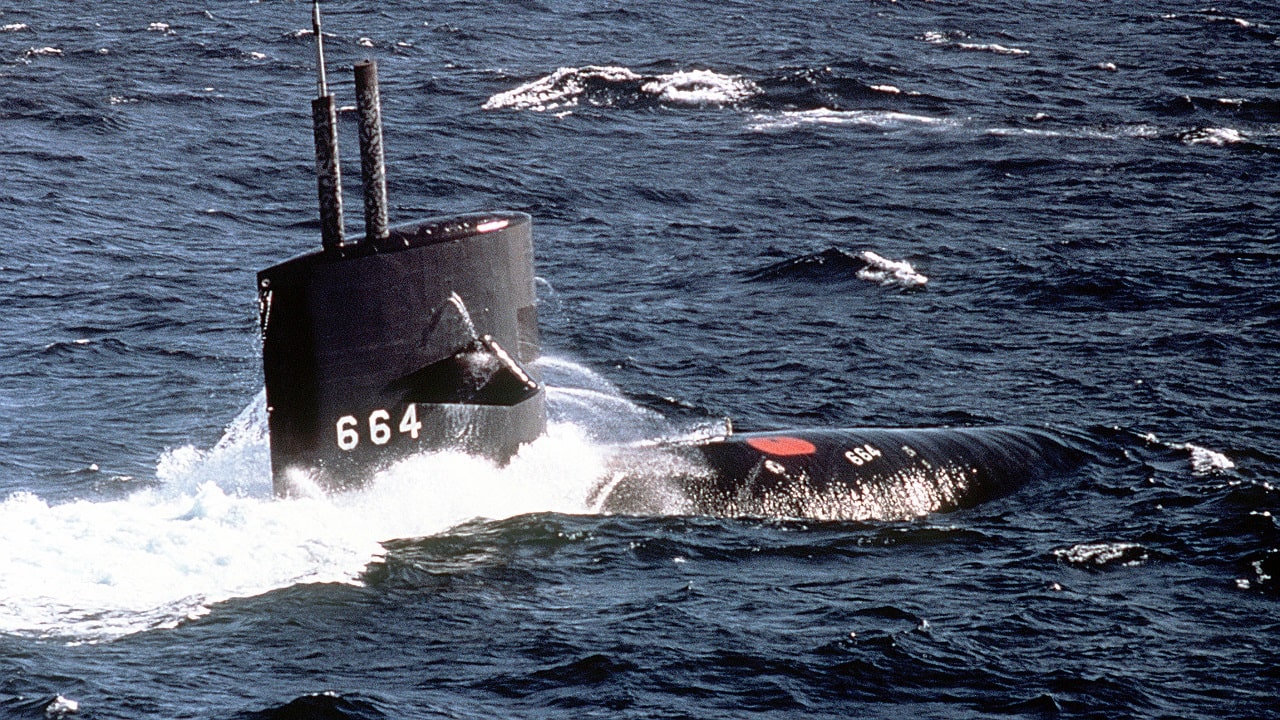
Key Points and Summary – USS Guitarro sank at the pier in 1969 when an open sonar-dome manhole—left uncovered during transducer work—let floodwater drag the bow under during trimming tests, rapidly cascading into major forward openings.
-Refloated days later, the “Mare Island Mud Puppy” was repaired, commissioned in 1972, and served two decades across multiple WestPac/Indian Ocean tours before decommissioning in 1992 and recycling in 1994.
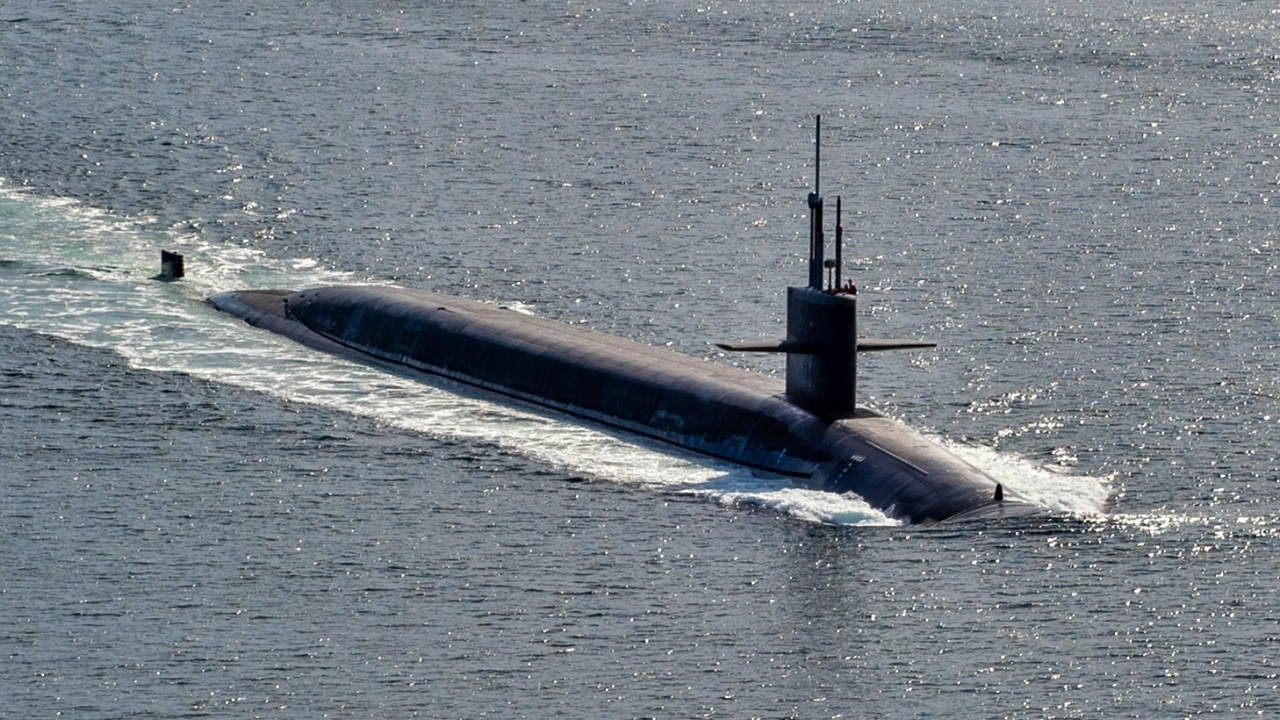
The Ohio-class ballistic-missile submarine USS Maine (SSBN 741) transits the Puget Sound during routine operations, March 18, 2025. Commander, Submarine Group (SUBGRU) 9, exercises administrative control authority for assigned submarine commands and units in the Pacific Northwest providing oversight for shipboard training, personnel, supply and material readiness of SSBNs and their crews. SUBGRU-9 is also responsible for nuclear submarines undergoing conversion or overhaul at Puget Sound Naval Shipyard in Bremerton. (U.S. Navy photo by Mass Communication Specialist 1st Class Ryan Riley)
-Beyond the embarrassment, the episode is a textbook lesson in configuration control, simultaneous-test hazards, and why small omissions can trigger big losses—especially on nuclear subs.
-We recap the mishap, Guitarro’s career, key specs, and the preserved Sturgeon-class sail you can visit today.
The US Navy Submarine Guitarro was Sunk by an Open Manhole Cover
Chances are, at least some of our readers have heard the old joke about screen doors on a submarine.
Urban Dictionary even has an entry for the phrase “about as useful as a screen-door on a submarine,” defining it as “Utterly useless,” “A waste of oxygen,” “Completely worthless,” “A waste of space,” and “Devoid of any purposeful function on this earth.”
Obviously, real-world submarines don’t have screen doors. (The history of human stupidity notwithstanding, no designer is truly *that* stupid.)
However, submarines have been sunk or severely damaged by negligent decisions that ended up having the same practical effect as a screen door, and these incidents were no laughing matter.
For example, back in March 2017, the Indian Navy’s first ballistic missile submarine, the INS Arihant (“Conqueror;” SSBN-80), was put out of action for 10 months after someone neglected to close a hatch properly.
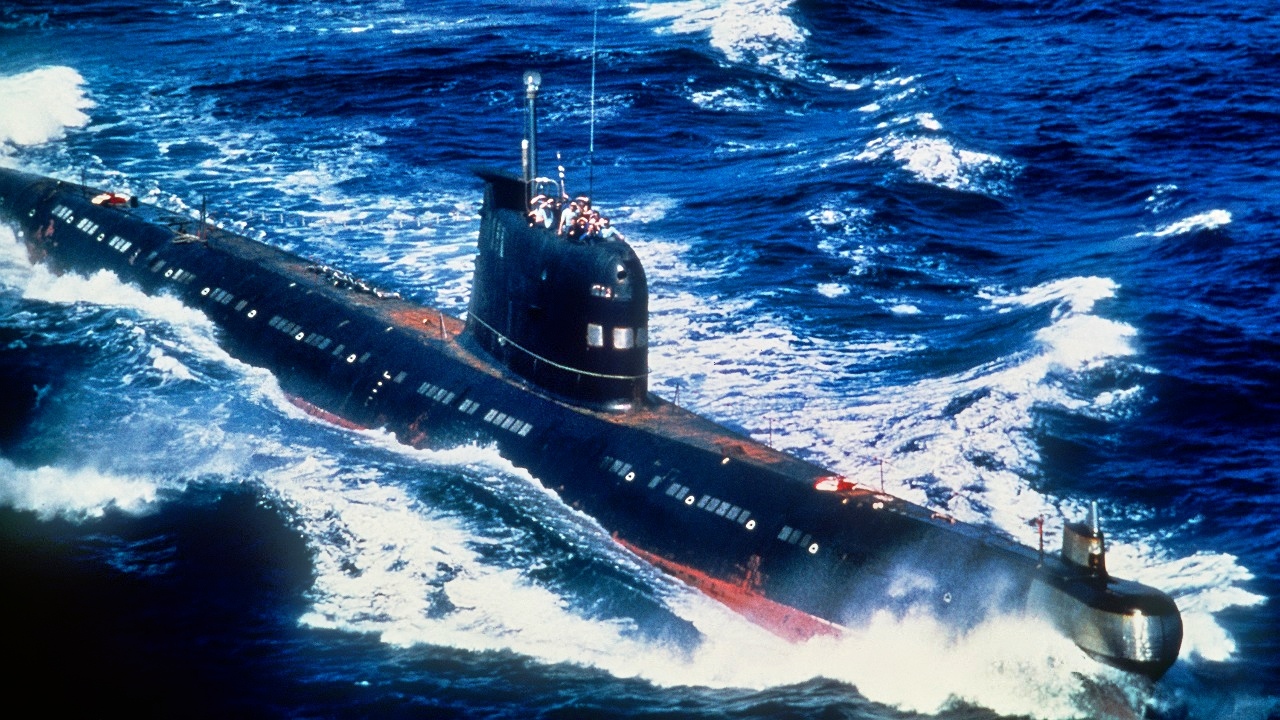
Foxtrot-Class Submarine. Image Credit: Creative Commons.
As embarrassing as that sounds, a similar mishap befell a U.S. Navy submarine 38 years prior, in the middle of the Cold War. National Security Journal now dives deeper into the story of the USS Guitarro and the open manhole caper.
The Basics/Bottom Line Up Front (BLUF)
The official account of the submarine’s sinking is quite telling, to say the least:
“In the most forward part of the ship is the bow structure sonar dome which contains the ship’s sonar sphere. Entrance to the dome is through a manhole which has a bolted cover. At the time of launch, this opening was also protected by a cofferdam approximately three and a half feet high. This additional precaution was taken to make sure that occasional water did not run down onto the electronic gear which was exposed at that time.”
The sonar’s operation is dependent on a number of large electronic components known as transducers. Sometime after the sonar equipment was installed it was discovered that some of these components were faulty and would have to be replaced. To facilitate this work, the cofferdam and the bolted manhole cover were removed. This occurred in early March 1969 and neither the cofferdam nor the cover was ever replaced. At the time the Guitarro went down, the manhole cover was on the dock and the cofferdam was in the storage warehouse.
From the testimony and records before the Subcommittee, it can be reasonably concluded that on May 15 a simultaneous trimming operation and calibrating test caused a sufficient change in the Guitarro’s draft to permit water to enter in quantity through the open sonar dome manhole. As the sonar dome became flooded, its weight caused the ship to further settle by the bow which permitted additional water to enter other openings. This soon allowed massive flooding through the large bow access and at this point the Guitarro was doomed.”
USS Guitarro (SSN-665) Post-Incident History
Luckily, Guitarro was refloated three days later and given the humorous namesake of “Mare Island Mud Puppy.”
As for her official namesake, Guitarro was named for the guitarro, AKA the guitarfish (Rhinobatos rhinobatos).
She was the 17th ship of the Sturgeon class of nuclear-powered fast attack submarines (SSNs). (A total of 37 Sturgeons were built between 1963 and 1975.)
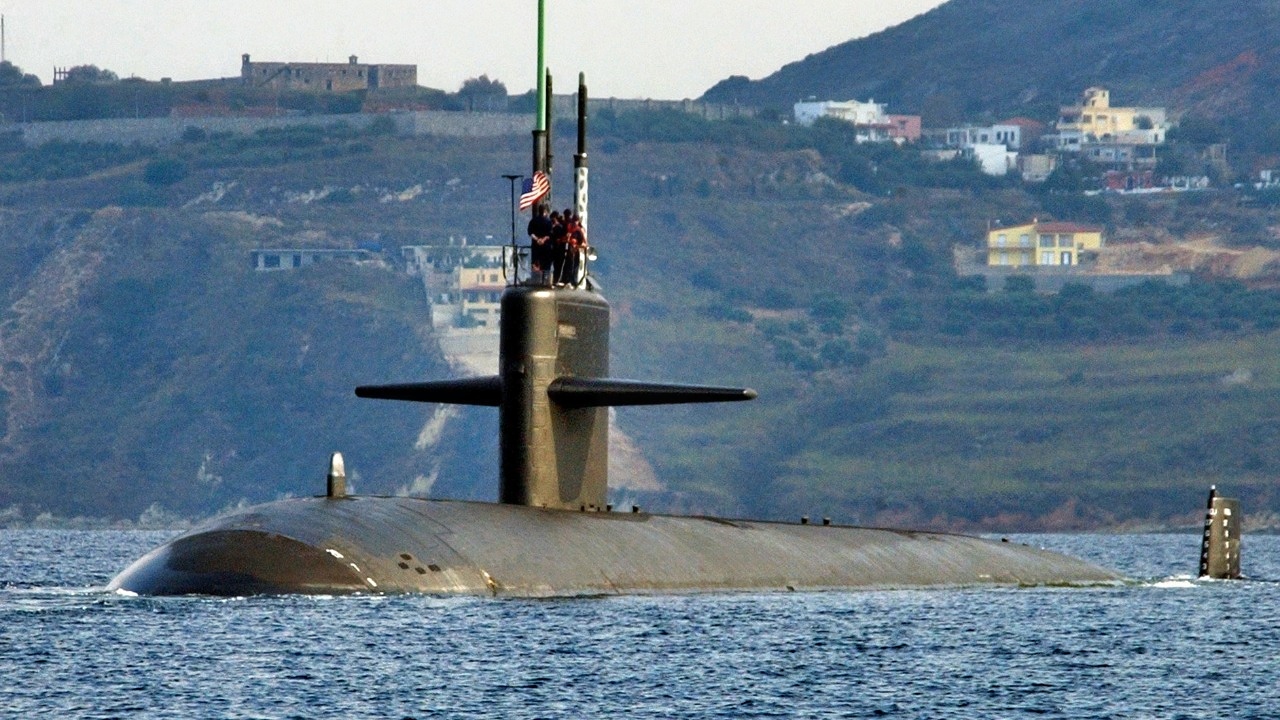
Port bow view showing US Navy (USN) Sailors manning a topside watch aboard the Los Angeles Class Attack Submarine USS NEWPORT NEWS (SSN 750), as the ship departs the harbor at Souda Bay, Crete, Greece following a port visit.
Guitarro was finally commissioned on September 9, 1972, four years and two months after her launching, and six years and nine months after her keel had been laid.
According to Hullnumber.com, Guitarro had her Shellback Ceremony cruise (i.e., the rite of passage when a sailor crosses the Equator for the first time, marking their transition from a “polliwog” to a “shellback”) on September 17, 1973.
From there, she embarked on the following major deployments:
-July 1974 – September 1974, West Pac
-March 1979 – June 1979, West Pac
-January 1983 – July 1983, West Pac-Indian Ocean
-May 1987 – November 1987, West Pac
-August 1989 – February 1990, West Pac
-29 May 1992, Decommissioned and stricken from the naval roster
Where Is She Now?
Sadly, Guitarro was not preserved for posterity. Instead, she scrapped via the Ship/Submarine Recycling Program (SRP), with the work completed on October 18, 1994.
But considering the embarrassing manhole mishap 35 years earlier, Guitarro and her crews were blessed to have lasted as long as she did.
That said, the sail of one of her sister ships, USS Sturgeon (SSN-637; the lead ship of the class), is lovingly preserved and displayed at the US Naval Undersea Museum in Keyport, Washington.
Submarine USS Guitarro (SSN-665) Technical Specifications and Vital Stats
Courtesy of GlobalMilitary.net:
-Displacement: 3,640 tons surfaced, 4,640 tons submerged
-Hull Length: 89.08 m (292.3 ft)
-Beam Width: 9.65 m (31.7 ft)
-Propulsion: 1 S 5W reactor with a power of 28,000 hp – 1 propeller
-Max Speed: 15 knots surfaced, 30 knots submerged
-Range: Unlimited, except for food supplies (thanks to the nuclear power factor)
-Max Depth: 400 m (1312.3 ft)
-Crew Complement: 107 commissioned officers and enlisted seamen
-Armament: 4 x 533mm torpedo launch tubes (TLTs) with 15 torpedoes in storage + 4 x UGM-84 Harpoon antiship missiles.
About the Author: Christian D. Orr, Defense Expert
Christian D. Orr is a Senior Defense Editor. He is a former Air Force Security Forces officer, Federal law enforcement officer, and private military contractor (with assignments worked in Iraq, the United Arab Emirates, Kosovo, Japan, Germany, and the Pentagon). Chris holds a B.A. in International Relations from the University of Southern California (USC) and an M.A. in Intelligence Studies (concentration in Terrorism Studies) from American Military University (AMU). He is also the author of the newly published book “Five Decades of a Fabulous Firearm: Celebrating the 50th Anniversary of the Beretta 92 Pistol Series.”
More Military
Russia’s ‘New’ Su-75 Checkmate Stealth Fighter Could Soon Be In the Air
China’s New Aircraft Carriers Have 1 Big Advantage over the U.S. Navy
Russia’s Airspace Provocations Are a Tell — And a Weakness
USS Parche: A U.S. Navy Nuclear Spy Submarine That Had Its Own Self-Destruct Mode
How a ‘Cheap and Tiny’ Submarine ‘Sank’ a $4,500,000,000 Nuclear Navy Aircraft Carrier


