

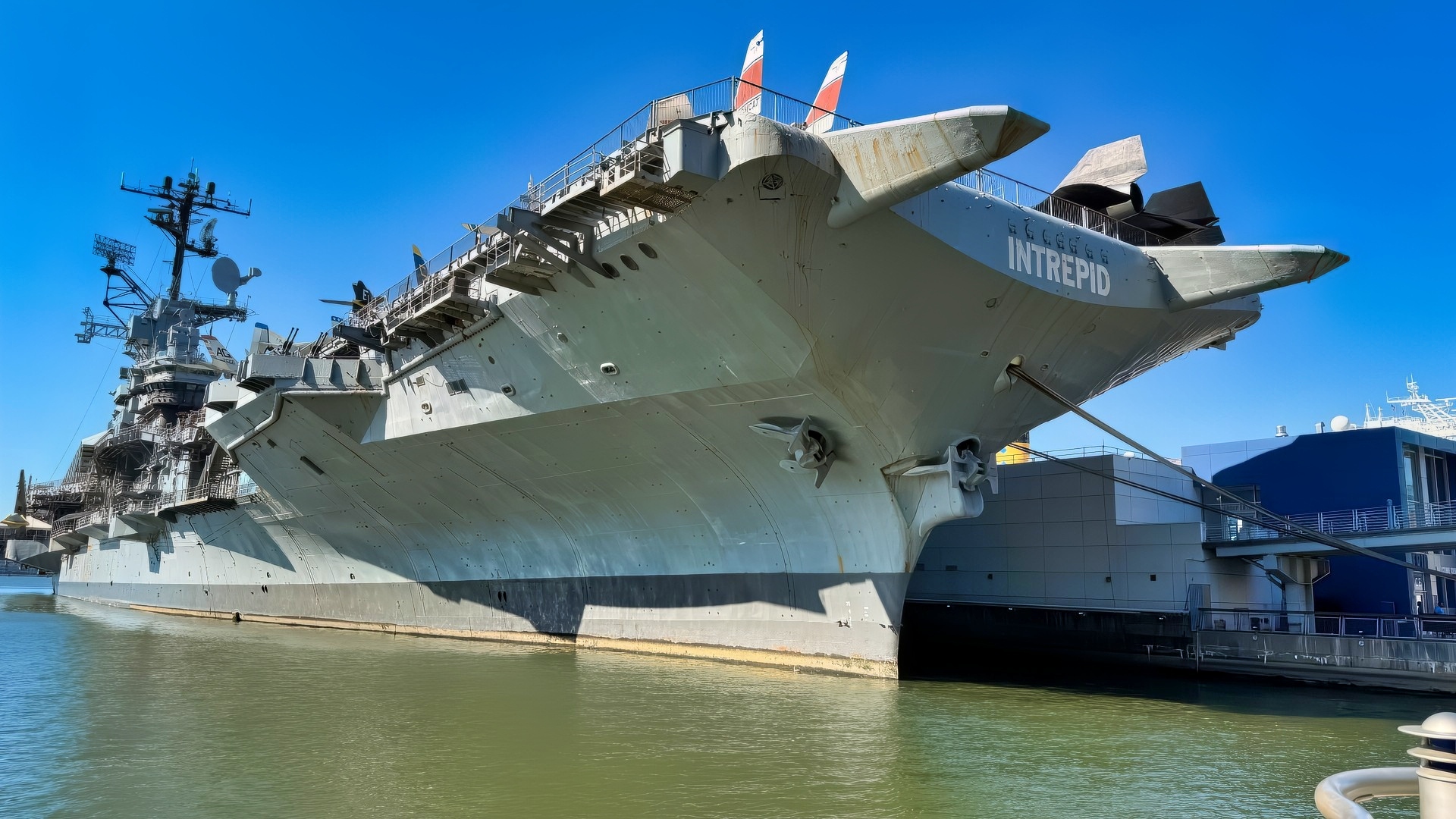
Key Points and Summary – Commissioned in August 1943, the Essex-class carrier USS Intrepid fought across the Pacific, surviving a torpedo at Truk and multiple kamikaze strikes while launching raids from the Marshalls to Okinawa.
-After postwar decommissioning, she returned in the 1950s with jet-era upgrades—angled deck, steam catapults—and later shifted to anti-submarine duty.
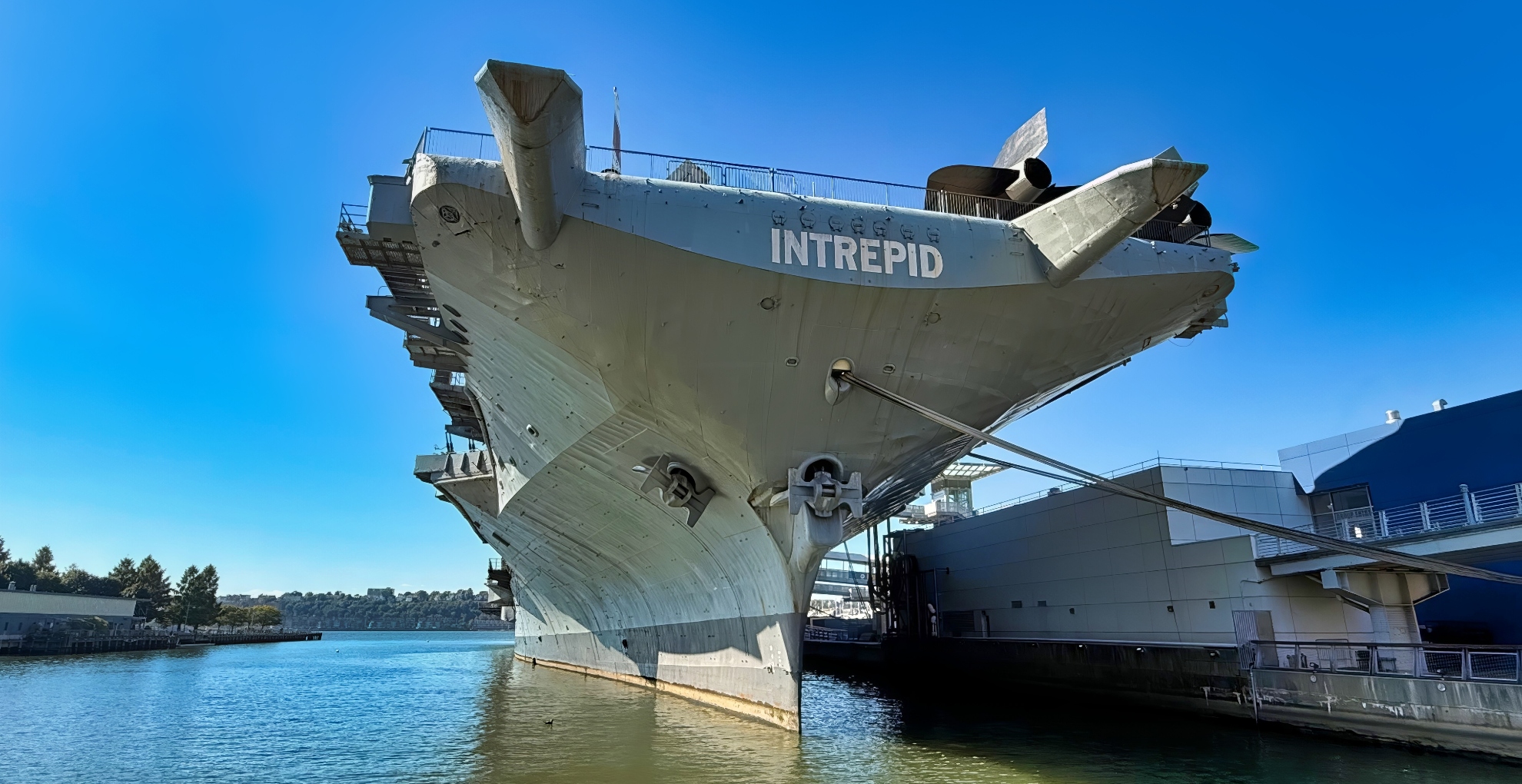
USS Intrepid NSJ Photo Taken on 9/22/2025. Taken by Jack Buckby.
-Intrepid recovered NASA’s Mercury and Gemini astronauts, then made three deployments to Vietnam, where one of her Skyraiders scored a rare MiG kill.
-Permanently retired in 1974, she avoided the scrapyard and reopened in 1982 as New York City’s Intrepid Sea, Air & Space Museum. Her journey traces U.S. sea power from World War II to the Space Age.
-BONUS – National Security Journal toured USS Intrepid back on September 18, 2025, and presents many original photos onboard and of the exterior of the aircraft carrier in this article.
USS Intrepid: From Pacific Warhorse to NYC’s Floating Time Machine
By late 1942, the Pacific war had crystallized one blunt truth: whoever could generate the most combat airpower at sea—reliably, quickly, and far from home—would shape the campaign’s tempo.
The Essex-class carriers answered that need with a design emphasizing sortie rate, repairability, and growth margin. USS Intrepid (CV-11) was part of that surge: a fast, hard-hitting flattop that could absorb punishment yet keep launching aircraft. Her mission was simple and unforgiving—carry war to Japan’s strongholds while screening an expanding amphibious juggernaut.
Construction: Built for a Long War
Laid down at Newport News Shipbuilding just as America entered World War II, Intrepid was launched in April 1943 and commissioned that August. Wartime urgency shaped every choice: robust machinery, large elevators, a capacious hangar, and a straight flight deck optimized for piston fighters and dive/torpedo bombers. She steamed west after shakedown, joining the fast-carrier task forces that would leapfrog across the Central Pacific.
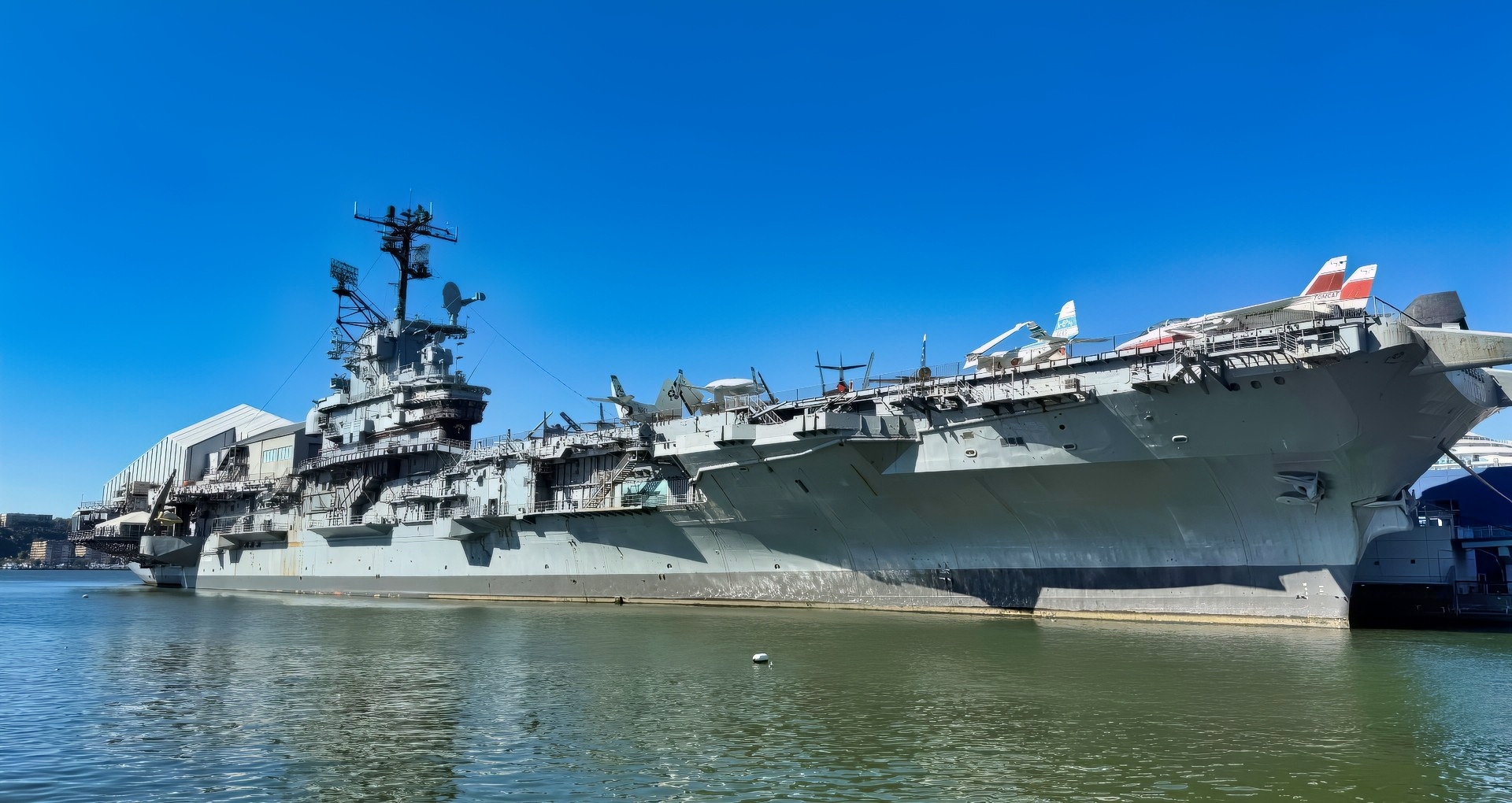
USS Intrepid CV-11 Photo by National Security Journal Taken on September 18, 2025.
World War II: A Carrier That Wouldn’t Quit
Intrepid’s air groups struck hard at the Marshalls in early 1944, then pounded Truk Lagoon during Operation Hailstone. There she took her first wound: a nighttime aerial torpedo smashed her stern and jammed the rudder. Damage control and ingenuity kept the ship in the fight—the crew even rigged a makeshift sail on the forecastle to help steer for repairs, a salty improvisation on a state-of-the-art ship.
Back in action, Intrepid joined the rolling carrier offensive through the Palaus and the Philippines, culminating in the sprawling Battle of Leyte Gulf. In the brutal autumn of 1944, she endured repeated kamikaze attacks, fighting fires, patching decks, and returning to flight ops with stubborn regularity. She was back again for Okinawa in 1945, launching strikes against airfields and fleet units while riding out more near-misses and hits.
The pattern held: damage, repair, return—testimony to steel, training, and damage-control culture.
Between Wars: Laid Up, Then Reimagined for Jets
With victory won, the Navy mothballed Intrepid in 1947. The jet age, however, demanded new carriers—or old carriers reborn. In the early 1950s, Intrepid underwent a deep modernization: stronger flight-deck structure, heavier arresting gear, powerful catapults, reworked gun batteries, and new electronics. A second round of upgrades added the signature angled flight deck and an enclosed “hurricane bow,” transforming her silhouette and enabling safer, faster jet operations. These Ship Characteristics Board (SCB) programs turned a WWII veteran into a capable Cold War attack carrier.
The Space-Age Sea Base
Cold War duty in the Atlantic and Mediterranean mixed with a very different mission: serving as a prime NASA recovery ship. Intrepid retrieved Mercury astronaut Scott Carpenter in 1962 and later the Gemini 3 crew in 1965—an improbable pairing of a WWII carrier and a new era of orbital flight. For sailors topside, the choreography—helicopters, swimmers, hoists—felt like a carrier landing cycle turned inside out.
Redesignated for the Next Threat: Submarines
As the Soviet undersea fleet grew, the Navy reoriented several carriers to anti-submarine warfare. Reclassified CVS-11 in the early 1960s, Intrepid embarked hunter-killer air groups with sonar-dipping helicopters and fixed-wing sub hunters. She drilled across the Atlantic, including the tense season around the Cuban Missile Crisis, proving the flexibility that had justified Essex-class upgrades in the first place.
Vietnam: A Piston Fighter’s Jet-Age Moment
From 1966 to 1969, Intrepid deployed three times to Southeast Asia. Her air wing blended A-4 Skyhawks, A-1 Skyraiders, electronic warfare and early warning aircraft—the “small-deck” mix that prioritized sortie rate and persistence over raw size. The ship made news for speed as well as endurance, flinging a dozen attack aircraft into the air in minutes. And in one of the war’s most unusual dogfights, a Intrepid-based Skyraider shot down a North Vietnamese MiG-17—proof that pilot skill and tactics can trump the spec sheet.
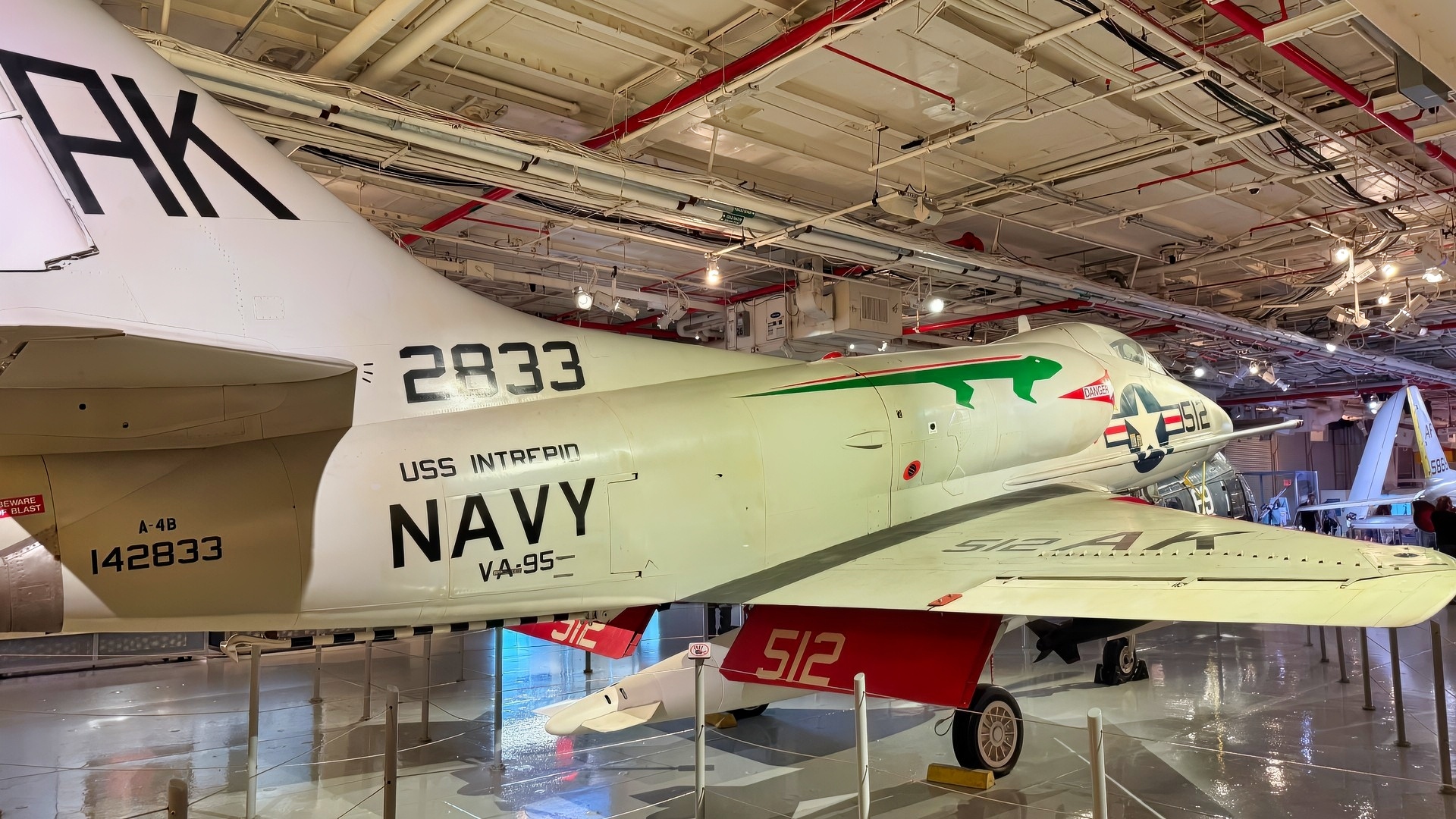
A-4 Skyhawk Sideview. Image by Jack Buckby for National Security Journal. Taken on 9/18/2025.
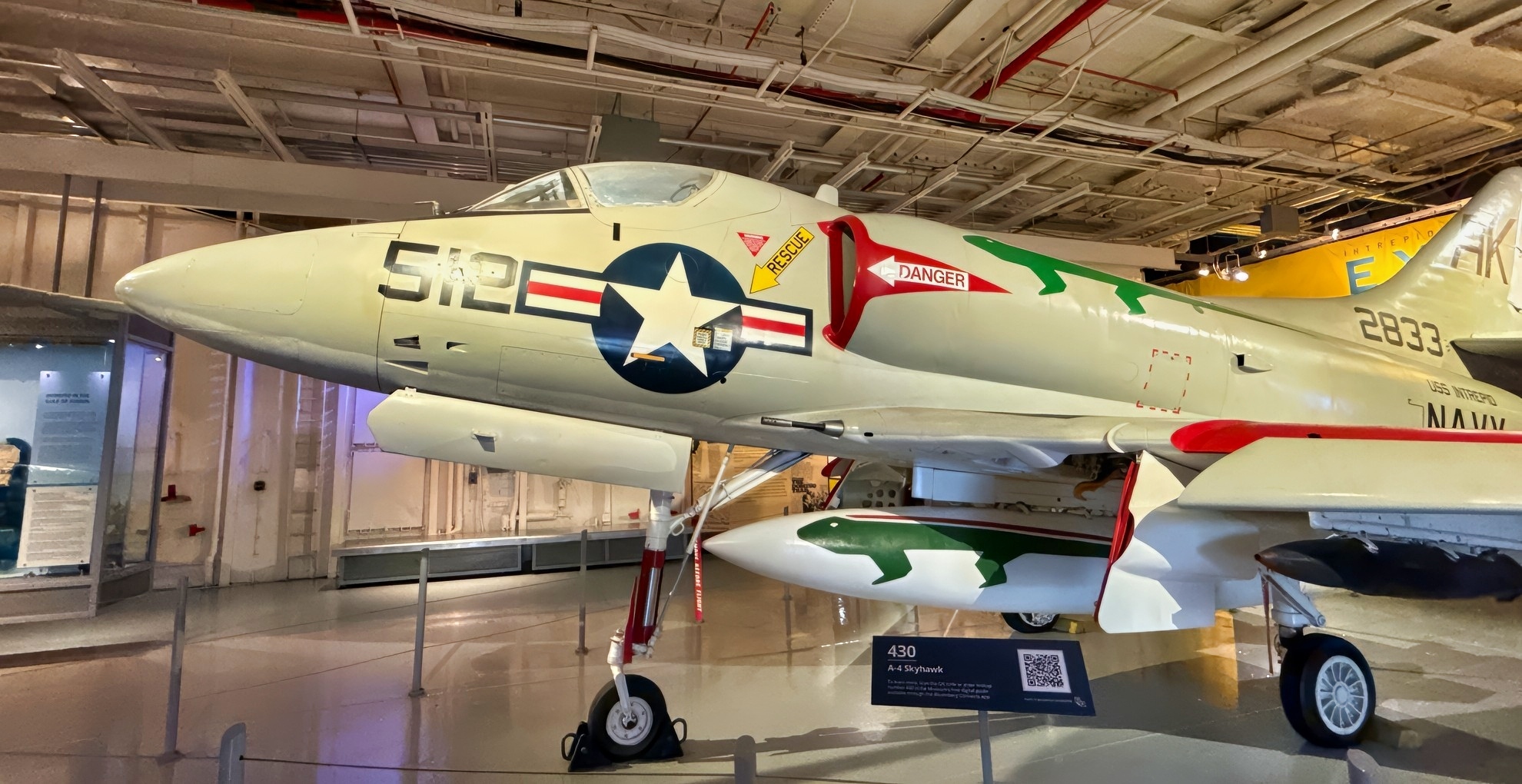
A-4 Skyhawk National Security Journal Museum Visit. Image Taken by Jack Buckby on September 18, 2025.
Intrepid’s Vietnam record was the product of dependable machinery and practiced crews: launch, recover, fuel, rearm, repeat. The rhythms of the Tonkin Gulf pressed every system and sailor; those cycles also carried echoes of her Pacific past.
Upgrades Over Time: How Intrepid Kept Up
The Essex platform survived because it could evolve:
Jet-Era Reinforcement (SCB-27C). Heavier flight-deck framing, stronger arresting gear, modernized gun/AA suites, and (on 27C ships) steam catapults to fling early jets with confidence.
Angled Deck and Bow (SCB-125). An angled landing area separated landing and launch paths; an enclosed hurricane bow improved seakeeping. A mirror landing system and revised island layout boosted safety and tempo.
Electronics and Air Wing Refresh. Successive radars, radios, and ECM packages; new aircraft communities—from piston attack to early jets to ASW helos—rotated through her decks.
These were not cosmetic changes; they extended the hull’s usefulness by decades and allowed the Navy to bridge from wartime mass to peacetime modernization without a budget-breaking new build every time the technology shifted.
USS Intrepid: Accidents, Losses, and Lessons
Like all carriers, Intrepid learned safety the hard way. Kamikaze strikes in 1944 and 1945 killed sailors and destroyed aircraft; each tragedy produced procedures that made the next fire smaller, the next repair faster. The torpedo hit at Truk forced a master class in seamanship and improvisation. Vietnam brought its own risks: high-tempo deck cycles, complex munitions, and relentless operations in heat and humidity. Across eras, damage control remained the ship’s soul—drills, discipline, and the quiet competence to “fight the fire and keep flying.”
Final Years in Uniform and Decommissioning
After Vietnam, Intrepid returned to Atlantic and Mediterranean duty, a veteran of two eras. She decommissioned for the last time in March 1974, slated—like so many distinguished hulls—for disposal. What followed was a rare act of public-spirited salvage: an advocacy campaign, philanthropic backing, and a city willing to host a 900-foot artifact of American history.
Becoming a Museum Ship: New Home, New Mission
Moored at Pier 86 on Manhattan’s West Side, the ship opened in 1982 as the Intrepid Sea, Air & Space Museum—part carrier, part classroom, part civic commons. Over time she hosted ceremonies, Fleet Week events, and millions of visitors, even serving as a temporary operations hub after 9/11.
A major drydocking and pier reconstruction in 2006–2008 restored her hull, refreshed exhibits, and readied the ship for decades more of public life. Today, Intrepid anchors a campus that spans naval aviation, space exploration, and Cold War undersea warfare—fitting for a ship that lived all three.
Combat History in Brief
Central Pacific (1944): Marshalls, Truk—torpedoed but saved; back in action by summer.
Philippines (1944): Air strikes during Leyte Gulf; multiple kamikaze hits survived with rapid repair and recovery.
Okinawa and Japan (1945): Strikes against airfields and fleet anchors; more damage, more repairs, and relentless sorties.
Vietnam (1966–1969): Three deployments; heavy strike tempo; a famed Skyraider-vs-MiG victory.
The throughline is resilience: shoot, get hit, repair, and fly again.
Why Intrepid Matters
Warships are more than steel—they’re repositories of institutional memory. Intrepid compressed three revolutions into one hull: the triumph of carrier aviation in WWII, the adaptation to jets in the 1950s, and the shift to ASW and limited wars during the Cold War.
As a NASA recovery ship, she touched the space race; as a museum, she hands those stories to new generations.
USS Intrepid Legacy: A Bridge from the Arsenal of Democracy to Today
Stand on her flight deck and you can trace a century of American power projection: piston fighters and torpedo bombers; early jets thundering off steam catapults; rescue helicopters hovering over a bobbing space capsule. Many carriers did parts of that journey. Intrepid did the whole arc.
That is why she endures—not just as a preserved artifact, but as a living syllabus on how a maritime nation adapts, improvises, and persists.
About the Author: Harry J. Kazianis
Harry J. Kazianis (@Grecianformula) is Editor-In-Chief and President of National Security Journal. He was the former Senior Director of National Security Affairs at the Center for the National Interest (CFTNI), a foreign policy think tank founded by Richard Nixon based in Washington, DC. Harry has over a decade of experience in think tanks and national security publishing. His ideas have been published in the NY Times, The Washington Post, The Wall Street Journal, CNN, and many other outlets worldwide. He has held positions at CSIS, the Heritage Foundation, the University of Nottingham, and several other institutions related to national security research and studies. He is the former Executive Editor of the National Interest and the Diplomat. He holds a Master’s degree focusing on international affairs from Harvard University.
More Military
F-16XL Was the Plane the Air Force Wouldn’t Fly
NATO-Russia War of 2025: It Won’t Be Pretty
K3: The ‘Stealth’ Tank That Looks Like a B-21 Raider and Runs on Hydrogen
The U.S. Navy’s Ohio-Class SSGN Submarines Summed Up in 1 Word


