

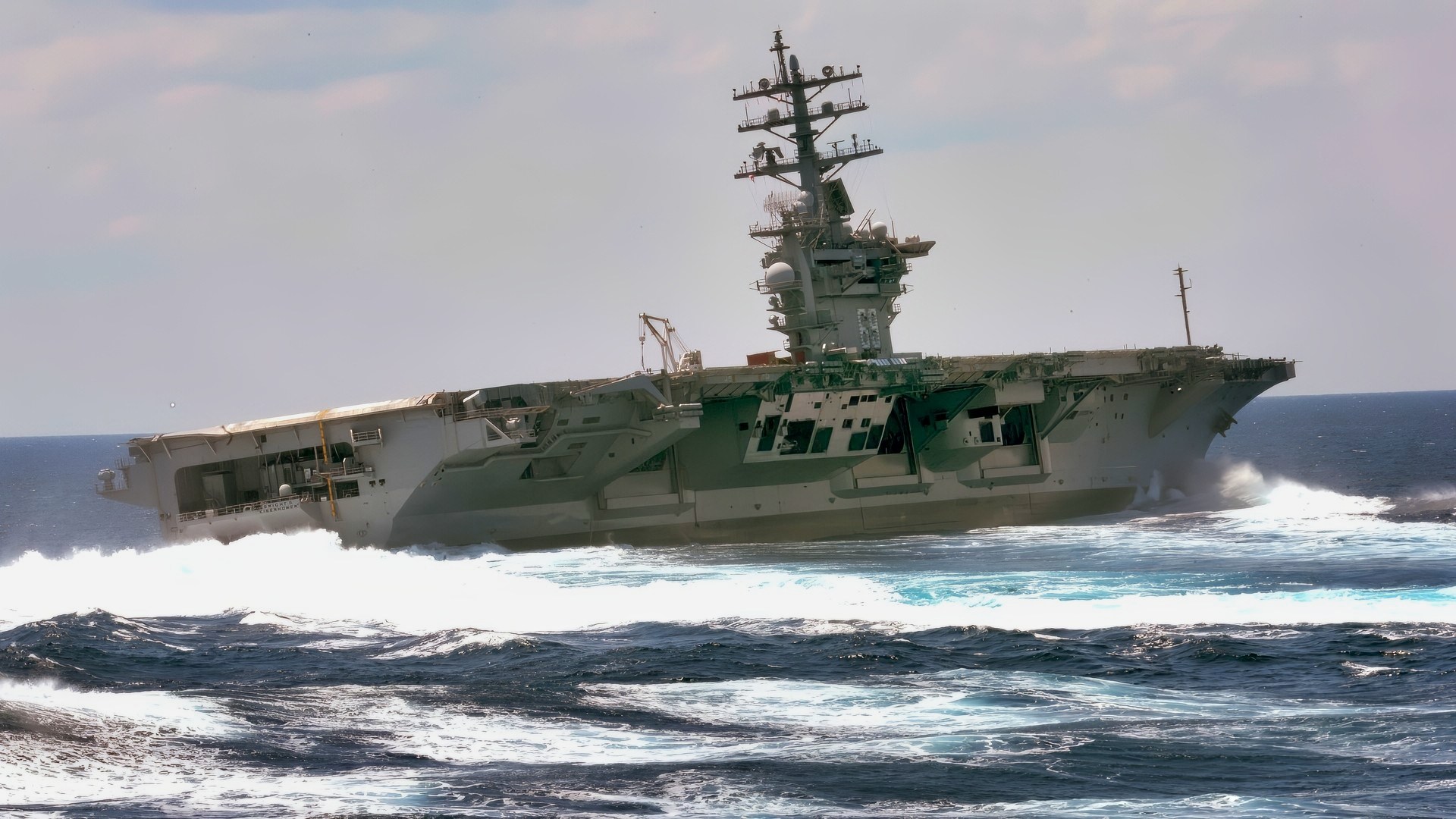
The USS Dwight D. Eisenhower is ready to sail again after a prolonged maintenance period. The Nimitz-class aircraft carrier was commissioned in 1977 and is the second carrier of the group. It was just given a clean bill of health after completing a Planned Incremental Availability (PIA) at Norfolk Naval Shipyard. The “Ike” just finished sea trials after the PIA.
The Eisenhower underwent a comprehensive maintenance effort, and numerous engineers and technicians inspected the carrier, identifying areas for repair and modernization. The Ike was next in line for a PIA after the Navy conducted maintenance overhauls on the USS George H.W. Bush in 2024.
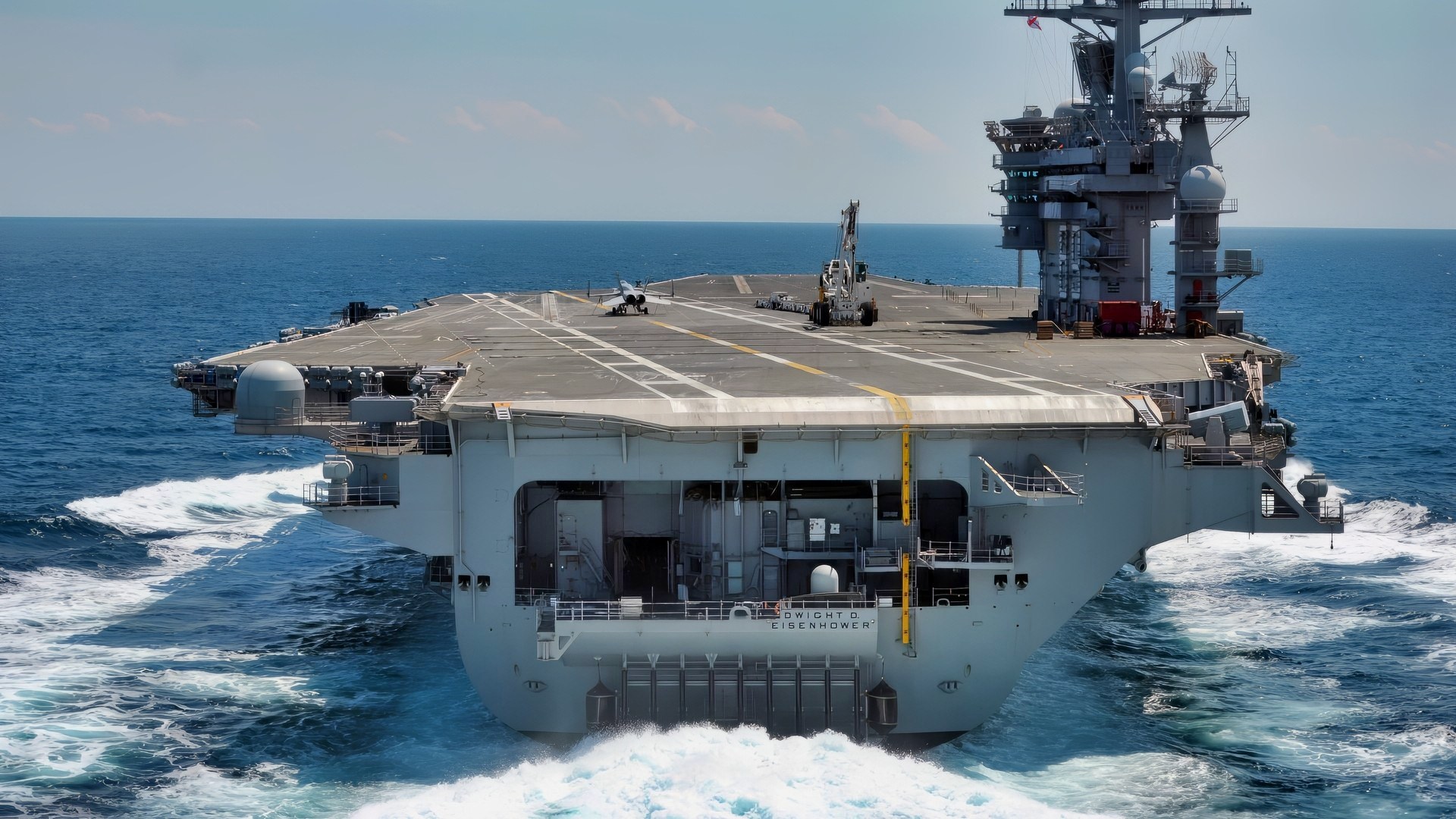
ATLANTIC OCEAN (June 14, 2011) The Nimitz-class aircraft carrier USS Dwight
D. Eisenhower (CVN 69) conducts rudder turns during sea trials. Dwight
D. Eisenhower completed a nine-month planned incremental availability at Norfolk Naval Ship Yard on June 10 and is scheduled to resume underway operations this summer. (U.S. Navy photo by Mass Communication Specialist 1st Class Christopher Stoltz/Released)
The Successful PIA Had Thousands of People Behind It
“The primary drivers behind IKE’s successful availability are the NNSY, Ship’s Force, and contractor teams who ensure the ship is materially ready to fight,” said Project Superintendent, Cmdr. Jason Downs in a Navy news release. “The entirety of the project team mustered more than 4,000 people daily, all with one common vision–deliver IKE, fully mission capable, back to the fleet before our commitment date. The highly skilled tradespeople and sharp engineering acumen are the heroes in the IKE FY25 PIA story.”
What Type of Work Was Conducted?
Workers replaced the primary seawater valve on the Ike. The main engine high-pressure turbines were also improved. “Lastly, we executed first-time catapult trough non-destructive test inspections and structural repairs, efforts that were pivotal to extending the life of this significant aircraft launch system,” Downs explained.

ATLANTIC OCEAN (June 14, 2011) The Nimitz-class aircraft carrier USS Dwight D. Eisenhower (CVN 69) conducts rudder turns during sea trials. Dwight
D. Eisenhower completed a nine-month planned incremental availability at Norfolk Naval Ship Yard on June 10 and is scheduled to resume underway operations this summer. (U.S. Navy photo by Mass Communication Specialist 1st Class Christopher Stoltz/Released)
Good News for the Eisenhower Aircraft Carrier
The PIA on the Ike was executed on time and under budget. This is good news for the overall Navy carrier program, which has faced recent difficulties. The USS Gerald R. Ford has been plagued by sewage problems, catapult and arresting gear delays, and a laundry room fire.
Will It Be Deployed to the Middle East?
The Dwight D. Eisenhower may be deployed to the Middle East to relieve one of the three carriers there now. The USS Abraham Lincoln has done an excellent job during Operation Epic Fury, but it could use some rest and maintenance to give its crew a break.
Ike’s History Began Nearly 50 Years Ago
In September of 1977, the Eisenhower was delivered to the Navy and its first fighter jets were launched from its flight deck. An A-7E Corsair II made its first landing on the carrier that year.

The Nimitz-class aircraft carrier USS Dwight D. Eisenhower conducts rudder turns during sea trials. Dwight D. Eisenhower completed a nine-month planned incremental availability at Norfolk Naval Ship Yard on June 10 and is scheduled to resume underway operations this summer.
The Ike had some bad luck in March 1978, when a HH-46A Sea Knight helicopter went down off the coast of Jacksonville, Florida. It crashed in the sea tail-first, and two crew members perished.
President Jimmy Carter Ordered It Into Action During Iran Hostage Crisis
In 1980, the Ike deployed to the Indian Ocean. This was to answer the Iran hostage crisis. The third deployment to the Mediterranean happened in 1982. After five deployments in 1985, the Eisenhower entered dry dock for a major refurbishing and maintenance period. It was sent back to the Mediterranean shortly thereafter.
Collision Could Have Been Worse
Upon return, near disaster struck. “While returning to Norfolk, on 29 August 1988, she collided with an anchored Spanish bulk carrier, the Urduliz, while entering the harbor to dock at Norfolk Naval Station, when wind and currents pushed the carrier off course, but only caused minor damage to both ships,” according to Naval History and Heritage Command.
Operation Desert Shield and Storm
When Iraq invaded Kuwait at the beginning of Operation Desert Shield, the Ike transited the Suez Canal and patrolled the Red Sea. The Ike also served in Operation Desert Storm, engaging in high-tempo sorties around the clock to eliminate Saddam Hussein’s military targets in support of the war effort. The Ike was in a maintenance period after the conflict between 1992 and 1993.
Global War on Terror Standout
But the Dwight D. Eisenhower was not done in Iraq. It returned to the theater to enforce a no-fly zone over the country, known as Operation Southern Watch. During the Global War on Terror, the Ike served in the U.S. 5th and 6th Fleet areas of operation in the Middle East.
How Long Will the Ike Be in Service?
The Eisenhower is scheduled to be replaced by the Ford-class USS Enterprise in 2029. Will this latest PIA allow the Ike to serve until then? The Eisenhower has been a stalwart carrier during its operational history. Except for the helicopter incident and the collision, the Ike has a sterling record at sea with only routine maintenance requirements.
Long-term Deployment of F-35C Squadrons
What is the future of the Eisenhower? This carrier can definitely make it another three years. The crew is exceptionally trained and expert at their jobs. The naval aviators are first-rate. The F-35C has been flying off the deck since 2015. The ship is ready for another combat deployment or could be used in the U.S. European Command area of responsibility to face down Russia if it is not sent to the Middle East.
The Eisenhower is a good example of how some Nimitz-class carriers have dominated for nearly 50 years and made numerous combat deployments. This is one sturdy carrier.
Service to Counteract Iran and China
Some have claimed that aircraft carriers are obsolete, but the USS Abraham Lincoln has enjoyed an excellent combat record during Operation Epic Fury. It has avoided more than 100 anti-ship missiles and drone attacks since the ceasefire. China has plans to take out U.S. carriers and pursue an anti-access/area denial strategy against Navy flat-tops, but it seems that U.S. carriers will still be in business in the future.
Potential Service Beyond 2029
The Eisenhower should perform well until it is replaced by the Enterprise in 2029. This could be the end of its service life. However, expect it to remain active until 2030 or later, as the Ford-class carriers have been delayed for various reasons. This could push the retirement of the Ike to a later date.
That helps the Navy with its operational readiness in the future. The Ike is a good example of how a well-maintained carrier can continue to conduct patrols and execute combat missions with impunity. That is exactly what the Navy needs in its carrier force at the moment.
Could the Ike Receive the New F/A-XX Fighter?
What aircraft will be deployed on the Ike beyond its current number of F-35Cs? The sixth-generation F/A-XX is on the drawing board, and it would be interesting to see if the Ike would be assigned this airplane. The F/A-XX may be meant for the USS Enterprise as its service life may not begin until the mid-2030s, but it is possible that the Eisenhower could be granted the F/A-XX at least at the beginning of the next-generation airplane’s deployment.
Potential Service in the Arctic Region
One area of operation that Eisenhower could be assigned to is the Arctic. This would be an interesting development for its historic run. The Arctic is a potential flashpoint for a clash between great powers competing to control its resources. Some polar ice caps are melting, and more sea lanes are opening, giving Russia and China a larger transit area. This would mean the Ike could be used to counteract this activity.
The next three years of its service life could see the Eisenhower in this area of responsibility as it becomes an important part of U.S. naval strategy in various regions. The men and women of the Ike will be busy, whatever the Navy has in store for it. The carrier has executed an esteemed war record and will be an excellent addition to the fleet wherever it is deployed.
The Look Ahead for the Ike
I could see Eisenhower serving past 2030. This carrier is a stout addition to the fleet, and if the Arctic becomes more important, the carrier could see a new lease on life. The F/A-XX could be deployed on the Ike, since the flat-top was so successful in its first F-35C deployments 11 years ago.
Let’s keep the Ike in mind as we forecast the future of the U.S. carrier force. U.S. flat-tops are not obsolete, and the Eisenhower may be able to answer the call for another five years if needed. This is a salute to the shipyard workers who have ensured the Ike can remain afloat for extended periods. This carrier is not yet done serving its country, and it has years ahead of it for new missions and to execute a 21st-century naval doctrine that still depends on the aircraft carrier for contingency operations around the globe.
About the Author: Brent M. Eastwood, PhD
Author of now over 3,500 articles on defense issues, Brent M. Eastwood, PhD, is the author of Don’t Turn Your Back On the World: A Conservative Foreign Policy and Humans, Machines, and Data: Future Trends in Warfare, plus two other books. Brent was the founder and CEO of a tech firm that predicted world events using artificial intelligence. He served as a legislative fellow for US Senator Tim Scott and advised the senator on defense and foreign policy issues. He has taught at American University, George Washington University, and George Mason University. Brent is a former US Army Infantry officer. He can be followed on X @BMEastwood.


George Taylor
April 28, 2026 at 3:25 pm
For years, independent military analysts (not aligned with a pro military industrial complex think tank or media outlet) have been predicting the obsolescence of the traditional aircraft carrier. We our now witnessing that prediction become reality. Currently our carriers aren’t coming within 400 miles of the Iranian coast as they attempt to keep a defensible buffer between themselves and Iranian drones and anti-ship missiles. In Vietnam, Gulf Wars I & II were routinely sailed within a 100 miles of the enemies coast, infact carriers went through the strait of Hormuz and launched sorties from the Persian Gulf. Why is this an issue? The naval combat aircraft have an average combat radius of around 500 miles putting most sorties at the limits of their range. This either requires air to air refueling, reducing the amount of munitions that can be carried or both. The need for aerial refueling makes mission planning more complicated, it reduces sortie rates. And this is Iran doing this not China. Let’s call it what it is, aircraft carriers are jobs programs, there military usefulness is just about over.