

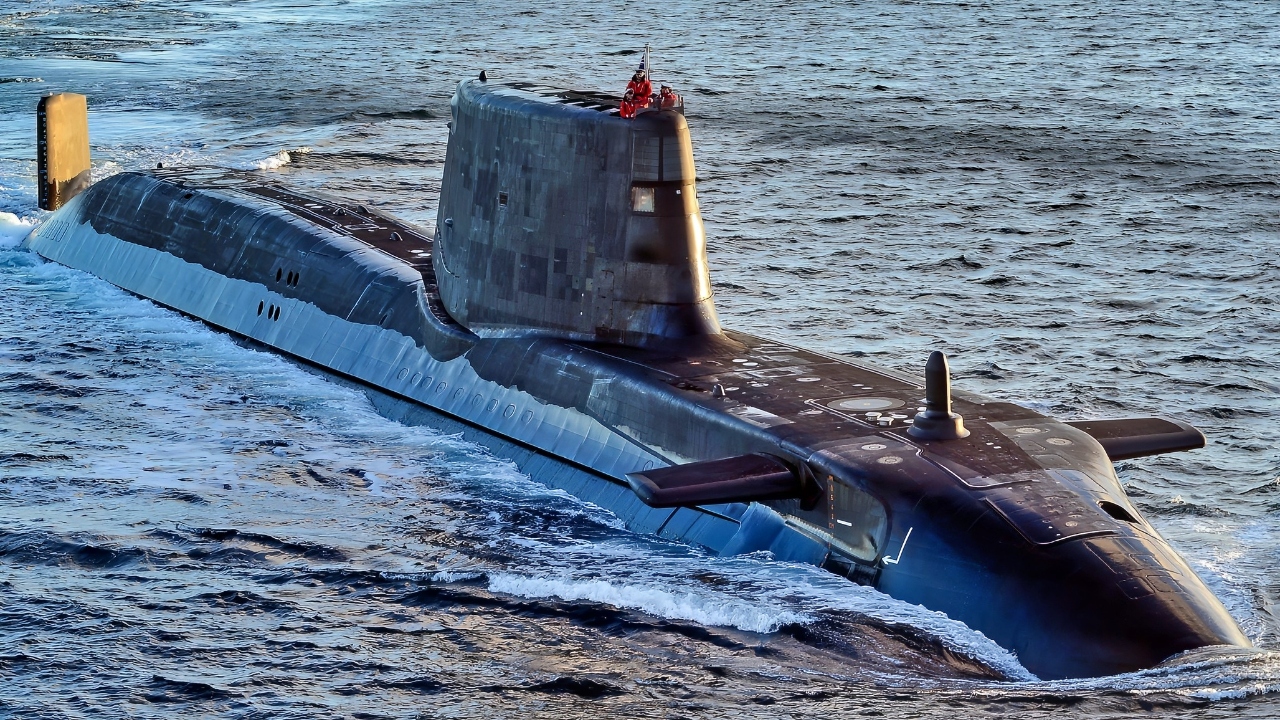
“I am sorry, but the best submarine on Earth isn’t American.” That’s what a former British naval offical told me yesterday. The bias is clear, but it is worth noting that such a bold claim is not made lightly. His point was clear: “That title belongs to the Asute-class nuclear attack submarine.”
The Astute-Class Submarine: How Britain Built The Best Hunter-Killer Submarine It Could — And Why Only One Of Them Can Currently Go To Sea
Astute-Class Submarine Royal Navy. Image Credit: Creative Commons.

Astute-Class. Image Credit: Creative Commons.
Ok, so the above is a minority opinion, for sure, but it shouldn’t be dismissed entirely. But as past and present prove, we do have some problems to cover.
But let’s step back for a sec. The Astute-class submarine is the most advanced warship the Royal Navy has ever put into service. Seven boats, each roughly 7,800 tons submerged, each powered by a Rolls-Royce nuclear reactor that does not need refueling for 25 years, each armed with 38 Spearfish heavyweight torpedoes and Tomahawk cruise missiles capable of striking targets 1,000 miles inland. The class is the British equivalent of the American Virginia-class — a quiet, deep-diving, multi-mission hunter-killer designed to find and kill Russian and Chinese submarines, strike land targets with cruise missiles, deliver special forces ashore, and gather intelligence in waters where surface ships cannot operate.
So, all of that does put it in the conversation as one of the best submarines on Earth, yes.
It is also a program that ran 57 percent over its original budget, took nine years longer than planned to deliver its first hull, and has produced a fleet so strained by maintenance backlogs that, as of early 2026, only one of the six commissioned Astute-class submarines can currently put to sea on short notice.
The Royal Navy is now waiting on SSN-AUKUS — the next-generation submarine being developed jointly with the United States and Australia under the AUKUS partnership — to replace the Astute-class beginning in the late 2030s. Whether the AUKUS program delivers in time is the open question that will define British undersea power for the next four decades.
Astute-Class: Why The UK Needed These Submarines
The Royal Navy decided in the late 1960s that nuclear-powered attack submarines would be its capital ships for the Cold War — the most effective platforms for countering the growing Soviet submarine threat in the North Atlantic.
Per Navy Lookout’s detailed history of the Astute-class program, the original force goal was 20 boats, and by the early 1980s, the Royal Navy had built the Dreadnought, Valiant, Churchill, and Swiftsure classes plus the highly successful Trafalgar class — seven boats delivered through the 1980s with an average construction time of about 50 months.

Trafalgar-Class Submarine Royal Navy Photo.
The Trafalgar-class was arguably one of the best Cold War SSN designs ever built. It was also reaching the end of its useful operational life by the mid-1990s. The Astute program was supposed to deliver its replacement.
The original concept began in February 1986 when the Ministry of Defence launched what was called project SSN20 — a series of studies intended to determine the capabilities required for replacing the Swiftsure and Trafalgar boats. The early SSN20 concept was ambitious. Per the Naval Submarine League’s archived assessment of the Astute program, feasibility studies began in 1986 and were completed by 1989, with a design contract placed with Vickers Shipbuilding and Engineering Ltd (VSEL) in 1987. The boat envisioned at that stage was a large blue-water hunter-killer optimized for the Cold War mission of finding Soviet ballistic missile submarines in the North Atlantic.
Then the Cold War ended.
The SSN20 project was canceled in 1992. The MOD’s revised approach was a lower-cost derivative of the Trafalgar class — known as the Batch 2 Trafalgar class, or B2TC. The plan was modest: a slightly improved version of the existing Trafalgar design, leveraging shared infrastructure and trained crews to deliver capability at a fraction of the cost of a clean-sheet replacement.
The plan did not survive contact with reality. The Rolls-Royce PWR2 nuclear reactor that the program ultimately specified was substantially larger than the PWR1 used in the Trafalgars, requiring a much bigger hull. The acoustic quieting requirements of the post-Cold War environment, combined with the increased complexity of modern combat systems, drove the design substantially beyond what a Trafalgar derivative could accommodate. By the time the actual contract was signed with GEC-Marconi in March 1997 for the first three boats, the Astute was no longer a Trafalgar improvement — it was an entirely new submarine.

Russia’s Typhoon-Class Submarine. Image Credit: Creative Commons.
The Royal Navy’s strategic doctrine had also changed. The Cold War’s emphasis on Atlantic anti-submarine warfare against Soviet boats gave way to the new framework of Maritime Contribution to Joint Operations — a doctrine that required submarines to do land-attack strike, special forces delivery, intelligence collection, and littoral operations alongside the traditional hunter-killer mission. The Astute had to be a generalist where the Trafalgar had been a specialist.
How The UK Built Them — And Why It Was Hard
The Astute-class program nearly broke British submarine engineering before it produced a working boat.
By the time GEC-Marconi (later absorbed into BAE Systems in November 1999) started serious design work on the Astute in 1997, the British submarine industry had been allowed to atrophy. The workforce at the Barrow-in-Furness shipyard had fallen from approximately 13,000 in the late 1980s to about 3,000 by the end of the 1990s. Approximately 20 years had passed since the Vanguard ballistic missile submarines were designed, and most of the specialist submarine designers who had built that class had either retired or moved into other industries. The institutional knowledge base required to design a clean-sheet attack submarine no longer existed in the UK at the scale demanded by the Astute program.
The technical problems compounded rapidly. Per Navy Lookout’s detailed assessment of the platform design, the Astute ultimately emerged as approximately 70 percent new design relative to the Trafalgar, with 10 of the 13 major systems on board completely new or substantially modified. Design work was conducted using the CADDS5 three-dimensional computer-aided design system that had been used to design HMS Ocean — a system not really up to the much more complex task of submarine design.

Vanguard-Class Submarine. Image Credit: Creative Commons.

Vanguard-Class Submarine From Royal Navy. Image Credit: Royal Navy.
By 2002, the program was in serious trouble. BAE Systems issued a profit warning in December 2002 because of cost overruns and delays. The MOD renegotiated the contract in December 2003, agreeing to add another £430 million to the program while BAE Systems absorbed £250 million of the overruns. The MOD also brought in General Dynamics Electric Boat — the American submarine builder responsible for the Virginia-class — to provide shipyard management and construction workflow planning through a U.S. Navy contract. A General Dynamics Electric Boat employee eventually became the Astute Project Director at Barrow. Thirteen submarine designers from GDEB were brought onto the project to set up new CAD tools, and over 100 additional designers based in the United States helped create thousands of detailed design drawings needed for manufacture, with $145 million eventually paid to GDEB for their services.
That American collaboration is the unspoken backstory of the Astute-class. Britain could not build the boat without American help. The institutional knowledge that flowed from Groton, Connecticut, to Barrow-in-Furness during the early 2000s was the difference between the Astute being completed and the entire program collapsing.
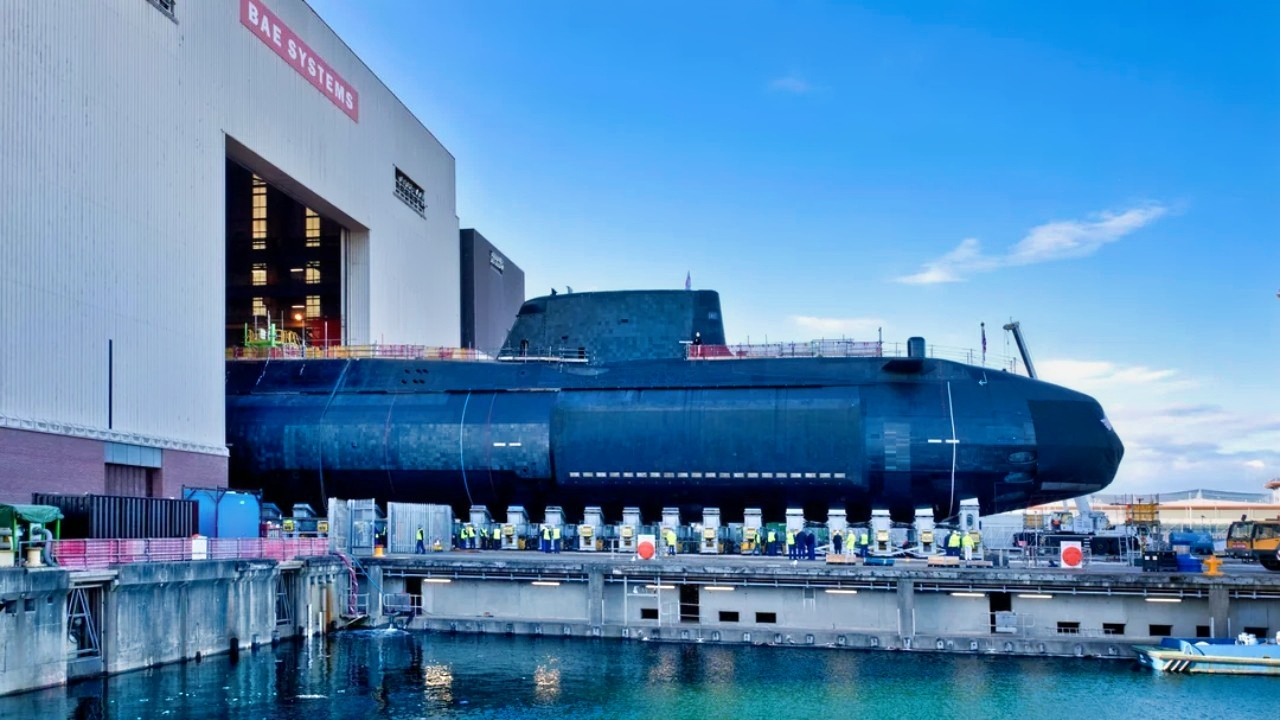
HMS Astute was eventually ordered in March 1997, with her keel laid down on January 31, 2001. She was launched June 8, 2007, and commissioned on August 27, 2010 — nine years later than the original schedule had projected. By the time the lead boat was delivered, the program’s revised total cost had reached £11.26 billion as reported by the Cabinet Office Infrastructure and Projects Authority in March 2024, climbing to £12.2 billion by May 2025.
Technology And Design
What Britain got for the money is, by most credible technical assessments, one of the best attack submarines in the world.
The Astute-class displaces approximately 7,800 tons submerged and measures 97 meters in length — the largest SSN the Royal Navy has ever operated, per Navy Lookout’s platform design analysis. The boats are powered by a Rolls-Royce PWR2 (Core H) pressurized water reactor — the same reactor family that powers the Vanguard-class ballistic missile submarines — with a 25-year service life requiring no refueling. The reactor drives a pump-jet propulsor rather than a conventional propeller, producing the quieter acoustic signature that modern hunter-killers require.
The acoustic quieting performance is the headline capability. The Astute-class boats are wrapped in anechoic tiles that mask sonar reflections and dampen radiated noise. Per analysts who have publicly commented on the platform, the Astute is among the quietest submarines ever built — at low speeds, comparable to, or even quieter than, the Virginia-class boats the Royal Navy now trains alongside. And, yes, that’s where the claims of ‘best submarine on Earth’ seem to come from, according to my source in the Royal Navy.
The sensor suite centers on Sonar 2076, the Thales-built integrated passive and active search and attack system with bow, intercept, flank, and towed arrays. Naval Technology’s assessment of the Astute notes that BAE Systems claims the 2076 is the world’s best sonar system — a claim difficult to independently verify but consistent with Royal Navy operational reporting from exercises against U.S. Navy boats.
Conventional periscopes have been replaced by two non-hull-penetrating Thales CM010 optronic masts carrying thermal imaging cameras and low-light television sensors. The combat management system — the Astute Combat Management System, developed by BAE Systems Insyte — is an evolved version of the Submarine Command System used across the British submarine fleet.
The weapons fit is six 533mm bow torpedo tubes with stowage for 38 weapons total. The standard load mixes Spearfish heavyweight torpedoes and Tomahawk Block IV cruise missiles, as the Royal Navy’s official armament data confirms. Tomahawk Block IV gives the Astute strategic land-attack reach of approximately 1,000 miles with mid-flight retargeting; Spearfish can engage targets at 14 miles, or up to 30 miles at lower speed. The MOD announced in 2022 that it would upgrade these missiles to Block V standard from 2024.
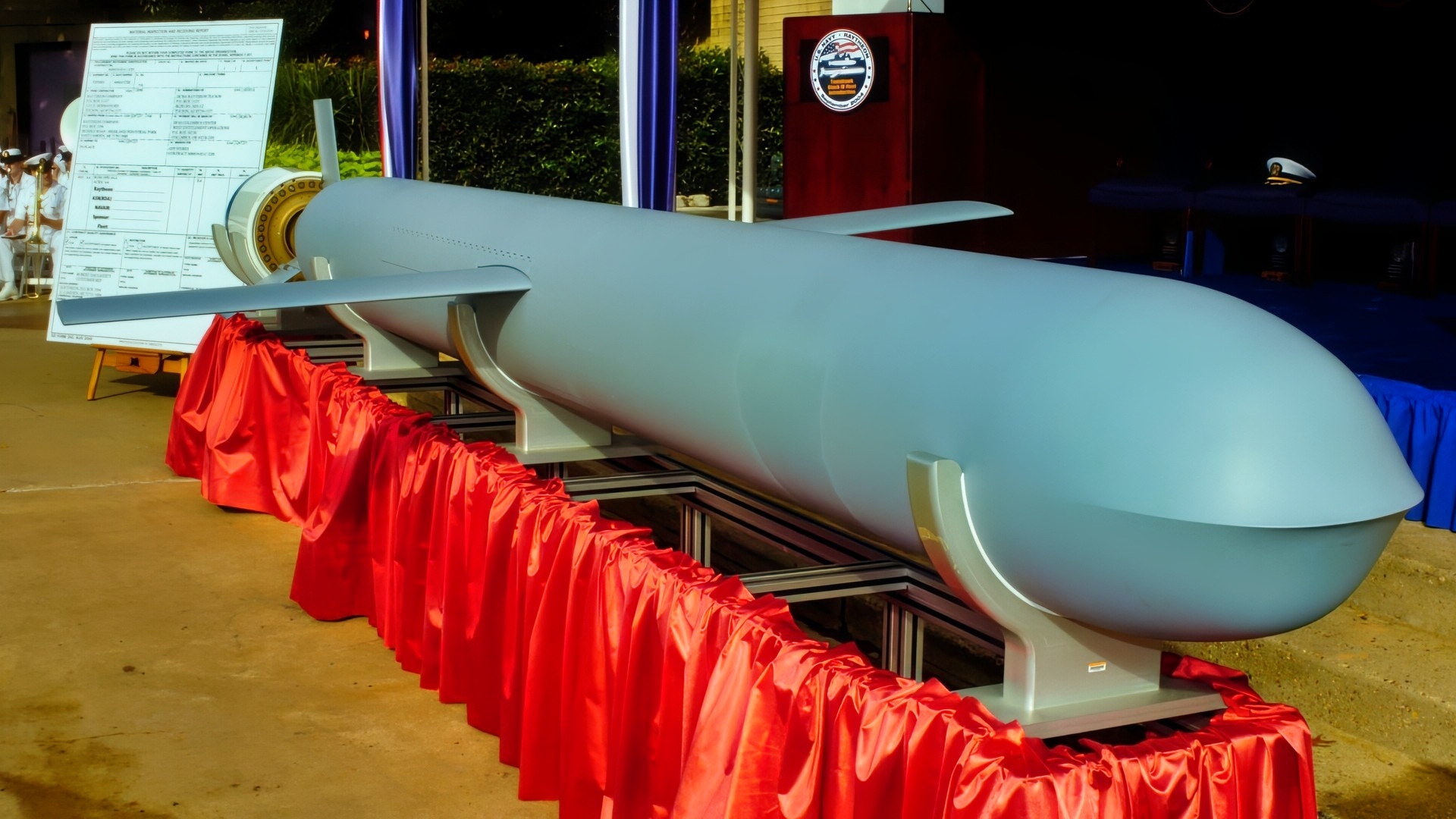
Tomahawk Block IV Missile. Image Credit: Creative Commons.
The platform also carries a Dry Deck Shelter mounting capability — a modification specifically requested by the Royal Navy during the design phase to support special forces and swimmer delivery vehicle operations from a submerged submarine. This requirement is what produced the Astute’s distinctive humpbacked profile, with the larger fin and modified aft casing required to accommodate the shelter.
Crew complement is 98 personnel, with capacity for an additional 12 sea riders, specialist augmentees, or an embarked military force. The boats can produce their own oxygen and drinking water, enabling endurance of approximately 90 days based on food capacity rather than mechanical limits.
Launch History And How Many Were Built
Seven Astute-class submarines are being built. The Royal Navy’s plan, originally placed at three boats in March 1997 and expanded to seven in stages through the mid-2000s and 2010s, has held essentially constant for two decades despite the program’s cost growth.
The lead boat HMS Astute (S119) was launched in 2007 and commissioned in 2010. HMS Ambush (S120) followed in March 2013. HMS Artful (S121) was inducted into the Royal Navy in March 2016. HMS Audacious (S122) was launched in April 2017 and arrived at her home base in April 2020. HMS Anson (S123) was launched in April 2021 and commissioned in August 2022. HMS Agamemnon (S124) was launched in 2024. HMS Agincourt (S125), the seventh and final boat of the class, is currently under construction at Barrow-in-Furness.
The Naval Technology profile of the class notes that all Astute-class boats are based at HM Naval Base Clyde at Faslane, Scotland. Construction has consistently taken between nine and 11 years per boat — substantially longer than the four-year average build time the Trafalgar class achieved in the 1980s.
Operational History of the Astute-Class
The Astute-class has operated as the Royal Navy’s primary hunter-killer force since HMS Astute completed initial trials in 2010. The boats deploy globally on classified missions — anti-submarine surveillance against Russian and Chinese boats, intelligence collection in contested waters, special forces support, and forward presence in regions where British strategic interests require submerged capability.
The most notable publicly documented engagement came in 2012, when HMS Astute participated in Exercise Fellowship, conducting simulated battles against the U.S. Navy Virginia-class submarine USS New Mexico. Per Global Military’s compiled service history, Royal Navy Commander Iain Breckenridge — Astute’s commanding officer at the time — publicly stated that the boat’s sonar performance exceeded expectations, with Astute holding USS New Mexico at ranges Breckenridge had not previously experienced against a Virginia-class target.
The same Global Military assessment documents several less flattering incidents. HMS Astute ran aground during trials off the Isle of Skye in 2010. A fatal shooting occurred aboard the lead vessel in 2011 while she was docked in Southampton. HMS Ambush sustained conning tower damage in 2016 following a collision with a merchant ship during exercises near Gibraltar.
Combat operations have remained classified. The Astute-class is widely understood to have participated in Tomahawk strike operations against Islamic State targets in Syria from 2015 onward, with HMS Triumph (a Trafalgar-class boat) confirmed as a launch platform for early operations and Astute-class boats taking over the role as Trafalgars decommissioned. The boats are also widely reported to have participated in Tomahawk strikes against Houthi targets in Yemen during the 2024 Red Sea engagements, though specific platform attribution has not been publicly confirmed.
How They Will Be Replaced
The successor to the Astute-class is SSN-AUKUS — the next-generation nuclear-powered attack submarine being developed jointly by the United Kingdom, the United States, and Australia under the AUKUS partnership signed in September 2021.

SSN-AUKUS. Image Credit: Creative Commons.
The program began in September 2021 as the British Submersible Ship Nuclear Replacement (SSNR) — the Royal Navy’s clean-sheet successor to the Astute class. Per the UK Defence Journal’s analysis of the program, SSNR was renamed SSN-AUKUS in March 2023 when Australia formally joined the effort and U.S. technology was incorporated into the design.
The new boats will be substantially larger than the Astute-class — displacement over 10,000 tons, comparable to the latest Virginia-class Block V submarines. The propulsion plant will be the Rolls-Royce PWR3 reactor or an enhanced derivative, an upgrade over the PWR2 used in the Astute and developed for the Dreadnought-class ballistic missile boats. The combat management system will be the General Dynamics AN/BYG-1 — the same combat control system used on the Virginia-class — a major architectural decision that anchors SSN-AUKUS to a U.S.-led combat system family.
The weapons fit will include both standard torpedo tubes and a vertical launching system for land-attack cruise missiles. Per Global Defence Technology’s analysis of the SSNR-to-SSN-AUKUS evolution, this VLS will be a first for Royal Navy submarines, which currently launch all land-attack missiles through their torpedo tubes. Tomahawk cruise missiles, advanced torpedoes, and potentially future hypersonic weapons are all on the prospective loadout.
The UK House of Commons Library briefing on the program confirms that the British government has committed to acquiring up to 12 SSN-AUKUS submarines under the June 2025 Strategic Defence Review — a substantial expansion over the seven-boat Astute fleet. Australia plans to operate a smaller number of SSN-AUKUS boats alongside three Virginia-class submarines purchased from the United States.
The first SSN-AUKUS boat is scheduled to enter Royal Navy service in the late 2030s. The first Australian SSN-AUKUS will follow in the early 2040s. The build target is one submarine every 18 months from Barrow-in-Furness, with parallel construction beginning in Australia at Osborne shipyard in Adelaide. Per Army Recognition’s coverage of the most recent program milestones, the United States approved a potential $1 billion package in March 2026 covering the SSN-AUKUS combat system and vertical launch capability, with Huntington Ingalls Industries, General Dynamics Electric Boat, General Dynamics Mission Systems, Progeny Systems, Lockheed Martin, and Systems Planning and Analysis named among the principal contractors.
The first AUKUS rotational presence at HMAS Stirling in Western Australia — known as Submarine Rotational Force – West — is scheduled to begin as early as 2027 with one Astute-class boat and up to four U.S. Navy submarines forward-deployed from the Australian base.
What This Means For British Naval Power
The Astute-class is the platform Britain built. It is genuinely excellent. The boats are quiet, capable, well-armed, and operationally proven across more than a decade of forward deployment. They have done what the Royal Navy asked them to do.
The platform also represents the limits of what Britain can do alone in modern submarine design. The American assistance that rescued the Astute program in 2003 is being institutionalized in SSN-AUKUS through formal trilateral cooperation rather than ad-hoc consultancy. The next generation of British submarines will be jointly designed with American technology and built using American manufacturing techniques to a degree that the Astute-class only began to approach.
That is the trade the Royal Navy is making. Sovereign British submarine capability is being absorbed into a trilateral framework where industrial efficiencies and shared design costs make a larger fleet affordable. Twelve SSN-AUKUS boats versus seven Astutes is the headline result. Whether that fleet actually materializes on the announced schedule — with one submarine delivered every 18 months from Barrow — is the open industrial question hanging over the program.
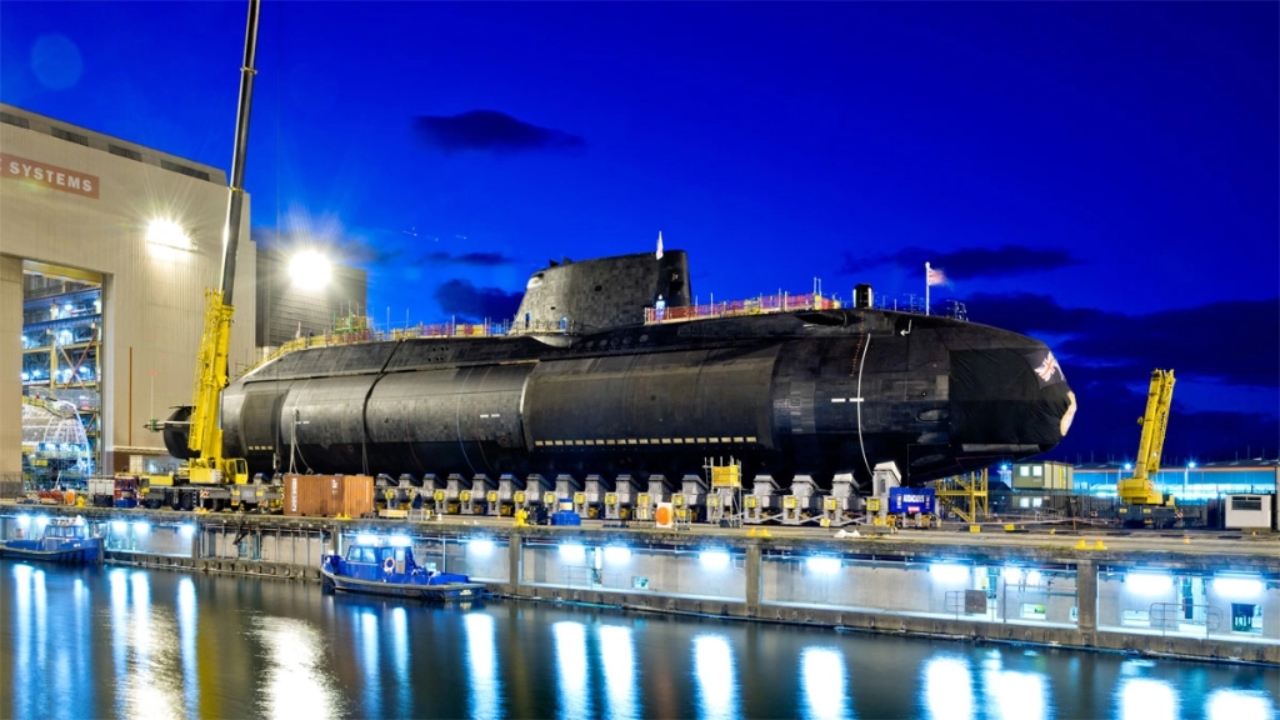
Astute-Class Submarine. Image Credit: Creative Commons/BAE Systems.
What the Astute-class proved is that Britain can build world-class hunter-killer submarines when it chooses to invest the money, the time, and the institutional capacity. What it also proved is that without continuous investment in the supplier base, the design workforce, and the operational experience of the Royal Navy submarine service, that capability can erode faster than any military planner thought possible.
The seventh and final Astute-class boat is currently under construction at Barrow. By the time HMS Agincourt commissions, the first SSN-AUKUS hull will be in early-stage construction in the same shipyard. The transition from one era of British undersea power to the next is happening right now, in the same dockyard, with many of the same workers.
Whether Britain can sustain that transition through the 2030s is the question that will define the Royal Navy’s strategic relevance for the rest of the century.
MORE – China Has Thousands of Missiles to Point at Navy Aircraft Carriers
MORE – Canada’s F-35 Purchase Could Get Squashed
About the Author: Harry J. Kazianis
Harry J. Kazianis (@Grecianformula) was the former Senior Director of National Security Affairs at the Center for the National Interest (CFTNI), a foreign policy think tank founded by Richard Nixon based in Washington, DC. Harry has over a decade of experience in think tanks and national security publishing. His ideas have been published in the NY Times, The Washington Post, The Wall Street Journal, CNN, and many other outlets worldwide. He has held positions at CSIS, the Heritage Foundation, the University of Nottingham, and several other institutions related to national security research and studies. He is the former Executive Editor of the National Interest and the Diplomat. He holds a Master’s degree focusing on international affairs from Harvard University.


MrObvious
May 19, 2026 at 7:34 pm
Yeah the Brits built it with our money, tech and planning. Now they can’t put it in the water because they need gas money from us!
Zazu
May 20, 2026 at 10:12 am
Before we go slamming the UKs submarines to hard, we need to take a long hard long at the state of our own shipbuilding industry. As some who made a career as a trades person, roreman, project manager and lastly a manager, I can say with authority that our shipbuilding / submarine industry is hanging on by its fingernails.
Zazu
May 20, 2026 at 10:18 am
Racism (against whites), labor unions,corruption, graft, cover ups and executive greed have all but killed what used to be the most powerful, efficient, and innovative industry that the world has ever seen. The Navy (and congress, led by Pete) needs to take a long, hard look into why we can’t build naval vessels the way we used to.