

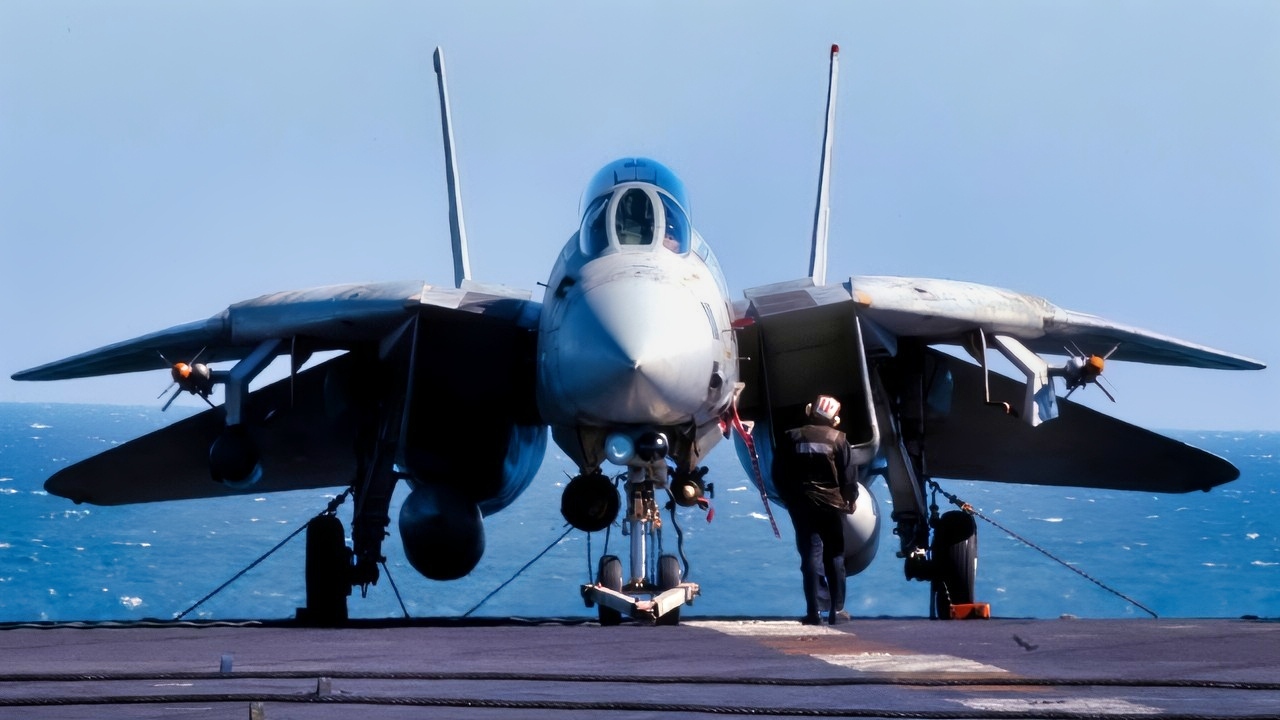
The F-14D Super Tomcat was the final and most capable version of the most famous American naval fighter ever to launch from an aircraft carrier deck – we know, we have seen quite a few of them up close, and have included the videos and photos we took for your viewing pleasure. New General Electric F110 engines, a digital glass cockpit, the upgraded AN/APG-71 radar, infrared search and track, and precision strike capability — the F-14D fixed nearly every flaw of the original F-14A. It dropped JDAMs over Afghanistan and Iraq. It flew its last combat mission in February 2006. Then the Navy retired it anyway, replaced by the F/A-18 Super Hornet. Twenty years later, the carrier air wing has yet to fully replace what the Tomcat could do.
The F-14D Super Tomcat: The Best Version Of The Best Naval Fighter The U.S. Navy Ever Built — It Was Retired Anyway
The F-14D Super Tomcat was the final variant of the most famous American naval fighter ever to launch from an aircraft carrier deck.
It corrected nearly every flaw that had plagued the earlier F-14A. It paired a twin-engine, variable-sweep airframe with new General Electric F110 engines, a digital glass cockpit, and the most capable air-to-air radar fitted to any American fighter of its generation. It could engage six enemy aircraft simultaneously at ranges no other naval fighter could match.
Then the Cold War ended, the budget collapsed, the production line was cut short, and the Super Tomcat was retired in 2006 — replaced by an aircraft that, by most pilots’ honest assessment, has never fully replicated the F-14D’s specific combination of range, payload, and fleet defense capability.
This is the story of the Super Tomcat. What the original F-14 needed fixed, what the D model fixed, what the aircraft did in combat across three decades, and why the U.S. Navy retired it anyway.
What The Original F-14 Got Wrong

F-14D National Security Journal Photo.

F-14D Tomcat at Smithsonian. Image Credit: Dr. Brent M. Eastwood/National Security Journal.
The F-14 Tomcat entered fleet service in 1974 as the U.S. Navy’s answer to a specific Soviet threat. The Soviet Naval Aviation force had begun fielding long-range supersonic bombers — Tu-22M Backfires and Tu-16 Badgers — armed with anti-ship cruise missiles that could strike American carrier battle groups from outside the range of any existing American naval fighter. The Tomcat was designed to push the engagement envelope out hundreds of miles, using its long-range AN/AWG-9 radar and AIM-54 Phoenix missiles to engage Soviet bombers and their missiles before they could reach the carrier.
The aircraft did what it was built to do. It was also unreliable, expensive to maintain, and powered by an engine that had no business being in a frontline fighter.
The Pratt & Whitney TF30 turbofan was the original F-14A’s fatal flaw. Per Aircraft Wiki’s detailed history of the program, the TF30 was prone to compressor stalls at high angles of attack — exactly the flight regime where a fighter pilot most needs reliable thrust. Engine surges during carrier launches and during air combat maneuvering killed pilots. The TF30 was also underpowered for the airframe’s weight, limiting the F-14A’s true performance well below what the design could have produced with proper engines.
Avionics were a separate problem. The AN/AWG-9 radar was extraordinary when it worked, but the analog systems supporting it were difficult to maintain, prone to component failures, and increasingly obsolete by the late 1980s as Soviet fighter avionics modernized. The cockpit was a mass of analog gauges that demanded substantial workload from the pilot and Radar Intercept Officer during high-tempo combat.
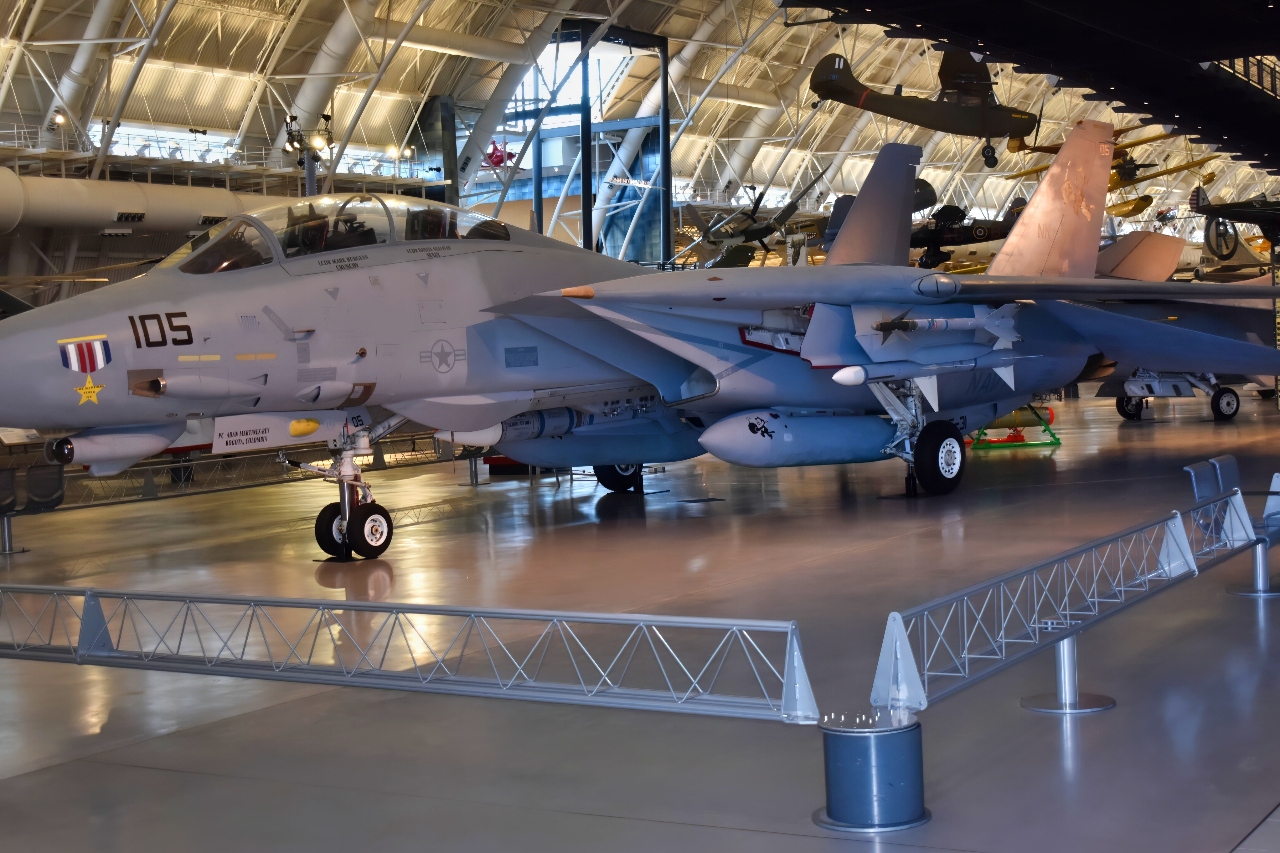
F-14D Tomcat. Image Taken By National Security Journal.
The Navy tried to fix the engine problem first. Some F-14As were upgraded with the General Electric F110-400 in 1987, redesignated F-14A+ and then F-14B in 1991. The engine swap solved the compressor stall issue and produced what most Tomcat aviators considered the first F-14 to actually fly the way the airframe deserved.
The avionics problem still needed fixing.
The F-14D: A Complete Overhaul
The F-14D Super Tomcat was the Navy’s answer.
Per the AirFighters technical profile of the variant, the D-model was the ultimate version of the F-14 and the end of a long line of progressive upgrades. The aircraft retained the F-14B’s General Electric F110-400 engines but added a comprehensive avionics modernization that touched nearly every system on the platform.

F-14D Tomcat NSJ Image. Image Credit: Taken by Jack Buckby on 9/18/2025.
The replacement radar was the AN/APG-71 — an upgraded multi-mode pulse-Doppler system that combined the AWG-9’s long-range engagement capability with substantially improved discrimination against ground clutter, electronic countermeasures resistance, and target tracking capacity. The APG-71 could engage multiple targets at extended ranges with substantially better reliability than the analog AWG-9 it replaced.
The cockpit was replaced with a digital glass cockpit — multifunction color displays in place of analog gauges, integrated weapons and sensor management, and dramatically reduced crew workload. The original F-14A required the RIO to manage radar, weapons, and tactical situational awareness across a console of dedicated controls. The F-14D centralized that management into integrated displays that handled the same workload across fewer hands.
Other systems came with the package. The Joint Tactical Information Distribution System (JTIDS) provided secure datalink connectivity with other aircraft and surface ships. The Airborne Self Protection Jammer (ASPJ) was equipped with integrated electronic countermeasures. The SJU-17 Naval Aircrew Common Ejection Seat replaced the original ejection system with a substantially safer, higher-performance design. An Infrared Search and Track (IRST) sensor gave the aircraft a passive long-range target detection capability that did not require active radar emissions — useful for engaging stealth-coated adversaries or maintaining tactical silence.
Per The Defense Watch’s specifications profile, unit cost for the F-14D was approximately $74 million in then-year dollars — significantly more than the original F-14A, but justified by the comprehensive nature of the upgrade.
The D model was first delivered in 1991. Per Aviation Photojournal’s variant history, production ran to 37 new airframes plus 18 conversions from earlier F-14A airframes (designated F-14D(R) for “rebuild”). Then-Secretary of Defense Dick Cheney cut the program short in 1989 after massive cost overruns and program delays, capping production at 55 total D-model airframes — far below the Navy’s original requirement for a fleet-wide replacement.

F-14 Tomcat. Image Credit: Jack Buckby/National Security Journal.

F-14 Tomcat Photo Taken on August 24 2025. Image Credit: Jack Buckby/National Security Journal.
The Grumman Super Tomcat 21 program was the follow-on plan. Per Simple Flying’s analysis of the cancelled upgrade program, the Super Tomcat 21 would have added F110-GE-429 engines capable of supercruise at Mach 1.3 without afterburner, increased fuel capacity, an AESA radar, and additional aerodynamic improvements.
The program was never funded. The Navy ultimately chose to develop the F/A-18E/F Super Hornet instead, leaving the Super Tomcat 21 as a never-built proposal that many former Tomcat aviators believe would have given the Navy a substantially better long-range strike fighter than what eventually replaced it.
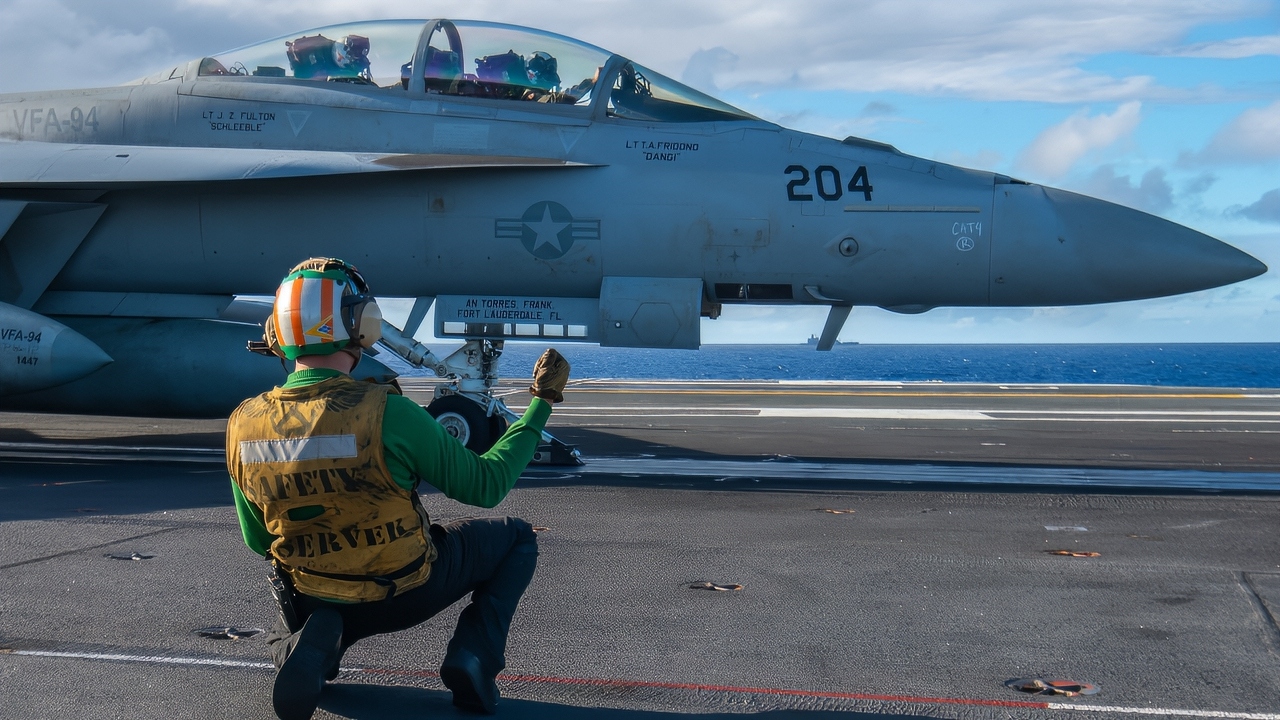
(Dec. 31, 2022) An F/A-18E Super Hornet assigned to the “Mighty Shrikes” of Strike Fighter Squadron (VFA) 94 prepares to launch from the aircraft carrier USS Nimitz (CVN 68) to participate in a long-range maritime strike demonstration. Nimitz is in 7th Fleet conducting routine operations. 7th Fleet is the U.S. Navy’s largest forward-deployed numbered fleet, and routinely interacts and operates with 35 maritime nations in preserving a free and open Indo-Pacific region. (U.S. Navy photo by Mass Communication Specialist 2nd Class Justin McTaggart)
Operational History
The F-14D entered fleet service with VF-2, VF-11, VF-31, VF-51, and several other squadrons across the early 1990s. The aircraft conducted Mediterranean and Persian Gulf deployments throughout the decade, supporting the no-fly zone enforcement missions over northern and southern Iraq under Operations Northern Watch and Southern Watch.
Combat experience came in incremental engagements. On January 5, 1999, two F-14Ds from VF-213 engaged Iraqi aircraft violating the southern no-fly zone, launching two AIM-54C Phoenix missiles at an Iraqi MiG-25 — the first combat employment of the AIM-54 by the U.S. Navy. Both missile motors failed and the engagement did not produce a kill, though the Iraqi MiG retreated without engaging.
The F-14D’s most consequential combat decade came after September 11, 2001. Operation Enduring Freedom in Afghanistan and Operation Iraqi Freedom in 2003 gave the Super Tomcat the precision-strike role that the original F-14 was never designed to perform. The LANTIRN targeting pod added to the F-14 in the late 1990s gave the aircraft laser designation capability for precision-guided weapons. The F-14D was eventually cleared to carry GBU-10, GBU-12, GBU-16, GBU-24, and GBU-38 JDAM precision munitions, plus the AGM-154 Joint Standoff Weapon. The F-14Ds of VF-2, VF-31, and VF-213 obtained JDAM capability in March 2003 just in time for the opening of Operation Iraqi Freedom.
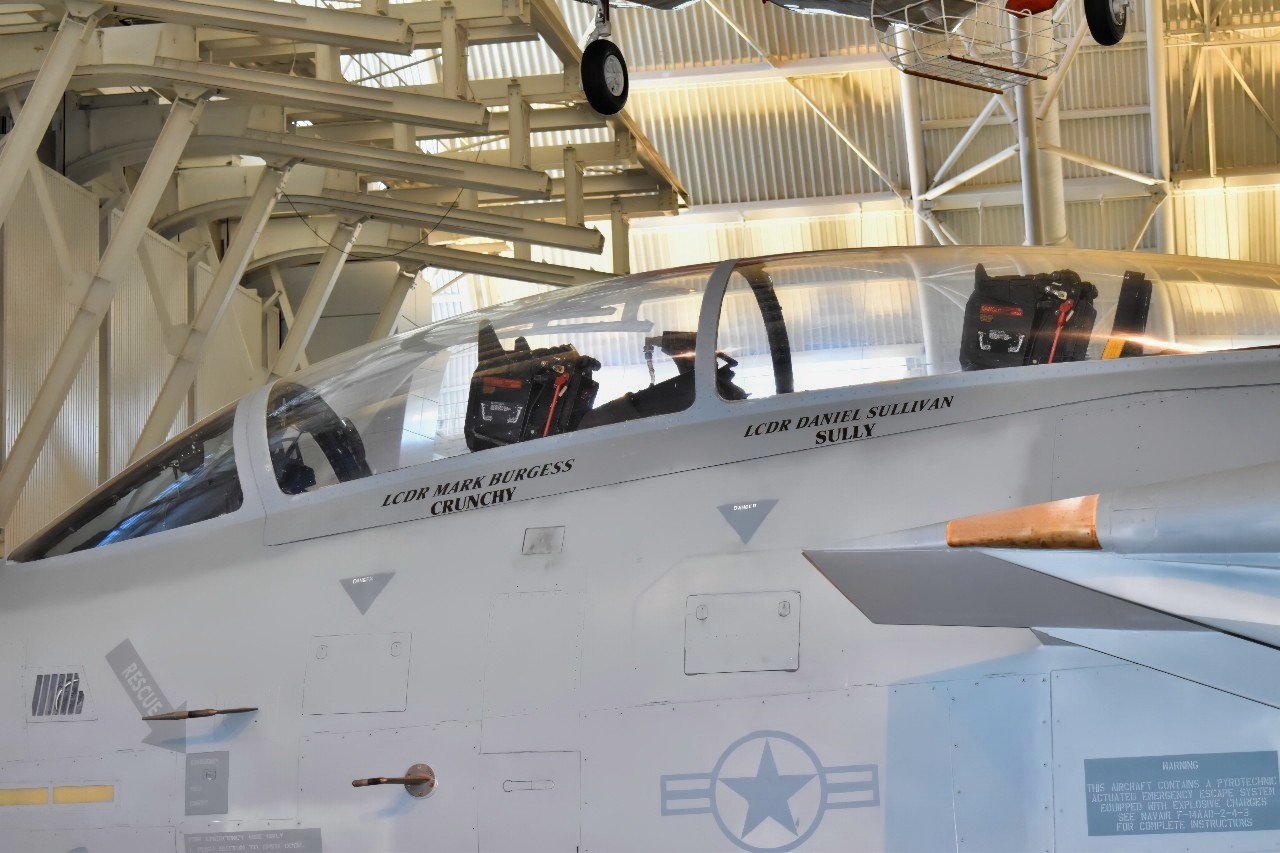
F-14 Cockpit at F-14 Tomcat at Steven F. Udvar-Hazy Center. Image taken on September 5, 2025, by National Security Journal.
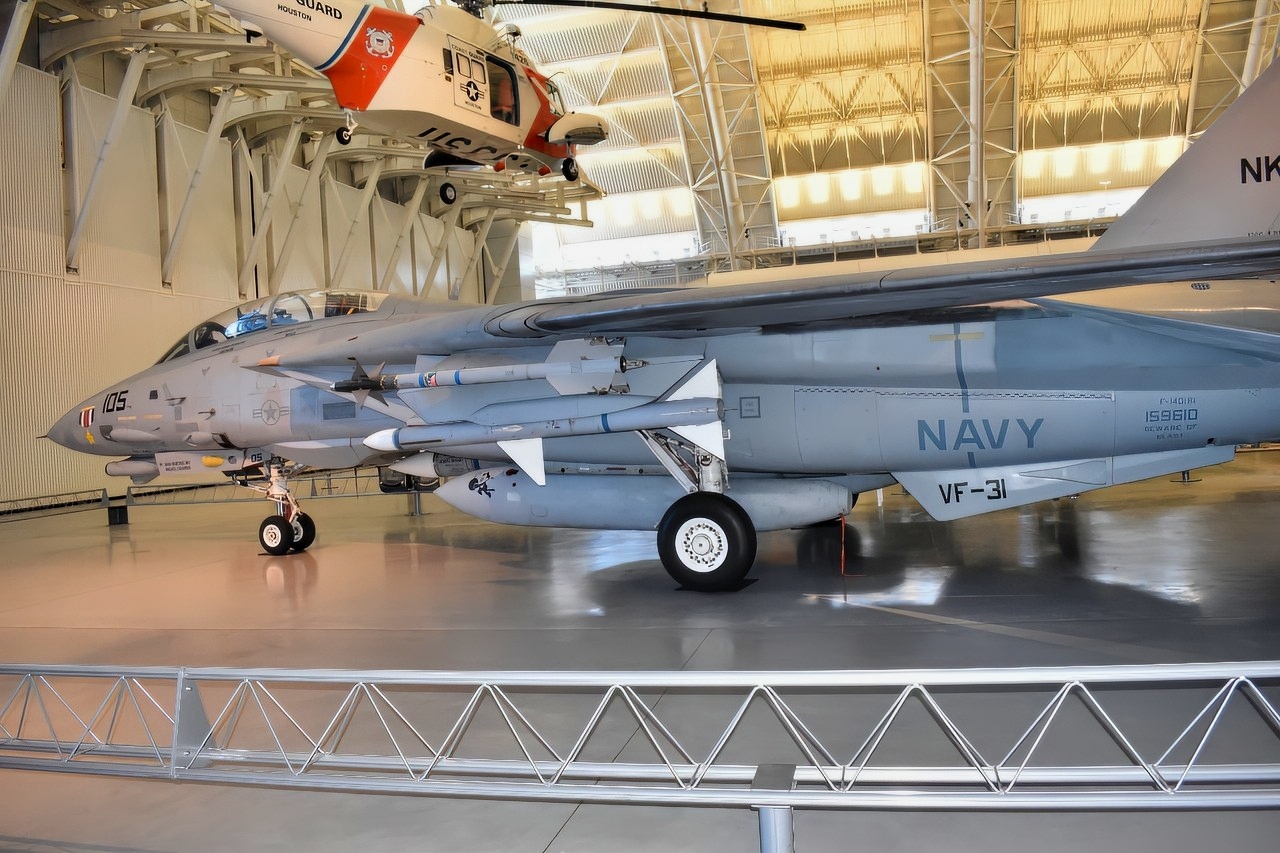
F-14 Tomcat at Steven F. Udvar-Hazy Center. Image by Brent M. Eastwood for National Security Journal.
The Tomcat air-to-ground performance during these campaigns was substantial. F-14s flew strike missions against Iraqi command and control nodes, including JDAM attacks against the Iraqi Ministry of Information’s Salman Pak radio relay facility near Baghdad. TARPS-equipped F-14Ds conducted reconnaissance missions across the entire Iraqi theater. F-14Ds operating as Forward Air Controllers (FAC-A) directed strike aircraft against ground targets. Per a detailed Aviation Geek Club account of one such mission, F-14D crews handed off targeting coordinates to F-16s and A-10s for follow-on JDAM strikes against Iraqi anti-aircraft positions.
In December 2005, the F-14Ds of VF-31 and VF-213 received the ROVER III downlink system, which allowed F-14 crews to transmit real-time imagery from their LANTIRN pods directly to ground-based forward air controllers — a capability that proved especially valuable for close air support of coalition troops in Iraq.
During their final deployment with USS Theodore Roosevelt from September 2005 through March 2006, VF-31 and VF-213 collectively completed 1,163 combat sorties totaling 6,876 flight hours, dropping 9,500 pounds of ordnance across reconnaissance, surveillance, and close air support missions in support of Operation Iraqi Freedom.
The Tomcat’s final combat mission came on February 8, 2006, when a pair of F-14Ds from VF-31 returned to USS Theodore Roosevelt after one dropped a single 500-pound GBU-38 JDAM over Iraq.
Retirement
The Navy retired the F-14 in 2006 for reasons that had little to do with the aircraft’s combat performance.
Per Defense Feeds’ assessment of the retirement decision, the Tomcat was expensive to maintain. The variable-sweep wings required substantial inspection and maintenance hours after every flight. The 1970s-era airframe and infrastructure consumed maintainer hours at a rate that the newer F/A-18 simply did not require. Corrosion was a persistent issue across the entire fleet, particularly on aircraft that had spent years operating in the salt-air environment of carrier deployments. Spare parts became increasingly difficult to source as Grumman wound down production support and the supplier base for F-14-specific components contracted.
The strategic environment had also changed. The Soviet Naval Aviation threat that had justified the F-14’s long-range interceptor role no longer existed. Post-Cold War American naval missions emphasized strike, close air support, electronic warfare, and littoral operations — roles where the F/A-18 Super Hornet’s multi-role design and lower maintenance burden offered substantial cost-of-ownership advantages.

F-14 Tomcat from Outside DC NSJ Image.
The final phase unfolded across late 2005 and 2006. VF-31 (the “Tomcatters”) and VF-213 (the “Black Lions”) completed the final combat deployment. The last F-14 catapult launch from a U.S. Navy carrier occurred on July 28, 2006 from USS Theodore Roosevelt — an F-14D from VF-31 piloted by Lieutenant Blake Coleman with Lieutenant Commander Dave Lauderbaugh as RIO.
The two squadrons conducted their final fly-in at Naval Air Station Oceana on March 10, 2006. The official retirement ceremony followed on September 22, 2006 at Oceana. Per the Prairie Aviation Museum’s retirement timeline, the primary aircraft scheduled for the ceremony experienced mechanical problems and had to be replaced with a backup — itself an unintentional reminder of the maintenance issues that had driven the retirement decision.
The actual final flight of an F-14 in U.S. Navy service came on October 4, 2006, when F-14D BuNo 164603 was ferried from NAS Oceana to Republic Airport in Farmingdale, New York, for historical preservation. The aircraft was the next-to-last F-14 built (number 711 of 712 total Tomcats produced) and was eventually transferred to a display position in front of the former Grumman Aerospace Corporation headquarters in Bethpage.
Legacy of the F-14D Super Tomcat
The F-14D’s legacy is more complicated than the headline retirement story suggests.
The Iranian Air Force continues to fly F-14As acquired before the 1979 revolution. Iran’s F-14 fleet is the only remaining flying Tomcat force in the world, with combat-ready airframes maintained through cannibalization and indigenous parts manufacturing despite the absence of any official support from the United States.
The American carrier air wing has not fully replicated the F-14D’s specific capability set. The F/A-18E/F Super Hornet is an excellent aircraft, but it carries less fuel, has shorter combat radius, and lacks the two-crew configuration that made the F-14D so effective in long-range strike, FAC-A, and reconnaissance missions. The F-35C adds stealth but does not match the Tomcat’s payload or range. The future F/A-XX sixth-generation fighter — scheduled for contract award in August 2026 — is being designed in part to restore the long-range carrier-based fighter capability lost with the F-14’s retirement.

Boeing NGAD F/A-XX Fighter Rendering. Image Credit: Boeing.

F/A-XX Handout Photo from Northrop Grumman.
Pilots and naval aviators who flew the F-14D continue to argue that the Navy retired the best aircraft in its inventory too early. That argument is not purely sentimental. The platform’s specific combination of range, payload, two-crew workload distribution, and combat persistence has yet to be fully replicated in any successor American naval fighter.
The Tomcat made its combat debut in April 1975 during the evacuation of Saigon. It made its final combat mission in February 2006 over Iraq. Across 31 years of carrier deployments, it served as the U.S. Navy’s primary fleet defense interceptor, long-range strike aircraft, reconnaissance platform, and forward air controller.
The F-14D was the best version of that aircraft. The Navy retired it anyway.
What the platform could have done across the past two decades of American naval combat — and what it could be doing right now in the Western Pacific against modern Chinese threats — is the open question that has shadowed the Tomcat’s retirement since the day the last airframe rolled into a museum.
About the Author: Harry J. Kazianis
Harry J. Kazianis (@Grecianformula) was the former Senior Director of National Security Affairs at the Center for the National Interest (CFTNI), a foreign policy think tank founded by Richard Nixon based in Washington, DC. Harry has over a decade of experience in think tanks and national security publishing. His ideas have been published in the NY Times, The Washington Post, The Wall Street Journal, CNN, and many other outlets worldwide. He has held positions at CSIS, the Heritage Foundation, the University of Nottingham, and several other institutions related to national security research and studies. He is the former Executive Editor of the National Interest and the Diplomat. He holds a Master’s degree focusing on international affairs from Harvard University.


Dan Pringle
May 21, 2026 at 7:21 pm
Wasn’t the F-14’s biggest issue the hours spent by the ground crew vs flight time? It was one of the most expensive jets to maintain ever! EVER!!