


The International Energy Agency’s May report shows global oil inventories fell by 250 million barrels across March and April, with the Q2 drawdown running at 8.5 million barrels a day. The U.S. just released another 53.3 million barrels from the Strategic Petroleum Reserve to Trafigura, Marathon, and ExxonMobil — the second major release this spring, leaving the reserve below 300 million barrels. President Trump set five new preconditions for resuming talks with Iran, including the delivery of Tehran’s full enriched uranium stockpile to the United States. Iran called the proposal totally unacceptable.
The Iran War, Oil Reserve Collapse and Donald Trump

President Donald Trump signs Executive Orders in the Oval Office, Thursday, April 24, 2025. (Official White House Photo by Abe McNatt)
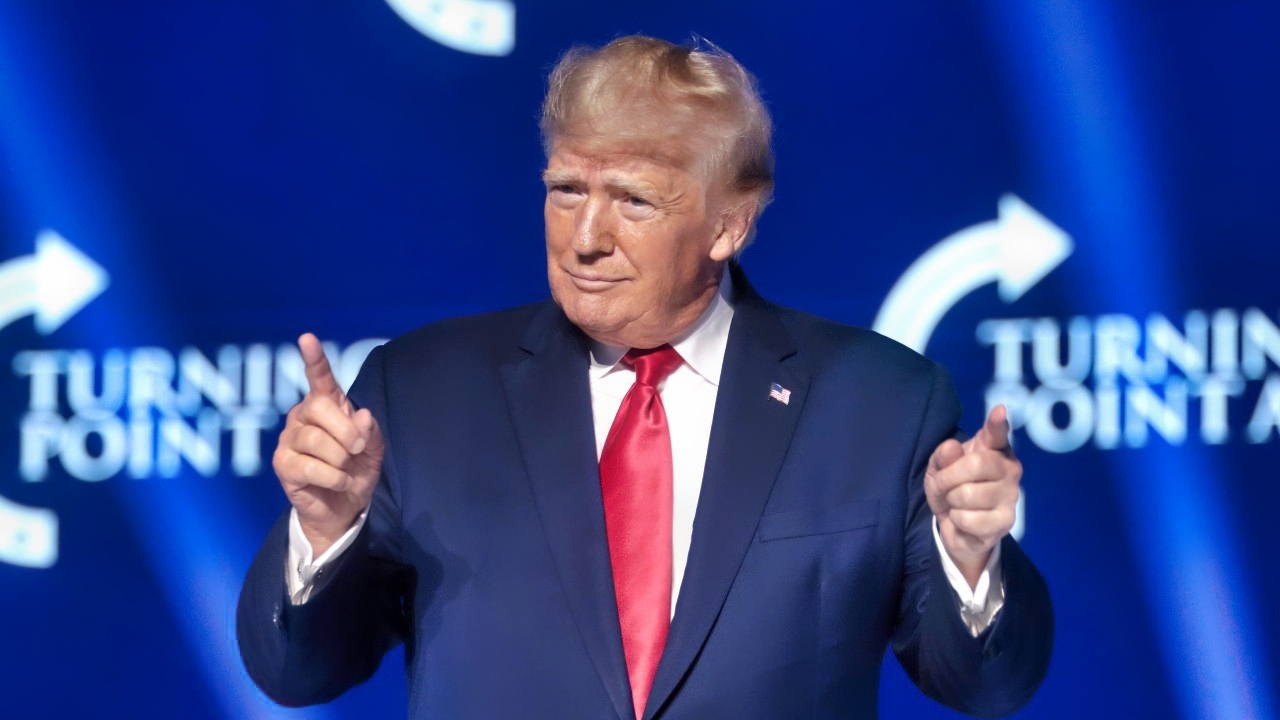
Donald Trump at Turning Points USA. Image by Gage Skidmore.
The oil market has its own ideas about how long the Iran war can last. Washington spent most of March pretending otherwise.
It cannot continue to do so.
The Numbers Don’t Lie
The IEA’s May report hit the White House at a bad moment. Global inventories dropped 250 million barrels across March and April — 129 million gone in March, another 117 million in April.
The agency projects the Q2 drawdown will average 8.5 million barrels a day, with the steepest draws arriving in May and June.
The U.S. last week issued emergency exchange contracts for another 53.3 million barrels from the Strategic Petroleum Reserve to Trafigura, Marathon, and ExxonMobil — the second major release this spring, after roughly 80 million barrels went out in an earlier round, leaving the reserve well below 300 million barrels once transfers are complete. The math is not comfortable.
It is not just an American problem. Europe, Asia, and North America together shed 146 million barrels from existing on-land stocks in April alone.
These reserve systems were built to handle disruptions.
They were not built to handle a severely disrupted Hormuz running into peak summer demand, with no end in sight. Gulf states, including Saudi Arabia, the UAE, and Qatar, are absorbing some of the heaviest fiscal damage.
European manufacturers are facing higher shipping and insurance costs with no alternative route that moves volume at anything like the same scale.

President Donald Trump delivers the Commencement address at the graduation ceremony for the University of Alabama, Thursday, May 1, 2025, at Coleman Coliseum in Tuscaloosa, Alabama. (Official White House Photo by Daniel Torok)

President Donald Trump is joined by White House Opportunity and Revitalization Council Executive Director Scott Turner, Washington Commanders owner Josh Harris, NFL Commissioner Roger Goodell, Washington D.C. Mayor Muriel Bowser, and Secretary of the Interior Doug Burgum, for an announcement that Washington, D.C. will host the 2027 NFL Draft, Monday, May 5, 2025, in the Oval Office. (Official White House Photo by Molly Riley)
Washington Is Asking the Wrong Question
Washington keeps having the wrong debate about this. The argument still centers on whether Iran can shut the strait entirely, as if full closure is the only thing that counts. It is not. Roughly 27% of the world’s seaborne crude trade transits Hormuz.
Markets do not need a shutdown to reprice. They need doubt. Once traders conclude the disruption might last, tanker delays start moving prices, insurance costs rise, and contracts get repriced well before a single barrel actually disappears. That mechanism is already running.
The system moves faster than it did twenty years ago.
Three decades of leaner stockpiles and tighter supply chains produced that outcome. Redundancy got engineered out as waste. It worked well enough when a serious great-power conflict stayed theoretical. It works considerably less well now that it is not.
Energy Independence Was Always a Talking Point
The shale boom genuinely changed America’s energy position. The United States pumps far more than it did a generation ago and has become the market’s most important backstop since Hormuz tightened.
But oil prices are set globally, and the idea that domestic production would keep the country out of Gulf disruptions was always more of a talking point than market reality.
The Strategic Petroleum Reserve was built in the 1970s by people who learned that lesson the hard way. It still provides a real buffer. It has also been drawn down repeatedly and sits well below its historic peaks. Finance ministries and trading desks track those levels. They are tracking them now.
Which is why the administration’s turn toward negotiations has stopped looking like geopolitics and started looking like arithmetic.
The Gaps Are Punishing
Through Pakistani intermediaries — a track Reuters confirmed is still active as of today — the two sides have been working on a fourteen-point framework: end the fighting, then negotiate the harder questions: sanctions, enrichment caps, what happens to Iran’s uranium stockpile, who controls the strait going forward. The gaps are punishing. Washington wants enrichment frozen for twenty years; Tehran offered five.
On the uranium stockpile itself, the situation shifted again this week. Trump said Iran told his team it would allow the U.S. to remove the material, then walked that back in its formal response. He called the proposal “totally unacceptable.”
As of last week, he declared the ceasefire “on life support” and met with his top military commanders to discuss next steps. Yesterday, he set five new preconditions for resuming talks, including the delivery of the full enriched uranium stockpile to the United States and shuttering all but one Iranian nuclear facility.
Whose clock is running faster is the real question now.
Iran Has No Reason to Hurry
Iran took serious military damage after the February 28 strikes. Air defenses were hit hard. Missile infrastructure was degraded. The regime did not break. The Revolutionary Guard commanders driving Tehran’s position came through looking durable enough to hold their line.
Giving up a restricted strait before Washington commits to real sanctions relief would surrender the one meaningful card Tehran still holds.
The House of Commons Library’s briefing on the ceasefire noted that Iran has publicly insisted its enriched uranium will not leave the country under any circumstances. They understand that well enough.
Washington is in a different bind.
Gasoline prices have surged sharply since the war began. Trump is pushing Congress to suspend the federal gas tax. His approval numbers are moving with the pump price, and CNN reported this week that aides say he is more seriously considering a resumption of combat operations than at any point since the ceasefire took hold in April. The Iran war is now a domestic political problem wearing a foreign policy uniform.
Netanyahu Makes It Harder
Militarily, the U.S. position in the Gulf is as strong as it has ever been. The original campaign hurt Iran badly without cracking the government, which is an awkward place to be at the negotiating table, even with the better hand.
Netanyahu makes it harder. Israel wants all enriched material out of Iran, enrichment sites gone, proxy networks dismantled — rational Israeli objectives that are extremely difficult to fold into a fast agreement while the energy numbers are pushing for one.
Trump also has to land a deal that cannot be compared to the Obama nuclear accord, his own base spent years attacking. The political geometry is narrow.
He still has the stronger position. Whether it produces an agreement before the oil market runs out of patience with both sides is the question nobody in Washington wants to be asked directly right now.
About the Author: Dr. Andrew Latham
Andrew Latham is a professor of international relations and political theory at Macalester College in Saint Paul, MN. You can follow him on X: @aakatham.


xi-xi
May 19, 2026 at 9:10 am
The gathering global chaos sparked by president chuanpu at the insistence of netanyahu, is a truly mighty godsend for Vladimir Putin.
But does Putin even know of it.
Unlikely, Putin is living in his own make-believe world.
A world full of fairies and angels that constantly sing praises of Moscow.
Putin needs to finish off the nazis while chuanpu kicks up the sand, and blinds everybody.
What should Putin do, now.
Putin needs to order his boffins to develop and produce air-launched burevestnik missiles armed with HE warheads to be carried aloft by high-powered drones.
Then those burevestnik-drone combos should be delivered against the nazis in western Ukraine.
That will shit up a massive whirlstorm in the west, but they won’t be able to do anything at all, except throwing up endless curses and empty threats.
But Putin is totally useless.