


Key Points and Summary – USS Saratoga (CV-60) was one of the Forrestal-class “supercarriers” that carried American power into the Cold War’s hottest moments.
-Commissioned in 1956, “Super Sara” deployed repeatedly to the Mediterranean, shadowed Soviet ships, and later fought off Vietnam, flying hundreds of combat missions over Hanoi and the Gulf of Tonkin.

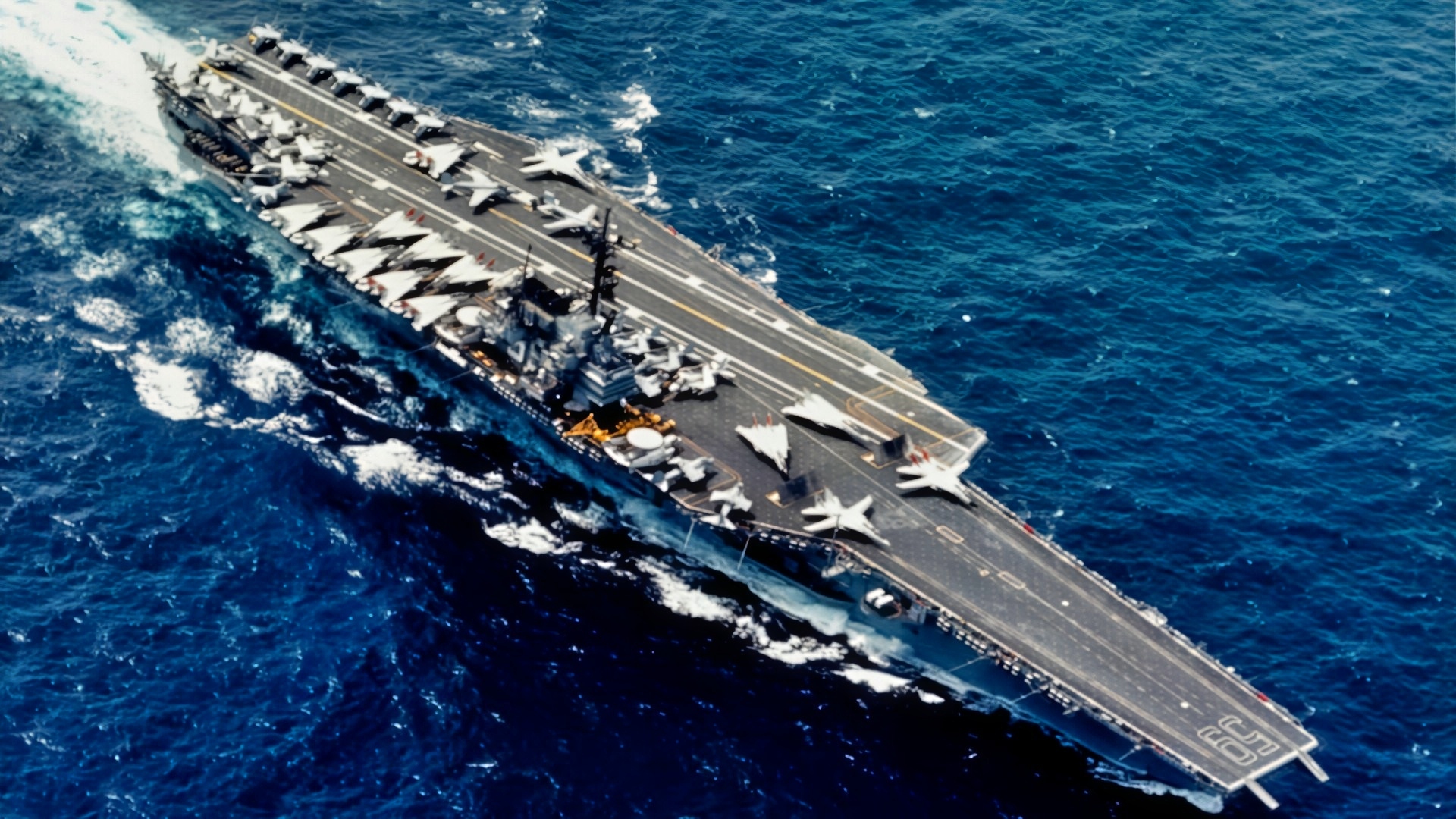
A high angle port bow view of the aircraft carrier USS SARATOGA (CV 60) underway.
-The ship survived collisions, catastrophic fires, and flight-deck accidents yet kept returning to sea. In 1985, Saratoga’s F-14s forced down the Achille Lauro hijackers’ escape jet without firing a shot.
-From NATO exercises to Desert Storm, the carrier earned a hard reputation as a workhorse that showed up when it mattered.
USS Saratoga Aircraft Carrier Was One to Remember
The USS Saratoga aircraft carrier never shied away from combat.
It just had a nose for difficult duty when the United States needed to project power and carry the American flag in dangerous environments.
Produced during the President Dwight D. Eisenhower administration, the Saratoga never had it easy, and its sailors were always ready for warfare.
This was one of the first Cold War aircraft carriers, a member of the Forrestal class.
USS Forrestal Aircraft Carrier. Image Credit: Creative Commons.
The Saratoga was laid down in the New York Naval Shipyard in December 1952. The carrier steamed to Cuba for its first shakedown cruise.
It returned to New York for more work, was launched in 1955, and commissioned in 1956.
Quick Look at the Carrier’s Specs
The Saratoga had 552 Officers and 3,988 enlisted sailors on board. It displaced 81,000 tons. Its length was 1,063 feet with a beam of 130 feet.
The Saratoga could hit 35 knots at flank speed, but usually steamed no more than 30 knots.
It Was a Favorite of President Eisenhower
President Eisenhower took a personal interest in the Saratoga and visited the carrier in 1957.
Eisenhower knew that the Navy needed as many new “fast” carriers as possible, and he wanted to support a naval strategy designed to address the Soviet menace in the 1950s and beyond.
Eisenhower spent two days on Saratoga and saw the vessel perform anti-submarine warfare drills and flight deck operations with F-8U Crusaders.

Grumman F9F-8 Cougar National Security Journal Photo
The first transatlantic voyage of the Saratoga took place in 1957.
The carrier took part in “Strikeback” naval exercises with NATO near Norway.
Saratoga was assigned to the Sixth Fleet shortly after the European deployment and sailed on many missions in the Mediterranean.
Saratoga completed eight different cruises at the time.
The First of Several Accidents Took Place
Then the good luck of the Saratoga ended. In 1960, the Saratoga ran into the German freighter Bernd Leonhardt off the coast of Virginia.
In 1961, a fire started in the second machinery space, and seven sailors died. This happened because of a ruptured fuel line.
In 1964, an airplane crashed on the flight deck and destroyed six other aircraft. It returned to homeport to repair damage and was taken out of service for a lengthy maintenance and refit period.
Another set of repair activities took place in 1968.
After that, USS Saratoga went on another Mediterranean cruise.
There it was shadowed by Soviet ships and aircraft.
Airplanes from Carrier Air Wing 3 conducted close-in reconnaissance of enemy aircraft and vessels.
The Saratoga also completed sorties with the AN/SPN-42, Automatic Carrier Landing System (ACLS).
Busy During the Vietnam War
In 1972, Saratoga was assigned to the Pacific and served in the Philippines area of operations.
Then it was time for combat duty near Vietnam. USS Saratoga often operated in the Gulf of Tonkin, with seven distinct mission groups. The Saratoga was busy.
“Two of her F-4 Phantoms from VF-31 attacked three MiG-21s over North Vietnam. Dodging four surface-to-air missiles, one of the F-4s, piloted by Cmdr. Samuel C. Flynn Jr., with radar intercept officer Lt. William H. John, shot down one of the MiG aircraft,” according to USCarriers.net.
USS Saratoga airplanes also attacked near Hanoi to eliminate fuel depots, and some F-4s and A-7s were sent to South Vietnam for close air support for soldiers and Marines.

F-4 Phantom II Fighter National Security Journal Photo. Taken on July 19, 2025 by Harry J. Kazianis.
The Saratoga flew over 708 missions during the war.
One interesting operation in the war happened when a Saratoga A-7 went down near Vinh.
The pilot ejected at night. Helicopters from Saratoga successfully rescued him from a bevy of enemy soldiers.
This was one of the deepest aerial penetrations of the war.
The Saratoga endured another mishap later in 1972. There was a fire in the boiler room that killed three sailors.
In 1976, the Saratoga deployed the S-3A Viking antisubmarine aircraft for the first time, and it showed that the carrier’s strike group could defend itself from enemy submarines in a tip-top fashion.

S-3 Viking US Navy. Image Credit: Creative Commons
Answering the Call Against Terrorism
In 1985, USS Saratoga was involved in one of the most effective counter-terror operations in naval history.
Terrorists had attacked an Italian cruise ship called the Achille Lauro that had departed Alexandria, Egypt.
After the terrorists hijacked the ship, they negotiated for a large jet to escape from Cairo. President Ronald Reagan leapt into action and commanded the Saratoga to react quickly.
“Seven F-14 Tomcats from the VF-74 ‘Bedevilers’ and VF-103 ‘Sluggers’ were launched from USS Saratoga. Supporting the Tomcats continuously were KA-6D air tankers and E-2C Hawkeye aircraft. Off the coast of Crete, the Tomcats, without the use of running lights, eased up beside and behind the airliner. On command, the F-14’s turned on their lights and dipped their wings – an international signal for a forced landing. The E-2C Hawkeye radioed the airliner to follow the F-14s. Realizing they were in a ‘no-win’ situation, the hijackers allowed the pilot to follow the Tomcats to Naval Air Station, Sigonella, Italy. One hour and 15 minutes later, the jumbo jet landed and the hijackers were taken into custody. Seven hours after the fighter jets were scrambled, all the Super Sara’s aircraft returned home without a shot fired,” USCarriers.net wrote.
Later during Operation Desert Storm, Saratoga launched thousands of sorties against Saddam Hussein’s forces and was instrumental in helping win the war.
The Saratoga had a long history of exemplary service spanning numerous decades. This was a historical carrier that had its share of triumphs and tragedies.
The Achille Lauro incident was probably Saratoga’s most notable success. There were numerous deadly accidents, but the Saratoga continued to answer the call when its country needed it the most.
About the Author: Brent M. Eastwood
Author of now over 3,000 articles on defense issues, Brent M. Eastwood, PhD is the author of Don’t Turn Your Back On the World: a Conservative Foreign Policy and Humans, Machines, and Data: Future Trends in Warfare plus two other books. Brent was the founder and CEO of a tech firm that predicted world events using artificial intelligence. He served as a legislative fellow for US Senator Tim Scott and advised the senator on defense and foreign policy issues. He has taught at American University, George Washington University, and George Mason University. Brent is a former US Army Infantry officer. He can be followed on X @BMEastwood.


