


Key Points and Summary – USS Saratoga (CV-60), the second Forrestal-class supercarrier, served from 1956–1994 as a symbol of U.S. sea power.
-With an angled deck and big air wing, “Sara” rotated through the Mediterranean, hosted Presidents Eisenhower and Nixon, and showcased long-range jet ops.
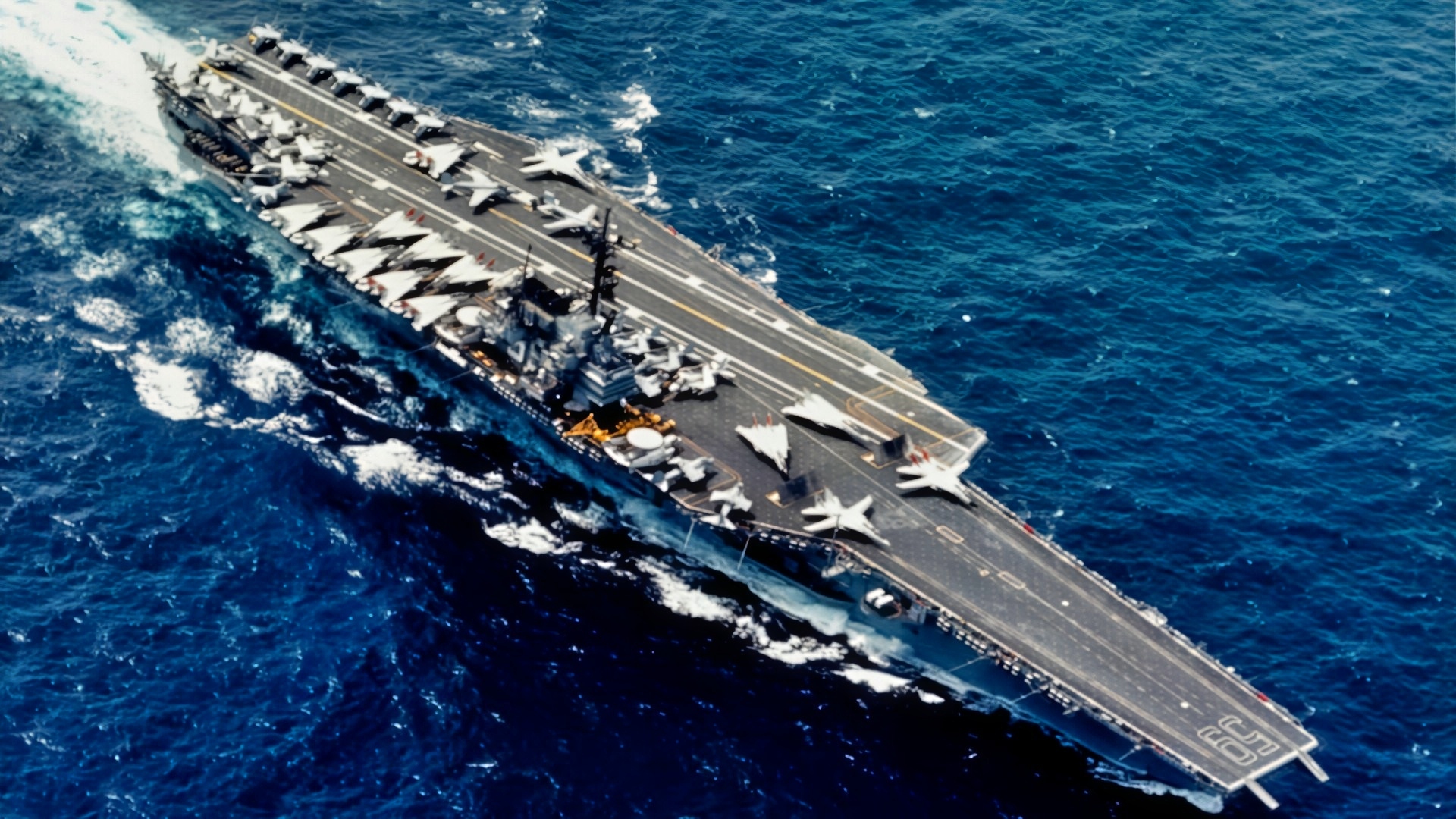
USS Forrestal Aircraft Carrier. Image Credit: Creative Commons.
-She fought in Vietnam (1972), intercepted the Achille Lauro hijackers, struck Libya, and in Desert Storm launched ~11,000 sorties from the Red Sea—despite a tragic ferry accident off Haifa.
-Notable moments include a daring SAR for a downed pilot and POW Lt. Jeffrey Zaun’s eventual return. After fires, collisions, and major upgrades (F-14s, S-3s), Saratoga decommissioned in 1994; her anchors live on aboard USS Harry S. Truman.
USS Saratoga CV-60, Cold War Aircraft Carrier
The USS Saratoga (CV-60) was the second of four Forrestal-class supercarriers. She was a U.S. Navy Cold War stalwart, serving from 1956 to 1994, and was named after a famous Revolutionary War battle site.
The Saratoga was a powerful symbol of American sea power, monitoring global events, conducting training with NATO allies, enforcing no-fly zones, and participating in combat during the Vietnam War and the Gulf War.
The 1,063-foot-long ship hosted Presidents Richard Nixon and Dwight Eisenhower. She was finally decommissioned in 1994 and eventually scrapped.
Meet The USS Saratoga (CV-60)
Commissioned in 1956, CV-60 was the second Forrestal-class carrier. She was notable for her angled flight deck, which allowed for simultaneous launch and recovery of jet aircraft, and her significantly larger size compared to previous carriers.
From 1958 through 1967, the Saratoga would spend at least part of the year in the Mediterranean. Eisenhower and members of his Cabinet spent two days onboard the ship to observe carrier operations, air operations, antisubmarine warfare, guided-missile operations, and the Navy’s latest bombing and strafing techniques.
The highlight of the demonstration was when a flight of Vought F-8 Crusaders departed from the USS Bon Homme Richard in the Pacific, and was received by the Saratoga in the Atlantic. The flight took just three and a half hours.
The carrier was a central feature of U.S. naval power projection. She deployed to volatile regions such as the Mediterranean to demonstrate American strength and track potential threats, particularly Soviet naval and air power. She participated in exercises with NATO allies and enforced no-fly zones, specifically when tasked with monitoring the skies over former Yugoslavia.
The USS Saratoga During the Vietnam War
CV-60 deployed to the Vietnam conflict, arriving at “Yankee Station” on May 18, 1972. Her aircraft flew thousands of combat missions that year. The Saratoga lost four aircraft and three pilots to surface-to-air missiles while conducting massive airstrikes in North Vietnam. On Aug. 6, Navy pilot Lt. Jim Lloyd was shot down over North Vietnam, and the Saratoga’s search and rescue teams flew a daring mission to recover him.
During the hijacking of the liner Achille Lauro, fighters from the Saratoga forced the hijackers to land at Sicily after they were given a jet in Egypt. During the mid-1980s, strike aircraft (A-6Es and A-7s) struck targets in Libya.
Gulf War
During the Gulf War, the Saratoga launched 11,000 sorties for defensive and offensive air missions. The Saratoga’s embarked air wing, CVW-17, participated primarily in the Red Sea.
However, before the outbreak of hostilities in Iraq, the Saratoga suffered a loss of 21 crewmembers in a ferry boat accident off the coast of Haifa, Israel.
During air operations, the Saratoga set several records. She completed six transits of the Suez Canal and completed approximately 11,000 aircraft launch and recovery cycles.
Iraqi leader Saddam Hussein during the war claimed on Iraqi television that the Saratoga had been sunk, along with several other coalition vessels. Iraq did fire one missile, a Scud, in the general direction of the Saratoga in the Red Sea, but it would miss by more than 100 nautical miles.
The Saratoga air wing did notably lose an A-6E Intruder. Bombardier/navigator Lt. Jeffrey Zaun was paraded before cameras by his Iraqi captors and was forced under torture to repeat anti-war sentiments, but was eventually returned to American forces and was able to return to the Saratoga.
USS Saratoga: Accidents and Upgrades
The Saratoga experienced several accidents during her many years in service including a major fire in 1961, a collision in 1960, and another minor collision in 1978. The Saratoga also underwent upgrades, including the integration of advanced aircraft such as the F-14 Tomcat and the S-3 Viking.
CV-60 was decommissioned in 1994, following a distinguished career that spanned nearly four decades – encompassing the Cold War and beyond. After several attempts to raise funds to convert her into a museum ship, she was scrapped.
However, both of Saratoga’s anchors were reused on the 1998-commissioned USS Harry S. Truman.
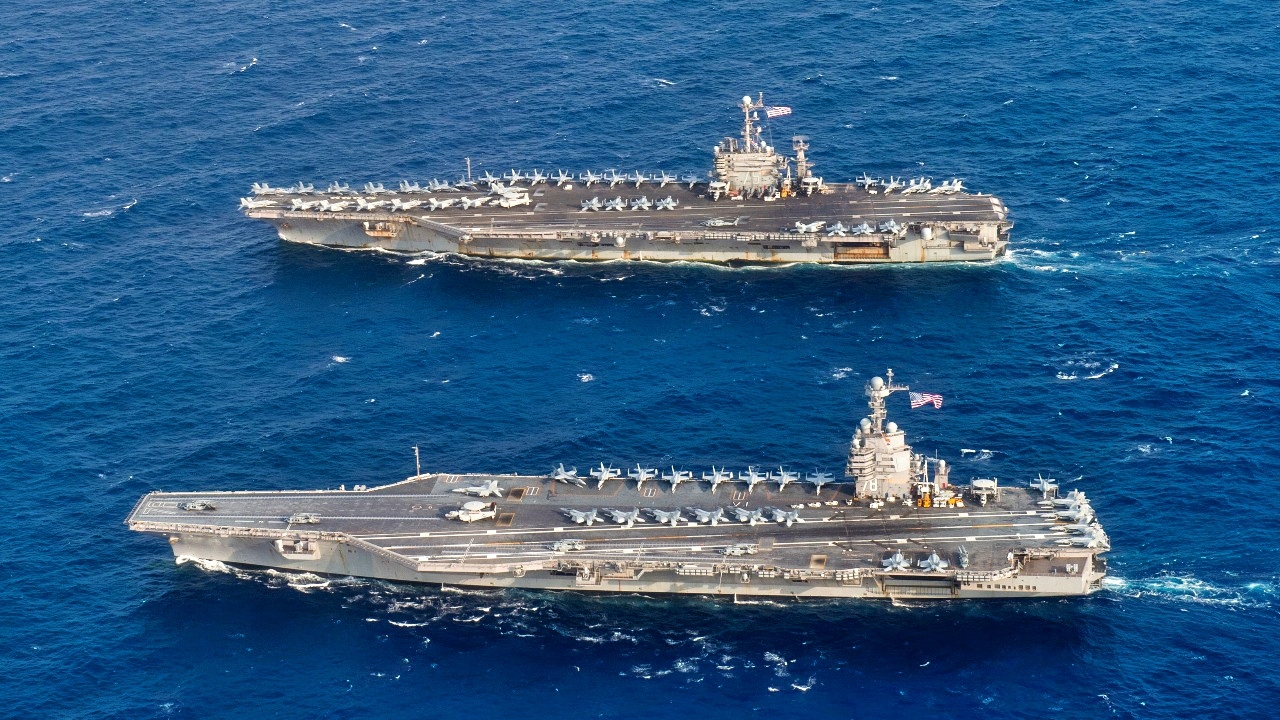
The U.S. Navy Gerald R. Ford–class aircraft carrier USS Gerald R. Ford (CVN-78) and the Nimitz-class aircraft carrier USS Harry S. Truman (CVN-75) underway in the Atlantic Ocean on 4 June 2020, marking the first time a Gerald R. Ford–class and a Nimitz-class aircraft carrier operated together underway.
About the Author: Steve Balestrieri
Steve Balestrieri is a National Security Columnist. He served as a US Army Special Forces NCO and Warrant Officer. In addition to writing on defense, he covers the NFL for PatsFans.com and is a member of the Pro Football Writers of America (PFWA). His work was regularly featured in many military publications.
More Military
The B-1B Lancer Bomber: Can It Fire Hypersonic Missiles?
USS Enterprise (CVN-65): Best Aircraft Carrier Ever?
The Kitty Hawk-Class Aircraft Carriers Have A Message for the U.S. Navy
The X-43A Hit Mach 9.6 (And It Was Cancelled?)
The Montana-Class Battleships Have a Message for the U.S. Navy


