

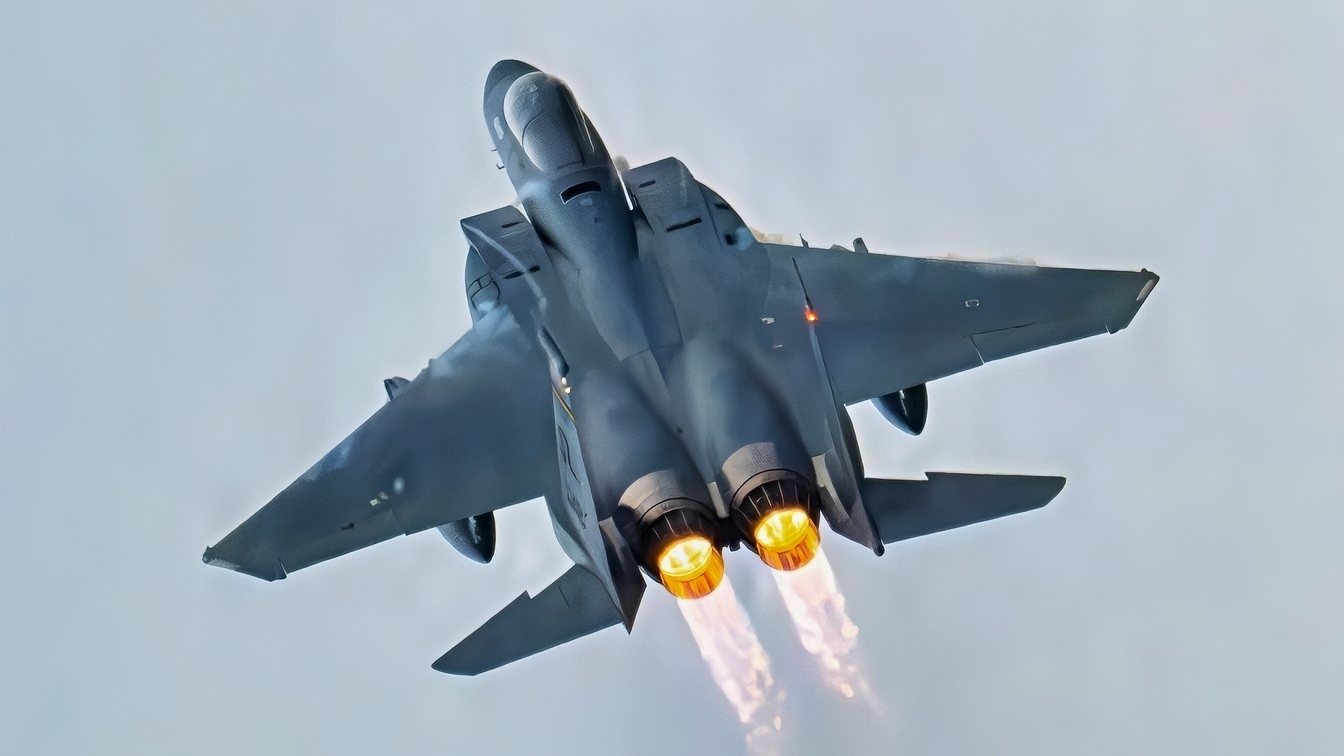
The Power Struggle Over The Strait Of Hormuz: The United States and Iran each say they control the Strait of Hormuz after attacks over the weekend stretching across the wider Middle East, which places the prospects of a lasting peace deal in jeopardy.
The Iranian decision to fire at and strike three commercial vessels in the Strait of Hormuz, disabling one of the ships in response to its use of the southern Omani side of the Strait, prompted the regime to declare the vital waterway closed.
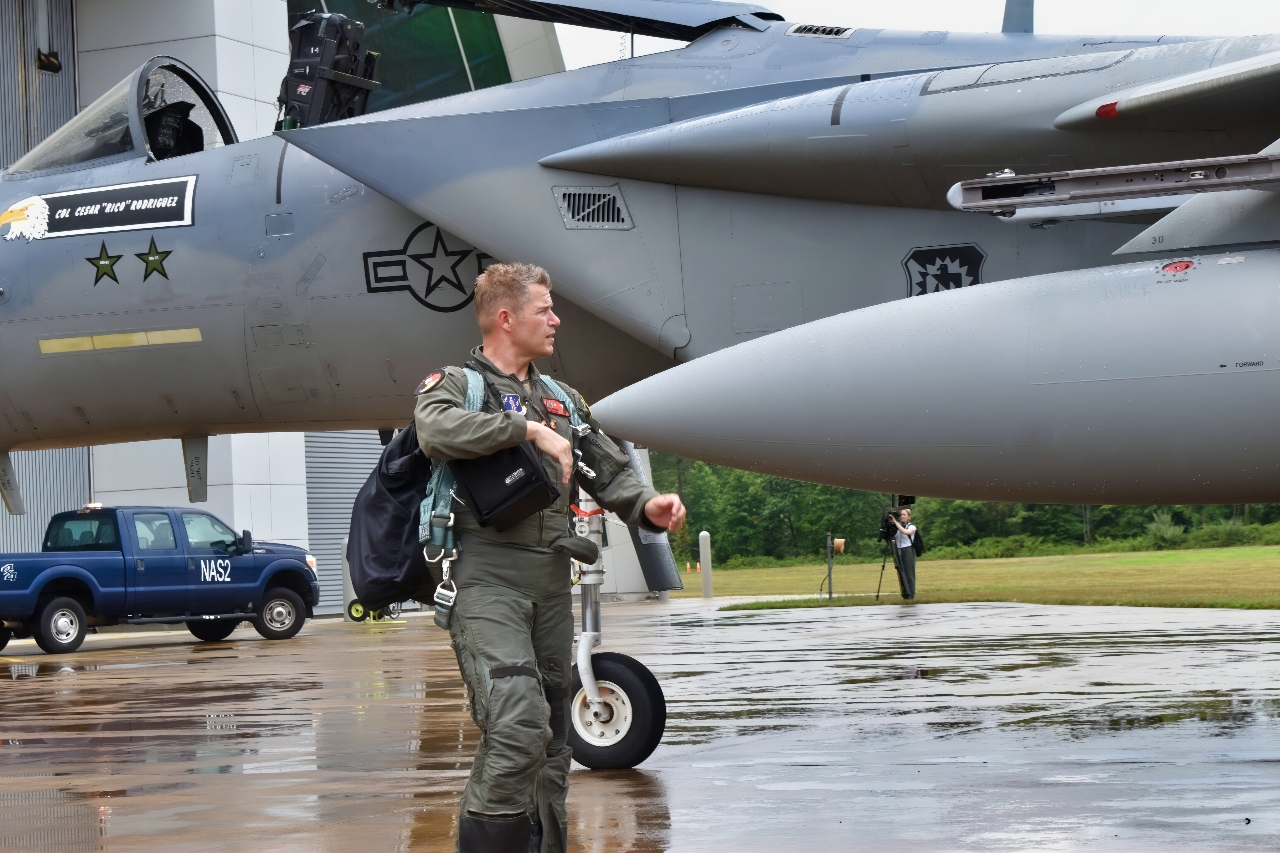
F-15C Pilot National Security Journal Photo. Image Credit: Brent M. Eastwood/National Security Journal.
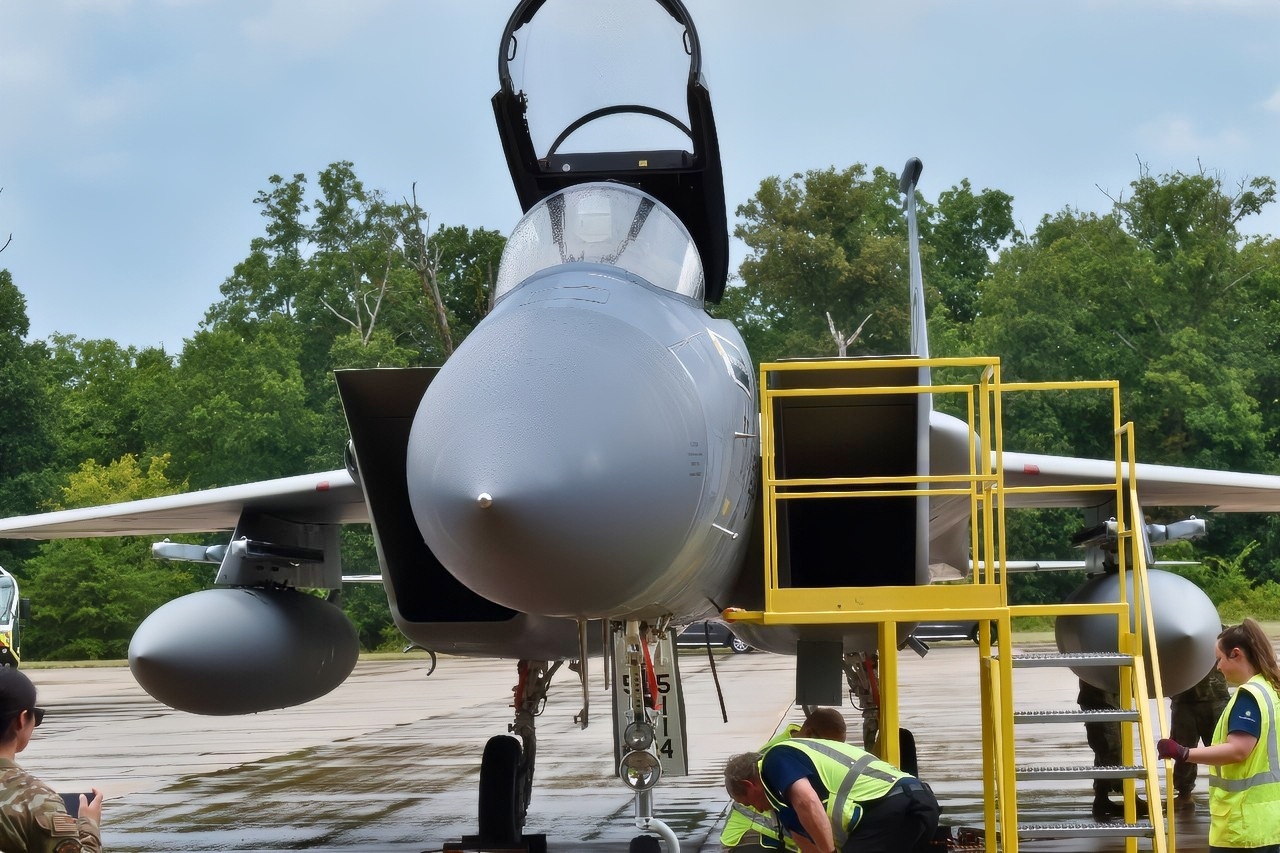
Rain on F-15C Fighter at Smithsonian National Security Journal Photo.
The IRGC said multiple vessels “disregarded our warnings” and ignored instructions to follow what it called an approved route. One “was struck by a warning shot and brought to a stop.”
This escalation triggered multiple heavy waves of U.S. airstrikes hitting more than 300 military targets in Iran, which in turn provoked Tehran to fire retaliatory missiles into neighboring Gulf countries and Jordan.
Container Ship Set Ablaze, One Crewmember Missing
In the latest fighting, Iranian forces fired on and disabled the Cyprus-flagged container ship GFS Galaxy in the Strait of Hormuz, leaving the vessel ablaze with significant engine room damage and one crew member missing.
The United States then retaliated with massive airstrikes. US Central Command (CENTCOM) said it struck dozens of targets in the strikes Monday, including air defense systems, radar sites, missile and drone equipment, and small boats. It said Iran does not control the Strait of Hormuz.
The U.S. military said it was seeking “to degrade” Iran’s “ability to attack commercial ships freely transiting” the strait.
The governor of Qeshm Island near the Strait told Iran’s state-run IRNA news agency that the US fired at military targets, but suffered no casualties. Explosions were also heard in the coastal city of Bandar Abbas and the city to the north.
Fight Over Control Of The Strait
Speaking with Fox News on Monday, President Trump said, “We’re taking over the Strait.” Trump added that “everything was agreed to” during an 11-hour meeting on Sunday, but Iranian negotiators later called back and suggested changes.
Iran responded to the American airstrikes with attacks on Bahrain, Kuwait, Qatar, Jordan, and Oman.
The Sultanate of Oman announced“its condemnation and denunciation of this attack”, which came just hours after the country hosted Iran’s foreign minister to address security issues in the Strait of Hormuz.
Iran has accused the Gulf Cooperation Council (GCC) countries of actively supporting US military operations by hosting its bases and allowing it to use their airspace.
The IRGC claimed a “heavy and surprise” attack on logistics support centers and refueling platforms used by US aircraft carriers at the port of Duqm in Oman, according to Iran’s state broadcaster IRIB.
Iran insists that all shipping in the Strait coordinate with its recently created Persian Gulf Strait Authority (PGSA) and then use a second northern route that passes along the Iranian coast and is closely monitored and controlled by Iran.
Although the Strait is narrow, it is too wide for Iran to maintain control over both routes without the use, or threatened use, of force. And despite Tehran agreeing to a 60-day window of unfettered access for shipping in the Strait, they have attacked ships for passing through on the Omani side.
Are The Gulf Nations Also Attacking Iran?
Iran has said the strait must now be under its sole control and that vessels should begin paying fees to Tehran — even though the world has, for decades, considered it an international waterway.
The IRGC released a statement stating the Strait of Hormuz is “our territory, and we will not allow a rogue and child-killing army from the other side of the world to continue its illegal interference in it.”
The U.S. Central Command said Thursday at around 6:30 a.m. local Iranian time that it had concluded its round of airstrikes that struck 90 targets. Shortly after that, Iranian news outlets and state media reported a series of airstrikes and explosions targeting the country’s Bushehr and Sistan and Baluchestan provinces, the cities of Ahvaz and Chabahar, and other areas.
No one claimed responsibility for airstrikes that hit Iran after the U.S. said it finished its attacks, leaving questions about who else may be targeting the Islamic Republic.
On Friday, the AP reported that Iranian state media quoted Esmail Kousari, a member of the Iranian parliament’s national security committee and a former commander in the paramilitary Revolutionary Guard, as warning the UAE would “pay the price for its cooperation with the United States.” He accused the Emirates of having a “behind-the-scenes” role in the recent U.S. attacks.
“We’re Not F***ing Around,” US Says
Channel 12 in Israel reported that an unnamed American official told the outlet that the US was going to continue airstrikes against Iran.
“We’re going to slap them a bit so they understand we’re not f***ing around,” the official said
The Israelis, who have made dozens of airstrikes on Iran, have not claimed to have made any airstrikes on Iran since the earliest days of the conflict. However, Israeli Defense Minister, Israel Katz, said the IDF was ready to resume air strikes if the situation called for it.
“If we will have to return, we will return with even greater force,” Katz said.
About the Author: Steve Balestrieri
Steve Balestrieri is a National Security Columnist. He served as a US Army Special Forces NCO and Warrant Officer. In addition to writing on defense, he covers the NFL for PatsFans.com and is a member of the Pro Football Writers of America (PFWA). His work was regularly featured in many military publications


