

Brent December futures were up 2.4% to $117.62 a barrel by 10:45 a.m. GMT on Friday, October 30. U.S. West Texas Intermediate reached $104.18 as both benchmarks seem set for their fourth straight month of gains.
These figures come amid fresh speculation that the U.S. and Israel could launch renewed strikes on Iran after next Tuesday’s midterm elections in the United States.
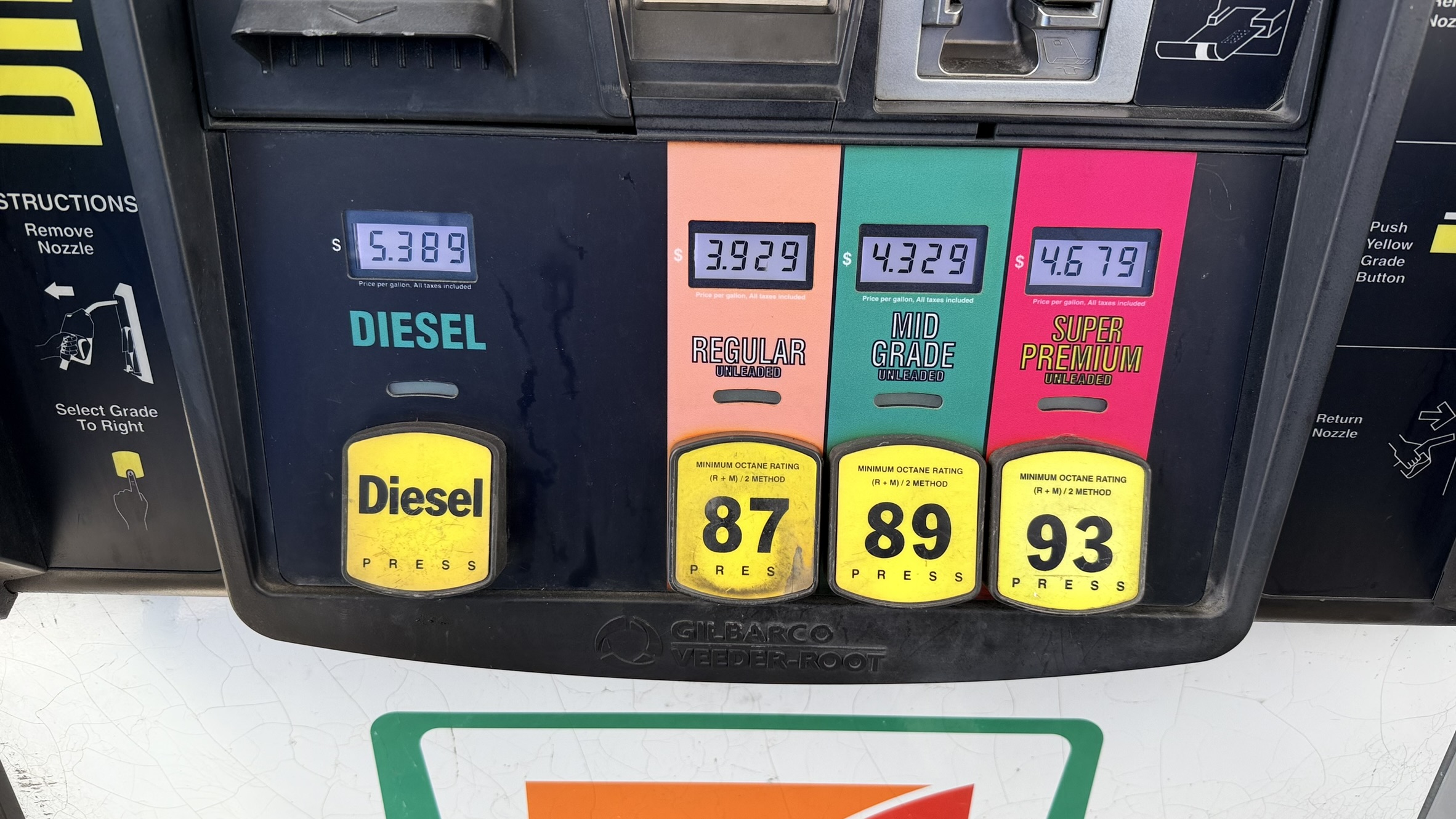
Gas Prices in Davenport, Florida. Image by National Security Journal.

Former President of the United States Donald Trump speaking with attendees at the Republican Jewish Coalition’s 2023 Annual Leadership Summit at the Venetian Convention & Expo Center in Las Vegas, Nevada. By Gage Skidmore.
Washington has said it has not yet made a final decision.
Talks with Tehran are also yet to yield a lasting peace agreement — namely one that imposes strict restrictions on the Islamic Republic’s nuclear ambitions.
Non-Iranian Suppliers’ Exports Increase
According to data from Kpler cited by the Financial Times, Gulf producers (excluding Iran) exported 24.6 million barrels per day in the week ending October 18, up from the prewar average of 23.3 million.
However, producers have partially bypassed the Strait of Hormuz by moving more oil through Saudi Arabia’s East-West pipeline to the Red Sea.
The United Arab Emirates is also using the Habshan-Fujairah pipeline, and some tankers are transferring cargo to larger vessels off the coasts of Oman and the UAE.
Despite a positive export week, the International Energy Agency said September’s output increase was a fragile recovery, with Gulf crude exports at just 75% of prewar levels.
“It’s still a considerable distance from 100 percent,” Raymond James strategist Pavel Molchanov told the Qatari-owned outlet Al Jazeera.
Slow, Risky & Expensive
Shipping in the Gulf region has become slower, riskier and much more costly.
On Friday, Reuters reported that a tanker was attacked in the Strait of Hormuz when a small boat carrying explosives hit the vessel.
Another tanker traveling out of the area was hit by an unidentified projectile on Thursday, UK Maritime Trade Operations reported — and warnings like these are now becoming routine in the Gulf.
Freight costs on some shipping routes now run up to $40 per barrel, according to figures from the London Stock Exchange Group cited by Al Jazeera.
“Delivering a barrel has become far more expensive,” Isabel Figuerola-Ferretti, an oil market expert at Comillas Pontifical University, told the outlet.
Kpler data also shows that ongoing security concerns mean tanker rates are high, as ships are stuck on longer journeys or at sea to switch cargo.
This is of particular concern for fuel supplies, as the IEA said that refined products and liquefied petroleum gas exports from the Middle East continued to sit below 50% of their prewar levels in September.
Traders Factoring in Future Conflict
Much of the pressure on oil prices comes from concerns about what will happen after the U.S. midterm elections on November 3.
“The oil market is getting increasingly spooked as we approach the midterms,” Ole Hansen of Saxo Bank told Reuters.
UBS commodity analyst Giovanni Staunovo said there was “a higher likelihood of an escalation and supply disruption.”
Oxford energy lecturer Adi Imsirovic told Al Jazeera that “escalation is very likely.”
Goldman Sachs’ head of oil research Daan Struyven said he estimates a geopolitical risk premium of around $27 per barrel in an interview on October 23.
People are “trying to get their hands on barrels while they’re available,” he said.
The IEA echoed this concern in its October report, noting that global inventories were 10 million barrels lower in September.
Analysts Say Prices May Remain High
Analysts are also speculating that prices are likely to remain high, with ANZ raising its Brent predictions for the end of the year to $105 on Friday.
“The forecast does not require another geopolitical shock,” the banking corporation’s strategists told Bloomberg.
A Reuters poll of 32 economists and analysts showed the average forecast for Brent in 2026 increased to $92.88.
The World Bank expects energy prices to rise by 32% this year, and Deputy Chief Economist Ayhan Kose said the commodity markets face “being hit by several major shocks at once.” Inflation and food price hikes are also a real risk.
Even if peace is restored, the shipping industry will not return to its previous schedule immediately. Saxo Bank expects crude prices to hover around $70 to $90, compared with the estimated prewar range of $60 to $70.
About the Author: Georgia Gilholy
Georgia Gilholy is a journalist based in the United Kingdom who has been published in Newsweek, The Times of Israel, and the Spectator. Gilholy writes about international politics, culture, and education.


