


Summary and Key Points: Congress is putting the brakes on the U.S. Navy’s proposed Trump-class BBG(X) battleship, demanding proof that the program’s key technologies — railguns, directed-energy weapons, and hypersonic missiles — are viable before construction proceeds. The first hull is projected at $15–17 billion, with $43 billion budgeted for the first three ships, more than an aircraft carrier per unit. CSIS analyst Mark Cancian recently concluded the program ‘will never sail’ as currently designed.
The Trump-Class Battleship Hits Stormy Seas

Trump-Class Battleship. Image Credit: White House.
As if awakening momentarily from a fugue state, the Republican-controlled Congress is putting up some serious red flags surrounding the Trump administration’s support for the United States Navy’s fantastical BBG(X) Trump-class “battleship” (it’s really a battlecruiser). That ship is part of the Trump administration’s larger “Golden Fleet” concept.
The first ship of the class, oddly named USS Defiant, is envisioned as a massive nuclear-powered guided-missile battleship carrying hypersonic weapons, railguns, nuclear cruise missiles, and directed energy weapons (DEWs).
They really should have just claimed the ship would come equipped with Star Trek-style phasers to complete the whole pitch deck for Congress.
Congress Is (Thankfully) Losing Confidence
Lawmakers in the powerful House Armed Services Committee (HASC) do not want the Navy progressing with construction on this monstrosity until the Navy can demonstrate that the ship’s key systems are viable. It appears that Congress has finally learned from the other massive shipbuilding failures that have plagued the Navy since the end of the Cold War.
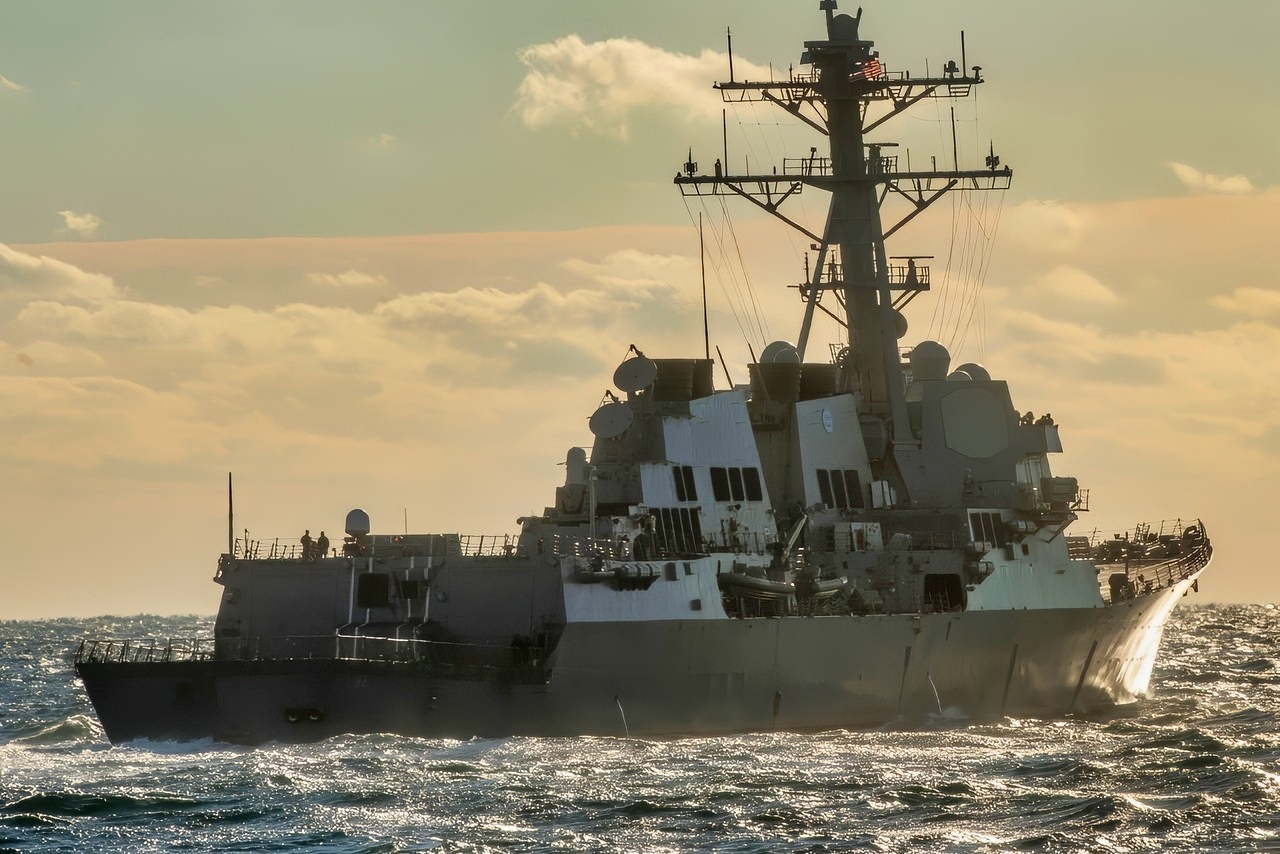
The Arleigh Burke-class guided-missile destroyer USS Lassen (DDG 82) moves into position for an underway exercise with the British Royal Navy aircraft carrier HMS Queen Elizabeth (R08) and Pre-Commissioning Unit (PCU) Michael Monsoor (DDG 1001). The future USS Michael Monsoor is the second ship in the Zumwalt-class of guided-missile destroyers. (Photo by Mass Communication Specialist 1st Class John Philip Wagner, Jr./Released)
You see, almost every post-Cold War-era US Navy program has struggled to live up to the promise its salesmen pitched to the usually addled elected representatives in the United States Congress (most of whom dream of landing cushy positions on the board of those major defense contractors after their political careers end). Even a usually compliant Congress, though, had to raise a stink about the hamfisted way in which the expensive and resource-intensive BBG(X) program was developing.
That’s because so much of the ship’s underlying technologies are immature. Shipboard railguns have effectively stalled for years. Meanwhile, the Navy’s DEW program remains severely constrained by power limitations. Then there’s the added problem of hypersonic weapons. The US lacks these systems (as well as viable defenses against them) at a time when–get this–its key strategic rivals of China, Russia, Iran, and North Korea, all possess working arsenals of these weapons.
And the American hypersonic weapons program continues lagging, even with all the political pressure and financial resources granted to those programs over the years!
Congress rightly fears another Zumwalt-class disaster. Essentially, America’s Legislative Branch believes that the Navy is putting the cart before the horse with the BBG(X) by building a costly platform that is built around technologies that either arrive late, underperform, or never materialize at all.

Zumwalt-Class U.S. Navy. Image Credit: Creative Commons.
The costs for this ship program are becoming staggering, too.
An Exploding Price Tag
Early estimates already place the first Trump-class hull at roughly $15-$17 bllion–that’s two-to-four billion dollars more than the USS Gerald R. Ford, America’s newest (and most overrated) nuclear-powered aircraft carrier, cost! The Navy’s own budgetary projections for the so-called Trump-class battleship show a staggering cost of $43 billion for the first three units of this ship class alone.
Many are rightly inquiring as to why it is prudent to spend carrier-level money on a single surface combatant in an era dominated by drones, anti-ship missiles, and other forms of distributed warfare.
These questions cannot simply be waved away by intransigent acquisitions specialists at the Pentagon as they were ignored during the Zumwalt-class crisis (before it was too late). That’s because today there are chronic, severe maintenance backlogs, massive submarine production shortfalls, munitions depletion, and overall collapse in shipyard throughput.

Zumwalt-class Guided Missile Destroyer USS Michael Monsoor (DDG 1001) transits the Pacific Ocean, June 25, 2022. Twenty-six nations, 38 ships, four submarines, more than 170 aircraft and 25,000 personnel are participating in RIMPAC from June 29 to Aug 4 in and around Hawaiian Islands and Southern California. The world’s largest international maritime exercise, RIMPAC provides a unique training opportunity while fostering and sustaining cooperative relationships among participants critical to ensuring the safety of sea lanes and security on the world’s oceans. RIMPAC 2022 is the 28th exercise in the series that began in 1971.
Frankly, the Navy literally can’t build even one of these warships, let alone wait around for the underlying technologies to mature (if they ever do).
“This Ship Will Never Sail”
Mark Cancian of CSIS wrote a particularly caustic report recently on the Trump-class battleship/cruiser. His conclusions in that riveting report can be summed up best by the line that, “This ship will never sail.” That’s because the BBG(X) defies the logic and evolution of modern naval warfare in truly irresponsible ways.
Modern naval warfare is clearly moving toward dispersed fleets, unmanned systems, survivability through distribution, and the advent of cheaper, less complex massed missile platforms. The Trump-class centralizes enormous combat power into a handful of ultra-expensive ships that become prime targets in combat for those distributed, redundant, layered enemy systems they will fight against.

Constellation-Class Frigate U.S. Navy. Image Credit: Industry Handout.
Cancian’s CSIS report rightly highlights several examples of how profoundly idiotic the Trump administration’s plan for the BBG(X) really is. Per the CSIS report, Ukraine’s destruction of major Russian naval assets using drones and long-range missiles–at a time when Ukraine lacked any serious naval capacity at all–is proof-positive that the Trump plan to build the BBG(X) is nutty.
There’s also the humiliating case of the Houthi Rebels out of Yemen in 2024, effectively chasing the American Navy out of the Red Sea, thanks to their cheap, distributed, layered system of drones and missile swarms, all of which directly threatened America’s large aircraft carriers and destroyers fighting them in nearby waters.
That’s to say little of the comprehensive anti-access/area-denial (A2/AD) network that China’s military has established for itself in places like the South China Sea. These systems are specifically designed to stunt the power projection of large US Navy surface warships, such as aircraft carriers. The BBG(X), whether it comes with all the next-generation weapons systems like its proponents claim, will struggle as much as the carriers and Arleigh Burke-class destroyers will against those Chinese A2/AD systems.
Supporters Insist America Needs “Capital Ships” Again
At the same time, reputable voices, such as maritime expert and head of the always excellent gCaptain website, John Konrad IV, insist in their writings that America requires capital ships again. These writers and many in the Navy brass believe that existing surface warfare platforms, notably the destroyers, are running out of electrical power, cooling capacity, missile volume, and growth margin.
For instance, the Flight III Arleigh Burke-class destroyers are near their physical limitations. Future warfare, notably missile defense and any DEW system, will require far greater energy levels than current platforms provide. Thus, a larger hull possessing advanced nuclear power, as the BBG(X) is set to possess, will naturally support these next-generation weapons.
Anyway, supporters of the Trump-class battleship concept counter their detractors by explaining that the BBG(X) is not a true battleship in the historical sense. Instead, BBG(X) is more akin to an advanced arsenal ship, possessing advanced missile defenses, a robust command-and-control platform, and can serve as a fleet power generator.
So, per these voices, the Trump-class acts as the backbone of a wider distributed fleet rather than replacing smaller vessels entirely.
The Real Story: Industrial Politics
As with so many of these stories, though, the real story comes down to industrial capacity. This ship is tied directly to the president’s correct “Golden Fleet” agenda. Trump’s overarching assessment of US Navy capacity comes down to his (and others’) belief that America’s naval shipyards essentially need a kick in the backside to get things moving in a way to support a much-needed larger Navy.
By placing the demand for the Trump-class, an onerous industrial program as ever, these elements in the Trump administration assume that it will trigger the kind of reforms to America’s withering defense industrial base that are needed. It is wishful thinking. After all, the construction of the USS Gerald R. Ford and its sister aircraft carriers did little to galvanize America’s ailing naval shipyards.
The bigger issue is that, for Trump’s true agenda to work, it requires wholesale reindustrialization to support such extreme projects, like the Trump-class. Despite the president’s rhetoric, even though there have been some notable advances in this preferred policy, as a whole, the United States is not meaningfully more industrialized today than it was during the Biden administration–or even when former President Barack Obama left office in 2016.
The Most Likely Outcome
Right now, the most likely outcome is not that the Navy gets 15 of these leviathans. Instead, the maritime branch will be lucky if it receives a scaled-down large surface combatant (which is still an anachronism, given the realities of modern warfare). There will be fewer of those scaled-down surface warships. Plus, these highly experimental systems will be pulled back out of understandable fears that they will never deliver as promised.
Oh, and expect a much longer development timeline.
Because Congress has conducted a haphazard oversight of this most ridiculous project, they are ensuring that the program will be delayed for years. The fact that the BBG(X) is so politically aligned with the controversial Trump-class, given the high likelihood of a Democratic Party sweep in Congress this November, makes it unlikely that this warship will ever leave the drawing board.
If this warship is still on the drawing board at the Pentagon in January 2029, after a new president enters office, regardless of their party, this boondoggle will either be canceled outright (likely if a Democrat is the new president) or severely pared down long before the steel for the hull is ever cut.
In other words, this ship is not needed. It will do more damage by draining the Navy’s coffers of resources, time, and money and redirecting those finite resources away from more beneficial, relevant programs into this presidential vanity project. Congress is right to pump the brakes on it. If only they’d get Trump to cut it entirely.
About the Author: Brandon J. Weichert
Brandon J. Weichert is a Senior National Security Editor. Recently, Weichert became the editor of the “NatSec Guy” section at Emerald. TV. He was previously the senior national security editor at The National Interest. Weichert hosts The National Security Hour on iHeartRadio, where he discusses national security policy every Wednesday at 8 p.m. Eastern. He hosts a companion show on Rumble entitled “National Security Talk.” Weichert consults regularly with various government institutions and private organizations on geopolitical issues. His writings have appeared in numerous publications, among them Popular Mechanics, National Review, MSN, and The American Spectator. His books include Winning Space: How America Remains a Superpower, Biohacked: China’s Race to Control Life, and The Shadow War: Iran’s Quest for Supremacy. Weichert’s newest book, A Disaster of Our Own Making: How the West Lost Ukraine, is available for purchase at any bookstore. Follow him via Twitter/X @WeTheBrandon.


