


Summary and Key Points: Volodymyr Zelensky and Swedish Prime Minister Ulf Kristersson announced today, May 28, 2026, that Ukraine will receive up to 36 JAS 39 Gripen fighter jets — 16 donated Gripen C/D aircraft from the existing Swedish Air Force inventory, plus 20 newer Gripen E/F variants that Ukraine will purchase using €2.5 billion from the EU’s Ukraine Support Loan.
-The deal is the largest single Western fighter aircraft commitment to Ukraine since the war began.
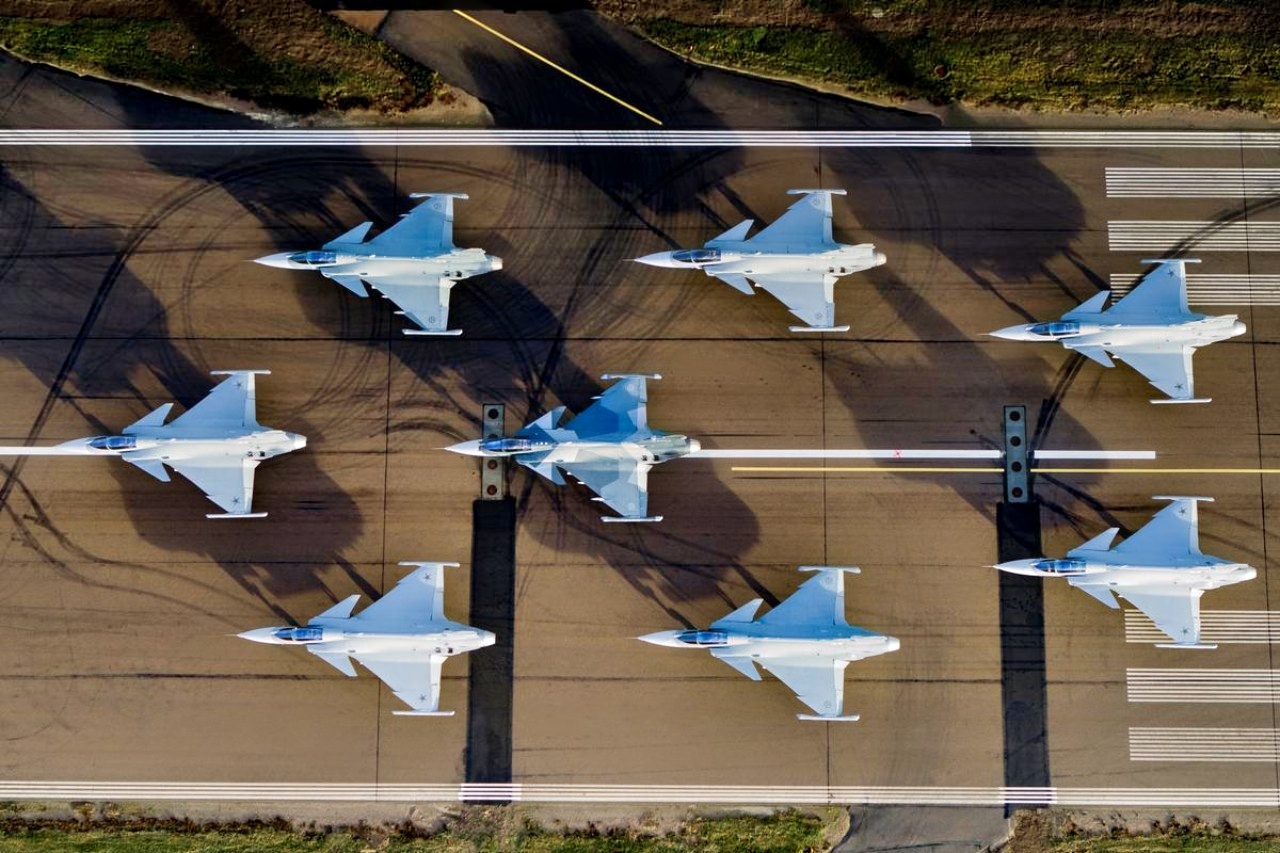
JAS 39 Gripen E Fighters. Image Credit: Creative Commons.
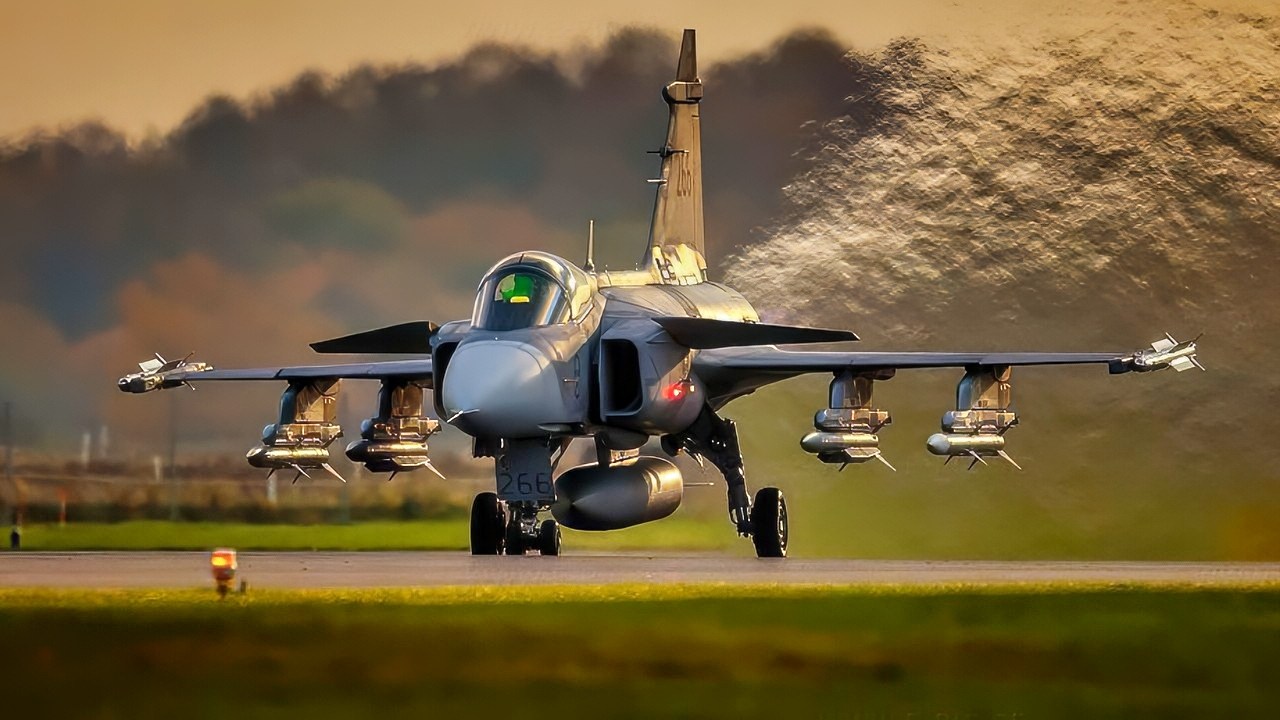
JAS 39 Gripen SAAB Image Handout

JAS 39 Gripen Flying in Formation.
The Bad News: The first combat sortie against Russian forces is at least 16 months away. The full force will not be at the front line until 2028 or 2029.
JAS 39 Gripen Fighters for Ukraine: The Announcement That Changed Ukrainian Airpower
Volodymyr Zelensky and Ulf Kristersson walked onto a podium at the F16 air flotilla in Uppsala this afternoon, May 28, 2026, and announced the largest single Western fighter aircraft commitment Ukraine has received since the full-scale invasion began. Sweden will donate 16 used JAS 39 Gripen C/D fighter jets to Ukraine as bilateral military assistance, free of charge. Ukraine will purchase up to 20 new Gripen E/F aircraft separately as the first batch of a longer-term acquisition that could eventually reach 150 airframes.
The combined headline number is 36 Gripens for Ukraine. The announcement was met with celebration across Kyiv, across the European defense community, and across the broader coalition of Ukraine’s military supporters. Saab CEO Micael Johansson called the day’s announcement a major step forward for Ukrainian air power. Swedish Prime Minister Kristersson called it a historic decision for Sweden that would strengthen Ukraine’s air defense significantly.
What today’s coverage has substantially underplayed is the timeline from the announcement to the first Ukrainian JAS 39 Gripen flying a combat sortie against Russian forces. That gap is measured in years, not months. The aircraft Ukraine will receive in the first wave are used Swedish Air Force C/D variants that need to be prepared for transfer, delivered to Ukrainian bases, integrated into the Ukrainian Air Force’s existing maintenance and logistics architecture, and crewed by pilots who must complete one of the most demanding conversion training programs in modern military aviation.
Each of those steps takes time. None of them can be substantially compressed. The Gripen deal is the strategic news of the day. The combat impact is a 2027-2028 story at the earliest.
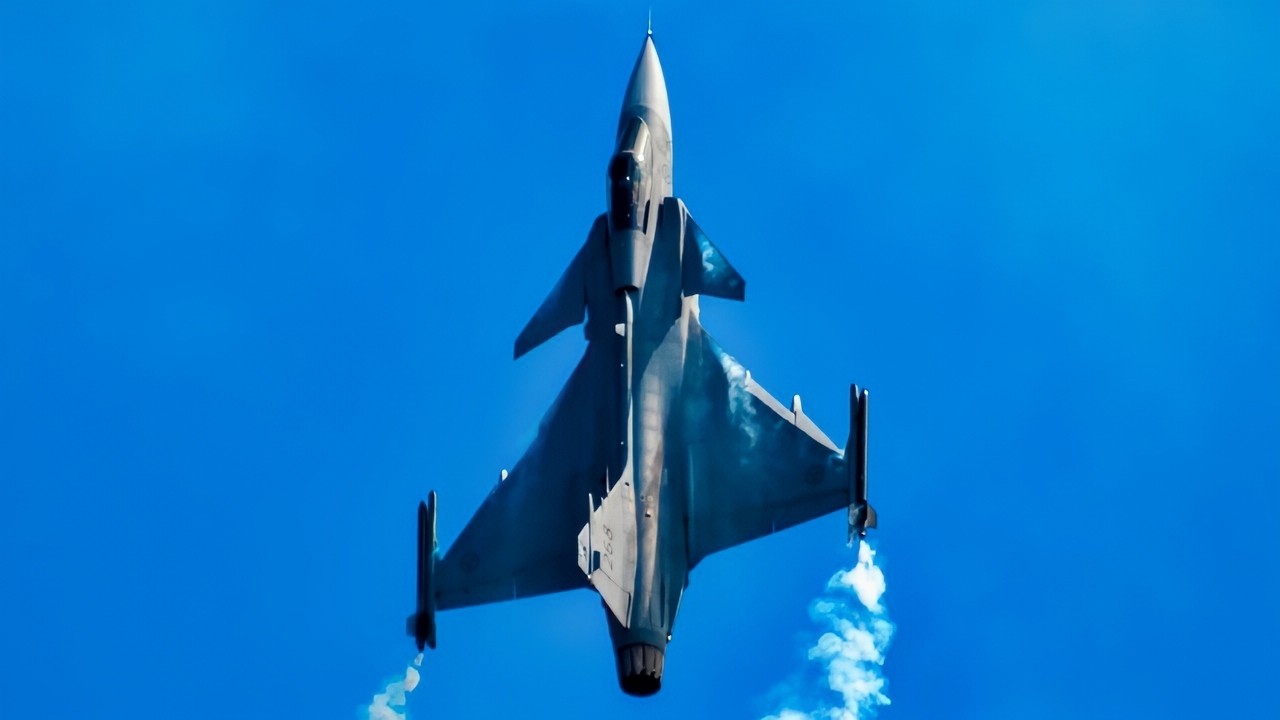
A Swedish Air Force Saab JAS 39 Gripen climbs during the 2019 Royal International Air Tattoo at RAF Fairford, England, July 20, 2019. This year, RIAT commemorated the 70th anniversary of NATO and highlighted the United States’ enduring commitment to its European allies. (U.S. Air Force photo by Tech Sgt. Aaron Thomasson)
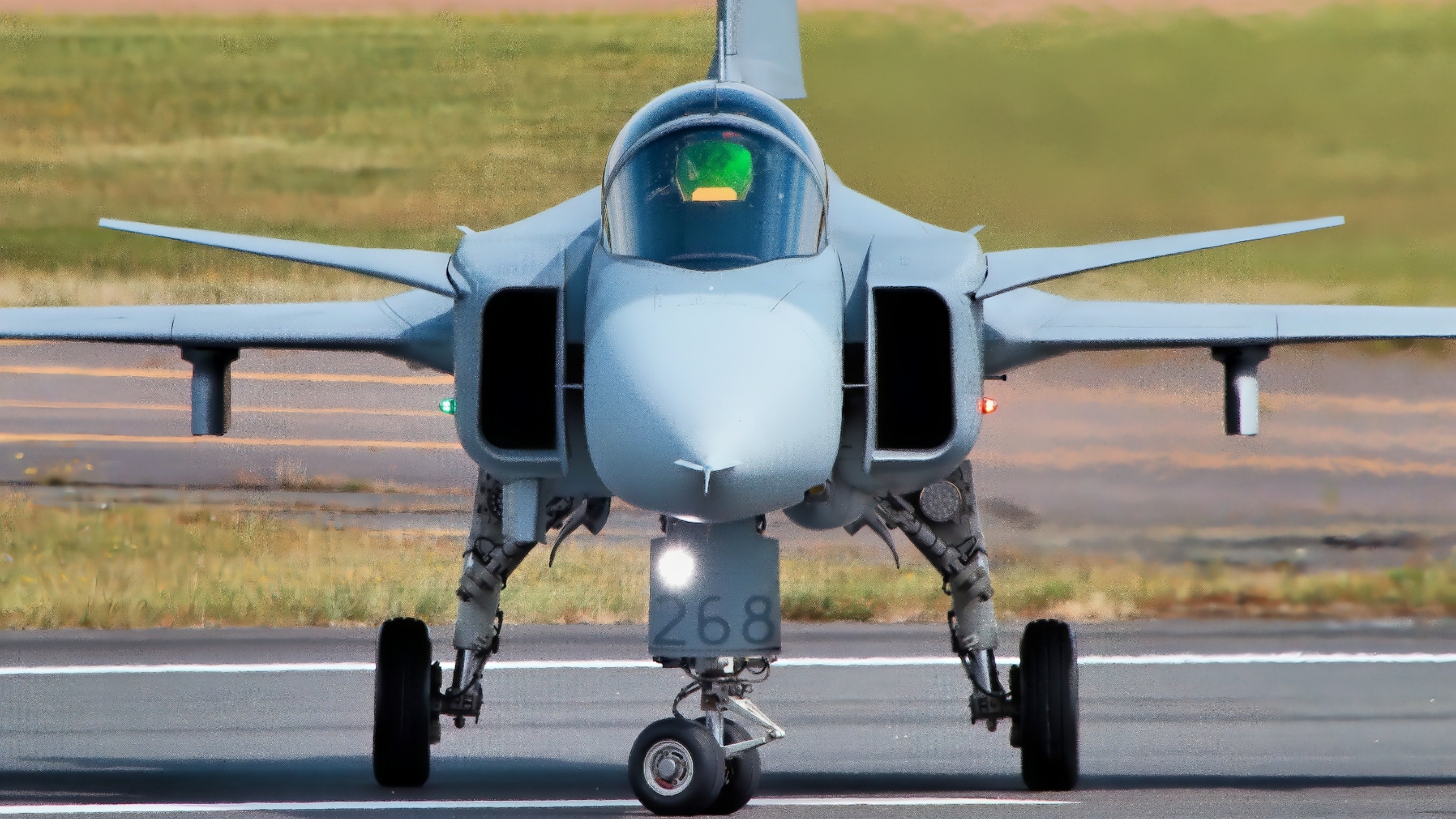
JAS 39 Gripen Front and Center. Image Credit: Creative Commons.

A Swedish Air Force JAS 39 Gripen participating in NATO exercise Ramstein Flag 24 flies over the west coast of Greece, Oct. 4, 2024. Over 130 fighter and enabler aircraft from Greece, Canada, France, Hungary, Italy, Poland, Portugal, Romania, Spain, Sweden, United Kingdom and United States are training side by side to improve tactics and foster more robust integration, demonstrating NATO’s resolve, commitment and ability to deter potential adversaries and defend the Alliance. (U.S. Air Force photo by Tech. Sgt. Emili Koonce)
What Was Actually Announced
The structure of the deal matters because the two halves operate on substantially different timelines.
The 16 used Gripen C/D aircraft come from the existing Swedish Air Force inventory and will be transferred to Ukraine as bilateral military assistance, free of charge, with deliveries beginning in early 2027. The 20 new Gripen E/F aircraft Ukraine will purchase using €2.5 billion from the European Union’s Ukraine Support Loan will not begin arriving until 2030, per Kristersson’s joint press conference statement.
The longer-term framework agreed between Sweden and Ukraine in October 2025 covers between 100 and 150 Gripen E/F airframes — roughly double Saab’s current production capacity. Zelensky stated today that Ukraine hopes to eventually secure financing for all 150 aircraft. The Ukrainian Air Force has identified the Gripen as its long-term fighter platform of choice, a decision that aligns Ukrainian airpower with Swedish industrial capacity and European defense industrial policy in ways that will shape Ukrainian military strategy for the next two decades.
The combat impact of all of that will not arrive on the day the first Gripen lands at a Ukrainian airfield. It will arrive when the first Ukrainian Gripen squadron is certified combat-ready, fully crewed, logistically supported, and tactically integrated into the broader Ukrainian Air Force operational structure.
That milestone is at least a year and a half away. The full force of 36 aircraft will not be at the front line until well into 2028 or 2029.
The Pilot Training Problem on the JAS 39 Gripen
The single biggest constraint on Ukrainian Gripen combat operations is not aircraft availability. It is pilot availability. A fully qualified fast-jet pilot transitioning from one fighter type to another typically requires six to nine months of intensive ground school and flight training before achieving initial mission qualification.
For Ukrainian pilots, many of whom were originally trained on Soviet-era platforms like the MiG-29 and Su-27, the conversion path is even longer — the Gripen flight syllabus reflects a fundamentally different operational philosophy from the Soviet flight-school tradition Ukrainian pilots inherited.
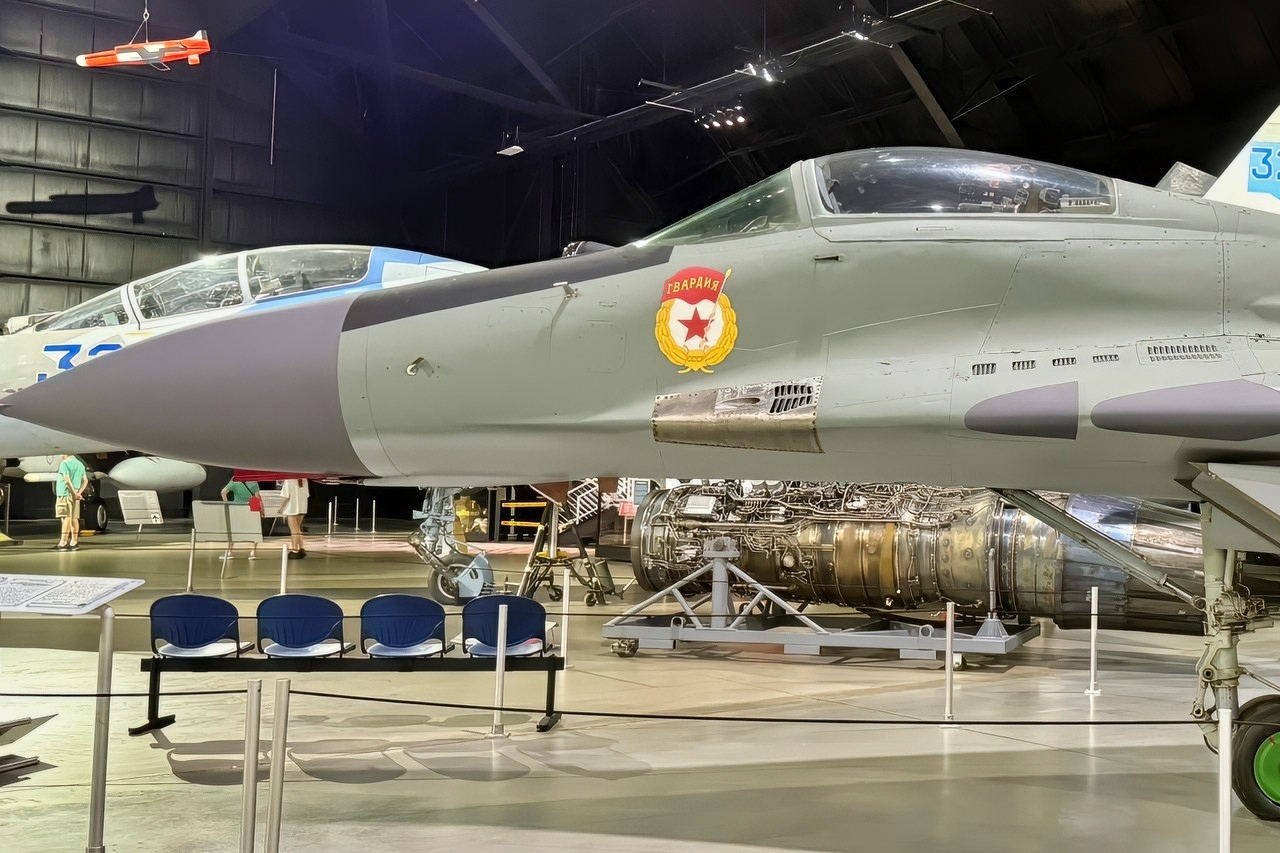
MiG-29 National Security Journal Photo Taken in July, 2025.
The Swedish Air Force has been training Ukrainian pilots for months. Today’s announcement confirmed that pilot training is already underway and will expand this autumn. The Uppsala base where today’s announcement was made is home to the Swedish Air Force Combat Training School, and Ukrainian pilots are reportedly already in advanced phases of conversion training on the C/D variant.
The good news on this front is that Sweden began the pilot pipeline well in advance of the formal aircraft-delivery commitment, replicating the pattern that enabled Ukrainian F-16 pilots to enter combat operations within weeks of the first F-16 delivery in July 2024.

F-16 Fighting Falcon Onboard USS Intrepid. Image Taken on September 18, 2025.
The bad news is that Ukraine needs more pilots than the Swedish training pipeline can currently produce. A standard fighter squadron requires approximately 18 to 22 qualified pilots for sustained combat operations, and a fleet of 16 C/D aircraft would need two full squadrons of qualified Ukrainian Gripen pilots to conduct meaningful operations. Twenty JAS 39 Gripen E/F aircraft arriving from 2030 onward would require an additional cadre of pilots to operate them.
The realistic Ukrainian Gripen pilot pipeline is producing fewer than 20 qualified pilots per year. Reaching the steady-state combat operations the 36-aircraft framework requires will take at least three years of sustained training output, and probably longer.
The Logistical And Maintenance Train
The second constraint is the maintenance and logistics infrastructure that turns a group of aircraft into an operational combat fleet.
Modern fighter aircraft require complex supply chains for spare parts, fuel, weapons, electronic warfare systems, and the specialized ground equipment used to maintain them.
Ukrainian Air Force maintainers have spent the past several years building this infrastructure for the F-16 fleet, with substantial assistance from the United States and Europe. The same process now has to happen for the Gripen.
The Gripen has a substantial advantage over the F-16 in this regard. The aircraft was specifically designed for the kind of dispersed, road-based operations Ukraine has demonstrated is necessary to survive Russian missile strikes on airbases. Per Swedish Air Force operating doctrine, the Gripen is designed to operate from short, primitive runways including highways, with rapid turnaround times and minimal ground support equipment.
The aircraft can be refueled and rearmed by a six-person ground crew working from a roadside position, and it can take off and land on highway strips as short as 800 meters.
This dispersed-basing capability is the single most important operational advantage the Gripen offers Ukraine over the F-16 and the Mirage 2000. Russian strikes on Ukrainian airbases have been a persistent threat across the past four years, and the ability to disperse Gripen operations across multiple roadside operating locations dramatically complicates the Russian targeting problem.
The Swedish operational concept has been described as designed for one specific thing — operating from dispersed locations under sustained attack from a numerically superior enemy. That mission profile matches Ukrainian operational requirements almost exactly.
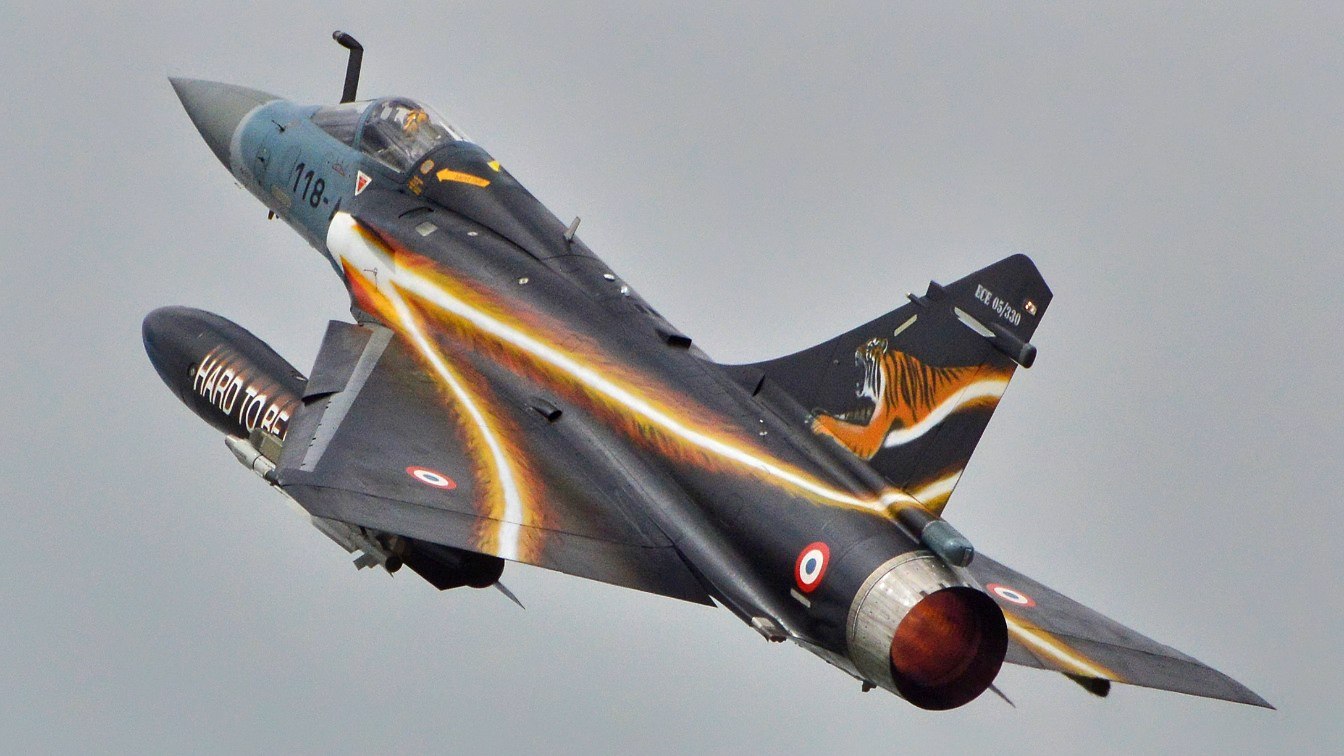
Mirage 2000. Image Credit: Creative Commons.
Building the Ukrainian logistics infrastructure to actually exploit this capability is itself a multi-year project. Each dispersed operating location requires fuel storage, weapons handling capacity, communications infrastructure, defensive systems, and trained maintenance personnel. The Swedish Air Force has been refining this operational architecture across decades. U
krainian crews have to learn it from scratch, often under combat conditions, and integrate it into the existing Ukrainian Air Force’s command-and-control structure, built around fixed airbases and Soviet-legacy operational doctrine.
The Combat Sortie Timeline
The realistic timeline for the first Ukrainian Gripen combat sortie against Russian forces is the second half of 2027, with the most likely date falling between September and December of that year. The first batch of donated C/D aircraft will have arrived by mid-2027 per the Swedish delivery commitments. Initial Ukrainian Gripen pilots will have completed conversion training and accumulated enough flight hours on the type to begin operational mission qualification. Ukrainian ground crews will have begun building the maintenance and logistics infrastructure to support sustained operations.
The F-16 precedent is instructive. Ukrainian F-16s first arrived in July 2024 and flew their first combat sortie within weeks, but the F-16 fleet did not reach steady-state combat operations until well into 2025. The same pattern is likely to play out with the Gripen.

F-16 Fighting Falcons from both the 35th and 80th Fighter Squadrons of the 8th Fighter Wing, as well as from the 466th Fighter Squadron of the 419th Fighter Wing at Hill Air Force Base, Utah, demonstrate an elephant walk formation as they taxi down a runway during an exercise at Kunsan Air Base, Republic of Korea Dec. 2, 2011. The exercise showcased Kunsan AB aircrews’ capability to quickly and safely prepare an aircraft for a wartime mission. (U.S. Air Force photo by Staff Sgt. Rasheen Douglas/Released)
First combat sorties are likely within a few months of delivery, but the operational tempo will remain limited until the full pilot cadre is qualified and the logistics infrastructure matures.
The full force of 36 Gripens will not be at the front line until well into 2028 or 2029. In the 100-to-150-aircraft long-term framework, Zelensky said today that he hopes the financing will not arrive in full until the early-to-mid 2030s.
The Ukrainian Air Force that will fight whatever phase of the war is underway in 2030 will be substantially different from the one operating today, but the transition will be gradual rather than sudden.
Used Aircraft And The Hidden Costs
The 16 donated Gripens are used by the Swedish Air Force C/D variants. The C version is single-seat, the D version is two-seat, and a typical configuration for a Ukrainian Gripen squadron would include approximately two D models for training and command roles, plus 14 single-seat C models for combat operations.
The C/D variants are an earlier generation of the Gripen design than the newer E/F models that Ukraine will eventually receive.
Used military aircraft come with hidden costs. Each airframe has accumulated flight hours that count against its total service life, and the aircraft Ukraine will receive in 2027 will be substantially closer to mid-life maintenance overhauls than freshly produced examples.
The donated Gripens will need to be prepared for transfer by the Swedish Air Force, a process that typically involves a full maintenance cycle, weapons system updates, and configuration changes to match Ukrainian operational requirements.

JAS 39 Gripen. Image Credit: Creative Commons.
The C/D variants are also limited in certain operational capabilities compared to the newer E/F variants. The aircraft will be delivered with IRIS-T short-range air-to-air missiles, AIM-120 AMRAAM medium-range air-to-air missiles, and the MBDA Meteor long-range air-to-air missile, which gives the aircraft credible beyond-visual-range engagement capability against Russian fighters. But the C/D’s radar is the older PS-05/A mechanically scanned array rather than the active electronically scanned array radar on the E/F. The C/D’s electronic warfare suite is less capable. The C/D’s processing power is substantially lower than that of the E/F’s open-architecture computing system.
For the immediate combat environment, the C/D variants will be operationally adequate against Russian Su-35s, Su-30s, and the broader Russian air defense network. Ukrainian Gripen pilots flying C/Ds with Meteor missiles will be able to engage Russian fighters at ranges that complicate Russian aerial operations across substantial portions of the front line. But the C/Ds are not the same aircraft as the E/Fs that Ukraine will eventually receive, and Ukrainian operational planning must account for the transition period during which two different Gripen variants will operate simultaneously.

Su-35 Fighter. Image Credit: Creative Commons.
What Today’s Announcement Actually Means
The strategic significance of the deal announced today by Sweden and Ukraine is real, but the timeline is longer than the celebratory coverage has acknowledged.
The first combat sortie of a Ukrainian Gripen is at least 16 months away. The first full Ukrainian Gripen squadron operating at sustained combat tempo is at least two years away. The full force of 36 aircraft is at least three years away. The long-term goal of 100-to-150 aircraft is a decade or longer away.
What today’s announcement does provide is a strategic commitment that locks Ukrainian airpower into a European industrial trajectory for the next twenty years. The Gripen is the platform Ukraine will fight Russia with through the 2030s and into the 2040s. And that’s the real win the media will miss.
About the Author: Harry J. Kazianis
Harry J. Kazianis (@Grecianformula) was the former Senior Director of National Security Affairs at the Center for the National Interest (CFTNI), a foreign policy think tank founded by Richard Nixon based in Washington, DC. Harry has over a decade of experience in think tanks and national security publishing. His ideas have been published in the NY Times, The Washington Post, The Wall Street Journal, CNN, and many other outlets worldwide. He has held positions at CSIS, the Heritage Foundation, the University of Nottingham, and several other institutions related to national security research and studies. He is the former Executive Editor of the National Interest and the Diplomat. He holds a Master’s degree focusing on international affairs from Harvard University.


dooyle
May 28, 2026 at 8:03 pm
By the time those gripens are ready for conbat, war would be over.
Wassat.
The story here is exactly same as the story of the nazi volksjager jets of WW2.
During the final months of WW2, as allied forces moved in from the west, and Soviet forces rushed forward from the east, the nazis finally fully awakened, and realized the situation was hopeless.
The nazis came up with their near magical gripens, uhh, volksjagers.
But in the end, really sad, and sorry end, only a few volksjagers were able to fly before WW2 in Europe came to an end.
The triumphant red army was in Berlin.
bobb
May 28, 2026 at 8:20 pm
During the thirties, the Nazis were severely afflicted with jewophobia, thus starting WW2.
Today, the Nazis are again afflicted by a similar disease, russiophobia, and thus the ukro war.
But will the Nazis succeed this time, with gripens.
Nah, they’ll again be defeated.