
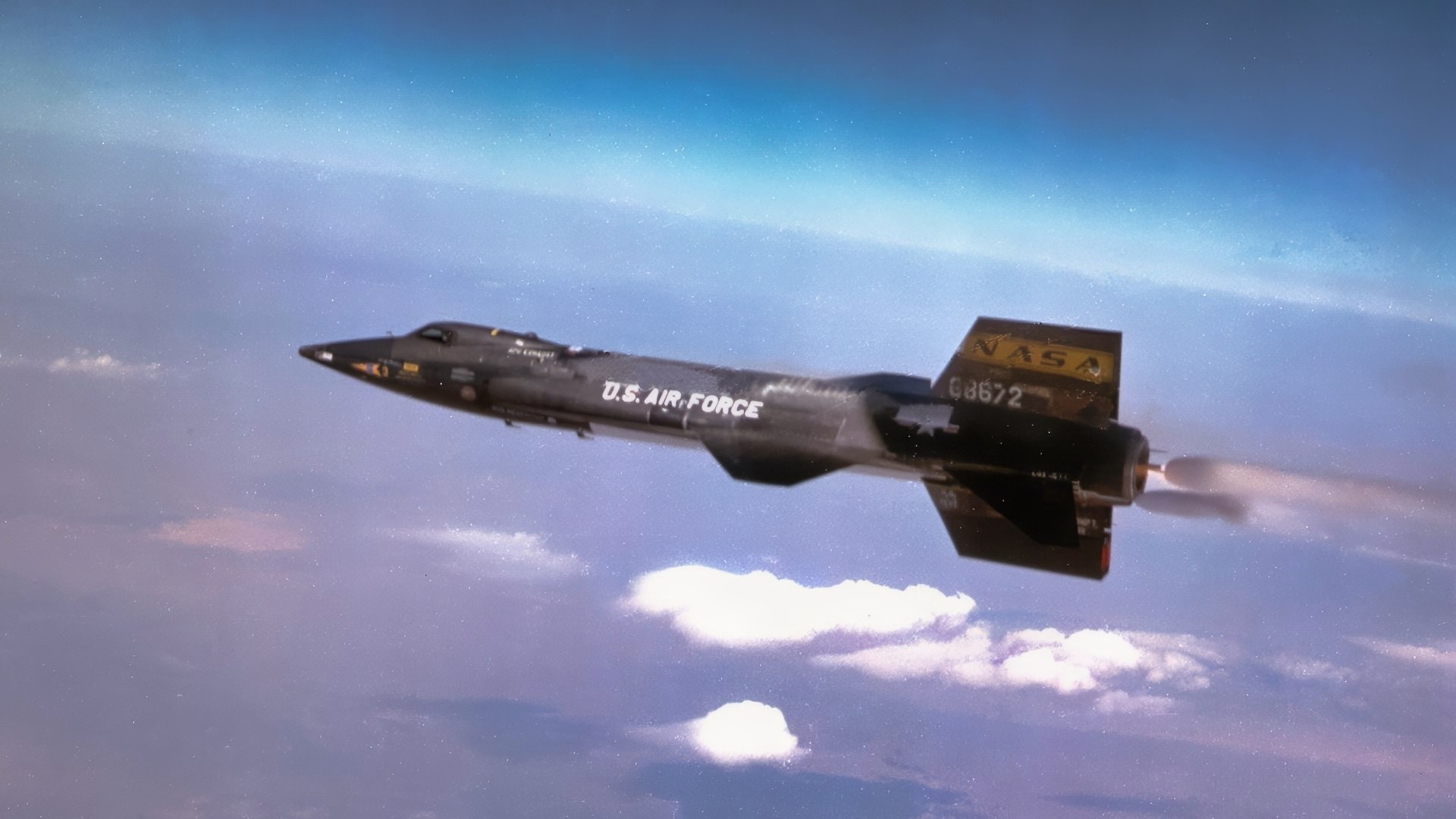
On October 3, 1967, U.S. Air Force pilot William “Pete” Knight flew the X-15A-2 to 4,520 miles per hour — Mach 6.7 — setting the speed record for a crewed powered aircraft that has stood for 59 years. Four years earlier, NASA pilot Joseph Walker had flown the same rocket-powered research aircraft to 354,200 feet, roughly 67 miles above Earth, an altitude record no crewed winged aircraft has broken since. Twelve pilots flew the X-15 between 1959 and 1968 — including future Apollo 11 commander Neil Armstrong — completing 199 missions and contributing data that NASA used to design Mercury, Gemini, Apollo, and the Space Shuttle.
The X-15 Broke All the Records

X-15 from U.S. Air Force Museum Original Photo. Image Credit: National Security Journal.

North American X-15 Head On. Image Credit: National Security Journal.

X-15 Long Shot and Engine Photo. Image Credit: National Security Journal.
NASA’s newest experimental aircraft is pushing the boundaries of high-speed flight over California’s Mojave Desert, with the X-59 quiet supersonic jet now conducting increasingly aggressive flight-test maneuvers as part of an effort to bring back commercial supersonic travel over land.
NASA announced on April 30 that the aircraft had begun performing bank-to-bank automatic roll maneuvers and additional tests to better understand its behavior in the air. The X-59 is designed to fly faster than the speed of sound while reducing the traditional sonic boom to what NASA has described as a “barely-audible thump.”
The aircraft is part of NASA’s Quest mission and represents the latest in a long line of American experimental high-speed aircraft programs stretching back decades.
But long before the X-59, NASA and the U.S. military were already flying aircraft at speeds and altitudes that remain extraordinary even by modern standards.
More than 60 years ago, the X-15 hypersonic research program pushed manned flight right up to Mach 6.7 and the edge of space, creating a body of data that helped shape the Mercury, Gemini, Apollo, and Space Shuttle programs.
America’s Original Hypersonic Aircraft
The X-15 was developed during the Cold War as a joint research effort between NASA, the U.S. Air Force, the U.S. Navy, and North American Aviation. The rocket-powered aircraft was designed to investigate the challenges of hypersonic flight, aerodynamic heating, high-altitude control, and near-space operations.
Unlike conventional jets, the X-15 did not take off under its own power from a runway. Instead, it was carried beneath the wing of a modified B-52 bomber to roughly 45,000 feet before being released in midair. Once separated, the rocket engine ignited, accelerating the aircraft to extreme speeds within minutes.

X-15A from U.S. Air Force Museum. Image Credit: National Security Journal.

X-15 USAF Museum Photo. Image Credit: National Security Journal.

X-15. Image Credit: Creative Commons.
The first X-15 arrived at NASA’s High-Speed Flight Station at Edwards Air Force Base in early 1959, while pilot Scott Crossfield conducted the first contractor demonstration flights. Over the next decade, the aircraft completed 199 missions before the program ended in 1968.
The aircraft itself looked radically different from modern fighters or passenger aircraft. It featured short, stubby wings, a thick fuselage built to withstand intense aerodynamic heating, and a black Inconel X nickel-alloy skin designed to withstand the temperatures generated during hypersonic flight.
Mach 6.7 And The Edge Of Space
The X-15 program produced records that, incredibly, still stand today for crewed winged aircraft operating inside the atmosphere. On October 3, 1967, Air Force pilot William “Pete” Knight flew the X-15A-2 to 4,520 mph, or Mach 6.7, setting the fastest speed ever achieved by a manned powered aircraft.
Several years earlier, NASA pilot Joseph Walker flew the aircraft to 354,200 feet on August 22, 1963, reaching an altitude of roughly 67 miles above Earth. Those missions pushed the aircraft far beyond its original design goals. NASA’s historical records note that the X-15 was originally intended to reach Mach 6 and approximately 250,000 feet, but ultimately exceeded both targets substantially.
Twelve pilots ultimately flew the X-15 during the program, including future Apollo 11 commander Neil Armstrong. Eight pilots eventually qualified for astronaut wings after flying above 50 miles in altitude, the Air Force’s definition of spaceflight at the time.
But the program was also extremely dangerous: Major Michael J. Adams was killed on November 15, 1967, after his X-15 entered a hypersonic spin and broke apart during reentry from high altitude.
The Program Helped Build America’s Space Program
The X-15’s importance extended far beyond record-setting flights. The aircraft served as a flying laboratory, allowing NASA and the military to study how aircraft and pilots behaved under conditions approaching spaceflight. One of the major challenges involved flight control at extreme altitude.
At the edge of space, the atmosphere becomes so thin that traditional control surfaces like rudders and elevators become ineffective because there is not enough air flowing over them. To solve this, the X-15 used small hydrogen-peroxide reaction-control thrusters mounted in the nose and wingtips, allowing pilots to maneuver the aircraft with miniature rocket jets instead of conventional aerodynamic controls.
NASA says the data gathered during the program directly contributed to the development of Mercury, Gemini, Apollo, and eventually the Space Shuttle. Engineers gained critical insights into hypersonic aerodynamics, thermal protection, pilot workload, stability, and atmospheric reentry.
Why the X-15 Still Matters Today
The X-15 is an interesting case study today as hypersonic technology returns to the center of global military competition.
The United States is not the only country pursuing this technology – China and Russia are doing the same, investing heavily in hypersonic weapons and high-speed aerospace systems like China’s DF-17 hypersonic glide vehicle, Russia’s Avangard boost-glide vehicle, and the 3M22 Zircon hypersonic cruise missile.
Modern programs like the X-59 focus on quieter supersonic commercial aviation rather than hypersonic flight alone.
However, the general principle remains the same: experimental aircraft are still necessary to gather data that cannot be fully replicated in wind tunnels or computer simulations. NASA’s X-59 is expected to eventually fly at Mach 1.4 at roughly 55,000 feet while collecting data intended to help regulators reconsider longstanding restrictions that prevent civilian supersonic flight over land.
About the Author: Jack Buckby
Jack Buckby is a British researcher and analyst specializing in defense and national security, based in New York. His work focuses on military capability, procurement, and strategic competition, producing and editing analysis for policy and defense audiences. He brings extensive editorial experience, with a career output spanning over 1,000 articles at 19FortyFive and National Security Journal, and has previously authored books and papers on extremism and deradicalization.


