

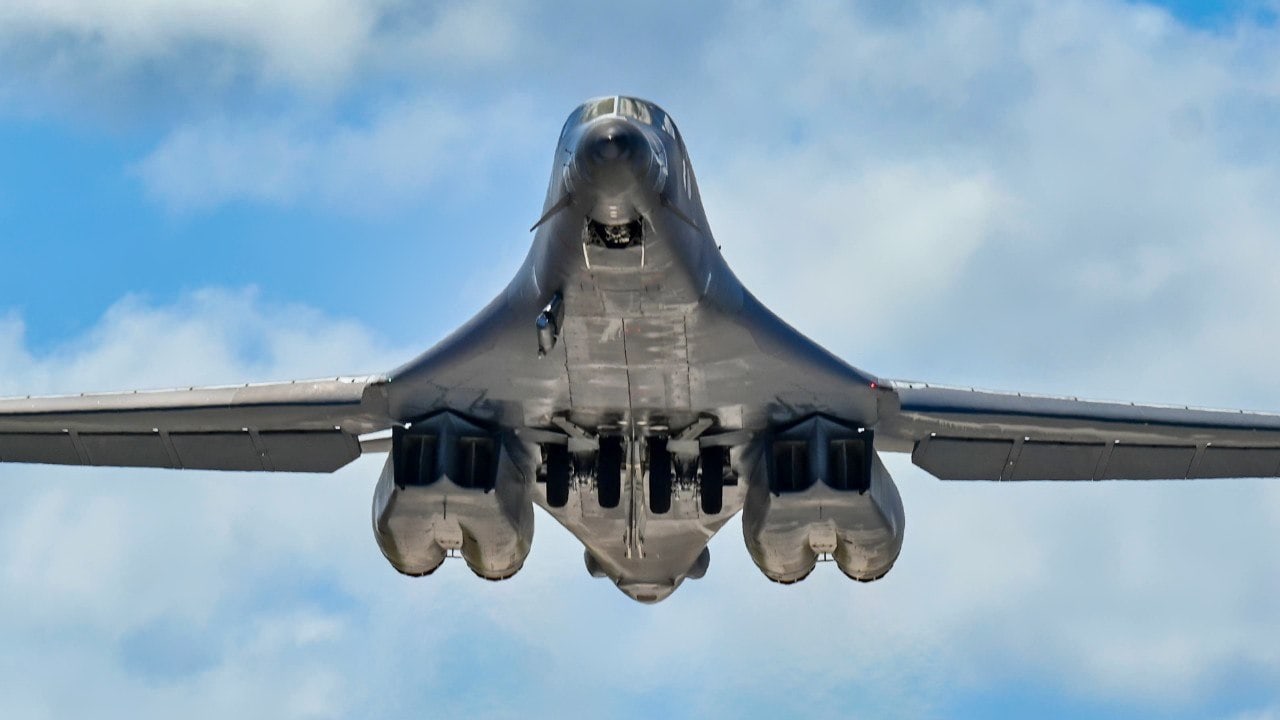
B-1 Bombers Returning To The Middle East To Hit Targets In Iran: The U.S. Air Force has deployed B-1B Lancer strategic bombers back to the Middle East as part of an escalating campaign against Iranian military and infrastructure targets.
Tracked departing from the UK, the bombers are carrying out precision strikes alongside a broader U.S. buildup of special operations forces and fighter squadrons in the region.
The B-1s were tracked taking off from RAF Fairford in Gloucestershire, UK, flying missions deep into Iranian territory. The strikes have targeted Islamic Revolutionary Guard Corps (IRGC) assets, including ballistic missile and drone storage facilities, maritime capabilities, and air defenses.
According to Axios, “The U.S. military used a B-1 long-range bomber on Tuesday to strike Islamic Revolutionary Guard Corps targets in Iran, U.S. officials said.”`
However, US Central Command (CENTCOM) didn’t mention that the B-1B had returned to the region, or how it had been used.
Could The “BONE” Be Used Against Pickaxe Mountain?
There have been numerous reports that Israeli intelligence believes Iran moved thousands of uranium-enrichment centrifuges into tunnels deep inside Pickaxe Mountain last fall.
President Trump said on Tuesday the U.S. would target Pickaxe Mountain, an Iranian nuclear site that is under construction and buried deep below the ground. “We’ll be hitting that area pretty soon, and very heavily,” Trump told the media from inside the White House.
The B-1B can drop the GBU-72 Advanced 5K penetrator, a bunker-buster bomb that can penetrate the ground up to 150 feet. The bomber can carry two dozen 2,000-lb bombs or dozens of cruise missiles.
The USAF Used The B-1B Earlier In The Conflict
The USAF used three B-1B Lancer strategic bombers for long-range strike operations against Iranian targets, often flying non-stop from the U.S. mainland.
The B-1B, carrying the largest conventional payload, is used to strike command centers, ammunition depots, and proxy forces.

B-1B Lancer Bomber U.S. Air Force Display. Image Credit: National Security Journal.
A US official confirmed to the Axios news site that the bombers struck “above-ground ballistic missile and command and control sites in Iran.”
While the US has also used the B-2 Spirit stealth bombers, the use of the B-1B Lancer is significant, as it confirms that, despite the very early timeframe of the mission, air superiority over Iran is now established.
The “BONE” is not stealthy and can be easily tracked by radar over the target area.
The B-21 Raider Will Replace The B-1B and the B-2 Spirit
The B-21 Raider was officially unveiled in December 2022 and is currently in low-rate initial production (LRIP) after making its maiden flight last November. U.S. Air Force officials say the B-21 Raider is a “dual nuclear and conventionally capable, stealth, penetrating, long-range strike platform.” The B-21 will replace the aging B-1B Lancer and B-2 Spirit in the coming decade.
The B-21 Raider is named after the Doolittle Raiders of World War II, an Army land bomber squadron that took off from an aircraft carrier and bombed Japan during the darkest days of WWII.
However, until the B-21 Raiders are ready, the Air Force’s triad will continue, and although the Lancer isn’t a stealth bomber, it still packs an incredible punch. The US recently sent a small fleet of B-1Bs to Guam as a deterrent.
B-1 Lancer’s Mission History
The B-1 bomber was officially named the Lancer, but pilots call it the “BONE,” a nickname derived from the spelling B-One. It was first developed in the 1970s as a supersonic replacement for the B-52 Stratofortress.
Her mission was to penetrate Soviet airspace flying low and fast, and when approaching a nuclear weapon target, pop up to an appropriate altitude, deliver her atomic bombs, and then drop her altitude using her speed to get away.
The original design could fly at speeds of Mach 2.2 (1,688 mph). However, President Carter cut the program in 1977 due to its high cost, the introduction of the AGM-86 cruise missile that flew the same essential speed and distance, and the development of the B-2 stealth bomber.
Carter said, “The B-1 bomber is an example of a proposed system which should not be funded and would waste taxpayers’ dollars.”
President Reagan On The B-1B And The B-2 Programs:
However, President Reagan faced the same dilemma as Carter: Should we develop the B-1 for the short term or wait for the B-2 stealth bomber? He decided to develop both programs.
Reagan restarted the program in 1981, and some changes were made. The payload was increased to 74,000 pounds, an improved radar was added, and the radar cross-section was reduced, while the inlets were decreased in size, lowering the top speed to Mach 1.2 (920 mph).
The B-1B was fitted with the APQ-164 multimode radar instead of the APQ-144 scanning radar and the APQ-146 terrain-following radar of the B-1A.
The changes made the “BONE” more of a bomb truck conducting precision air strikes, rather than a nuclear deterrent.
The first B-1B bomber, “The Star of Abilene,” was delivered in 1985. By 1988, all 100 orders had been delivered, and production had stopped. The US had a bomber force that could penetrate Soviet airspace and take out targets inside the Soviet Union in a nuclear confrontation.
The B-1B “Weapon’s Truck” Upgrade:
The Air Force plans to keep the B-1Bs in service until 2038, when the B-21 Raider stealth bomber is expected to enter service in full.
The Air Force is launching the External Heavy-Stores Pylon (LAM) program, with over $50 million requested in FY 2026 to equip B-1B Lancers with Load Adaptable Modular (LAM) pylons.
These external pylons restore and upgrade dormant external hardpoints to carry larger, modern standoff missiles (like LRASM and JASSM) and hypersonic weapons, boosting payload capacity and “volume of fires” to bridge capability gaps before the B-21 Raider is fully operational.
By expanding the number of existing standoff weapons the B-1B can carry—such as the AGM-158 Joint Air-to-Surface Standoff Missile and its stablemate, the Long-Range Anti-Ship Missile (LRASM)—the Air Force says it can “mitigate transition risk of the Air Force bomber fleet prior to the emergence of the B-21 as a combat bomber.”
This program increases the B-1B’s total missile capacity by roughly 45,000 lbs, allowing it to carry 24 or more internal weapons while adding significant external carriage.
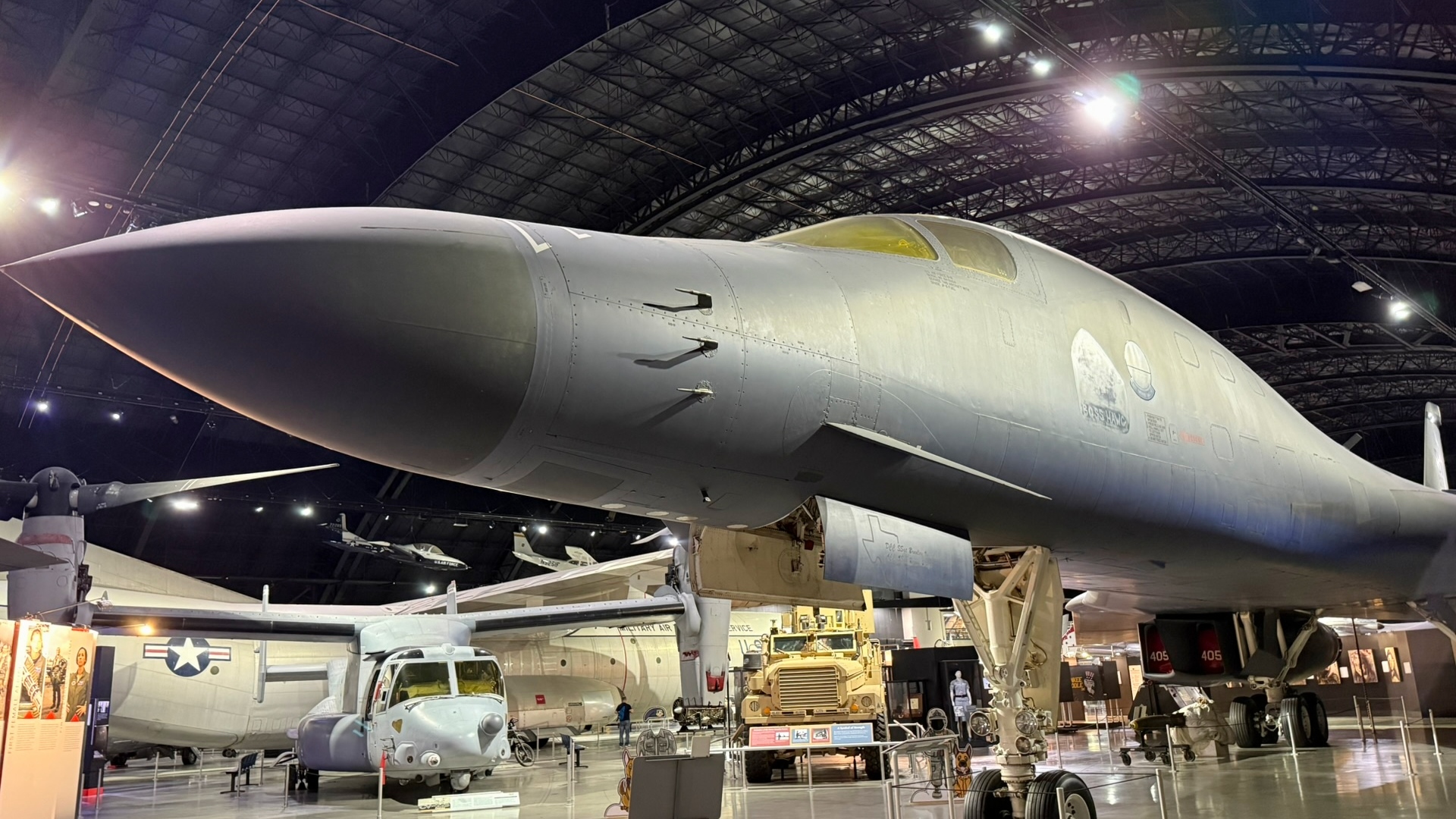
Sideview of B-1B Lancer Bomber. Image Credit: National Security Journal.
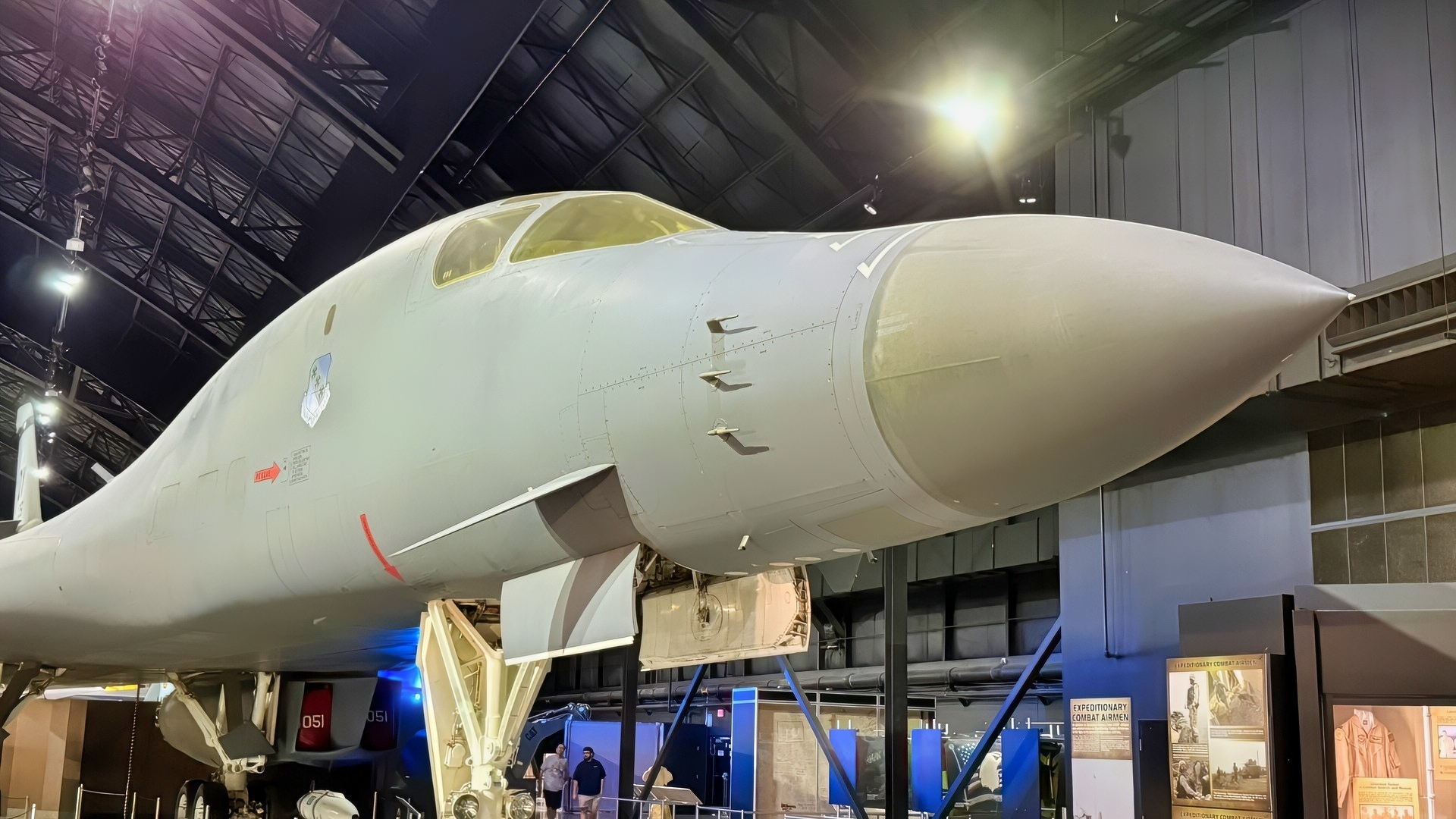
B-1B Lancer 2025 National Security Journal. Image Credit: Harry J. Kazianis/NSJ.

B-1B Lancer at USAF Museum in July 2025. Image Credit: National Security Journal.
The War Zone reported that the FY 2026 budget also referenced the “Hypersonic Integration Program,” which apparently showcased the Lancer’s ability to “execute a captive carry of a 5,000-pound class store and the release of a proven weapon shape from a Load Adaptable Modular (LAM) pylon.”
The AGM-183A Air-Launched Rapid Response Weapon is a hypersonic weapon that uses a boost-glide system, meaning that when it returns to Earth after achieving near-space altitudes, it reaches speeds greater than Mach 5. While China and Russia have hypersonics that are fired from ground launchers, this air-deployed missile would make it inherently more dangerous.
The US will start seeing the B-21s integrated in the bomber force by late 2026 or early 2027, but with the news that the B-1B bomber has returned to the fight, it means that the escalation continues, and that may include Pickaxe Mountain.
About the Author: Steve Balestrieri
Steve Balestrieri is a National Security Columnist. He served as a US Army Special Forces NCO and Warrant Officer. In addition to writing on defense, he covers the NFL for PatsFans.com and is a member of the Pro Football Writers of America (PFWA). His work was regularly featured in many military publications.


