

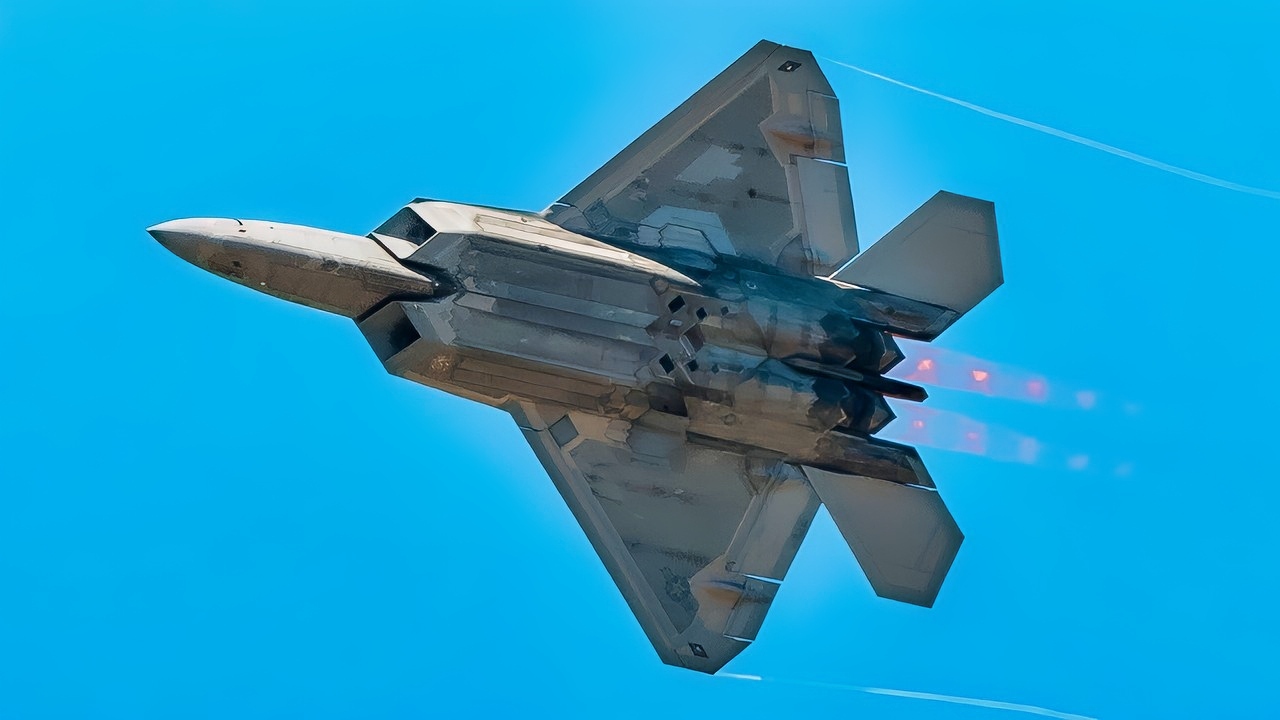
PUBLISHED on August 6, 2025, 1:24 PM EST – Key Points and Summary – While many suggest restarting the F-22 Raptor production line, it would be a costly and strategically flawed decision.
-The specialized manufacturing infrastructure and supply chain for the F-22 no longer exist, with a 2017 Air Force report estimating a restart would cost over $50 billion.
-Furthermore, the F-22’s 1990s-era technology is now outdated, its operational costs are notoriously high, and restarting the program would divert critical funding away from truly next-generation fighters like the F-47.
-For these reasons, bringing back the legendary jet is easier said than done.
The F-22 Raptor Comeback Idea Is Back
A recent article by Defence Blog slammed Lockheed Martin’s plans for a twin-engine variant of the F-35, also known as the F-55.
In this article, they assert that the idea is broken from the outset, as a twin-engine F-35 would require almost a complete structural redesign from the ground up.
However, I’m not interested in discussing the F-55 at the moment.
Instead, one quote caught my eye from the article: “Reopening the F-22 line and upgrading it would be smarter, cheaper, and faster. But doing so would force too many people in Washington to admit the truth—that the F-35 was never a true replacement.”
This is an interesting statement.
Would restarting F-22 production and modernizing it really be the best and smartest idea?
As neat as it sounds to restart a legacy model, there are a couple of reasons why restarting the F-22 might be a bad idea.
Why Restarting F-22 Production is Easier Said Than Done
To begin with, much of the infrastructure on the old F-22 lines has been lost.
When the production line was shut down, the specialized tooling, machinery, and facilities used to build the aircraft were dismantled or repurposed.
Recreating this infrastructure would be a massive and costly endeavor.
A 2017 U.S. Air Force report estimated that restarting the line to produce 194 additional aircraft would cost over $50 billion. And, with inflation and increased costs, that number is surely much higher.
This figure does not include the cost of modernizing the aircraft to meet current standards. Furthermore, many of the subcontractors and suppliers that provided parts for the F-22 have either gone out of business or moved on to other projects.
Rebuilding this supply chain would be time-consuming and expensive, and in some cases, impossible without redesigning components from scratch.
A Better F-22?
Another significant issue is the aging technology embedded in the F-22.
While it was revolutionary in the 1990s and early 2000s, much of its hardware and software is now outdated.
The avionics and processors are based on architectures that are no longer supported, making maintenance and upgrades difficult.
Radar and sensor systems, though still formidable, are being surpassed by newer systems found in aircraft like the F-35 and those planned for future sixth-generation fighters.
Stealth materials and coatings have also improved significantly since the F-22’s development, making newer designs more effective and easier to maintain.
Restarting production would likely require a significant redesign to bring the aircraft up to modern standards, effectively creating a new aircraft under the guise of the F-22.
Not the Cost-Effective Option People Think It Is
Furthermore, operational and maintenance costs further complicate the case for restarting production. The F-22 is notoriously expensive to operate, with a cost per flight hour estimated at over $70,000.
It also has a relatively low mission-capable rate, often hovering around 50 to 60 percent, meaning that nearly half the fleet is grounded at any given time due to maintenance issues. The stealth coating, in particular, is maintenance-intensive and requires specialized facilities and personnel. These factors make the F-22 less suitable for sustained operations compared to newer, more maintainable platforms.
The U.S. is also investing heavily in the F-47 program, which aims to field a sixth-generation fighter by the 2030s. The F-47, according to reports, will incorporate advanced stealth, artificial intelligence integration, drone teaming, and next-generation propulsion systems.
Restarting F-22 production would divert resources from the F-47 and other future-focused programs. It would be a step backward at a time when the U.S. needs to leap forward to maintain air dominance.
Does the U.S. Need the F-22 Raptor?
One could also argue that there are better alternatives to the F-22 already in service. The F-35, while not as dominant in air-to-air combat as the F-22, is a more versatile and modern platform. It features advanced sensor fusion, superior electronic warfare capabilities, easier maintenance and logistics, lower operating costs, and a robust international user base.
Additionally, the U.S. Air Force is upgrading its F-15EX fleet, which offers high payload capacity, modern avionics, and lower costs, making it a strong complement to stealth platforms.
Export restrictions further limit the viability of restarting F-22 production. The aircraft was never exported due to the Obey Amendment, which prohibits its sale to foreign nations. This means that any restarted production would be solely for the U.S. Air Force, limiting economies of scale and making the program even more expensive.
While some allies, such as Japan and Australia, have expressed interest in acquiring F-22-like capabilities, they are now investing in their fifth- and sixth-generation programs or purchasing the F-35, which is available for export and offers more modern systems.
The F-22 Raptor Is a Great Fighter, But…
Despite all of this, I am not saying that the F-55 is a better option. I agree with many of the criticisms made in the original article regarding the concept of a twin-engine F-35. However, I disagree that the solution lies with the F-22.
As formidable as the F-22 is, the cost of setting up all the infrastructure, combined with the costs of modernization and aircraft production, would amount to multiple billions of dollars.
In my opinion, rather than trying to modernize the F-22 or F-35, the money is better spent on developing new systems like the F-47 or F/A-XX, which not only address the military’s current needs, but also.
About the Author: Isaac Seitz
Isaac Seitz, a Defense Columnist, graduated from Patrick Henry College’s Strategic Intelligence and National Security program. He has also studied Russian at Middlebury Language Schools and has worked as an intelligence Analyst in the private sector.
More Military
Today Marks 80 Years Since Hiroshima


