


Warsaw, Poland – On the morning of Sunday, 14 June, the United Kingdom armed forces intercepted a Russian shadow fleet oil tanker transiting through the English Channel. The announcement, which came from the Ministry of Defence (MoD) in London, is one of the more recent efforts by the NATO-member nation – and one of Ukraine’s strongest supporters – to disrupt Moscow’s sanctions-evading oil exporting network.
Russia’s shadow fleet is a motley collection of more than 700 vessels, some of which are makeshift tanker conversions, estimated today to be responsible for transporting about 75 percent of Moscow’s sanctioned oil exports. These oil shipments are an increasingly vital financial lifeline and source of revenue for the Kremlin, the primary means of funding Russia’s war machine.

HMS Prince of Wales. Image Credit: Royal Navy.
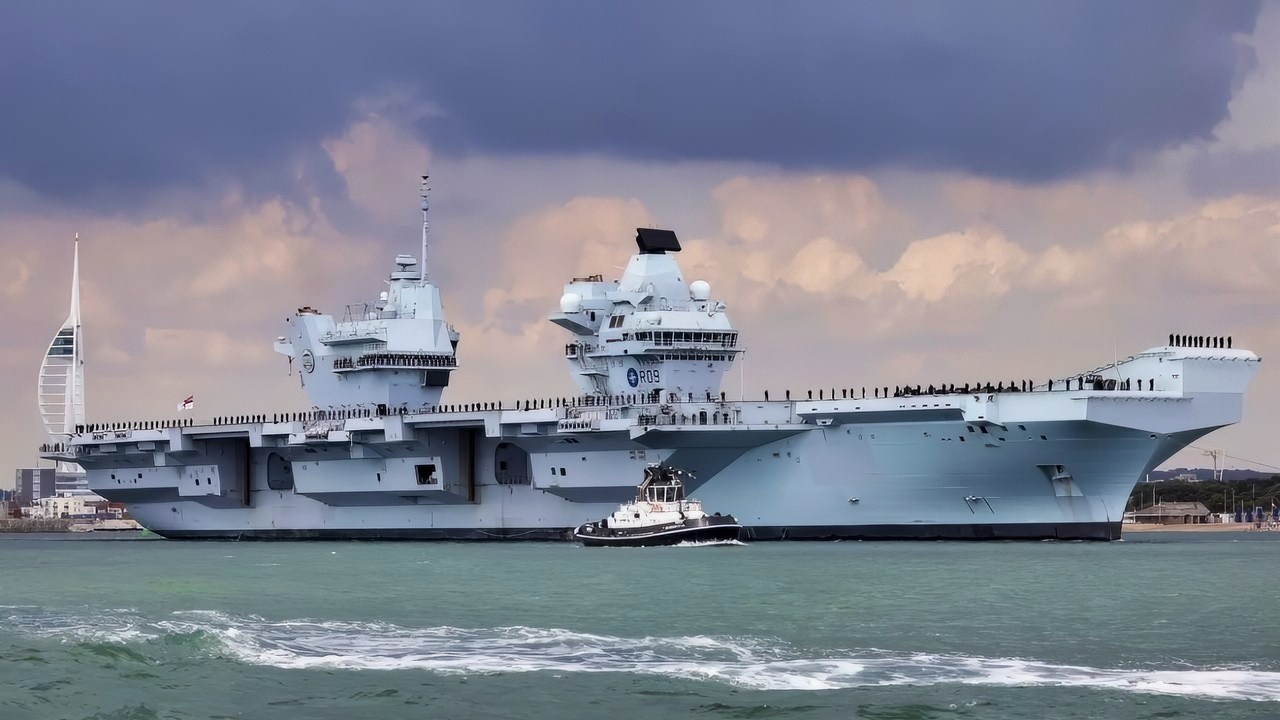
HMS Prince of Wales Aircraft Carrier. Image Credit: Royal Navy.
The head of a major Ukrainian defense enterprise told National Security Journal this last week that “the reason Moscow is able to keep building dozens and dozens of ballistic and cruise missiles is that it continues to export oil in violation of the sanctions regime imposed on Russia,” he said. “Until these exports are shut down completely and for good, the Russian war on the cities of Ukraine and killing civilians will go on indefinitely.”
“This operation delivers yet another blow to Russia and reminds those fueling Putin’s war in Ukraine that they cannot hide,” Prime Minister Keir Starmer said in a statement regarding the tanker’s interception. Royal Marine Commandos and officers from Britain’s National Crime Agency (NCA) boarded the vessel, the Smyrtos, while it was steaming through the English Channel, reported the MoD.
The ministry also stated that the tanker will be held and monitored off the seaside town of Weymouth on the south coast of England while the matter is under investigation.
Seizure By Special Operations Units
Footage of the operation, shared by Starmer on his X account, shows UK armed military personnel descending onto the vessel after rappelling from an overhead helicopter. Other footage also shows UK special operations commandos searching cabins on board the Smyrtos with their weapons drawn, while UK NCA investigating officers are inspecting the ship’s registration, cargo manifest, and other official paperwork.
The operation reportedly lasted six hours and was carried out in what was called “close coordination with French authorities,” according to the MoD. “Russia relies on its shadow fleet to fund its conflict in Ukraine, and our interdiction delivers a blow to Putin’s illegal war,” Britain’s newly-appointed Defence Secretary Dan Jarvis said today.
Ukraine’s President Volodymyr Zelenskyy said he was “grateful to the UK for taking this important step against Russia’s oil fleet.”
He also wrote in a post on X that “It was Russia’s hubris, fueled by high oil and gas revenues, that paved the way for this war, and every decision by partners that deprives Russia of [oil and gas] money also limits the war itself.”
According to the vessel-tracking website MarineTraffic, the Smyrtos was sailing under the flag of Cameroon. NCA officers reported that there were 25 crew on board. The Royal Marines and the NCA undertook the mission with support from the Royal Air Force, which intercepted and boarded the vessel during the six-hour operation. This seizure of the tanker was also the first operation of its kind by the UK armed forces.
Both the UK and France have previously committed to obstructing and intercepting any vessels that are linked to Russia’s shadow fleet that pass through their waters carrying sanctioned Russian oil or other goods for sale on black markets.
These and other sanctions-evading activities are what have been helping Russian President Vladimir Putin finance his war in Ukraine.
Reducing Russian Oil Revenues
The UK has sanctioned almost 600 shadow fleet vessels, said the MoD, and detailed that the various actions taken against the fleet and Moscow’s oil industry have reduced Russia’s oil revenues by 27 percent compared with October 2024. Moscow’s earnings from oil are now at their lowest point since the start of the war.
Enforcement efforts by the UK and France against Russian tankers passing through the Channel have intensified recently, particularly since Moscow stopped escorting them with naval combat vessels.

ATLANTIC OCEAN (Aug. 8, 2017) The Royal Navy aircraft carrier HMS Queen Elizabeth II sails in formation alongside the Nimitz-class aircraft carrier USS George H.W. Bush (CVN 77) during exercise Saxon Warrior 2017, Aug. 8. Saxon Warrior is a United States and United Kingdom co-hosted carrier strike group exercise that demonstrates interoperability and capability to respond to crises and deter potential threats. (U.S. Navy photo by Mass Communication Specialist 3rd Class Tristan B. Lotz/Released)
At the end of May, the French Marine Nationale boarded an oil tanker named the Tagor in the Atlantic. According to French President Emmanuel Macron, the ship was boarded because it was subject to international sanctions and had sailed from Russia.
In January, French forces, acting on intelligence provided by the UK, intercepted another tanker, the Grinch, in the Mediterranean. UK intelligence said that the ship had departed a Russian port.
And French maritime authorities said at the time that the ship was suspected of operating under a false flag.
About the Author: Reuben F. Johnson
Reuben F. Johnson has thirty-six years of experience analyzing and reporting on foreign weapons systems, defense technologies, and international arms export policy. Johnson is the Director of Research at the Casimir Pulaski Foundation. He is also a survivor of the Russian invasion of Ukraine in February 2022. He worked for years in the American defense industry as a foreign technology analyst and later as a consultant for the U.S. Department of Defense, the Departments of the Navy and Air Force, and the governments of the United Kingdom and Australia. In 2022-2023, he won two awards in a row for his defense reporting. He holds a bachelor’s degree from DePauw University and a master’s degree from Miami University in Ohio, with a specialization in Soviet and Russian studies. He lives in Warsaw.


M
June 16, 2026 at 5:44 pm
“They cannot hide,” Starmer said.
Evidently the rubber boats carrying illegal migrants across the channel from France can hide very well…..